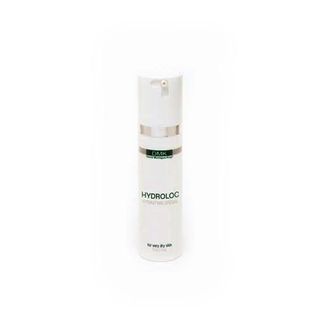
Danne Montague-King DMK Hydroloc Creme
Works for
1 of 2 advertised claims delivered
Moisturizing8 ingredients credited for this claimGood support
“DMK Hydroloc Creme”
This product can help improve hydration of the skin with the two types of ingredients.
The first type is called “humectants”:
these ingredients help attract water.
When humectants are on the surface of the skin, they “pull in” the moisture from the outside environment, or from
within deeper layers of the skin. The following ingredients in this product do the job:
glycerin.
This product also contains ingredients called “occlusives”. They help reduce the speed with which our skin loses moisture to the outside environment. These ingredients also help soften the upper layer of the skin, so it feels less tight and nicer to the touch. The following ingredients in this product do the job: helianthus annuus seed oil, carthamus tinctorius seed oil.
Anti-agingNo ingredient credited for this claimNo support
“This oil is extremely powerful at maintaining youthful skin as it helps to retain moisture and water in the cells and prevents the skin from drying out.”
Effective ingredients missing or their concentration is too low.
Can it cause trouble?
Irritancy2 strong irritants: Rosmarinus officinalis leaf oil, ParfumMedium risk
Comedogenic1 ingredient rated 2 or more on the 0–5 pore-clogging scale1 flagged
User reviews
Be the first — your take helps the next person decide.
Ingredients
Filter by role to see what each ingredient is doing.
Water~40–60%
Stearic acid~7.9–11.8%
- Irritation risk
- Low
Helps oil and water mix together and works as an emollient
More about Stearic acidOleic acid~3.6–5.4%
- Irritation risk
- Medium
Helps soften the upper layer of the skin. At the same time, it can weaken the skin's barrier enhancing penetration of other ingredients and increasing the risk of skin dryness
More about Oleic acidGlycerin~2.8–4.2%
- Irritation risk
- Low
One of the best moisturizing ingredients. Naturally present in skin. It attracts water to the upper layer of the skin working as a humectant
More about GlycerinDimethyl isosorbide~2.1–3.2%
- Irritation risk
- Low
Used to dissolve other ingredients in a product and can enhance their ability to penetrate the skin
More about Dimethyl isosorbideHelianthus annuus seed oil~1.8–2.8%
- Irritation risk
- Low
A great emollient due to its high linoleic acid content. One of the most effective plant oils in helping skin hydration and repairing skin barrier function
More about Helianthus annuus seed oilCarthamus tinctorius seed oil~1.5–2.2%
- Irritation risk
- Low
An emollient that helps soften the skin and might help calm down inflammation
More about Carthamus tinctorius seed oilGlyceryl stearate~1.3–1.9%
- Irritation risk
- Low
An emollient that softens the skin and forms a protective layer on its surface. Helps water and oil mix together
More about Glyceryl stearatePolysorbate 20~1.1–1.6%
Styrene/butadiene copolymer~0.9–1.4%
- Irritation risk
- Low
Triethanolamine~0.5–1.2%
- Irritation risk
- Medium
Used to adjust pH of the product and can help improve the product's smell
More about TriethanolamineGlycine soja oil~0.45–1.05%
- Irritation risk
- Medium
- Comedogenicity
- 2/5
A good emollient that helps soften the skin and helps repair its barrier function. It can clog pores if used in high concentrations.
More about Glycine soja oilEthylhexylglycerin~0.35–0.85%
Ophiopogon japonicus root extract~0.2–0.7%
- Irritation risk
- Medium
Plant extract that might help neutralize free radicals and support skin barrier function, but research on its effectiveness in skin is lacking
More about Ophiopogon japonicus root extractRosmarinus officinalis leaf oil~0.15–0.55%
- Irritation risk
- High
A plant oil with high content of volatile compounds that can irritate the skin. Can be used as a fragrance. Has anti-bacterial properties and might help neutralize free radicals on the surface of the skin
More about Rosmarinus officinalis leaf oilDisodium edta~0.1–0.4%
Chloroxylenol~0.05–0.3%
- Irritation risk
- Low
Phenoxyethanol~0.1–0.3%
- Irritation risk
- Low
A preservative. It helps prevent bacterial growth in cosmetic products
More about PhenoxyethanolParfum~0.05–0.15%
- Irritation risk
- High
An aromatic blend of unspecified and possibly irritating ingredients
More about ParfumIngredient list view
Water, Stearic acid, Oleic acid, Glycerin, Dimethyl isosorbide, Helianthus annuus seed oil, Carthamus tinctorius seed oil, Glyceryl stearate, Polysorbate 20, Styrene/butadiene copolymer, Triethanolamine, Glycine soja oil, Ethylhexylglycerin, Ophiopogon japonicus root extract, Rosmarinus officinalis leaf oil, Disodium edta, Chloroxylenol, Phenoxyethanol, Parfum
Compare prices
Retailers ranked by price — lowest first.

Affiliate links · prices updated regularly
Sources cited in this review
Every concentration estimate and effectiveness label is anchored to one of these 16 studies and safety reviews.
- 1
- 2https://www.sciencedirect.com/science/article/pii/0168365995000887sciencedirect.com
- 3
- 4
- 5
- 6

Affiliate links · As an Amazon Associate, WIMJ earns from qualifying purchases.