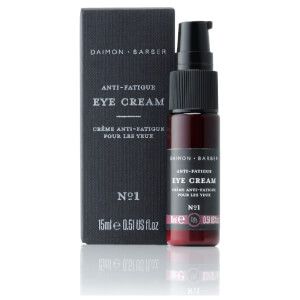
Daimon Barber Anti-Fatigue Eye Cream
Works for
1 of 2 advertised claims delivered
Moisturizing11 ingredients credited for this claimGood support
“Catering specifically for men, the Anti-Fatigue Eye Cream from Daimon Barber utilises an innovative Honeybee Moisture Complex to hydrate, revitalise and refine the eye area.”
This product can help improve hydration of the skin with the two types of ingredients.
The first type is called “humectants”:
these ingredients help attract water.
When humectants are on the surface of the skin, they “pull in” the moisture from the outside environment, or from
within deeper layers of the skin. The following ingredients in this product do the job:
betaine, glycerin.
This product also contains ingredients called “occlusives”. They help reduce the speed with which our skin loses moisture to the outside environment. These ingredients also help soften the upper layer of the skin, so it feels less tight and nicer to the touch. The following ingredients in this product do the job: simmondsia chinensis seed oil, astrocaryum murumuru seed butter.
Anti-aging2 ingredients credited for this claimWeak support
“Anti-Fatigue Eye Cream”
Effective ingredients missing or their concentration is too low.
Can it cause trouble?
Irritancy1 strong irritant: Citrus aurantifolia seed oilMedium risk
Comedogenic2 ingredients rated 2 or more on the 0–5 pore-clogging scale2 flagged
User reviews
Be the first — your take helps the next person decide.
Ingredients
Filter by role to see what each ingredient is doing.
Water~40–60%
Glycerin~4–6.1%
- Irritation risk
- Low
One of the best moisturizing ingredients. Naturally present in skin. It attracts water to the upper layer of the skin working as a humectant
More about GlycerinPolyglyceryl-3 cetearyl ether olivate~3.3–5%
Simmondsia chinensis seed oil~2.8–4.2%
- Irritation risk
- Medium
Softens the upper layer of skin and helps restore the healthy skin barrier. Has shown to help calm down inflammation in skin. It is a stable oil, meaning that it retains its properties even when exposed to air.
More about Simmondsia chinensis seed oilCamellia oleifera seed oil~2.1–3.1%
- Irritation risk
- Medium
An emollient that does not leave a greasy finish
More about Camellia oleifera seed oilCitrus aurantifolia seed oil~1.6–2.4%
- Irritation risk
- High
Oenothera biennis oil~1.4–2.1%
- Irritation risk
- Medium
Helps soften the upper layer of the skin and can support skin barrier function
More about Oenothera biennis oilPyrus malus seed oil~1.3–1.9%
- Irritation risk
- High
Can contain essential oil that can be irritating. Can help to soften the upper layer of the skin. Might be helpful in neutralizing free radicals
More about Pyrus malus seed oilRosa canina fruit oil~1–1.5%
- Irritation risk
- Medium
A great emollient. Contains vitamin E (tocopherol) which may give it some anti-oxidant properties. Can contain volatile compounds and can be irritating
More about Rosa canina fruit oilTocopherol~0.8–1.2%
- Irritation risk
- Low
Pure form of vitamin E. Can help moisturise and protect the skin from free radicals. Often used to help stabilise other ingredients or the formula itself
More about TocopherolPhenoxyethanol~0.5–1%
- Irritation risk
- Low
A preservative. It helps prevent bacterial growth in cosmetic products
More about PhenoxyethanolAlbizia julibrissin bark extract~0.4–0.9%
- Irritation risk
- High
A plant extract that might help to neutralize free radicals in skin. Is claimed to help reduce hyperpigmentation but evidence is missing
More about Albizia julibrissin bark extractPolyacrylamide~0.4–0.9%
- Irritation risk
- Medium
Used to improve product texture and help oil and water mix together
More about PolyacrylamideSilica~0.5–1.2%
Astrocaryum murumuru seed butter~0.3–0.75%
- Irritation risk
- Medium
Helps soften the upper layer of the skin. Could be comedogenic due to the myrisic acid content
More about Astrocaryum murumuru seed butterC13-14 isoparaffin~0.35–0.8%
- Irritation risk
- Low
Helps soften the upper layer of the skin, dissolve other ingredients and create a thicker product consistency
More about C13-14 isoparaffinOlive oil glycereth-8 esters~0.35–0.8%
Mica~0.2–0.75%
- Irritation risk
- Low
Creates an illusion of smoother and more radiant skin tone. Adds shimmer to the skin by reflecting light
More about MicaBetaine~0.15–0.65%
- Irritation risk
- Low
Helps attract water to the upper layer of the skin and improves the product texture
More about BetaineHydroxyethylcellulose~0.15–0.65%
- Irritation risk
- Low
Used to thicken product formulations and create gel-like textures
More about HydroxyethylcelluloseLactic acid~0.15–0.55%
- Irritation risk
- Medium
An exfoliating and moisturizing alpha-hydroxy acid (AHA). Typically causes less irritation than other AHAs, for example, glycolic acid. At high concentrations (about 15%), lactic acid can help reduce lines and wrinkles. Recent studies show that lactic acid can support the "good" bacteria living on skin's surface (healthy skin microbiome)
More about Lactic acidEthylhexylglycerin~0.15–0.6%
Laureth-7~0.15–0.5%
Olea europaea oil unsaponifiables~0.1–0.5%
- Irritation risk
- Low
Help soften the upper layer of the skin
More about Olea europaea oil unsaponifiablesGlycine soja oil unsaponifiables~0.15–0.55%
- Irritation risk
- Low
- Comedogenicity
- 2/5
Triticum vulgare germ oil unsaponifiables~0.15–0.55%
- Irritation risk
- Low
- Comedogenicity
- 2/5
Pollen extract~0.15–0.55%
- Irritation risk
- Low
Hydroxypropyltrimonium honey~0.1–0.4%
- Irritation risk
- Low
Potassium sorbate~0.1–0.35%
Darutoside~0.1–0.35%
- Irritation risk
- Low
Ci 77891~0.05–0.3%
- Irritation risk
- Low
Titanium dioxide~0.1–0.5%
- Irritation risk
- Low
Works as a UV filter when used in high concentrations. It is photostable and is effective mostly against the UVB light, with some protection in the UVA range. In small concentrations, used for its ability to improve the color of cosmetic products. Is usually well tolerated by the skin
More about Titanium dioxideTin oxide~0.1–0.4%
- Irritation risk
- Low
A colorant that can add a pearl-like appearance to the formulation
More about Tin oxideCi 77491~0.05–0.15%
- Irritation risk
- Low
A red colorant made of iron oxide. Typically is not irritating
More about Ci 77491Iron oxides~0.05–0.1%
- Irritation risk
- Low
An umbrella term for the following three colorants: CI 77491, CI 77492, CI 77499. They might be able to offer some protection against visible light, but the degree of the protection is not clear
More about Iron oxidesIngredient list view
Water, Glycerin, Polyglyceryl-3 cetearyl ether olivate, Simmondsia chinensis seed oil, Camellia oleifera seed oil, Citrus aurantifolia seed oil, Oenothera biennis oil, Pyrus malus seed oil, Rosa canina fruit oil, Tocopherol, Phenoxyethanol, Albizia julibrissin bark extract, Polyacrylamide, Silica, Astrocaryum murumuru seed butter, C13-14 isoparaffin, Olive oil glycereth-8 esters, Mica, Betaine, Hydroxyethylcellulose, Lactic acid, Ethylhexylglycerin, Laureth-7, Olea europaea oil unsaponifiables, Glycine soja oil unsaponifiables, Triticum vulgare germ oil unsaponifiables, Pollen extract, Hydroxypropyltrimonium honey, Potassium sorbate, Darutoside, Ci 77891, Titanium dioxide, Tin oxide, Ci 77491, Iron oxides
Compare prices
Retailers ranked by price — lowest first.

Affiliate links · prices updated regularly
Sources cited in this review
Every concentration estimate and effectiveness label is anchored to one of these 10 studies and safety reviews.
- 1
- 2
- 3Vitamin E in dermatologyncbi.nlm.nih.gov
- 4Vitamin E and Skin Healthlpi.oregonstate.edu
- 5Phytopharmacological properties of Albizia species: A reviewresearchgate.net
- 6

Affiliate links · As an Amazon Associate, WIMJ earns from qualifying purchases.