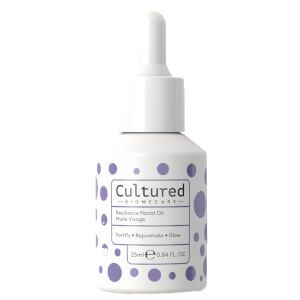
Cultured Resilience Facial Oil
Works for
1 of 1 advertised claim delivered
Moisturizing20 ingredients credited for this claimGood support
“Set to strengthen your moisture barrier, protect against pollution and optimise your skin health (phew!”
This product can help soften the skin and reduce its moisture loss with emollients and occlusives: helianthus annuus seed oil, simmondsia chinensis seed oil.
Keep in mind that this product does not contain effective ingredients to attract water to the upper layer of the skin. This is why an additional product with humectants like glycerin or hyaluronic acid can be helpful (apply it before this product for the best results).
Can it cause trouble?
Irritancy1 strong irritant: Rosmarinus officinalis leaf extractMedium risk
Comedogenic1 ingredient rated 2 or more on the 0–5 pore-clogging scale1 flagged

User reviews
Be the first — your take helps the next person decide.
Ingredients
Filter by role to see what each ingredient is doing.
Coco-caprylate/caprate~22–33%
- Irritation risk
- Low
Helps to soften the upper layer of the skin without creating a greasy texture
More about Coco-caprylate/caprateBorago officinalis seed oil~4–6%
- Irritation risk
- Low
A plant oil that is effective in reducing irritation in skin, restore the barrier function and support its hydration
More about Borago officinalis seed oilSimmondsia chinensis seed oil~4–6%
- Irritation risk
- Medium
Softens the upper layer of skin and helps restore the healthy skin barrier. Has shown to help calm down inflammation in skin. It is a stable oil, meaning that it retains its properties even when exposed to air.
More about Simmondsia chinensis seed oilPrunus armeniaca kernel oil~3.2–4.9%
- Irritation risk
- Medium
An emollient that helps soften the skin
More about Prunus armeniaca kernel oilAlmond/borage/linseed/olive acids/glycerides~2.5–3.7%
- Irritation risk
- Low
Helianthus annuus seed oil~1.8–2.8%
- Irritation risk
- Low
A great emollient due to its high linoleic acid content. One of the most effective plant oils in helping skin hydration and repairing skin barrier function
More about Helianthus annuus seed oilPhytosteryl canola glycerides~1.2–1.7%
- Irritation risk
- Low
Helps soften the upper layer of the skin
More about Phytosteryl canola glyceridesAdansonia digitata seed oil~1.2–1.9%
- Irritation risk
- Medium
Helps soften the upper layer of the skin
More about Adansonia digitata seed oilAleurites moluccanus seed oil~0.9–1.35%
- Irritation risk
- Low
Helps soften the upper layer of the skin
More about Aleurites moluccanus seed oilCamellia oleifera seed oil~0.55–1.35%
- Irritation risk
- Medium
An emollient that does not leave a greasy finish
More about Camellia oleifera seed oilCannabis sativa seed oil~0.45–1.05%
- Irritation risk
- Medium
A plant oil that due to its high linoleic acid content can help strengthen skin's barrier function and soften its upper layer
More about Cannabis sativa seed oilCarthamus tinctorius seed oil~0.35–0.8%
- Irritation risk
- Low
An emollient that helps soften the skin and might help calm down inflammation
More about Carthamus tinctorius seed oilCandida bombicola/glucose/methyl rapeseedate ferment~0.15–0.7%
- Irritation risk
- Low
Helps water and oil mix together and preserve the product formulation
More about Candida bombicola/glucose/methyl rapeseedate fermentLupinus albus seed extract~0.1–0.45%
- Irritation risk
- Medium
A plant extract that helps soften the upper layer of the skin
More about Lupinus albus seed extractPhospholipids~0.1–0.4%
- Irritation risk
- Low
Emollients that are naturaly present in skin. In addition, they help water and oil mix together in the product
More about PhospholipidsGlycine soja oil~0.1–0.5%
- Irritation risk
- Medium
- Comedogenicity
- 2/5
A good emollient that helps soften the skin and helps repair its barrier function. It can clog pores if used in high concentrations.
More about Glycine soja oilOlea europaea fruit oil~0.15–0.55%
- Irritation risk
- Medium
An emollient that helps soften the skin but is not effective for restoring its barrier function. Might be helpful to calm down inflammation
More about Olea europaea fruit oilGlycolipids~0.1–0.4%
- Irritation risk
- Low
Argania spinosa kernel oil~0.15–0.55%
- Irritation risk
- Medium
An emollient that helps soften the upper layer of the skin. Might have some weak anti-oxidant properties
More about Argania spinosa kernel oilBacillus ferment~0.1–0.35%
- Irritation risk
- Low
A product of bacterial fermentation. Can help attract water to the upper layer of the skin
More about Bacillus fermentPhaeodactylum tricornutum extract~0.05–0.25%
- Irritation risk
- Low
Angelica gigas root extract~0.1–0.35%
- Irritation risk
- Low
Glycyrrhiza uralensis root extract~0.1–0.35%
- Irritation risk
- Medium
Licorice root extract. Might be helpful in reducing hyperpigmentation
More about Glycyrrhiza uralensis root extractLithospermum erythrorhizon root extract~0.1–0.35%
- Irritation risk
- High
A plant extract that might help neutralize free radicals in skin. Can be used for its fragrance
More about Lithospermum erythrorhizon root extractGlycine soja sterols~0.1–0.45%
- Irritation risk
- Low
An emollient that helps soften the skin
More about Glycine soja sterolsAscorbyl palmitate~0.05–0.2%
- Irritation risk
- Medium
Being a lipid soluble form of vitamin C, it is more stable and can penetrate the skin better than L-Ascorbic acid. It is effective in protecting the skin from free radicals, as well as evening the skin tone, but is less effective in stimulating collagen production compared to L-Ascorbic acid.
More about Ascorbyl palmitateAvena sativa kernel extract~0.1–0.4%
- Irritation risk
- Low
An effective moisturizing and skin barrier repair ingredient. Helps calm down inflammation and has some anti-oxidant properties
More about Avena sativa kernel extractTocopherol~0.05–0.15%
- Irritation risk
- Low
Pure form of vitamin E. Can help moisturise and protect the skin from free radicals. Often used to help stabilise other ingredients or the formula itself
More about TocopherolRosmarinus officinalis leaf extract~0.01–0.05%
- Irritation risk
- High
Can be helpful in reducing inflammation in skin, including inflamed acne. It can be irritating
More about Rosmarinus officinalis leaf extractAnthemis nobilis flower oil~0.01–0.05%
- Irritation risk
- High
An essential oil that is used as a fragrance and can be irritating. It might have some anti-oxidant effect in skin
More about Anthemis nobilis flower oilIngredient list view
Coco-caprylate/caprate, Borago officinalis seed oil, Simmondsia chinensis seed oil, Prunus armeniaca kernel oil, Almond/borage/linseed/olive acids/glycerides, Helianthus annuus seed oil, Phytosteryl canola glycerides, Adansonia digitata seed oil, Aleurites moluccanus seed oil, Camellia oleifera seed oil, Cannabis sativa seed oil, Carthamus tinctorius seed oil, Candida bombicola/glucose/methyl rapeseedate ferment, Lupinus albus seed extract, Phospholipids, Glycine soja oil, Olea europaea fruit oil, Glycolipids, Argania spinosa kernel oil, Bacillus ferment, Phaeodactylum tricornutum extract, Angelica gigas root extract, Glycyrrhiza uralensis root extract, Lithospermum erythrorhizon root extract, Glycine soja sterols, Ascorbyl palmitate, Avena sativa kernel extract, Tocopherol, Rosmarinus officinalis leaf extract, Anthemis nobilis flower oil
Compare prices
Retailers ranked by price — lowest first.

Affiliate links · prices updated regularly
Worth comparing, line by line.
Match % combines shared ingredients, the first five ingredients, shared actives and hero ingredients, irritancy (lower counts in the alternative's favour), texture and body area. Only products in the same routine step are compared.
| CulturedResilience Facial OilYOUR PRODUCT | Cultured BiomecareResilience Facial Oil | |
|---|---|---|
| Match | — | 52% |
| Price | $60.81 | $60.81 |
| Shared key ingredients | — | 12 of 12 |
| Key difference | — | — |
| Irritancy | Medium | Medium |
| Drying alcohol | — | — |
| View product | Shop |

Sources cited in this review
Every concentration estimate and effectiveness label is anchored to one of these 17 studies and safety reviews.
- 1Safety Assessment of Alkyl Esters as Used in Cosmeticscir-safety.org
- 2
- 3
- 4
- 5
- 6Effect of topically applied lipids on surfactant-irritated skinonlinelibrary.wiley.com

Affiliate links · As an Amazon Associate, WIMJ earns from qualifying purchases.