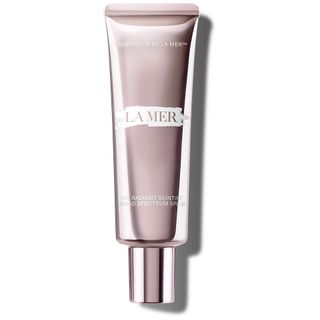
Crème de la Mer The Radiant Skintint SPF30

Crème de la Mer The Radiant Skintint SPF30

SPF 30Efficacy60/100IrritancyHigh·3 UV filters
Edit

Works for

2 of 3 advertised claims delivered

Sun protection
SPF 30 · 3 UV filters · Partial spectrum
Weak protection
SPF 30Partial spectrumMineral + chemical filtersTinted

This product does not offer good protection against UVA rays.

UV spectrum
UVB290–320 nmUVA II320–340 nmUVA I340–400 nm
Octinoxate
Octisalate
Titanium Dioxide
FilterCoverageWhat it doesEst. amount
OctinoxateEthylhexyl MethoxycinnamateUVBOctinoxate. When used in higher concentrations, works as a sunscreen protecting the skin from UVB rays. When used in lower concentration, helps to preserve the product formulation. Is shown to be harmful to coral reefs - consider avoiding bathing in coral reef areas when wearing a product with this ingredient. It can be irritating7.5%
OctisalateEthylhexyl SalicylateUVBOctisalate. A UV filter. It offers some protection against the sun rays that cause sunburn (UVB), but does not protect against the most aging sun rays (UVA). It loses its effectiveness quickly when exposed to sunlight. It is an organic, or so called "chemical" sunscreen2%
Titanium Dioxide Mineral UVBUVA2 Photo-stable Works as a UV filter when used in high concentrations. It is photostable and is effective mostly against the UVB light, with some protection in the UVA range. In small concentrations, used for its ability to improve the color of cosmetic products. Is usually well tolerated by the skin5.3%
Anti-aging
9 ingredients credited for this claim
Strong support
What the product description says
“Fine dry lines are plumped with hydration as signs of fatigue are visibly diminished.”
Source: La mer

This product can help reduce and prevent fine lines and wrinkles, improve skin elasticity and firmness because it contains acetyl glucosamine.

These ingredients in the product can also be helpful, even though there is less evidence for their effectiveness: acetyl hexapeptide-8, ascorbyl glucoside.

Keep in mind that it typically takes at least 6 weeks to notice any results because the changes that are needed to improve fine lines and elasticity happen in the deeper layers of the skin. No topical anti-aging product can “erase” wrinkles or fully reverse signs of aging.

Acetyl glucosamineKey activeEffect: HighAn effective moisturizing ingredient that also has been shown to be effective in evening out the skin tone and reducing hyperpigmentation. It can help somewhat reduce wrinkles in skin~0.35–0.6%
Ascorbyl glucosideKey activeEffect: MediumA vitamin C derivative that is more stable but less potent than pure form of vitamin C. Has a potential to boost collagen production, nutralise free radicals and reduce hyperpigmentation, but the required concentration is likely to be much higher than for the pure form of vitamin C, limiting the ingredient's effectiveness in products~2.3–2.8%
Acetyl hexapeptide-8Key activeEffect: MediumA type of peptide. Peptides are excellent moisturizers and might be able support collagen production reducing fine lines and wrinkles~0.35–0.6%
Algae extractEffect: LowPlant extract that helps the skin to attract water and make it more smooth for touch. Also shows promise of anti-aging properties, but research is not extensive yet~1.6–1.9%
NiacinUnder-dosedEffect: MediumA form of vitamin B3. It is similar in action to niacinamide, but is more likely to cause red flashes in skin as the side effect~0.35–0.65%
Zinc gluconateEffect: Low, below effective doseTypically used to stabilize the product formulations. It is a salt of a polyhydroxy acid (PHA) and in larger concentrations, can help shed the dead cells from the skin surface revealing smoother skin. It can help attract water to the upper layer of the skin. Might to be helpful against acne and clogged pores. Could be helpful in neutralizing free radicals, but solid research is missing. Due to the zinc content, might help calm down inflammation in skin~0.45–0.7%
Copper gluconateEffect: Low, below effective doseTypically used to stabilize the product formulations. It is a salt of polyhydroxy acid (PHA) and in larger concentrations, can help shed the dead cells from the skin surface revealing smoother skin. It can help attract water to the upper layer of the skin. Might to be helpful against acne and clogged pores. Could be helpful in neutralizing free radicals, but solid research is missing~0.55–0.8%
Laminaria saccharina extractEffect: Low, below effective doseA seaweed extract that contains sugars and can be helpful in attracting water to the upper layers of the skin if used in high enough concentrations~0.3–0.55%
Laminaria digitata extractEffect: Low, below effective doseSeaweed extract that helps the skin to attract water and make it more smooth for touch. Also shows promise of anti-aging properties, but good research is lacking at the moment~0.3–0.55%
Moisturizing
33 ingredients credited for this claim
Strong support
What the product description says
“Fine dry lines are plumped with hydration as signs of fatigue are visibly diminished.”
Source: La mer

This product can help improve hydration of the skin with the two types of ingredients.

The first type is called “humectants”:
these ingredients help attract water. When humectants are on the surface of the skin, they “pull in” the moisture from the outside environment, or from within deeper layers of the skin. The following ingredients in this product do the job: algae extract, galactoarabinan.

This product also contains ingredients called “occlusives”. They help reduce the speed with which our skin loses moisture to the outside environment. These ingredients also help soften the upper layer of the skin, so it feels less tight and nicer to the touch. The following ingredients in this product do the job: algae extract, octyldodecyl neopentanoate.

The following ingredients in this product are especially good for supporting the skin barrier and helping with the hydration level: acetyl glucosamine, acetyl hexapeptide-8

Octyldodecyl neopentanoateKey active· EmollientEffect: HighAn emollient that helps soften the skin. Often used to stabilize other ingredients, for example, sunscreen~5.1–6.2%
Saccharomyces lysate extractKey active· HumectantEffect: HighHelps attract water to the upper layer of the skin. Can have some anti-inflammatory effect~0.3–0.55%
Sesamum indicum seed oilKey active· EmollientEffect: HighA good moisturizing plant oil. Due to the high linoleic acid content, it helps soften the upper layer of the skin, reduce water loss and support skin barrier function~1.3–1.6%
Sodium hyaluronateKey active· HumectantEffect: HighOne of the best moisturizing ingredients. Attracts water into the upper layer of the skin~0.3–0.6%
SucroseKey active· HumectantEffect: HighCan help attract water to the upper layer of the skin. In crystal form, it can work as a gentle exfoliant, gentler than the salt scrub. Helps stabilize the emulsion~0.3–0.6%
Acetyl glucosamineHero· HumectantEffect: HighAn effective moisturizing ingredient that also has been shown to be effective in evening out the skin tone and reducing hyperpigmentation. It can help somewhat reduce wrinkles in skin~0.35–0.6%
Acetyl hexapeptide-8Hero· HumectantEffect: HighA type of peptide. Peptides are excellent moisturizers and might be able support collagen production reducing fine lines and wrinkles~0.35–0.6%
Algae extractKey active· Humectant, EmollientEffect: HighPlant extract that helps the skin to attract water and make it more smooth for touch. Also shows promise of anti-aging properties, but research is not extensive yet~1.6–1.9%
Corallina officinalis extractKey activeEffect: HighRed algae extract that helps attract water to the upper layer of the skin and might contain antioxidants~0.3–0.55%
GalactoarabinanKey active· HumectantEffect: HighHelps attract water to the upper layer of the skin~0.45–0.7%
GlycerinKey active· HumectantEffect: HighOne of the best moisturizing ingredients. Naturally present in skin. It attracts water to the upper layer of the skin working as a humectant~0.4–0.65%
Cetyl alcoholKey active· EmollientEffect: MediumA non-drying alcohol that works to soften the skin and stabilize product formulations helping oil and water mix together~3.7–4.5%
Vitis vinifera fruit extractKey activeEffect: MediumA plant extract that helps attract water to the upper layer of the skin. It might be helpful in neutralizing free radicals in skin, but is less potent than the extract from the seeds~0.3–0.55%
Medicago sativa seed powderKey activeEffect: MediumMight help soften the upper layer of the skin and help thicken the product formulation. It might have some anti-oxidant effect~1–1.2%
Magnesium gluconateEffect: LowA mineral that might be able to support skin hydration, but convincing research on its effectiveness in topical skincare is lacking~0.5–0.75%
Butylene glycol· HumectantEffect: LowUsed to create a nice product texture and help delivery of other ingredients. Might be somewhat helpful in attracting water to the upper layer of the skin~5.4–6.6%
Calcium gluconate· HumectantEffect: LowHelps attract water to the upper layer of the skin and helps to improve appearance of the product~0.55–0.85%
Caprylyl glycol· Humectant, EmollientEffect: LowHelps preserve products and creates a nice product texture~0.45–0.65%
Whey protein· EmollientEffect: LowA protein derived from milk. In skincare products, might help to soften the upper layer of the skin~0.45–0.7%
Propylene glycol dicaprate· EmollientEffect: LowAn emollient that helps soften the upper layer of the skin~0.45–0.7%
Scutellaria baicalensis root extract· HumectantEffect: LowA plant extract that might contain a compound baicalin that could be helpful in neutralizing free radicals and reducing inflammation in skin. The baicalin concentration in skincare products is often too low for an effective action. Can be used for its fragrant properties~0.3–0.55%
Neopentyl glycol diheptanoate· EmollientEffect: LowHelps soften the upper layer of the skin and create a nice product consistency~1.9–2.3%
Isohexadecane· EmollientEffect: LowImproves the texture of the product and helps soften the skin. Helps oil and water mix together and can be used as a cleansing agent~0.5–0.75%
Rosa damascena flower oilEffect: LowUsed as a fragrance. Can be irritating~0.35–0.6%
Yeast extractUnder-dosedEffect: HighHelps attract water to the upper layer of the skin and might have some anti-oxidant and skin lightening properties. It can help calm down inflammation in skin~0.35–0.6%
Laminaria saccharina extractUnder-dosedEffect: HighA seaweed extract that contains sugars and can be helpful in attracting water to the upper layers of the skin if used in high enough concentrations~0.3–0.55%
NiacinUnder-dosedEffect: HighA form of vitamin B3. It is similar in action to niacinamide, but is more likely to cause red flashes in skin as the side effect~0.35–0.65%
Copper gluconateUnder-dosedEffect: HighTypically used to stabilize the product formulations. It is a salt of polyhydroxy acid (PHA) and in larger concentrations, can help shed the dead cells from the skin surface revealing smoother skin. It can help attract water to the upper layer of the skin. Might to be helpful against acne and clogged pores. Could be helpful in neutralizing free radicals, but solid research is missing~0.55–0.8%
Zinc gluconateUnder-dosedEffect: HighTypically used to stabilize the product formulations. It is a salt of a polyhydroxy acid (PHA) and in larger concentrations, can help shed the dead cells from the skin surface revealing smoother skin. It can help attract water to the upper layer of the skin. Might to be helpful against acne and clogged pores. Could be helpful in neutralizing free radicals, but solid research is missing. Due to the zinc content, might help calm down inflammation in skin~0.45–0.7%
Laminaria digitata extractUnder-dosedEffect: MediumSeaweed extract that helps the skin to attract water and make it more smooth for touch. Also shows promise of anti-aging properties, but good research is lacking at the moment~0.3–0.55%
Stearic acidEffect: Low, below effective doseHelps oil and water mix together and works as an emollient~0.5–0.75%
LecithinEffect: Low, below effective doseUsed mostly for creating emulsions - helping oil and water mix together. Helps soften the upper layer of the skin~0.45–0.7%
Cucumis sativus fruit extractEffect: Low, below effective doseMight be somewhat helpful in reducing hyperpigmentation and neutralizing free radicals but its typical concentration in a product is too low for having an effect~0.3–0.55%
Anti-oxidation
Not advertised by the brand · 15 ingredients credited for this claim
Strong support

This product contains antioxidants (glycyrrhetinic acid) that can help neutralize free radicals in skin. By doing so, they can lessen the damage the skin gets from the UV light (sun).

The following ingredients - ascorbyl glucoside also can have an antioxidant effect, but there is less evidence to confirm their effectiveness in skin.

Glycyrrhetinic acidKey activeEffect: HighActive compound of licorice root. Works to calm down inflammation, as an anti-oxidant, and might be helpful in lightening the skin and reducing hyperpigmentation~0.35–0.65%
Ascorbyl glucosideKey activeEffect: MediumA vitamin C derivative that is more stable but less potent than pure form of vitamin C. Has a potential to boost collagen production, nutralise free radicals and reduce hyperpigmentation, but the required concentration is likely to be much higher than for the pure form of vitamin C, limiting the ingredient's effectiveness in products~2.3–2.8%
Medicago sativa seed powderEffect: LowMight help soften the upper layer of the skin and help thicken the product formulation. It might have some anti-oxidant effect~1–1.2%
Scutellaria baicalensis root extractEffect: LowA plant extract that might contain a compound baicalin that could be helpful in neutralizing free radicals and reducing inflammation in skin. The baicalin concentration in skincare products is often too low for an effective action. Can be used for its fragrant properties~0.3–0.55%
CaffeineEffect: LowMight be helpful in neutralizing free radicals. Can have a dehydration effect that might somewhat decrease the look of puffy eyes~0.35–0.6%
Corallina officinalis extractEffect: LowRed algae extract that helps attract water to the upper layer of the skin and might contain antioxidants~0.3–0.55%
Pelargonium graveolens flower oilEffect: LowAn essential oil. Can be irritating. Can become an allergen with oxidation~0.3–0.6%
Morus nigra root extractEffect: LowA plant extract that might help neutralize free radicals in skin and have some skin-lightening effect, but good evidence is missing~0.3–0.55%
Vitis vinifera fruit extractEffect: LowA plant extract that helps attract water to the upper layer of the skin. It might be helpful in neutralizing free radicals in skin, but is less potent than the extract from the seeds~0.3–0.55%
Yeast extractUnder-dosedEffect: MediumHelps attract water to the upper layer of the skin and might have some anti-oxidant and skin lightening properties. It can help calm down inflammation in skin~0.35–0.6%
Hordeum vulgare extractEffect: Low, below effective doseA plant extract that might have some anti-oxidant properties. Avoid if you are sensitive to gluten~0.45–0.7%
Zinc gluconateEffect: Low, below effective doseTypically used to stabilize the product formulations. It is a salt of a polyhydroxy acid (PHA) and in larger concentrations, can help shed the dead cells from the skin surface revealing smoother skin. It can help attract water to the upper layer of the skin. Might to be helpful against acne and clogged pores. Could be helpful in neutralizing free radicals, but solid research is missing. Due to the zinc content, might help calm down inflammation in skin~0.45–0.7%
Laminaria digitata extractEffect: Low, below effective doseSeaweed extract that helps the skin to attract water and make it more smooth for touch. Also shows promise of anti-aging properties, but good research is lacking at the moment~0.3–0.55%
Copper gluconateEffect: Low, below effective doseTypically used to stabilize the product formulations. It is a salt of polyhydroxy acid (PHA) and in larger concentrations, can help shed the dead cells from the skin surface revealing smoother skin. It can help attract water to the upper layer of the skin. Might to be helpful against acne and clogged pores. Could be helpful in neutralizing free radicals, but solid research is missing~0.55–0.8%
Cucumis sativus fruit extractEffect: Low, below effective doseMight be somewhat helpful in reducing hyperpigmentation and neutralizing free radicals but its typical concentration in a product is too low for having an effect~0.3–0.55%
Evens skin tone
Not advertised by the brand · 9 ingredients credited for this claim
Strong support

This product can help reduce hypepigmentation and even out the skin tone because it contains the following effective ingredients: acetyl glucosamine

The following ingredient (ingredients) in this product might be helpful, but there is no evidence to confirm that it actually can help even out the skin tone: ascorbyl glucoside, dimethoxytolyl propylresorcinol, glycyrrhetinic acid, morus nigra root extract.

Keep in mind that you would need to apply any topical skincare targetted at hypigmentation consistently for a couple of months to get a result. No topical skincare product can help get rid of hyperpigmentation (including post-acne marks and age spots) instantly.

This product can also help with skin tone because it offers sun protection. Sun damage is the main factor causing age spots, darkening of post-acne marks and other discolorations. This is why sun protection is the best strategy for maintaining an even skin tone. We, however, do not recommend using this product as a sunscreen because the protection it offers is not strong enough).

Acetyl glucosamineKey activeEffect: HighAn effective moisturizing ingredient that also has been shown to be effective in evening out the skin tone and reducing hyperpigmentation. It can help somewhat reduce wrinkles in skin~0.35–0.6%
Ascorbyl glucosideKey activeEffect: MediumA vitamin C derivative that is more stable but less potent than pure form of vitamin C. Has a potential to boost collagen production, nutralise free radicals and reduce hyperpigmentation, but the required concentration is likely to be much higher than for the pure form of vitamin C, limiting the ingredient's effectiveness in products~2.3–2.8%
Glycyrrhetinic acidKey activeEffect: MediumActive compound of licorice root. Works to calm down inflammation, as an anti-oxidant, and might be helpful in lightening the skin and reducing hyperpigmentation~0.35–0.65%
Dimethoxytolyl propylresorcinolKey activeEffect: MediumCan help reduce hyperpigmentation and lighten skin, but additional research is needed to test its effectiveness on human skin~0.35–0.6%
Morus nigra root extractEffect: LowA plant extract that might help neutralize free radicals in skin and have some skin-lightening effect, but good evidence is missing~0.3–0.55%
NiacinUnder-dosedEffect: MediumA form of vitamin B3. It is similar in action to niacinamide, but is more likely to cause red flashes in skin as the side effect~0.35–0.65%
Yeast extractEffect: Low, below effective doseHelps attract water to the upper layer of the skin and might have some anti-oxidant and skin lightening properties. It can help calm down inflammation in skin~0.35–0.6%
Copper gluconateEffect: Low, below effective doseTypically used to stabilize the product formulations. It is a salt of polyhydroxy acid (PHA) and in larger concentrations, can help shed the dead cells from the skin surface revealing smoother skin. It can help attract water to the upper layer of the skin. Might to be helpful against acne and clogged pores. Could be helpful in neutralizing free radicals, but solid research is missing~0.55–0.8%
Zinc gluconateEffect: Low, below effective doseTypically used to stabilize the product formulations. It is a salt of a polyhydroxy acid (PHA) and in larger concentrations, can help shed the dead cells from the skin surface revealing smoother skin. It can help attract water to the upper layer of the skin. Might to be helpful against acne and clogged pores. Could be helpful in neutralizing free radicals, but solid research is missing. Due to the zinc content, might help calm down inflammation in skin~0.45–0.7%

Can it cause trouble?

Irritancy
10 strong irritants: Eucalyptus globulus leaf oil, Mentha viridis extract + 8 more — patch-test recommended
High risk
We flagged 34 ingredients with irritancy potential. Severity depends on your sensitivity threshold; the table lists the worst offenders first.
IngredientFunctionIrritationEst. amount
Ethylhexyl methoxycinnamateOctinoxate. When used in higher concentrations, works as a sunscreen protecting the skin from UVB rays. When used in lower concentration, helps to preserve the product formulation. Is shown to be harmful to coral reefs - consider avoiding bathing in coral reef areas when wearing a product with this ingredient. It can be irritatingHigh7.5%
Eucalyptus globulus leaf oilAn essential oil that can be very irritating. Has some anti-bacterial propertiesHigh~0.6–0.85%est.
NiacinA form of vitamin B3. It is similar in action to niacinamide, but is more likely to cause red flashes in skin as the side effectHigh~0.35–0.65%est.
Scutellaria baicalensis root extractA plant extract that might contain a compound baicalin that could be helpful in neutralizing free radicals and reducing inflammation in skin. The baicalin concentration in skincare products is often too low for an effective action. Can be used for its fragrant propertiesHigh~0.3–0.55%est.
Mentha viridis extractUsed as a fragrance and can be irritatingHigh~0.35–0.65%est.
Pelargonium graveolens flower oilAn essential oil. Can be irritating. Can become an allergen with oxidationHigh~0.3–0.6%est.
Citrus grandis peel oilA plant oil with high content of volatile compounds that, especially when exposed to air, can cause allergic reactions and irritate the skinHigh~0.3–0.5%est.
MethyldihydrojasmonateUsed as a fragrance. Smells similar to jasmineHigh~0.3–0.55%est.
Dimethoxytolyl propylresorcinolCan help reduce hyperpigmentation and lighten skin, but additional research is needed to test its effectiveness on human skinHigh~0.35–0.6%est.
Citrus aurantifolia peel extract—High~0.35–0.65%est.
Rosa damascena flower oilUsed as a fragrance. Can be irritatingHigh~0.35–0.6%est.
Alcohol denat.Produces temporary toning effect. Can help dissolve other ingredients or preserve productsHigh~0.25–0.45%est.
LinaloolA fragrance. Can be irritatingHigh~0.2–0.35%est.
GeraniolA fragrance. Can be irritatingHigh~0.2–0.35%est.
CitronellolA fragrance. Can be irritatingHigh~0.15–0.3%est.
LimoneneA common frangrance that can easily irritate skin, especially if exposed to air, light or heatHigh~0.15–0.3%est.
Laureth-4Helps water and oil mix togetherMedium~3–3.7%est.
Ascorbyl glucosideA vitamin C derivative that is more stable but less potent than pure form of vitamin C. Has a potential to boost collagen production, nutralise free radicals and reduce hyperpigmentation, but the required concentration is likely to be much higher than for the pure form of vitamin C, limiting the ingredient's effectiveness in productsMedium~2.3–2.8%est.
Medicago sativa seed powderMight help soften the upper layer of the skin and help thicken the product formulation. It might have some anti-oxidant effectMedium~1–1.2%est.
Copper gluconateTypically used to stabilize the product formulations. It is a salt of polyhydroxy acid (PHA) and in larger concentrations, can help shed the dead cells from the skin surface revealing smoother skin. It can help attract water to the upper layer of the skin. Might to be helpful against acne and clogged pores. Could be helpful in neutralizing free radicals, but solid research is missingMedium~0.55–0.8%est.
Zinc gluconateTypically used to stabilize the product formulations. It is a salt of a polyhydroxy acid (PHA) and in larger concentrations, can help shed the dead cells from the skin surface revealing smoother skin. It can help attract water to the upper layer of the skin. Might to be helpful against acne and clogged pores. Could be helpful in neutralizing free radicals, but solid research is missing. Due to the zinc content, might help calm down inflammation in skinMedium~0.45–0.7%est.
Tocopheryl succinateUsed to preserve the product formulationMedium~0.4–0.65%est.
Cucumis sativus fruit extractMight be somewhat helpful in reducing hyperpigmentation and neutralizing free radicals but its typical concentration in a product is too low for having an effectMedium~0.3–0.55%est.
Morus nigra root extractA plant extract that might help neutralize free radicals in skin and have some skin-lightening effect, but good evidence is missingMedium~0.3–0.55%est.
Vitis vinifera fruit extractA plant extract that helps attract water to the upper layer of the skin. It might be helpful in neutralizing free radicals in skin, but is less potent than the extract from the seedsMedium~0.3–0.55%est.
Sigesbeckia orientalis extractA plant extract that can contain an anti-inflammatory compoundMedium~0.3–0.6%est.
Glycyrrhetinic acidActive compound of licorice root. Works to calm down inflammation, as an anti-oxidant, and might be helpful in lightening the skin and reducing hyperpigmentationMedium~0.35–0.65%est.
CaffeineMight be helpful in neutralizing free radicals. Can have a dehydration effect that might somewhat decrease the look of puffy eyesMedium~0.35–0.6%est.
Polyglyceryl-3 beeswaxHelps water and oil mix together. Could be an allergen (beeswax)Medium~0.4–0.6%est.
Caprylyl glycolHelps preserve products and creates a nice product textureMedium~0.45–0.65%est.
Hordeum vulgare extractA plant extract that might have some anti-oxidant properties. Avoid if you are sensitive to glutenMedium~0.45–0.7%est.
GalactoarabinanHelps attract water to the upper layer of the skinMedium~0.45–0.7%est.
Disodium edtaStabilizes the product formulationMedium~0.25–0.45%est.
BhtA preservativeMedium~0.25–0.45%est.
Comedogenic
5 ingredients rated 2 or more on the 0–5 pore-clogging scale
5 flagged
These ingredients have a comedogenic rating of 2 or more on a 0–5 scale; the table shows each one's rating. In leave-on products they can clog pores in acne-prone skin.
IngredientFunctionRatingEst. amount
Algae extractPlant extract that helps the skin to attract water and make it more smooth for touch. Also shows promise of anti-aging properties, but research is not extensive yet3/5~1.6–1.9%est.
Corallina officinalis extractRed algae extract that helps attract water to the upper layer of the skin and might contain antioxidants3/5~0.3–0.55%est.
Laminaria saccharina extractA seaweed extract that contains sugars and can be helpful in attracting water to the upper layers of the skin if used in high enough concentrations3/5~0.3–0.55%est.
Laminaria digitata extractSeaweed extract that helps the skin to attract water and make it more smooth for touch. Also shows promise of anti-aging properties, but good research is lacking at the moment3/5~0.3–0.55%est.
Laureth-4Helps water and oil mix together2/5~3–3.7%est.
Edit

User reviews

Would you recommend?
No community reviews yet.

Be the first — your take helps the next person decide.

Write a review · ~30s

Ingredients

Filter by role to see what each ingredient is doing.

Ethylhexyl methoxycinnamate7.5%
UV filterKey activeIrritant · high
Irritation risk
High
Works for
Sun protection

Octinoxate. When used in higher concentrations, works as a sunscreen protecting the skin from UVB rays. When used in lower concentration, helps to preserve the product formulation. Is shown to be harmful to coral reefs - consider avoiding bathing in coral reef areas when wearing a product with this ingredient. It can be irritating

More about Ethylhexyl methoxycinnamate
Ethylhexyl salicylate2%
UV filter
Irritation risk
Low
Works for
Sun protection

Octisalate. A UV filter. It offers some protection against the sun rays that cause sunburn (UVB), but does not protect against the most aging sun rays (UVA). It loses its effectiveness quickly when exposed to sunlight. It is an organic, or so called "chemical" sunscreen

More about Ethylhexyl salicylate
Water~45–55%
Formula
Irritation risk
Low

Plain old water

More about Water
Butylene glycol~5.4–6.6%
Formula
Irritation risk
Low
Works for
Moisturizing

Used to create a nice product texture and help delivery of other ingredients. Might be somewhat helpful in attracting water to the upper layer of the skin

More about Butylene glycol
Octyldodecyl neopentanoate~5.1–6.2%
Key active
Irritation risk
Low
Works for
Moisturizing

An emollient that helps soften the skin. Often used to stabilize other ingredients, for example, sunscreen

More about Octyldodecyl neopentanoate
Cetyl alcohol~3.7–4.5%
Key active
Irritation risk
Low
Works for
CleansingMoisturizing

A non-drying alcohol that works to soften the skin and stabilize product formulations helping oil and water mix together

More about Cetyl alcohol
Laureth-4~3–3.7%
Comedogenic 2/5Irritant · medium
Irritation risk
Medium
Comedogenicity
2/5
Works for
Cleansing

Helps water and oil mix together

More about Laureth-4
Ascorbyl glucoside~2.3–2.8%
Key activeIrritant · medium
Irritation risk
Medium
Works for
Evens skin toneAnti-agingAnti-oxidation

A vitamin C derivative that is more stable but less potent than pure form of vitamin C. Has a potential to boost collagen production, nutralise free radicals and reduce hyperpigmentation, but the required concentration is likely to be much higher than for the pure form of vitamin C, limiting the ingredient's effectiveness in products

More about Ascorbyl glucoside
Neopentyl glycol diheptanoate~1.9–2.3%
Formula
Irritation risk
Low
Works for
Moisturizing

Helps soften the upper layer of the skin and create a nice product consistency

More about Neopentyl glycol diheptanoate
Algae extract~1.6–1.9%
Key activeComedogenic 3/5
Irritation risk
Low
Comedogenicity
3/5
Works for
MoisturizingAnti-aging

Plant extract that helps the skin to attract water and make it more smooth for touch. Also shows promise of anti-aging properties, but research is not extensive yet

More about Algae extract
Sesamum indicum seed oil~1.3–1.6%
Key active
Irritation risk
Low
Works for
Moisturizing

A good moisturizing plant oil. Due to the high linoleic acid content, it helps soften the upper layer of the skin, reduce water loss and support skin barrier function

More about Sesamum indicum seed oil
Medicago sativa seed powder~1–1.2%
Key activeIrritant · medium
Irritation risk
Medium
Works for
MoisturizingAnti-oxidation

Might help soften the upper layer of the skin and help thicken the product formulation. It might have some anti-oxidant effect

More about Medicago sativa seed powder
Helianthus annuus seedcake~1–1.3%
Formula
Irritation risk
Low

Used to thicken the product consistency

More about Helianthus annuus seedcake
Prunus amygdalus dulcis seed meal~0.9–1.1%
Formula
Irritation risk
Low

Helps thicken the product texture

More about Prunus amygdalus dulcis seed meal
Eucalyptus globulus leaf oil~0.6–0.85%
Irritant · high
Irritation risk
High
Works for
Antibacterial

An essential oil that can be very irritating. Has some anti-bacterial properties

More about Eucalyptus globulus leaf oil
Sodium gluconate~0.55–0.8%
Formula
Irritation risk
Low

Helps stabilize product formulations

More about Sodium gluconate
Copper gluconate~0.55–0.8%
Under-dosedIrritant · medium
Irritation risk
Medium
Works for
MoisturizingAnti-agingEvens skin toneAnti-blemishExfoliationAnti-oxidation

Typically used to stabilize the product formulations. It is a salt of polyhydroxy acid (PHA) and in larger concentrations, can help shed the dead cells from the skin surface revealing smoother skin. It can help attract water to the upper layer of the skin. Might to be helpful against acne and clogged pores. Could be helpful in neutralizing free radicals, but solid research is missing

More about Copper gluconate
Calcium gluconate~0.55–0.85%
Formula
Irritation risk
Low
Works for
Moisturizing

Helps attract water to the upper layer of the skin and helps to improve appearance of the product

More about Calcium gluconate
Magnesium gluconate~0.5–0.75%
Formula
Irritation risk
Low
Works for
Moisturizing

A mineral that might be able to support skin hydration, but convincing research on its effectiveness in topical skincare is lacking

More about Magnesium gluconate
Zinc gluconate~0.45–0.7%
Under-dosedIrritant · medium
Irritation risk
Medium
Works for
MoisturizingAnti-inflammatoryAnti-agingAnti-oxidationExfoliationAnti-blemishEvens skin tone

Typically used to stabilize the product formulations. It is a salt of a polyhydroxy acid (PHA) and in larger concentrations, can help shed the dead cells from the skin surface revealing smoother skin. It can help attract water to the upper layer of the skin. Might to be helpful against acne and clogged pores. Could be helpful in neutralizing free radicals, but solid research is missing. Due to the zinc content, might help calm down inflammation in skin

More about Zinc gluconate
Tocopheryl succinate~0.4–0.65%
Irritant · medium
Irritation risk
Medium

Used to preserve the product formulation

More about Tocopheryl succinate
Niacin~0.35–0.65%
Under-dosedIrritant · high
Irritation risk
High
Works for
MoisturizingAnti-agingAnti-blemishEvens skin tone

A form of vitamin B3. It is similar in action to niacinamide, but is more likely to cause red flashes in skin as the side effect

More about Niacin
Sesamum indicum seed powder~0.3–0.6%
Formula
Polyethylene~0.6–0.9%
Formula
Irritation risk
Low

Used to thicken the product's texture

More about Polyethylene
Helichrysum arenarium extract~0.3–0.55%
Formula
Cucumis sativus fruit extract~0.3–0.55%
Irritant · medium
Irritation risk
Medium
Works for
MoisturizingAnti-oxidation

Might be somewhat helpful in reducing hyperpigmentation and neutralizing free radicals but its typical concentration in a product is too low for having an effect

More about Cucumis sativus fruit extract
Magnolia officinalis bark extract~0.3–0.55%
Formula
Peg-100 stearate~0.4–0.65%
Formula
Irritation risk
Low
Works for
Cleansing

Helps oil and water mix togehter and creates a nice product texture

More about Peg-100 stearate
Scutellaria baicalensis root extract~0.3–0.55%
Irritant · high
Irritation risk
High
Works for
Anti-inflammatoryAnti-oxidationMoisturizingReduces irritationAntibacterial

A plant extract that might contain a compound baicalin that could be helpful in neutralizing free radicals and reducing inflammation in skin. The baicalin concentration in skincare products is often too low for an effective action. Can be used for its fragrant properties

More about Scutellaria baicalensis root extract
Morus nigra root extract~0.3–0.55%
Irritant · medium
Irritation risk
Medium
Works for
Evens skin toneAnti-oxidation

A plant extract that might help neutralize free radicals in skin and have some skin-lightening effect, but good evidence is missing

More about Morus nigra root extract
Hydrogenated lecithin~0.3–0.6%
Formula
Irritation risk
Low
Works for
Cleansing

Helps to retain moisture by creating a protective barrier on the skin. Rich in fatty acids. Improves product texture and helps with the penetration of other ingredients.

More about Hydrogenated lecithin
Corallina officinalis extract~0.3–0.55%
Key activeComedogenic 3/5
Irritation risk
Low
Comedogenicity
3/5
Works for
MoisturizingAnti-oxidation

Red algae extract that helps attract water to the upper layer of the skin and might contain antioxidants

More about Corallina officinalis extract
Gelidium cartilagineum extract~0.3–0.55%
Formula
Vitis vinifera fruit extract~0.3–0.55%
Key activeIrritant · medium
Irritation risk
Medium
Works for
MoisturizingAnti-oxidation

A plant extract that helps attract water to the upper layer of the skin. It might be helpful in neutralizing free radicals in skin, but is less potent than the extract from the seeds

More about Vitis vinifera fruit extract
Saccharomyces lysate extract~0.3–0.55%
Key active
Irritation risk
Low
Works for
Moisturizing

Helps attract water to the upper layer of the skin. Can have some anti-inflammatory effect

More about Saccharomyces lysate extract
Mentha viridis extract~0.35–0.65%
Irritant · high
Irritation risk
High

Used as a fragrance and can be irritating

More about Mentha viridis extract
Pelargonium graveolens flower oil~0.3–0.6%
Irritant · high
Irritation risk
High
Works for
Anti-oxidation

An essential oil. Can be irritating. Can become an allergen with oxidation

More about Pelargonium graveolens flower oil
Laminaria saccharina extract~0.3–0.55%
Under-dosedComedogenic 3/5
Irritation risk
Low
Comedogenicity
3/5
Works for
MoisturizingAnti-aging

A seaweed extract that contains sugars and can be helpful in attracting water to the upper layers of the skin if used in high enough concentrations

More about Laminaria saccharina extract
Citrus grandis peel oil~0.3–0.5%
Irritant · high
Irritation risk
High

A plant oil with high content of volatile compounds that, especially when exposed to air, can cause allergic reactions and irritate the skin

More about Citrus grandis peel oil
Laminaria digitata extract~0.3–0.55%
Under-dosedComedogenic 3/5
Irritation risk
Low
Comedogenicity
3/5
Works for
MoisturizingAnti-oxidationAnti-aging

Seaweed extract that helps the skin to attract water and make it more smooth for touch. Also shows promise of anti-aging properties, but good research is lacking at the moment

More about Laminaria digitata extract
Methyldihydrojasmonate~0.3–0.55%
Irritant · high
Irritation risk
High

Used as a fragrance. Smells similar to jasmine

More about Methyldihydrojasmonate
Sigesbeckia orientalis extract~0.3–0.6%
Irritant · medium
Irritation risk
Medium
Works for
Anti-inflammatory

A plant extract that can contain an anti-inflammatory compound

More about Sigesbeckia orientalis extract
Acetyl hexapeptide-8~0.35–0.6%
Hero · Moisturizing
Irritation risk
Low
Works for
MoisturizingAnti-aging

A type of peptide. Peptides are excellent moisturizers and might be able support collagen production reducing fine lines and wrinkles

More about Acetyl hexapeptide-8
Sucrose~0.3–0.6%
Key active
Irritation risk
Low
Works for
Moisturizing

Can help attract water to the upper layer of the skin. In crystal form, it can work as a gentle exfoliant, gentler than the salt scrub. Helps stabilize the emulsion

More about Sucrose
Glycerin~0.4–0.65%
Key active
Irritation risk
Low
Works for
Moisturizing

One of the best moisturizing ingredients. Naturally present in skin. It attracts water to the upper layer of the skin working as a humectant

More about Glycerin
Glycyrrhetinic acid~0.35–0.65%
Key activeIrritant · medium
Irritation risk
Medium
Works for
Anti-inflammatoryAnti-oxidationEvens skin tone

Active compound of licorice root. Works to calm down inflammation, as an anti-oxidant, and might be helpful in lightening the skin and reducing hyperpigmentation

More about Glycyrrhetinic acid
Caffeine~0.35–0.6%
Irritant · medium
Irritation risk
Medium
Works for
De-puffingAnti-oxidation

Might be helpful in neutralizing free radicals. Can have a dehydration effect that might somewhat decrease the look of puffy eyes

More about Caffeine
Propylene glycol diethylhexanoate~0.45–0.7%
Formula
Lecithin~0.45–0.7%
Formula
Irritation risk
Low
Works for
CleansingMoisturizing

Used mostly for creating emulsions - helping oil and water mix together. Helps soften the upper layer of the skin

More about Lecithin
Isohexadecane~0.5–0.75%
Formula
Irritation risk
Low
Works for
CleansingMoisturizing

Improves the texture of the product and helps soften the skin. Helps oil and water mix together and can be used as a cleansing agent

More about Isohexadecane
Polyglyceryl-3 beeswax~0.4–0.6%
Irritant · medium
Irritation risk
Medium
Works for
Cleansing

Helps water and oil mix together. Could be an allergen (beeswax)

More about Polyglyceryl-3 beeswax
Whey protein~0.45–0.7%
Formula
Irritation risk
Low
Works for
Moisturizing

A protein derived from milk. In skincare products, might help to soften the upper layer of the skin

More about Whey protein
Dimethoxytolyl propylresorcinol~0.35–0.6%
Key activeIrritant · high
Irritation risk
High
Works for
Evens skin tone

Can help reduce hyperpigmentation and lighten skin, but additional research is needed to test its effectiveness on human skin

More about Dimethoxytolyl propylresorcinol
Citrus aurantifolia peel extract~0.35–0.65%
Irritant · high
Acetyl glucosamine~0.35–0.6%
Hero · Moisturizing
Irritation risk
Low
Works for
Anti-agingEvens skin toneMoisturizingExfoliation

An effective moisturizing ingredient that also has been shown to be effective in evening out the skin tone and reducing hyperpigmentation. It can help somewhat reduce wrinkles in skin

More about Acetyl glucosamine
Vp/hexadecene copolymer~0.45–0.65%
Formula
Irritation risk
Low

Creates a nice product texture and can support water-resistance of sunscreens

More about Vp/hexadecene copolymer
Tourmaline~0.35–0.65%
Formula
Irritation risk
Low
More about Tourmaline
Yeast polysaccharides~0.5–0.7%
Formula
Caprylyl glycol~0.45–0.65%
Irritant · medium
Irritation risk
Medium
Works for
Moisturizing

Helps preserve products and creates a nice product texture

More about Caprylyl glycol
Rosa damascena flower oil~0.35–0.6%
Irritant · high
Irritation risk
High
Works for
Moisturizing

Used as a fragrance. Can be irritating

More about Rosa damascena flower oil
Yeast extract~0.35–0.6%
Under-dosed
Irritation risk
Low
Works for
MoisturizingAnti-inflammatoryAnti-oxidationReduces irritationEvens skin tone

Helps attract water to the upper layer of the skin and might have some anti-oxidant and skin lightening properties. It can help calm down inflammation in skin

More about Yeast extract
Isostearic acid~0.45–0.7%
Formula
Irritation risk
Low
Works for
Cleansing

Used to create a nice product texture

More about Isostearic acid
Propylene glycol dicaprate~0.45–0.7%
Formula
Irritation risk
Low
Works for
Moisturizing

An emollient that helps soften the upper layer of the skin

More about Propylene glycol dicaprate
Stearic acid~0.5–0.75%
Formula
Irritation risk
Low
Works for
CleansingMoisturizing

Helps oil and water mix together and works as an emollient

More about Stearic acid
Hordeum vulgare extract~0.45–0.7%
Irritant · medium
Irritation risk
Medium
Works for
Anti-oxidation

A plant extract that might have some anti-oxidant properties. Avoid if you are sensitive to gluten

More about Hordeum vulgare extract
Tromethamine~0.35–0.65%
Formula
Irritation risk
Low

Helps adjust pH in products

More about Tromethamine
Acrylamide/sodium acryloyldimethyltaurate copolymer~0.35–0.65%
Formula
Irritation risk
Low

Helps water and oil mix together and create gel-like textures

More about Acrylamide/sodium acryloyldimethyltaurate copolymer
Galactoarabinan~0.45–0.7%
Key activeIrritant · medium
Irritation risk
Medium
Works for
Moisturizing

Helps attract water to the upper layer of the skin

More about Galactoarabinan
Nylon-12~0.4–0.65%
Formula
Irritation risk
Low

Used to create a nice product consistency

More about Nylon-12
Zeolite~0.35–0.65%
Formula
Irritation risk
Low

Used to create a thicker product consistency

More about Zeolite
Synthetic fluorphlogopite~0.35–0.65%
Formula
Irritation risk
Low

A mineral that is used as an optical filter (makes the skin looks nicer through light reflection) and to improve the texture of cosmetic products

More about Synthetic fluorphlogopite
Tocopheryl linoleate/oleate~0.35–0.6%
Formula
Sodium hyaluronate~0.3–0.6%
Key active
Irritation risk
Low
Works for
Moisturizing

One of the best moisturizing ingredients. Attracts water into the upper layer of the skin

More about Sodium hyaluronate
Boron nitride~0.35–0.65%
Formula
Irritation risk
Low

Helps to absord oil and evenly disperse other ingredients (for example, pigment) in product formulation

More about Boron nitride
Xanthan gum~0.35–0.6%
Formula
Irritation risk
Low
Works for
Cleansing

Used to create a thicker product consistency

More about Xanthan gum
Polysorbate 80~0.35–0.6%
Formula
Irritation risk
Low
Works for
Cleansing

Helps water and oil mix together

More about Polysorbate 80
Silica~0.4–0.65%
Formula
Irritation risk
Low

Used to absorb oil and can temporarily mattify skin

More about Silica
Aluminum hydroxide~0.3–0.55%
Formula
Irritation risk
Low

Is used to add opaque (non-transparent) appearance to formulations. Can be used to coat other ingredients for even dispersion. This is a different ingredient compared to the ones used in antipersperants (aluminium chloride and aluminium chlorohydrate)

More about Aluminum hydroxide
Alcohol denat.~0.25–0.45%
Irritant · high
Irritation risk
High

Produces temporary toning effect. Can help dissolve other ingredients or preserve products

More about Alcohol denat.
Tin oxide~0.4–0.6%
Formula
Irritation risk
Low

A colorant that can add a pearl-like appearance to the formulation

More about Tin oxide
Disodium edta~0.25–0.45%
Irritant · medium
Irritation risk
Medium

Stabilizes the product formulation

More about Disodium edta
Bht~0.25–0.45%
Irritant · medium
Irritation risk
Medium

A preservative

More about Bht
Linalool~0.2–0.35%
Irritant · high
Irritation risk
High

A fragrance. Can be irritating

More about Linalool
Geraniol~0.2–0.35%
Irritant · high
Irritation risk
High

A fragrance. Can be irritating

More about Geraniol
Citronellol~0.15–0.3%
Irritant · high
Irritation risk
High

A fragrance. Can be irritating

More about Citronellol
Limonene~0.15–0.3%
Irritant · high
Irritation risk
High

A common frangrance that can easily irritate skin, especially if exposed to air, light or heat

More about Limonene
Phenoxyethanol~0.15–0.25%
Formula
Irritation risk
Low

A preservative. It helps prevent bacterial growth in cosmetic products

More about Phenoxyethanol
Titanium dioxide5.3%
UV filterKey active
Irritation risk
Low
Works for
Sun protection

Works as a UV filter when used in high concentrations. It is photostable and is effective mostly against the UVB light, with some protection in the UVA range. In small concentrations, used for its ability to improve the color of cosmetic products. Is usually well tolerated by the skin

More about Titanium dioxide
Iron oxides~0.15–0.25%
Formula
Irritation risk
Low
Works for
Sun protection

An umbrella term for the following three colorants: CI 77491, CI 77492, CI 77499. They might be able to offer some protection against visible light, but the degree of the protection is not clear

More about Iron oxides
Iron oxides~0.1–0.2%
Formula
Irritation risk
Low
Works for
Sun protection

An umbrella term for the following three colorants: CI 77491, CI 77492, CI 77499. They might be able to offer some protection against visible light, but the degree of the protection is not clear

More about Iron oxides
Iron oxides~0.1–0.15%
Formula
Irritation risk
Low
Works for
Sun protection

An umbrella term for the following three colorants: CI 77491, CI 77492, CI 77499. They might be able to offer some protection against visible light, but the degree of the protection is not clear

More about Iron oxides
Mica~0.1–0.15%
Formula
Irritation risk
Low

Creates an illusion of smoother and more radiant skin tone. Adds shimmer to the skin by reflecting light

More about Mica
Ingredient list view

Ethylhexyl methoxycinnamate, Ethylhexyl salicylate, Water, Butylene glycol, Octyldodecyl neopentanoate, Cetyl alcohol, Laureth-4, Ascorbyl glucoside, Neopentyl glycol diheptanoate, Algae extract, Sesamum indicum seed oil, Medicago sativa seed powder, Helianthus annuus seedcake, Prunus amygdalus dulcis seed meal, Eucalyptus globulus leaf oil, Sodium gluconate, Copper gluconate, Calcium gluconate, Magnesium gluconate, Zinc gluconate, Tocopheryl succinate, Niacin, Sesamum indicum seed powder, Polyethylene, Helichrysum arenarium extract, Cucumis sativus fruit extract, Magnolia officinalis bark extract, Peg-100 stearate, Scutellaria baicalensis root extract, Morus nigra root extract, Hydrogenated lecithin, Corallina officinalis extract, Gelidium cartilagineum extract, Vitis vinifera fruit extract, Saccharomyces lysate extract, Mentha viridis extract, Pelargonium graveolens flower oil, Laminaria saccharina extract, Citrus grandis peel oil, Laminaria digitata extract, Methyldihydrojasmonate, Sigesbeckia orientalis extract, Acetyl hexapeptide-8, Sucrose, Glycerin, Glycyrrhetinic acid, Caffeine, Propylene glycol diethylhexanoate, Lecithin, Isohexadecane, Polyglyceryl-3 beeswax, Whey protein, Dimethoxytolyl propylresorcinol, Citrus aurantifolia peel extract, Acetyl glucosamine, Vp/hexadecene copolymer, Tourmaline, Yeast polysaccharides, Caprylyl glycol, Rosa damascena flower oil, Yeast extract, Isostearic acid, Propylene glycol dicaprate, Stearic acid, Hordeum vulgare extract, Tromethamine, Acrylamide/sodium acryloyldimethyltaurate copolymer, Galactoarabinan, Nylon-12, Zeolite, Synthetic fluorphlogopite, Tocopheryl linoleate/oleate, Sodium hyaluronate, Boron nitride, Xanthan gum, Polysorbate 80, Silica, Aluminum hydroxide, Alcohol denat., Tin oxide, Disodium edta, Bht, Linalool, Geraniol, Citronellol, Limonene, Phenoxyethanol, Titanium dioxide, Iron oxides, Iron oxides, Iron oxides, Mica

Compare prices

Retailers ranked by price — lowest first.

La mer
$110.00
Buy

Affiliate links · prices updated regularly

Worth comparing, line by line.

Match % combines shared ingredients, the first five ingredients, shared actives and hero ingredients, irritancy (lower counts in the alternative's favour), texture and body area. Only products in the same routine step are compared.

Side-by-side comparison of this product against its closest alternatives
Crème de la MerThe Radiant Skintint SPF30YOUR PRODUCTEstée LauderFuturist Hydra Rescue Moisturizing Makeup SPF45
Match—58%
Price$105.76$50.00−$55.76
Shared key ingredients—7 of 23
Key difference—Linoleic Acid
Irritancy High Medium
SPFSPF 30SPF 45
Drying alcohol Contains drying alcohol —
View product Shop
Cheaper alternatives? See how this stacks up against similar formulas.
We compare ingredient profiles across our catalog — pick the closest match for your budget.
Open dupe finder

Product summary

We do not recommend "Crème de la Mer - The Radiant Skintint SPF30" because it does not provide good UVA protection. UVA sun rays don't burn the skin, but they still lead to photoaging and hyperpigmentation.

It also works as a moisturizer, so you do not have to use an additional hydrating product. This product prevents early signs of aging by protecting against sun damage (all broad spectrum sunscreens do that).

Sunscreen filters

This is a "mixed" sunscreen in the sense that it uses both mineral and organic (so-called "chemical") sun filters. The organic filters in the product are: octinoxate and octisalate. As for the mineral filters, this sunscreen uses titanium dioxide.

Irritation risk

There are quite a few common irritants in this product, including ingredients without particular skin benefits. We would not recommend it for sensitive skin. We assess the overall irritancy of this moisturizer to be high. For a detailed overview of all potential irritants: click here

You can see the detailed formula review with the breakdown of all actives in the product and the full ingredient list with estimated concentrations in the tables below.

Price

The product retails from 62.69£ up to 80.00£ in the United Kingdom and for 110.00$ in the United States.

For a detailed price comparison: click here.

Sources cited in this review

Every concentration estimate and effectiveness label is anchored to one of these 51 studies and safety reviews.

  1. 1
  2. 2
  3. 3
  4. 4
  5. 5
  6. 6
Crème de la Mer The Radiant Skintint SPF30
Crème de la MerThe Radiant Skintint SPF30

Affiliate links · As an Amazon Associate, WIMJ earns from qualifying purchases.

As an Amazon Associate, WIMJ earns from qualifying purchases.