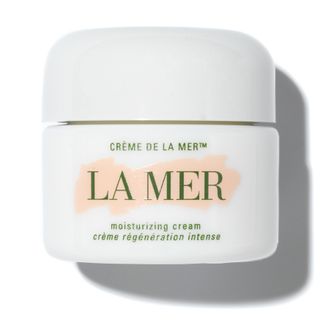
Crème de la Mer Moisturizing Cream
Works for
1 of 2 advertised claims delivered
Moisturizing19 ingredients credited for this claimStrong support
“Decadently rich, the formula soothes skin and imparts intense moisture, leaving skin feeling soft, supple and oh-so smooth.”
This product can help improve hydration of the skin with the two types of ingredients.
The first type is called “humectants”:
these ingredients help attract water.
When humectants are on the surface of the skin, they “pull in” the moisture from the outside environment, or from
within deeper layers of the skin. The following ingredients in this product do the job:
algae extract, glycerin.
This product also contains ingredients called “occlusives”. They help reduce the speed with which our skin loses moisture to the outside environment. These ingredients also help soften the upper layer of the skin, so it feels less tight and nicer to the touch. The following ingredients in this product do the job: algae extract, sesamum indicum seed oil.
The following ingredients in this product are especially good for supporting the skin barrier and helping with the hydration level: panthenol, paraffinum liquidum, petrolatum
Anti-aging4 ingredients credited for this claimLimited support
“Suitable for both day and night, the paraben and phthalate-free formula even diminishes dry lines for positively beaming, even skin.”
This product does not contain ingredients that are able to reduce fine lines and wrinkles or help with skin elasticity, but it can improve the look of the skin temporarily through moisturization. Well-moisturized skin might also be able to repair the sun damage better.
Can it cause trouble?
Irritancy13 strong irritants: Citrus aurantifolia fruit extract, Eucalyptus globulus leaf oil + 11 more — patch-test recommendedHigh risk
Comedogenic2 ingredients rated 2 or more on the 0–5 pore-clogging scale2 flagged


User reviews
Be the first — your take helps the next person decide.
Ingredients
Filter by role to see what each ingredient is doing.
Algae extract~23–34%
- Irritation risk
- Low
- Comedogenicity
- 3/5
Plant extract that helps the skin to attract water and make it more smooth for touch. Also shows promise of anti-aging properties, but research is not extensive yet
More about Algae extractParaffinum liquidum~5.1–7.7%
- Irritation risk
- Low
Mineral oil. One of the most effective and well studied occlusive and emollient moisturizing ingredients. Helps reduce moisture loss in skin and repair skin barrier function
More about Paraffinum liquidumPetrolatum~4.7–7%
- Irritation risk
- Low
One of the most effective and the most studied occlusive ingredients that creates a protective layer on top of the skin preventing moisture loss
More about PetrolatumGlycerin~3.2–4.9%
- Irritation risk
- Low
One of the best moisturizing ingredients. Naturally present in skin. It attracts water to the upper layer of the skin working as a humectant
More about GlycerinIsohexadecane~2.8–4.2%
- Irritation risk
- Low
Improves the texture of the product and helps soften the skin. Helps oil and water mix together and can be used as a cleansing agent
More about IsohexadecaneCitrus aurantifolia fruit extract~1.9–2.8%
Microcrystalline wax~1.5–2.3%
Lanolin alcohol~1.3–1.9%
- Irritation risk
- Medium
Helps oil and water mix together. Can be irritating
More about Lanolin alcoholSesamum indicum seed oil~1.1–1.7%
- Irritation risk
- Low
A good moisturizing plant oil. Due to the high linoleic acid content, it helps soften the upper layer of the skin, reduce water loss and support skin barrier function
More about Sesamum indicum seed oilEucalyptus globulus leaf oil~0.9–1.4%
- Irritation risk
- High
An essential oil that can be very irritating. Has some anti-bacterial properties
More about Eucalyptus globulus leaf oilMagnesium sulfate~0.9–1.3%
Sesamum indicum seed~0.85–1.25%
Medicago sativa seed powder~0.5–1.15%
- Irritation risk
- Medium
Might help soften the upper layer of the skin and help thicken the product formulation. It might have some anti-oxidant effect
More about Medicago sativa seed powderHelianthus annuus seedcake~0.85–1.25%
Prunus amygdalus dulcis seed meal~0.55–1.25%
Sodium gluconate~0.45–1%
Potassium gluconate~0.45–1%
- Irritation risk
- Low
A mineral that might be able to support skin hydration, but convincing research on its effectiveness in topical skincare is lacking
More about Potassium gluconateCopper gluconate~0.4–0.95%
- Irritation risk
- Medium
Typically used to stabilize the product formulations. It is a salt of polyhydroxy acid (PHA) and in larger concentrations, can help shed the dead cells from the skin surface revealing smoother skin. It can help attract water to the upper layer of the skin. Might to be helpful against acne and clogged pores. Could be helpful in neutralizing free radicals, but solid research is missing
More about Copper gluconateCalcium gluconate~0.4–0.95%
- Irritation risk
- Low
Helps attract water to the upper layer of the skin and helps to improve appearance of the product
More about Calcium gluconateMagnesium gluconate~0.35–0.85%
- Irritation risk
- Low
A mineral that might be able to support skin hydration, but convincing research on its effectiveness in topical skincare is lacking
More about Magnesium gluconateZinc gluconate~0.35–0.8%
- Irritation risk
- Medium
Typically used to stabilize the product formulations. It is a salt of a polyhydroxy acid (PHA) and in larger concentrations, can help shed the dead cells from the skin surface revealing smoother skin. It can help attract water to the upper layer of the skin. Might to be helpful against acne and clogged pores. Could be helpful in neutralizing free radicals, but solid research is missing. Due to the zinc content, might help calm down inflammation in skin
More about Zinc gluconateParaffin~0.3–0.75%
- Irritation risk
- Low
Prevents water loss from the skin surface and thickens the product consistency
More about ParaffinTocopheryl succinate~0.35–0.8%
Niacin~0.35–0.75%
- Irritation risk
- High
A form of vitamin B3. It is similar in action to niacinamide, but is more likely to cause red flashes in skin as the side effect
More about NiacinBeta-carotene~0.35–0.75%
Decyl oleate~0.4–0.9%
- Irritation risk
- Low
- Comedogenicity
- 2/5
Helps soften the upper layer of the skin
More about Decyl oleateAluminum distearate~0.35–0.8%
- Irritation risk
- Low
Octyldodecanol~0.35–0.85%
- Irritation risk
- Low
An emollient that helps to soften the skin and create a pleasant product texture and stabilize the formulation
More about OctyldodecanolCitric acid~0.3–0.75%
- Irritation risk
- Medium
Can work as an exfoliant but is typically used to adjust the product pH
More about Citric acidCyanocobalamin~0.35–0.75%
- Irritation risk
- Low
Can support skin barrier function and reduce inflammation in skin
More about CyanocobalaminMagnesium stearate~0.35–0.8%
Panthenol~0.3–0.7%
- Irritation risk
- Low
Helps attract water to the upper layer of the skin and can help improve skin barrier function
More about PanthenolLimonene~0.2–0.75%
- Irritation risk
- High
A common frangrance that can easily irritate skin, especially if exposed to air, light or heat
More about LimoneneGeraniol~0.2–0.75%
Linalool~0.15–0.7%
Hydroxycitronellal~0.15–0.65%
- Irritation risk
- High
A fragrance. A likely allergen and can be irritating
More about HydroxycitronellalCitronellol~0.15–0.6%
Benzyl salicylate~0.15–0.55%
Citral~0.1–0.5%
Methylchloroisothiazolinone~0.00075–0.0015%
- Irritation risk
- High
A preservative. Is a frequent allergen in cosmetics
More about MethylchloroisothiazolinoneMethylisothiazolinone~0.00075–0.0015%
Alcohol denat.~0.1–0.45%
- Irritation risk
- High
Produces temporary toning effect. Can help dissolve other ingredients or preserve products
More about Alcohol denat.Parfum~0.1–0.4%
- Irritation risk
- High
An aromatic blend of unspecified and possibly irritating ingredients
More about ParfumIngredient list view
Algae extract, Paraffinum liquidum, Petrolatum, Glycerin, Isohexadecane, Citrus aurantifolia fruit extract, Microcrystalline wax, Lanolin alcohol, Sesamum indicum seed oil, Eucalyptus globulus leaf oil, Magnesium sulfate, Sesamum indicum seed, Medicago sativa seed powder, Helianthus annuus seedcake, Prunus amygdalus dulcis seed meal, Sodium gluconate, Potassium gluconate, Copper gluconate, Calcium gluconate, Magnesium gluconate, Zinc gluconate, Paraffin, Tocopheryl succinate, Niacin, Beta-carotene, Decyl oleate, Aluminum distearate, Octyldodecanol, Citric acid, Cyanocobalamin, Magnesium stearate, Panthenol, Limonene, Geraniol, Linalool, Hydroxycitronellal, Citronellol, Benzyl salicylate, Citral, Methylchloroisothiazolinone, Methylisothiazolinone, Alcohol denat., Parfum
Compare prices
Retailers ranked by price — lowest first.

Worth comparing, line by line.
Match % combines shared ingredients, the first five ingredients, shared actives and hero ingredients, irritancy (lower counts in the alternative's favour), texture and body area. Only products in the same routine step are compared.
| Crème de la MerMoisturizing CreamYOUR PRODUCT | CicaBiafineAnti-Irritations Moisturising Cream | EnvironFocus Care Moisture+ Vita-Complex Super Moisturiser | NeosporinEczema Essentials Daily Moisturizing Cream | |
|---|---|---|---|---|
| Match | — | 58% | 56% | 56% |
| Price | $101.50 | $17.96−$83.54 | $43.63−$57.87 | $11.59−$89.91 |
| Shared key ingredients | — | 4 of 10 | 4 of 10 | 4 of 10 |
| Key difference | — | Dimethicone | Jojoba Oil | Ceramide Np |
| Irritancy | High | Low | Low | Low |
| Drying alcohol | Contains drying alcohol | — | — | — |
| View product | Shop | Shop | Shop |


Product summary
Based on the ingredients included, "Crème de la Mer - Moisturizing Cream" works well for moisturizing the skin. This moisturizer uses a good combo of humectants and emollients. These both types of ingredients are essentials for improving the skin hydration and keeping the skin barrier healthy. Glycerin and calcium gluconate in this product (humectants) attract water molecules to the upper layer of the skin (the water comes from the outside air or from the deeper layers of the skin if the air is dry). Emollients in this formulation (paraffinum liquidum, petrolatum, sesamum indicum seed oil, cera microcristallina and chondrus crispus extract) help to reduce the moisture loss from the skin. They also soften the skin surface and relieve the feeling of dryness and tightness.
Ingredient callouts
- An effective concentration of Panthenol (pro-vitamin B5) - about 0.20% - 0.80%. Panthenol helps strengthen the skin barrier, improve hydration and reduce inflammation in skin.
Irritation risk
There are quite a few common irritants in this product, including ingredients without particular skin benefits. We would not recommend it for sensitive skin. We assess the overall irritancy of this moisturizer to be high. For a detailed overview of all potential irritants: click here
You can see the detailed formula review with the breakdown of all actives in the product and the full ingredient list with estimated concentrations in the tables below.
Price
The product retails from 78.00£ up to 9206.00£ in the United Kingdom, for 340.54CA$ in Canada, for 842.52A$ in Australia and from 101.50$ up to 275.25$ in the United States.
For a detailed price comparison: click here.
Sources cited in this review
Every concentration estimate and effectiveness label is anchored to one of these 22 studies and safety reviews.
- 1A review on the extensive skin benefits of mineral oilncbi.nlm.nih.gov
- 2
- 3
- 4
- 5Triglyceride composition of Sesamum indicum seed oilonlinelibrary.wiley.com
- 6

Affiliate links · As an Amazon Associate, WIMJ earns from qualifying purchases.