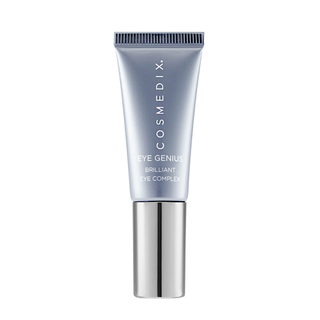
CosMedix Eye Genius Brilliant Eye Complex
Works for
2 of 2 advertised claims delivered
Moisturizing26 ingredients credited for this claimStrong support
“Designed to tackle the stubborn eye issues, including dark circles, fine lines and puffiness, the ‘Genius’ formula both moisturises skin, whilst having a visible anti-ageing effect.”
This product can help improve hydration of the skin with the two types of ingredients.
The first type is called “humectants”:
these ingredients help attract water.
When humectants are on the surface of the skin, they “pull in” the moisture from the outside environment, or from
within deeper layers of the skin. The following ingredients in this product do the job:
dextran, glycerin.
This product also contains ingredients called “occlusives”. They help reduce the speed with which our skin loses moisture to the outside environment. These ingredients also help soften the upper layer of the skin, so it feels less tight and nicer to the touch. The following ingredients in this product do the job: caprylic/capric triglyceride, helianthus annuus seed oil.
The following ingredients in this product are especially good for supporting the skin barrier and helping with the hydration level: acetyl octapeptide-3, caprooyl tetrapeptide-3, dipeptide-2, palmitoyl tetrapeptide-7, palmitoyl tripeptide-38
Anti-aging9 ingredients credited for this claimModerate support
“Finished with Mica, the serum reflects light to create youthful, radiant and bright eyes.”
This product contains acetyl octapeptide-3, caprooyl tetrapeptide-3, dipeptide-2, palmitoyl tetrapeptide-7, palmitoyl tripeptide-38, tocotrienols. These ingredients might be able to help reduce and prevent fine lines and wrinkles, improve skin elasticity and firmness, but there is not enough evidence that it actually works.
Anti-oxidationNot advertised by the brand · 7 ingredients credited for this claimStrong support
This product contains antioxidants (tocotrienols) that can help neutralize free radicals in skin. By doing so, they can lessen the damage the skin gets from the UV light (sun).
The following ingredients - squalene also can have an antioxidant effect, but there is less evidence to confirm their effectiveness in skin.
Can it cause trouble?
Irritancy7 strong irritants: Lavandula angustifolia oil, Rosmarinus officinalis leaf oil + 5 more — patch-test recommendedHigh risk
Comedogenic3 ingredients rated 2 or more on the 0–5 pore-clogging scale3 flagged
User reviews
Be the first — your take helps the next person decide.
Ingredients
Filter by role to see what each ingredient is doing.
Water~45–55%
Glycerin~4.4–5.3%
- Irritation risk
- Low
One of the best moisturizing ingredients. Naturally present in skin. It attracts water to the upper layer of the skin working as a humectant
More about GlycerinCaprylic/capric triglyceride~4.2–5.1%
- Irritation risk
- Medium
A good mix of fatty acids that forms a protective layer on the skin. Improves the shelf life of products. Derived from coconut and glycerin
More about Caprylic/capric triglycerideGlyceryl stearate~2.7–3.3%
- Irritation risk
- Low
An emollient that softens the skin and forms a protective layer on its surface. Helps water and oil mix together
More about Glyceryl stearatePolysorbate 60~2.2–2.7%
Cetearyl alcohol~1.9–2.3%
- Irritation risk
- Low
- Comedogenicity
- 2/5
A non-drying alcohol. Works as an emollient. Helps water and oil mix together and creates a nice product texture
More about Cetearyl alcoholPalmitic acid~1.6–1.9%
- Irritation risk
- Low
An emollient that is naturally present in skin and helps soften it
More about Palmitic acidStearic acid~1.5–1.9%
- Irritation risk
- Low
Helps oil and water mix together and works as an emollient
More about Stearic acidMica~1.3–1.6%
- Irritation risk
- Low
Creates an illusion of smoother and more radiant skin tone. Adds shimmer to the skin by reflecting light
More about MicaSqualane~1–1.2%
- Irritation risk
- Low
An oil naturally present in skin. Works as an emollient to soften the skin and form a protective layer on its surface without a greasy feeling.
More about SqualaneCetyl alcohol~0.75–1.15%
- Irritation risk
- Low
A non-drying alcohol that works to soften the skin and stabilize product formulations helping oil and water mix together
More about Cetyl alcoholBorago officinalis seed oil~0.6–0.85%
- Irritation risk
- Low
A plant oil that is effective in reducing irritation in skin, restore the barrier function and support its hydration
More about Borago officinalis seed oilSodium hyaluronate~0.5–0.75%
- Irritation risk
- Low
One of the best moisturizing ingredients. Attracts water into the upper layer of the skin
More about Sodium hyaluronatePerfluorohexane~0.45–0.7%
- Irritation risk
- Medium
Used in products to help dissolve oxygen and enhance oxygen molecule penetration into the skin. There is no evidence for benefits of the oxygen emulsion in topical creams, lotions or serums. There is a study available confirming a positive impact of oxygen therapy for skin wound healing, but it used an oxygen emulsion stored under high pressure using special equipment
More about PerfluorohexaneOlea europaea fruit oil~0.45–0.65%
- Irritation risk
- Medium
An emollient that helps soften the skin but is not effective for restoring its barrier function. Might be helpful to calm down inflammation
More about Olea europaea fruit oilPhenethyl alcohol~0.45–0.65%
Caprylyl glycol~0.45–0.65%
- Irritation risk
- Medium
Helps preserve products and creates a nice product texture
More about Caprylyl glycolXanthan gum~0.35–0.6%
- Irritation risk
- Low
Used to create a thicker product consistency
More about Xanthan gumPrunus amygdalus dulcis oil~0.35–0.6%
- Irritation risk
- Low
An emollient that softens the skin
More about Prunus amygdalus dulcis oilLavandula angustifolia oil~0.25–0.5%
- Irritation risk
- High
An essential oil. Potential allergen and can be irritating. It has some anti-bacterial properties
More about Lavandula angustifolia oilRosmarinus officinalis leaf oil~0.25–0.45%
- Irritation risk
- High
A plant oil with high content of volatile compounds that can irritate the skin. Can be used as a fragrance. Has anti-bacterial properties and might help neutralize free radicals on the surface of the skin
More about Rosmarinus officinalis leaf oilPerfluoroperhydrophenanthrene~0.25–0.45%
- Irritation risk
- Low
Hesperidin methyl chalcone~0.25–0.45%
- Irritation risk
- High
Might help neutralize free radicals in skin. Is claimed to be able to improve the appearance of undereye darkness but evidence is missing. Can be an allergen and cause irritation
More about Hesperidin methyl chalconePerfluorodecalin~0.25–0.45%
- Irritation risk
- Low
Tocotrienols~0.25–0.45%
- Irritation risk
- Low
A type of vitamin E that is more powerful in neutralizing free radicals compared to its other forms
More about TocotrienolsRetinyl palmitate~0.2–0.4%
- Irritation risk
- High
Three steps removed from the active form of vitamin A - retinoic acid. To have an effect in the skin, it first needs to be converted twice to become the retinoic acid. This means it is less potent than retinol, but could also be less irritating. Once converted to the retinoic acid in the skin, it helps against all signs of aging, improves skin cell turnover and helps fight blemishes and clogged pores. However, in many cosmetic formulations, it is used in a concentration that is too low to have the full effect
More about Retinyl palmitateElaeis guineensis oil~0.25–0.5%
- Irritation risk
- Low
Helps soften the upper layer of the skin
More about Elaeis guineensis oilSteareth-20~0.3–0.6%
Caprooyl tetrapeptide-3~0.25–0.5%
- Irritation risk
- Low
A type of peptide. Peptides are excellent moisturizers and might be able support collagen production reducing fine lines and wrinkles
More about Caprooyl tetrapeptide-3Dextran~0.25–0.45%
- Irritation risk
- Low
Helps attract water to the most upper layer of the skin. Derived from sugar
More about DextranJasminum officinale oil~0.15–0.3%
- Irritation risk
- Low
Aloe barbadensis leaf juice powder~0.2–0.4%
- Irritation risk
- Medium
Traditionally used to treat sunburns, dermatitis and inflammation, but evidence for its effectiveness is lacking. The extract can contain humectants that help attract water into the skin
More about Aloe barbadensis leaf juice powderHelianthus annuus seed oil~0.25–0.5%
- Irritation risk
- Low
A great emollient due to its high linoleic acid content. One of the most effective plant oils in helping skin hydration and repairing skin barrier function
More about Helianthus annuus seed oilCitric acid~0.25–0.45%
- Irritation risk
- Medium
Can work as an exfoliant but is typically used to adjust the product pH
More about Citric acidPerfluorodimethylcyclohexane~0.25–0.45%
- Irritation risk
- Low
Myristic acid~0.25–0.5%
- Irritation risk
- Medium
- Comedogenicity
- 3/5
Helps oil and water mix together. Could be comedogenic
More about Myristic acidTocopherol~0.25–0.45%
- Irritation risk
- Low
Pure form of vitamin E. Can help moisturise and protect the skin from free radicals. Often used to help stabilise other ingredients or the formula itself
More about TocopherolSqualene~0.25–0.5%
- Irritation risk
- Low
- Comedogenicity
- 2/5
An oil that is naturally part of skin sebum that helps to soften its upper layer, reduce water loss and neutralize free radicals. It might be comedogenic. Avoid applying large concentrations (or pure oil) before sun exposure as oxidized squalene can clog pores and lead to skin irritation. Today squalene is mostly derived from vegetable oils or synthetized by yeast
More about SqualeneTrisodium ethylenediamine disuccinate~0.25–0.4%
- Irritation risk
- Medium
Used to improve stability of the formulation
More about Trisodium ethylenediamine disuccinateSodium hydroxide~0.25–0.45%
Hydroxypropyl cyclodextrin~0.25–0.5%
- Irritation risk
- Medium
Used to stabilize product formulations and help soften the upper layer of the skin
More about Hydroxypropyl cyclodextrinPyruvic acid~0.25–0.45%
- Irritation risk
- Low
Sodium citrate~0.2–0.4%
- Irritation risk
- Medium
Helps to control the skin's pH level. Maintains the skin's natural film of amino-lactic acids and oils. Helps to preserve products
More about Sodium citrateBeta-sitosterol~0.25–0.5%
- Irritation risk
- Low
A phytosterol that can support skin's barrier function and help the skin stay hydrated
More about Beta-sitosterolDipeptide-2~0.2–0.4%
- Irritation risk
- Low
A type of peptide. Peptides are excellent moisturizers and might be able support collagen production reducing fine lines and wrinkles
More about Dipeptide-2Acetyl octapeptide-3~0.2–0.4%
- Irritation risk
- Low
A type of peptide. Peptides are excellent moisturizers and might be able support collagen production reducing fine lines and wrinkles
More about Acetyl octapeptide-3Palmitoyl tetrapeptide-7~0.25–0.45%
- Irritation risk
- Low
A type of peptide. Peptides are excellent moisturizers and might be able support collagen production reducing fine lines and wrinkles
More about Palmitoyl tetrapeptide-7Palmitoyl tripeptide-38~0.2–0.4%
- Irritation risk
- Low
A type of peptide. Peptides are excellent moisturizers and might be able support collagen production reducing fine lines and wrinkles
More about Palmitoyl tripeptide-38Potassium sorbate~0.2–0.35%
Chlorhexidine digluconate~0.15–0.3%
Linalool~0.15–0.3%
Benzyl benzoate~0.15–0.25%
- Irritation risk
- High
Fragrance with sweet balsamic smell. Help to preserve products and dissolve other ingredients. Could trigger allergic reactions and be irritating
More about Benzyl benzoateLimonene~0.1–0.2%
- Irritation risk
- High
A common frangrance that can easily irritate skin, especially if exposed to air, light or heat
More about LimoneneEugenol~0.1–0.25%
Benzyl alcohol~0.1–0.2%
- Irritation risk
- High
A preservative. Can be used to mask unpleasant smell. Can be irritating
More about Benzyl alcoholTitanium dioxide~0.1–0.15%
- Irritation risk
- Low
Works as a UV filter when used in high concentrations. It is photostable and is effective mostly against the UVB light, with some protection in the UVA range. In small concentrations, used for its ability to improve the color of cosmetic products. Is usually well tolerated by the skin
More about Titanium dioxideCi 77891~0.05–0.1%
- Irritation risk
- Low
Ingredient list view
Water, Glycerin, Caprylic/capric triglyceride, Glyceryl stearate, Polysorbate 60, Cetearyl alcohol, Palmitic acid, Stearic acid, Mica, Squalane, Cetyl alcohol, Borago officinalis seed oil, Sodium hyaluronate, Perfluorohexane, Olea europaea fruit oil, Phenethyl alcohol, Caprylyl glycol, Xanthan gum, Prunus amygdalus dulcis oil, Lavandula angustifolia oil, Rosmarinus officinalis leaf oil, Perfluoroperhydrophenanthrene, Hesperidin methyl chalcone, Perfluorodecalin, Tocotrienols, Retinyl palmitate, Elaeis guineensis oil, Steareth-20, Caprooyl tetrapeptide-3, Dextran, Jasminum officinale oil, Aloe barbadensis leaf juice powder, Helianthus annuus seed oil, Citric acid, Perfluorodimethylcyclohexane, Myristic acid, Tocopherol, Squalene, Trisodium ethylenediamine disuccinate, Sodium hydroxide, Hydroxypropyl cyclodextrin, Pyruvic acid, Sodium citrate, Beta-sitosterol, Dipeptide-2, Acetyl octapeptide-3, Palmitoyl tetrapeptide-7, Palmitoyl tripeptide-38, Potassium sorbate, Chlorhexidine digluconate, Linalool, Benzyl benzoate, Limonene, Eugenol, Benzyl alcohol, Titanium dioxide, Ci 77891
Compare prices
Retailers ranked by price — lowest first.

Product summary
"CosMedix - Eye Genius Brilliant Eye Complex" has a good moisturizing formula. To work well, any moisturizer needs to include a combination of water-binding and emollient ingredients. CosMedix - Eye Genius Brilliant Eye Complex ticks this box. Acetyl octapeptide-3, dextran, glycerin, sodium hyaluronate and caprylyl glycol in this product (humectants) attract water molecules to the upper layer of the skin (the water comes from the outside air or from the deeper layers of the skin if the air is dry). Caprooyl tetrapeptide-3, palmitoyl tetrapeptide-7, beta-sitosterol, borago officinalis seed oil and caprylic/capric triglyceride in this product help decrease the water evoporation from the skin, so that it stays hydrated for longer. These ingredients also soften the skin and take away the feeling of tightness and dryness.
Ingredient callouts
- this moisturizer includes a form of retinoids (vitamin A) - retinyl palmitate 0.20% - 0.40%, but this type of vitamin A is not very effective. It could in theory help with fine lines and wrinkles, but the effect is most likely minimal.
- We like that this moisturizer contains peptides (palmitoyl tripeptide-38 0.20% - 0.40%, palmitoyl tetrapeptide-7 0.25% - 0.45%, acetyl octapeptide-3 0.20% - 0.40%, dipeptide-2 0.20% - 0.40% and caprooyl tetrapeptide-3 0.25% - 0.50%). There are many different kind of peptides and they are naturally present in our skin. They all are a combination of amino-acids. Some of them work as natural anti-biotics, promote wound-healing and production of collagen. The science is still not settled on how effective peptides in skincare are, but it is very likely that they have a benefit. Peptides might help restore the skin barrier and fight the signs of aging. At the very least, peptides work as humectants: they attract water to the upper layer of the skin and improve its hydration.
Irritation risk
There are quite a few common irritants in this product, including ingredients without particular skin benefits. We would not recommend it for sensitive skin. We assess the overall irritancy of this moisturizer to be high. For a detailed overview of all potential irritants: click here
You can see the detailed formula review with the breakdown of all actives in the product and the full ingredient list with estimated concentrations in the tables below.
About the brand
According to Cruelty-Free Kitty "CosMedix" is cruelty free and so is its parent company.
Price
The product retails from 70.00$ up to 77.00$ in the United States, for 84.83A$ in Australia and for 113.99£ in the United Kingdom.
For a detailed price comparison: click here.
Sources cited in this review
Every concentration estimate and effectiveness label is anchored to one of these 36 studies and safety reviews.
- 1
- 2
- 3
- 4Hyaluronic acid: A key molecule in skin agingncbi.nlm.nih.gov
- 5
- 6Topical Oxygen Emulsion A Novel Wound Therapyjamanetwork.com

Affiliate links · As an Amazon Associate, WIMJ earns from qualifying purchases.