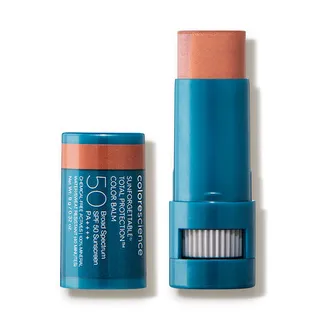
Colorescience Sunforgettable Total Protection Color Balm - Bronze
Works for
Sun protectionSPF 50 · 3 UV filtersBroad spectrum
This product offers a good level of protection against both UVB and UVA rays.
This sunscreen uses organic (so-called "chemical") sunscreen filters. Organic, or "chemical" filters usually provide reliable sun protection and rarely leave a white cast. Sunscreens with organic filters can sting eyes.
This product can be considered "reef safe" because it does not contain the UV filters (oxybenzone and octinoxate) that can be harmful to coral reefs when present in the water in high concentrations.
Anti-agingSide benefit · TocopherolWorks well
This product can help prevent early signs of skin aging because it offers a good level of broad spectrum sun protection. Sun damage is the main cause of premature skin aging, and protecting your skin from the sun is the best anti-aging strategy.
Anti-oxidationSide benefit · Dimethylmethoxy chromanol, Tocopheryl acetate + 2 moreWorks well
This product contains antioxidants (dimethylmethoxy chromanol) that can help neutralize free radicals in skin. By doing so, they can lessen the damage the skin gets from the UV light (sun).
MoisturizingSide benefit the brand mentions · Dimethicone, Polymethylsilsesquioxane + 9 moreWorks
“+ Hydrates & conditions for healthier-looking lips”
This product can help soften the skin and reduce its moisture loss with emollients and occlusives: copernicia cerifera wax, dimethicone.
Keep in mind that this product does not contain effective ingredients to attract water to the upper layer of the skin. This is why an additional product with humectants like glycerin or hyaluronic acid can be helpful (apply it before this product for the best results).
Can it cause trouble?
Irritancy12 flagged ingredients — patch-test recommendedHigh risk
ComedogenicClean of flagged comedogenic ingredientsNone flagged
User reviews
Be the first — your take helps the next person decide.
Ingredients
Filter by role to see what each ingredient is doing.
Zinc oxide12.5%
- Irritation risk
- Low
A broad spectrum sunblock (protects from both UVA and UVB rays). Is suitable for most sensitive skins. In small concentrations, can be used as a colorant
More about Zinc oxideJojoba esters~23–35%
- Irritation risk
- Medium
An emollient made of jojoba oil. Helps soften the skin and support its barrier function
More about Jojoba estersC26-28 alkyl dimethicone~4.8–7.1%
- Irritation risk
- Low
Butyloctyl salicylate~3.7–5.5%
- Irritation risk
- Medium
A synthetic ester of salicylic acid that is used to help disperse pigments and boost effectiveness of sunscreen ingredients. It is able to absorb UV light (working as an organic, or chemical filter), but is not approved as a sunscreen ingredient on its own
More about Butyloctyl salicylateSqualane~2.8–4.1%
- Irritation risk
- Low
An oil naturally present in skin. Works as an emollient to soften the skin and form a protective layer on its surface without a greasy feeling.
More about SqualaneC18-36 acid triglyceride~2–3.1%
- Irritation risk
- Low
Polymethylsilsesquioxane~1.6–2.5%
- Irritation risk
- Low
A silicone that improves product texture and helps dissolve other ingredients. Can form a non-greasy film on the skin to prevent moisture loss
More about PolymethylsilsesquioxaneGlyceryl dibehenate~1.4–2.1%
- Irritation risk
- Low
Synthetic fluorphlogopite~1.3–1.9%
- Irritation risk
- Low
A mineral that is used as an optical filter (makes the skin looks nicer through light reflection) and to improve the texture of cosmetic products
More about Synthetic fluorphlogopiteEuphorbia cerifera wax~1.2–1.9%
- Irritation risk
- Low
Tridecyl salicylate~0.55–1.35%
- Irritation risk
- Low
Vp/eicosene copolymer~0.5–1.15%
- Irritation risk
- Medium
Used to improve the product adherence to the skin, for example, to pro-long the protective effect of sunscreens. Can be irritating to very sensitive skin
More about Vp/eicosene copolymerMethylpropanediol~0.4–0.9%
Tribehenin~0.35–0.85%
- Irritation risk
- Low
Used to create a thicker product consistency and soften the upper layer of the skin
More about TribeheninLecithin~0.35–0.8%
- Irritation risk
- Low
Used mostly for creating emulsions - helping oil and water mix together. Helps soften the upper layer of the skin
More about LecithinMica~0.35–0.75%
- Irritation risk
- Low
Creates an illusion of smoother and more radiant skin tone. Adds shimmer to the skin by reflecting light
More about MicaCopernicia cerifera wax~0.35–0.8%
- Irritation risk
- Low
Helps to soften the upper layer of the skin and create a nice product consistency
More about Copernicia cerifera waxGlyceryl behenate~0.3–0.7%
- Irritation risk
- Medium
Used to create a thicker product consistency and help soften the upper layer of the skin
More about Glyceryl behenateCaprylyl glycol~0.15–0.7%
- Irritation risk
- Medium
Helps preserve products and creates a nice product texture
More about Caprylyl glycolPhysalis angulata extract~0.15–0.6%
- Irritation risk
- Low
Caprylic/capric triglyceride~0.15–0.65%
- Irritation risk
- Medium
A good mix of fatty acids that forms a protective layer on the skin. Improves the shelf life of products. Derived from coconut and glycerin
More about Caprylic/capric triglycerideBisabolol~0.1–0.4%
- Irritation risk
- Low
An active component of chamomile plant that historically has been used to calm down irritated skin. A recent study shows that bisabolol indeed can have some anti-inflammatory effect on skin, even though conclusive data is lacking. Bisabolol has a sweet floral scent and can be added to products for its aromatic properties
More about BisabololTocopheryl acetate~0.15–0.5%
- Irritation risk
- Medium
A more stable but less bio-available form of vitamin E compared to Tocopherol. Might help moisturize and protect the skin from free radicals, but mostly used in low concentrations to stabilize other ingredients.
More about Tocopheryl acetatePhenylpropanol~0.1–0.4%
- Irritation risk
- High
Helps mask the smell of other ingredients and helps preserve the product formulation
More about PhenylpropanolDimethylmethoxy chromanol~0.1–0.45%
- Irritation risk
- Low
Can help neutralize free radicals in skin
More about Dimethylmethoxy chromanolDimethicone~0.15–0.55%
- Irritation risk
- Low
A silicone that helps to reduce water loss from the surface of the skin. Can temporarily "fill in" lines and wrinkles, absorb oil, and create a nice product finish
More about DimethiconeTocopherol~0.1–0.45%
- Irritation risk
- Low
Pure form of vitamin E. Can help moisturise and protect the skin from free radicals. Often used to help stabilise other ingredients or the formula itself
More about TocopherolTin oxide~0.2–0.7%
- Irritation risk
- Low
A colorant that can add a pearl-like appearance to the formulation
More about Tin oxideIron oxides~0.1–0.4%
- Irritation risk
- Low
An umbrella term for the following three colorants: CI 77491, CI 77492, CI 77499. They might be able to offer some protection against visible light, but the degree of the protection is not clear
More about Iron oxidesTitanium dioxide~0.15–0.65%
- Irritation risk
- Low
Works as a UV filter when used in high concentrations. It is photostable and is effective mostly against the UVB light, with some protection in the UVA range. In small concentrations, used for its ability to improve the color of cosmetic products. Is usually well tolerated by the skin
More about Titanium dioxideJojoba esters~0.15–0.55%
- Irritation risk
- Medium
An emollient made of jojoba oil. Helps soften the skin and support its barrier function
More about Jojoba estersC26-28 alkyl dimethicone~0.1–0.4%
- Irritation risk
- Low
Squalane~0.15–0.55%
- Irritation risk
- Low
An oil naturally present in skin. Works as an emollient to soften the skin and form a protective layer on its surface without a greasy feeling.
More about SqualaneButyloctyl salicylate~0.1–0.4%
- Irritation risk
- Medium
A synthetic ester of salicylic acid that is used to help disperse pigments and boost effectiveness of sunscreen ingredients. It is able to absorb UV light (working as an organic, or chemical filter), but is not approved as a sunscreen ingredient on its own
More about Butyloctyl salicylateC18-36 acid triglyceride~0.1–0.5%
- Irritation risk
- Low
Polymethylsilsesquioxane~0.1–0.5%
- Irritation risk
- Low
A silicone that improves product texture and helps dissolve other ingredients. Can form a non-greasy film on the skin to prevent moisture loss
More about PolymethylsilsesquioxaneGlyceryl dibehenate~0.15–0.55%
- Irritation risk
- Low
Euphorbia cerifera wax~0.15–0.5%
- Irritation risk
- Low
Tridecyl salicylate~0.1–0.4%
- Irritation risk
- Low
Vp/eicosene copolymer~0.1–0.5%
- Irritation risk
- Medium
Used to improve the product adherence to the skin, for example, to pro-long the protective effect of sunscreens. Can be irritating to very sensitive skin
More about Vp/eicosene copolymerMethylpropanediol~0.1–0.45%
Tribehenin~0.1–0.5%
- Irritation risk
- Low
Used to create a thicker product consistency and soften the upper layer of the skin
More about TribeheninLecithin~0.15–0.55%
- Irritation risk
- Low
Used mostly for creating emulsions - helping oil and water mix together. Helps soften the upper layer of the skin
More about LecithinCopernicia cerifera wax~0.15–0.6%
- Irritation risk
- Low
Helps to soften the upper layer of the skin and create a nice product consistency
More about Copernicia cerifera waxGlyceryl behenate~0.15–0.55%
- Irritation risk
- Medium
Used to create a thicker product consistency and help soften the upper layer of the skin
More about Glyceryl behenateMica~0.15–0.55%
- Irritation risk
- Low
Creates an illusion of smoother and more radiant skin tone. Adds shimmer to the skin by reflecting light
More about MicaSynthetic fluorphlogopite~0.15–0.5%
- Irritation risk
- Low
A mineral that is used as an optical filter (makes the skin looks nicer through light reflection) and to improve the texture of cosmetic products
More about Synthetic fluorphlogopiteCaprylyl glycol~0.15–0.5%
- Irritation risk
- Medium
Helps preserve products and creates a nice product texture
More about Caprylyl glycolPhysalis angulata extract~0.1–0.45%
- Irritation risk
- Low
Caprylic/capric triglyceride~0.15–0.55%
- Irritation risk
- Medium
A good mix of fatty acids that forms a protective layer on the skin. Improves the shelf life of products. Derived from coconut and glycerin
More about Caprylic/capric triglycerideBisabolol~0.1–0.35%
- Irritation risk
- Low
An active component of chamomile plant that historically has been used to calm down irritated skin. A recent study shows that bisabolol indeed can have some anti-inflammatory effect on skin, even though conclusive data is lacking. Bisabolol has a sweet floral scent and can be added to products for its aromatic properties
More about BisabololTocopheryl acetate~0.1–0.5%
- Irritation risk
- Medium
A more stable but less bio-available form of vitamin E compared to Tocopherol. Might help moisturize and protect the skin from free radicals, but mostly used in low concentrations to stabilize other ingredients.
More about Tocopheryl acetatePhenylpropanol~0.1–0.4%
- Irritation risk
- High
Helps mask the smell of other ingredients and helps preserve the product formulation
More about PhenylpropanolDimethicone~0.15–0.55%
- Irritation risk
- Low
A silicone that helps to reduce water loss from the surface of the skin. Can temporarily "fill in" lines and wrinkles, absorb oil, and create a nice product finish
More about DimethiconeDimethylmethoxy chromanol~0.1–0.45%
- Irritation risk
- Low
Can help neutralize free radicals in skin
More about Dimethylmethoxy chromanolTocopherol~0.1–0.45%
- Irritation risk
- Low
Pure form of vitamin E. Can help moisturise and protect the skin from free radicals. Often used to help stabilise other ingredients or the formula itself
More about TocopherolCi 75470~0.1–0.45%
Ci 77163~0.1–0.45%
Iron oxides~0.1–0.4%
- Irritation risk
- Low
An umbrella term for the following three colorants: CI 77491, CI 77492, CI 77499. They might be able to offer some protection against visible light, but the degree of the protection is not clear
More about Iron oxidesJojoba esters~0.15–0.55%
- Irritation risk
- Medium
An emollient made of jojoba oil. Helps soften the skin and support its barrier function
More about Jojoba estersCalcium sodium borosilicate~0.15–0.5%
Synthetic fluorphlogopite~0.15–0.5%
- Irritation risk
- Low
A mineral that is used as an optical filter (makes the skin looks nicer through light reflection) and to improve the texture of cosmetic products
More about Synthetic fluorphlogopiteMica~0.15–0.55%
- Irritation risk
- Low
Creates an illusion of smoother and more radiant skin tone. Adds shimmer to the skin by reflecting light
More about MicaButyloctyl salicylate~0.1–0.4%
- Irritation risk
- Medium
A synthetic ester of salicylic acid that is used to help disperse pigments and boost effectiveness of sunscreen ingredients. It is able to absorb UV light (working as an organic, or chemical filter), but is not approved as a sunscreen ingredient on its own
More about Butyloctyl salicylateC26-28 alkyl dimethicone~0.1–0.4%
- Irritation risk
- Low
Squalane~0.15–0.55%
- Irritation risk
- Low
An oil naturally present in skin. Works as an emollient to soften the skin and form a protective layer on its surface without a greasy feeling.
More about SqualaneC18-36 acid triglyceride~0.1–0.5%
- Irritation risk
- Low
Glyceryl dibehenate~0.15–0.55%
- Irritation risk
- Low
Tridecyl salicylate~0.1–0.4%
- Irritation risk
- Low
Euphorbia cerifera wax~0.15–0.5%
- Irritation risk
- Low
Vp/eicosene copolymer~0.1–0.5%
- Irritation risk
- Medium
Used to improve the product adherence to the skin, for example, to pro-long the protective effect of sunscreens. Can be irritating to very sensitive skin
More about Vp/eicosene copolymerTribehenin~0.1–0.5%
- Irritation risk
- Low
Used to create a thicker product consistency and soften the upper layer of the skin
More about TribeheninMethylpropanediol~0.1–0.45%
Lecithin~0.15–0.55%
- Irritation risk
- Low
Used mostly for creating emulsions - helping oil and water mix together. Helps soften the upper layer of the skin
More about LecithinGlyceryl behenate~0.15–0.55%
- Irritation risk
- Medium
Used to create a thicker product consistency and help soften the upper layer of the skin
More about Glyceryl behenateCopernicia cerifera wax~0.15–0.6%
- Irritation risk
- Low
Helps to soften the upper layer of the skin and create a nice product consistency
More about Copernicia cerifera waxCaprylyl glycol~0.15–0.5%
- Irritation risk
- Medium
Helps preserve products and creates a nice product texture
More about Caprylyl glycolPhysalis angulata extract~0.1–0.45%
- Irritation risk
- Low
Caprylic/capric triglyceride~0.15–0.55%
- Irritation risk
- Medium
A good mix of fatty acids that forms a protective layer on the skin. Improves the shelf life of products. Derived from coconut and glycerin
More about Caprylic/capric triglycerideBisabolol~0.1–0.35%
- Irritation risk
- Low
An active component of chamomile plant that historically has been used to calm down irritated skin. A recent study shows that bisabolol indeed can have some anti-inflammatory effect on skin, even though conclusive data is lacking. Bisabolol has a sweet floral scent and can be added to products for its aromatic properties
More about BisabololTocopheryl acetate~0.1–0.5%
- Irritation risk
- Medium
A more stable but less bio-available form of vitamin E compared to Tocopherol. Might help moisturize and protect the skin from free radicals, but mostly used in low concentrations to stabilize other ingredients.
More about Tocopheryl acetatePhenylpropanol~0.1–0.4%
- Irritation risk
- High
Helps mask the smell of other ingredients and helps preserve the product formulation
More about PhenylpropanolTin oxide~0.2–0.7%
- Irritation risk
- Low
A colorant that can add a pearl-like appearance to the formulation
More about Tin oxideDimethylmethoxy chromanol~0.1–0.45%
- Irritation risk
- Low
Can help neutralize free radicals in skin
More about Dimethylmethoxy chromanolDimethicone~0.15–0.55%
- Irritation risk
- Low
A silicone that helps to reduce water loss from the surface of the skin. Can temporarily "fill in" lines and wrinkles, absorb oil, and create a nice product finish
More about DimethiconeTocopherol~0.1–0.45%
- Irritation risk
- Low
Pure form of vitamin E. Can help moisturise and protect the skin from free radicals. Often used to help stabilise other ingredients or the formula itself
More about TocopherolIron oxides~0.1–0.4%
- Irritation risk
- Low
An umbrella term for the following three colorants: CI 77491, CI 77492, CI 77499. They might be able to offer some protection against visible light, but the degree of the protection is not clear
More about Iron oxidesTitanium dioxide~0.15–0.65%
- Irritation risk
- Low
Works as a UV filter when used in high concentrations. It is photostable and is effective mostly against the UVB light, with some protection in the UVA range. In small concentrations, used for its ability to improve the color of cosmetic products. Is usually well tolerated by the skin
More about Titanium dioxideJojoba esters~0.15–0.55%
- Irritation risk
- Medium
An emollient made of jojoba oil. Helps soften the skin and support its barrier function
More about Jojoba estersSynthetic fluorphlogopite~0.15–0.5%
- Irritation risk
- Low
A mineral that is used as an optical filter (makes the skin looks nicer through light reflection) and to improve the texture of cosmetic products
More about Synthetic fluorphlogopiteC26-28 alkyl dimethicone~0.1–0.4%
- Irritation risk
- Low
Butyloctyl salicylate~0.1–0.4%
- Irritation risk
- Medium
A synthetic ester of salicylic acid that is used to help disperse pigments and boost effectiveness of sunscreen ingredients. It is able to absorb UV light (working as an organic, or chemical filter), but is not approved as a sunscreen ingredient on its own
More about Butyloctyl salicylateSqualane~0.15–0.55%
- Irritation risk
- Low
An oil naturally present in skin. Works as an emollient to soften the skin and form a protective layer on its surface without a greasy feeling.
More about SqualaneC18-36 acid triglyceride~0.1–0.5%
- Irritation risk
- Low
Polymethylsilsesquioxane~0.1–0.5%
- Irritation risk
- Low
A silicone that improves product texture and helps dissolve other ingredients. Can form a non-greasy film on the skin to prevent moisture loss
More about PolymethylsilsesquioxaneEuphorbia cerifera wax~0.15–0.5%
- Irritation risk
- Low
Glyceryl dibehenate~0.15–0.55%
- Irritation risk
- Low
C12-15 alkyl benzoate~0.1–0.5%
- Irritation risk
- Low
Enhances the product texture and makes it more spreadable. Helps reduce water loss from the outer layer of skin. Extands the shelf life by preventing bacteria growth
More about C12-15 alkyl benzoateTridecyl salicylate~0.1–0.4%
- Irritation risk
- Low
Vp/eicosene copolymer~0.1–0.5%
- Irritation risk
- Medium
Used to improve the product adherence to the skin, for example, to pro-long the protective effect of sunscreens. Can be irritating to very sensitive skin
More about Vp/eicosene copolymerMethylpropanediol~0.1–0.45%
Lecithin~0.15–0.55%
- Irritation risk
- Low
Used mostly for creating emulsions - helping oil and water mix together. Helps soften the upper layer of the skin
More about LecithinTribehenin~0.1–0.5%
- Irritation risk
- Low
Used to create a thicker product consistency and soften the upper layer of the skin
More about TribeheninCopernicia cerifera wax~0.15–0.6%
- Irritation risk
- Low
Helps to soften the upper layer of the skin and create a nice product consistency
More about Copernicia cerifera waxGlyceryl behenate~0.15–0.55%
- Irritation risk
- Medium
Used to create a thicker product consistency and help soften the upper layer of the skin
More about Glyceryl behenateCaprylyl glycol~0.15–0.5%
- Irritation risk
- Medium
Helps preserve products and creates a nice product texture
More about Caprylyl glycolPhysalis angulata extract~0.1–0.45%
- Irritation risk
- Low
Caprylic/capric triglyceride~0.15–0.55%
- Irritation risk
- Medium
A good mix of fatty acids that forms a protective layer on the skin. Improves the shelf life of products. Derived from coconut and glycerin
More about Caprylic/capric triglycerideTin oxide~0.2–0.7%
- Irritation risk
- Low
A colorant that can add a pearl-like appearance to the formulation
More about Tin oxideBisabolol~0.1–0.35%
- Irritation risk
- Low
An active component of chamomile plant that historically has been used to calm down irritated skin. A recent study shows that bisabolol indeed can have some anti-inflammatory effect on skin, even though conclusive data is lacking. Bisabolol has a sweet floral scent and can be added to products for its aromatic properties
More about BisabololMica~0.15–0.55%
- Irritation risk
- Low
Creates an illusion of smoother and more radiant skin tone. Adds shimmer to the skin by reflecting light
More about MicaTocopheryl acetate~0.1–0.5%
- Irritation risk
- Medium
A more stable but less bio-available form of vitamin E compared to Tocopherol. Might help moisturize and protect the skin from free radicals, but mostly used in low concentrations to stabilize other ingredients.
More about Tocopheryl acetatePhenylpropanol~0.1–0.4%
- Irritation risk
- High
Helps mask the smell of other ingredients and helps preserve the product formulation
More about PhenylpropanolPolyglyceryl-4 diisostearate/polyhydroxystearate/sebacate~0.15–0.5%
- Irritation risk
- Medium
Helps water and oil mix together
More about Polyglyceryl-4 diisostearate/polyhydroxystearate/sebacateHydrogenated lecithin~0.1–0.5%
- Irritation risk
- Low
Helps to retain moisture by creating a protective barrier on the skin. Rich in fatty acids. Improves product texture and helps with the penetration of other ingredients.
More about Hydrogenated lecithinDimethylmethoxy chromanol~0.1–0.45%
- Irritation risk
- Low
Can help neutralize free radicals in skin
More about Dimethylmethoxy chromanolAluminum hydroxide~0.15–0.5%
- Irritation risk
- Low
Is used to add opaque (non-transparent) appearance to formulations. Can be used to coat other ingredients for even dispersion. This is a different ingredient compared to the ones used in antipersperants (aluminium chloride and aluminium chlorohydrate)
More about Aluminum hydroxideTocopherol~0.1–0.45%
- Irritation risk
- Low
Pure form of vitamin E. Can help moisturise and protect the skin from free radicals. Often used to help stabilise other ingredients or the formula itself
More about TocopherolTitanium dioxide~0.15–0.65%
- Irritation risk
- Low
Works as a UV filter when used in high concentrations. It is photostable and is effective mostly against the UVB light, with some protection in the UVA range. In small concentrations, used for its ability to improve the color of cosmetic products. Is usually well tolerated by the skin
More about Titanium dioxideIron oxides~0.1–0.4%
- Irritation risk
- Low
An umbrella term for the following three colorants: CI 77491, CI 77492, CI 77499. They might be able to offer some protection against visible light, but the degree of the protection is not clear
More about Iron oxidesCi 75470~0.1–0.45%
Iron oxides~0.1–0.4%
- Irritation risk
- Low
An umbrella term for the following three colorants: CI 77491, CI 77492, CI 77499. They might be able to offer some protection against visible light, but the degree of the protection is not clear
More about Iron oxidesCi 77163~0.1–0.45%
Jojoba esters~0.15–0.55%
- Irritation risk
- Medium
An emollient made of jojoba oil. Helps soften the skin and support its barrier function
More about Jojoba estersC26-28 alkyl dimethicone~0.1–0.4%
- Irritation risk
- Low
Butyloctyl salicylate~0.1–0.4%
- Irritation risk
- Medium
A synthetic ester of salicylic acid that is used to help disperse pigments and boost effectiveness of sunscreen ingredients. It is able to absorb UV light (working as an organic, or chemical filter), but is not approved as a sunscreen ingredient on its own
More about Butyloctyl salicylateMica~0.15–0.55%
- Irritation risk
- Low
Creates an illusion of smoother and more radiant skin tone. Adds shimmer to the skin by reflecting light
More about MicaSqualane~0.15–0.55%
- Irritation risk
- Low
An oil naturally present in skin. Works as an emollient to soften the skin and form a protective layer on its surface without a greasy feeling.
More about SqualaneC18-36 acid triglyceride~0.1–0.5%
- Irritation risk
- Low
Polymethylsilsesquioxane~0.1–0.5%
- Irritation risk
- Low
A silicone that improves product texture and helps dissolve other ingredients. Can form a non-greasy film on the skin to prevent moisture loss
More about PolymethylsilsesquioxaneSynthetic fluorphlogopite~0.15–0.5%
- Irritation risk
- Low
A mineral that is used as an optical filter (makes the skin looks nicer through light reflection) and to improve the texture of cosmetic products
More about Synthetic fluorphlogopiteEuphorbia cerifera wax~0.15–0.5%
- Irritation risk
- Low
Glyceryl dibehenate~0.15–0.55%
- Irritation risk
- Low
Tridecyl salicylate~0.1–0.4%
- Irritation risk
- Low
Vp/eicosene copolymer~0.1–0.5%
- Irritation risk
- Medium
Used to improve the product adherence to the skin, for example, to pro-long the protective effect of sunscreens. Can be irritating to very sensitive skin
More about Vp/eicosene copolymerMethylpropanediol~0.1–0.45%
C12-15 alkyl benzoate~0.1–0.5%
- Irritation risk
- Low
Enhances the product texture and makes it more spreadable. Helps reduce water loss from the outer layer of skin. Extands the shelf life by preventing bacteria growth
More about C12-15 alkyl benzoateLecithin~0.15–0.55%
- Irritation risk
- Low
Used mostly for creating emulsions - helping oil and water mix together. Helps soften the upper layer of the skin
More about LecithinTribehenin~0.1–0.5%
- Irritation risk
- Low
Used to create a thicker product consistency and soften the upper layer of the skin
More about TribeheninCopernicia cerifera wax~0.15–0.6%
- Irritation risk
- Low
Helps to soften the upper layer of the skin and create a nice product consistency
More about Copernicia cerifera waxGlyceryl behenate~0.15–0.55%
- Irritation risk
- Medium
Used to create a thicker product consistency and help soften the upper layer of the skin
More about Glyceryl behenateSilica~0.2–0.7%
Caprylyl glycol~0.15–0.5%
- Irritation risk
- Medium
Helps preserve products and creates a nice product texture
More about Caprylyl glycolPhysalis angulata extract~0.1–0.45%
- Irritation risk
- Low
Caprylic/capric triglyceride~0.15–0.55%
- Irritation risk
- Medium
A good mix of fatty acids that forms a protective layer on the skin. Improves the shelf life of products. Derived from coconut and glycerin
More about Caprylic/capric triglycerideBisabolol~0.1–0.35%
- Irritation risk
- Low
An active component of chamomile plant that historically has been used to calm down irritated skin. A recent study shows that bisabolol indeed can have some anti-inflammatory effect on skin, even though conclusive data is lacking. Bisabolol has a sweet floral scent and can be added to products for its aromatic properties
More about BisabololTin oxide~0.2–0.7%
- Irritation risk
- Low
A colorant that can add a pearl-like appearance to the formulation
More about Tin oxideTocopheryl acetate~0.1–0.5%
- Irritation risk
- Medium
A more stable but less bio-available form of vitamin E compared to Tocopherol. Might help moisturize and protect the skin from free radicals, but mostly used in low concentrations to stabilize other ingredients.
More about Tocopheryl acetatePhenylpropanol~0.1–0.4%
- Irritation risk
- High
Helps mask the smell of other ingredients and helps preserve the product formulation
More about PhenylpropanolPolyglyceryl-4 diisostearate/polyhydroxystearate/sebacate~0.15–0.5%
- Irritation risk
- Medium
Helps water and oil mix together
More about Polyglyceryl-4 diisostearate/polyhydroxystearate/sebacateHydrogenated lecithin~0.1–0.5%
- Irritation risk
- Low
Helps to retain moisture by creating a protective barrier on the skin. Rich in fatty acids. Improves product texture and helps with the penetration of other ingredients.
More about Hydrogenated lecithinAluminum hydroxide~0.15–0.5%
- Irritation risk
- Low
Is used to add opaque (non-transparent) appearance to formulations. Can be used to coat other ingredients for even dispersion. This is a different ingredient compared to the ones used in antipersperants (aluminium chloride and aluminium chlorohydrate)
More about Aluminum hydroxideDimethylmethoxy chromanol~0.1–0.45%
- Irritation risk
- Low
Can help neutralize free radicals in skin
More about Dimethylmethoxy chromanolTocopherol~0.1–0.45%
- Irritation risk
- Low
Pure form of vitamin E. Can help moisturise and protect the skin from free radicals. Often used to help stabilise other ingredients or the formula itself
More about TocopherolIron oxides~0.1–0.4%
- Irritation risk
- Low
An umbrella term for the following three colorants: CI 77491, CI 77492, CI 77499. They might be able to offer some protection against visible light, but the degree of the protection is not clear
More about Iron oxidesTitanium dioxide~0.15–0.65%
- Irritation risk
- Low
Works as a UV filter when used in high concentrations. It is photostable and is effective mostly against the UVB light, with some protection in the UVA range. In small concentrations, used for its ability to improve the color of cosmetic products. Is usually well tolerated by the skin
More about Titanium dioxideCi 75470~0.1–0.45%
Ci 77163~0.1–0.45%
Jojoba esters~0.15–0.55%
- Irritation risk
- Medium
An emollient made of jojoba oil. Helps soften the skin and support its barrier function
More about Jojoba estersC26-28 alkyl dimethicone~0.1–0.4%
- Irritation risk
- Low
Mica~0.15–0.55%
- Irritation risk
- Low
Creates an illusion of smoother and more radiant skin tone. Adds shimmer to the skin by reflecting light
More about MicaButyloctyl salicylate~0.1–0.4%
- Irritation risk
- Medium
A synthetic ester of salicylic acid that is used to help disperse pigments and boost effectiveness of sunscreen ingredients. It is able to absorb UV light (working as an organic, or chemical filter), but is not approved as a sunscreen ingredient on its own
More about Butyloctyl salicylateSqualane~0.15–0.55%
- Irritation risk
- Low
An oil naturally present in skin. Works as an emollient to soften the skin and form a protective layer on its surface without a greasy feeling.
More about SqualaneC18-36 acid triglyceride~0.1–0.5%
- Irritation risk
- Low
Synthetic fluorphlogopite~0.15–0.5%
- Irritation risk
- Low
A mineral that is used as an optical filter (makes the skin looks nicer through light reflection) and to improve the texture of cosmetic products
More about Synthetic fluorphlogopitePolymethylsilsesquioxane~0.1–0.5%
- Irritation risk
- Low
A silicone that improves product texture and helps dissolve other ingredients. Can form a non-greasy film on the skin to prevent moisture loss
More about PolymethylsilsesquioxaneEuphorbia cerifera wax~0.15–0.5%
- Irritation risk
- Low
Glyceryl dibehenate~0.15–0.55%
- Irritation risk
- Low
C12-15 alkyl benzoate~0.1–0.5%
- Irritation risk
- Low
Enhances the product texture and makes it more spreadable. Helps reduce water loss from the outer layer of skin. Extands the shelf life by preventing bacteria growth
More about C12-15 alkyl benzoateTridecyl salicylate~0.1–0.4%
- Irritation risk
- Low
Vp/eicosene copolymer~0.1–0.5%
- Irritation risk
- Medium
Used to improve the product adherence to the skin, for example, to pro-long the protective effect of sunscreens. Can be irritating to very sensitive skin
More about Vp/eicosene copolymerAlumina~0.2–0.7%
- Irritation risk
- Low
The same compound that is used safely in dental implants and bone cements. In cosmetics, it is used to improve the consistency of products
More about AluminaMethylpropanediol~0.1–0.45%
Lecithin~0.15–0.55%
- Irritation risk
- Low
Used mostly for creating emulsions - helping oil and water mix together. Helps soften the upper layer of the skin
More about LecithinTribehenin~0.1–0.5%
- Irritation risk
- Low
Used to create a thicker product consistency and soften the upper layer of the skin
More about TribeheninCopernicia cerifera wax~0.15–0.6%
- Irritation risk
- Low
Helps to soften the upper layer of the skin and create a nice product consistency
More about Copernicia cerifera waxGlyceryl behenate~0.15–0.55%
- Irritation risk
- Medium
Used to create a thicker product consistency and help soften the upper layer of the skin
More about Glyceryl behenateCaprylyl glycol~0.15–0.5%
- Irritation risk
- Medium
Helps preserve products and creates a nice product texture
More about Caprylyl glycolPhysalis angulata extract~0.1–0.45%
- Irritation risk
- Low
Caprylic/capric triglyceride~0.15–0.55%
- Irritation risk
- Medium
A good mix of fatty acids that forms a protective layer on the skin. Improves the shelf life of products. Derived from coconut and glycerin
More about Caprylic/capric triglycerideBisabolol~0.1–0.35%
- Irritation risk
- Low
An active component of chamomile plant that historically has been used to calm down irritated skin. A recent study shows that bisabolol indeed can have some anti-inflammatory effect on skin, even though conclusive data is lacking. Bisabolol has a sweet floral scent and can be added to products for its aromatic properties
More about BisabololTocopheryl acetate~0.1–0.5%
- Irritation risk
- Medium
A more stable but less bio-available form of vitamin E compared to Tocopherol. Might help moisturize and protect the skin from free radicals, but mostly used in low concentrations to stabilize other ingredients.
More about Tocopheryl acetatePhenylpropanol~0.1–0.4%
- Irritation risk
- High
Helps mask the smell of other ingredients and helps preserve the product formulation
More about PhenylpropanolPolyglyceryl-4 diisostearate/polyhydroxystearate/sebacate~0.15–0.5%
- Irritation risk
- Medium
Helps water and oil mix together
More about Polyglyceryl-4 diisostearate/polyhydroxystearate/sebacateDimethylmethoxy chromanol~0.1–0.45%
- Irritation risk
- Low
Can help neutralize free radicals in skin
More about Dimethylmethoxy chromanolAluminum hydroxide~0.15–0.5%
- Irritation risk
- Low
Is used to add opaque (non-transparent) appearance to formulations. Can be used to coat other ingredients for even dispersion. This is a different ingredient compared to the ones used in antipersperants (aluminium chloride and aluminium chlorohydrate)
More about Aluminum hydroxideHydrogenated lecithin~0.1–0.5%
- Irritation risk
- Low
Helps to retain moisture by creating a protective barrier on the skin. Rich in fatty acids. Improves product texture and helps with the penetration of other ingredients.
More about Hydrogenated lecithinTin oxide~0.2–0.7%
- Irritation risk
- Low
A colorant that can add a pearl-like appearance to the formulation
More about Tin oxideTocopherol~0.1–0.45%
- Irritation risk
- Low
Pure form of vitamin E. Can help moisturise and protect the skin from free radicals. Often used to help stabilise other ingredients or the formula itself
More about TocopherolIron oxides~0.1–0.4%
- Irritation risk
- Low
An umbrella term for the following three colorants: CI 77491, CI 77492, CI 77499. They might be able to offer some protection against visible light, but the degree of the protection is not clear
More about Iron oxidesTitanium dioxide~0.15–0.65%
- Irritation risk
- Low
Works as a UV filter when used in high concentrations. It is photostable and is effective mostly against the UVB light, with some protection in the UVA range. In small concentrations, used for its ability to improve the color of cosmetic products. Is usually well tolerated by the skin
More about Titanium dioxideJojoba esters~0.15–0.55%
- Irritation risk
- Medium
An emollient made of jojoba oil. Helps soften the skin and support its barrier function
More about Jojoba estersSynthetic fluorphlogopite~0.15–0.5%
- Irritation risk
- Low
A mineral that is used as an optical filter (makes the skin looks nicer through light reflection) and to improve the texture of cosmetic products
More about Synthetic fluorphlogopiteC26-28 alkyl dimethicone~0.1–0.4%
- Irritation risk
- Low
Squalane~0.15–0.55%
- Irritation risk
- Low
An oil naturally present in skin. Works as an emollient to soften the skin and form a protective layer on its surface without a greasy feeling.
More about SqualaneButyloctyl salicylate~0.1–0.4%
- Irritation risk
- Medium
A synthetic ester of salicylic acid that is used to help disperse pigments and boost effectiveness of sunscreen ingredients. It is able to absorb UV light (working as an organic, or chemical filter), but is not approved as a sunscreen ingredient on its own
More about Butyloctyl salicylateC18-36 acid triglyceride~0.1–0.5%
- Irritation risk
- Low
Calcium sodium borosilicate~0.15–0.5%
Euphorbia cerifera wax~0.15–0.5%
- Irritation risk
- Low
Glyceryl dibehenate~0.15–0.55%
- Irritation risk
- Low
Polymethylsilsesquioxane~0.1–0.5%
- Irritation risk
- Low
A silicone that improves product texture and helps dissolve other ingredients. Can form a non-greasy film on the skin to prevent moisture loss
More about PolymethylsilsesquioxaneTridecyl salicylate~0.1–0.4%
- Irritation risk
- Low
Vp/eicosene copolymer~0.1–0.5%
- Irritation risk
- Medium
Used to improve the product adherence to the skin, for example, to pro-long the protective effect of sunscreens. Can be irritating to very sensitive skin
More about Vp/eicosene copolymerMica~0.15–0.55%
- Irritation risk
- Low
Creates an illusion of smoother and more radiant skin tone. Adds shimmer to the skin by reflecting light
More about MicaMethylpropanediol~0.1–0.45%
Lecithin~0.15–0.55%
- Irritation risk
- Low
Used mostly for creating emulsions - helping oil and water mix together. Helps soften the upper layer of the skin
More about LecithinTribehenin~0.15–0.55%
- Irritation risk
- Low
Used to create a thicker product consistency and soften the upper layer of the skin
More about TribeheninCopernicia cerifera wax~0.15–0.7%
- Irritation risk
- Low
Helps to soften the upper layer of the skin and create a nice product consistency
More about Copernicia cerifera waxGlyceryl behenate~0.15–0.65%
- Irritation risk
- Medium
Used to create a thicker product consistency and help soften the upper layer of the skin
More about Glyceryl behenateCaprylyl glycol~0.15–0.6%
- Irritation risk
- Medium
Helps preserve products and creates a nice product texture
More about Caprylyl glycolPhysalis angulata extract~0.15–0.55%
- Irritation risk
- Low
Caprylic/capric triglyceride~0.15–0.65%
- Irritation risk
- Medium
A good mix of fatty acids that forms a protective layer on the skin. Improves the shelf life of products. Derived from coconut and glycerin
More about Caprylic/capric triglycerideBisabolol~0.1–0.4%
- Irritation risk
- Low
An active component of chamomile plant that historically has been used to calm down irritated skin. A recent study shows that bisabolol indeed can have some anti-inflammatory effect on skin, even though conclusive data is lacking. Bisabolol has a sweet floral scent and can be added to products for its aromatic properties
More about BisabololTin oxide~0.2–0.8%
- Irritation risk
- Low
A colorant that can add a pearl-like appearance to the formulation
More about Tin oxideTocopheryl acetate~0.15–0.55%
- Irritation risk
- Medium
A more stable but less bio-available form of vitamin E compared to Tocopherol. Might help moisturize and protect the skin from free radicals, but mostly used in low concentrations to stabilize other ingredients.
More about Tocopheryl acetatePhenylpropanol~0.1–0.5%
- Irritation risk
- High
Helps mask the smell of other ingredients and helps preserve the product formulation
More about PhenylpropanolTriethoxycaprylylsilane~0.15–0.5%
- Irritation risk
- Low
A type of silicone that helps oil and water mix well together. Helps to disperse other ingredients, e.g. pigments, evenly in a formulation
More about TriethoxycaprylylsilaneDimethylmethoxy chromanol~0.15–0.5%
- Irritation risk
- Low
Can help neutralize free radicals in skin
More about Dimethylmethoxy chromanolTocopherol~0.15–0.55%
- Irritation risk
- Low
Pure form of vitamin E. Can help moisturise and protect the skin from free radicals. Often used to help stabilise other ingredients or the formula itself
More about TocopherolTitanium dioxide~0.2–0.7%
- Irritation risk
- Low
Works as a UV filter when used in high concentrations. It is photostable and is effective mostly against the UVB light, with some protection in the UVA range. In small concentrations, used for its ability to improve the color of cosmetic products. Is usually well tolerated by the skin
More about Titanium dioxideIron oxides~0.1–0.5%
- Irritation risk
- Low
An umbrella term for the following three colorants: CI 77491, CI 77492, CI 77499. They might be able to offer some protection against visible light, but the degree of the protection is not clear
More about Iron oxidesJojoba esters~0.15–0.6%
- Irritation risk
- Medium
An emollient made of jojoba oil. Helps soften the skin and support its barrier function
More about Jojoba estersMica~0.15–0.6%
- Irritation risk
- Low
Creates an illusion of smoother and more radiant skin tone. Adds shimmer to the skin by reflecting light
More about MicaC26-28 alkyl dimethicone~0.1–0.5%
- Irritation risk
- Low
Butyloctyl salicylate~0.1–0.5%
- Irritation risk
- Medium
A synthetic ester of salicylic acid that is used to help disperse pigments and boost effectiveness of sunscreen ingredients. It is able to absorb UV light (working as an organic, or chemical filter), but is not approved as a sunscreen ingredient on its own
More about Butyloctyl salicylateSqualane~0.15–0.65%
- Irritation risk
- Low
An oil naturally present in skin. Works as an emollient to soften the skin and form a protective layer on its surface without a greasy feeling.
More about SqualanePolymethylsilsesquioxane~0.15–0.6%
- Irritation risk
- Low
A silicone that improves product texture and helps dissolve other ingredients. Can form a non-greasy film on the skin to prevent moisture loss
More about PolymethylsilsesquioxaneC18-36 acid triglyceride~0.15–0.55%
- Irritation risk
- Low
Glyceryl dibehenate~0.15–0.6%
- Irritation risk
- Low
Euphorbia cerifera wax~0.15–0.6%
- Irritation risk
- Low
C12-15 alkyl benzoate~0.15–0.55%
- Irritation risk
- Low
Enhances the product texture and makes it more spreadable. Helps reduce water loss from the outer layer of skin. Extands the shelf life by preventing bacteria growth
More about C12-15 alkyl benzoateTridecyl salicylate~0.1–0.5%
- Irritation risk
- Low
Vp/eicosene copolymer~0.15–0.55%
- Irritation risk
- Medium
Used to improve the product adherence to the skin, for example, to pro-long the protective effect of sunscreens. Can be irritating to very sensitive skin
More about Vp/eicosene copolymerTribehenin~0.15–0.55%
- Irritation risk
- Low
Used to create a thicker product consistency and soften the upper layer of the skin
More about TribeheninMethylpropanediol~0.15–0.55%
Lecithin~0.15–0.6%
- Irritation risk
- Low
Used mostly for creating emulsions - helping oil and water mix together. Helps soften the upper layer of the skin
More about LecithinCopernicia cerifera wax~0.15–0.7%
- Irritation risk
- Low
Helps to soften the upper layer of the skin and create a nice product consistency
More about Copernicia cerifera waxGlyceryl behenate~0.15–0.65%
- Irritation risk
- Medium
Used to create a thicker product consistency and help soften the upper layer of the skin
More about Glyceryl behenateCaprylyl glycol~0.15–0.6%
- Irritation risk
- Medium
Helps preserve products and creates a nice product texture
More about Caprylyl glycolPhysalis angulata extract~0.15–0.6%
- Irritation risk
- Low
Caprylic/capric triglyceride~0.15–0.7%
- Irritation risk
- Medium
A good mix of fatty acids that forms a protective layer on the skin. Improves the shelf life of products. Derived from coconut and glycerin
More about Caprylic/capric triglycerideBisabolol~0.1–0.45%
- Irritation risk
- Low
An active component of chamomile plant that historically has been used to calm down irritated skin. A recent study shows that bisabolol indeed can have some anti-inflammatory effect on skin, even though conclusive data is lacking. Bisabolol has a sweet floral scent and can be added to products for its aromatic properties
More about BisabololTocopheryl acetate~0.15–0.6%
- Irritation risk
- Medium
A more stable but less bio-available form of vitamin E compared to Tocopherol. Might help moisturize and protect the skin from free radicals, but mostly used in low concentrations to stabilize other ingredients.
More about Tocopheryl acetatePhenylpropanol~0.1–0.5%
- Irritation risk
- High
Helps mask the smell of other ingredients and helps preserve the product formulation
More about PhenylpropanolPolyglyceryl-4 diisostearate/polyhydroxystearate/sebacate~0.15–0.55%
- Irritation risk
- Medium
Helps water and oil mix together
More about Polyglyceryl-4 diisostearate/polyhydroxystearate/sebacateDimethylmethoxy chromanol~0.1–0.5%
- Irritation risk
- Low
Can help neutralize free radicals in skin
More about Dimethylmethoxy chromanolHydrogenated lecithin~0.1–0.45%
- Irritation risk
- Low
Helps to retain moisture by creating a protective barrier on the skin. Rich in fatty acids. Improves product texture and helps with the penetration of other ingredients.
More about Hydrogenated lecithinAluminum hydroxide~0.15–0.55%
- Irritation risk
- Low
Is used to add opaque (non-transparent) appearance to formulations. Can be used to coat other ingredients for even dispersion. This is a different ingredient compared to the ones used in antipersperants (aluminium chloride and aluminium chlorohydrate)
More about Aluminum hydroxideTocopherol~0.1–0.35%
- Irritation risk
- Low
Pure form of vitamin E. Can help moisturise and protect the skin from free radicals. Often used to help stabilise other ingredients or the formula itself
More about TocopherolTitanium dioxide~0.15–0.55%
- Irritation risk
- Low
Works as a UV filter when used in high concentrations. It is photostable and is effective mostly against the UVB light, with some protection in the UVA range. In small concentrations, used for its ability to improve the color of cosmetic products. Is usually well tolerated by the skin
More about Titanium dioxideIron oxides~0.1–0.3%
- Irritation risk
- Low
An umbrella term for the following three colorants: CI 77491, CI 77492, CI 77499. They might be able to offer some protection against visible light, but the degree of the protection is not clear
More about Iron oxidesIron oxides~0.05–0.3%
- Irritation risk
- Low
An umbrella term for the following three colorants: CI 77491, CI 77492, CI 77499. They might be able to offer some protection against visible light, but the degree of the protection is not clear
More about Iron oxidesCi 77163~0.05–0.15%
Ci 75470~0.05–0.15%
Ingredient list view
Zinc oxide, Jojoba esters, C26-28 alkyl dimethicone, Butyloctyl salicylate, Squalane, C18-36 acid triglyceride, Polymethylsilsesquioxane, Glyceryl dibehenate, Synthetic fluorphlogopite, Euphorbia cerifera wax, Tridecyl salicylate, Vp/eicosene copolymer, Methylpropanediol, Tribehenin, Lecithin, Mica, Unknown, Copernicia cerifera wax, Glyceryl behenate, Caprylyl glycol, Physalis angulata extract, Caprylic/capric triglyceride, Bisabolol, Tocopheryl acetate, Phenylpropanol, Dimethylmethoxy chromanol, Dimethicone, Tocopherol, Tin oxide, Iron oxides, Titanium dioxide, Jojoba esters, C26-28 alkyl dimethicone, Squalane, Butyloctyl salicylate, C18-36 acid triglyceride, Polymethylsilsesquioxane, Glyceryl dibehenate, Euphorbia cerifera wax, Tridecyl salicylate, Vp/eicosene copolymer, Methylpropanediol, Tribehenin, Lecithin, Unknown, Copernicia cerifera wax, Glyceryl behenate, Mica, Synthetic fluorphlogopite, Caprylyl glycol, Physalis angulata extract, Caprylic/capric triglyceride, Bisabolol, Tocopheryl acetate, Phenylpropanol, Dimethicone, Dimethylmethoxy chromanol, Tocopherol, Ci 75470, Ci 77163, Iron oxides, Jojoba esters, Calcium sodium borosilicate, Synthetic fluorphlogopite, Mica, Butyloctyl salicylate, C26-28 alkyl dimethicone, Squalane, C18-36 acid triglyceride, Glyceryl dibehenate, Tridecyl salicylate, Euphorbia cerifera wax, Vp/eicosene copolymer, Tribehenin, Methylpropanediol, Lecithin, Unknown, Glyceryl behenate, Copernicia cerifera wax, Caprylyl glycol, Physalis angulata extract, Caprylic/capric triglyceride, Bisabolol, Tocopheryl acetate, Phenylpropanol, Tin oxide, Dimethylmethoxy chromanol, Dimethicone, Tocopherol, Iron oxides, Titanium dioxide, Jojoba esters, Synthetic fluorphlogopite, C26-28 alkyl dimethicone, Butyloctyl salicylate, Squalane, C18-36 acid triglyceride, Polymethylsilsesquioxane, Euphorbia cerifera wax, Glyceryl dibehenate, C12-15 alkyl benzoate, Tridecyl salicylate, Vp/eicosene copolymer, Methylpropanediol, Lecithin, Tribehenin, Unknown, Copernicia cerifera wax, Glyceryl behenate, Caprylyl glycol, Physalis angulata extract, Caprylic/capric triglyceride, Tin oxide, Bisabolol, Mica, Tocopheryl acetate, Phenylpropanol, Polyglyceryl-4 diisostearate/polyhydroxystearate/sebacate, Hydrogenated lecithin, Dimethylmethoxy chromanol, Aluminum hydroxide, Tocopherol, Titanium dioxide, Iron oxides, Ci 75470, Iron oxides, Ci 77163, Jojoba esters, C26-28 alkyl dimethicone, Butyloctyl salicylate, Mica, Squalane, C18-36 acid triglyceride, Polymethylsilsesquioxane, Synthetic fluorphlogopite, Euphorbia cerifera wax, Glyceryl dibehenate, Tridecyl salicylate, Vp/eicosene copolymer, Methylpropanediol, C12-15 alkyl benzoate, Lecithin, Tribehenin, Unknown, Copernicia cerifera wax, Glyceryl behenate, Silica, Caprylyl glycol, Physalis angulata extract, Caprylic/capric triglyceride, Bisabolol, Tin oxide, Tocopheryl acetate, Phenylpropanol, Polyglyceryl-4 diisostearate/polyhydroxystearate/sebacate, Hydrogenated lecithin, Aluminum hydroxide, Dimethylmethoxy chromanol, Tocopherol, Iron oxides, Titanium dioxide, Ci 75470, Ci 77163, Jojoba esters, C26-28 alkyl dimethicone, Mica, Butyloctyl salicylate, Squalane, C18-36 acid triglyceride, Synthetic fluorphlogopite, Polymethylsilsesquioxane, Euphorbia cerifera wax, Glyceryl dibehenate, C12-15 alkyl benzoate, Tridecyl salicylate, Vp/eicosene copolymer, Alumina, Methylpropanediol, Lecithin, Tribehenin, Unknown, Copernicia cerifera wax, Glyceryl behenate, Caprylyl glycol, Physalis angulata extract, Caprylic/capric triglyceride, Bisabolol, Tocopheryl acetate, Phenylpropanol, Polyglyceryl-4 diisostearate/polyhydroxystearate/sebacate, Dimethylmethoxy chromanol, Aluminum hydroxide, Hydrogenated lecithin, Tin oxide, Tocopherol, Iron oxides, Titanium dioxide, Jojoba esters, Synthetic fluorphlogopite, C26-28 alkyl dimethicone, Squalane, Butyloctyl salicylate, C18-36 acid triglyceride, Calcium sodium borosilicate, Euphorbia cerifera wax, Glyceryl dibehenate, Polymethylsilsesquioxane, Tridecyl salicylate, Vp/eicosene copolymer, Mica, Methylpropanediol, Lecithin, Tribehenin, Unknown, Copernicia cerifera wax, Glyceryl behenate, Caprylyl glycol, Physalis angulata extract, Caprylic/capric triglyceride, Bisabolol, Tin oxide, Tocopheryl acetate, Phenylpropanol, Triethoxycaprylylsilane, Dimethylmethoxy chromanol, Tocopherol, Titanium dioxide, Iron oxides, Jojoba esters, Mica, C26-28 alkyl dimethicone, Butyloctyl salicylate, Squalane, Polymethylsilsesquioxane, C18-36 acid triglyceride, Glyceryl dibehenate, Euphorbia cerifera wax, C12-15 alkyl benzoate, Tridecyl salicylate, Vp/eicosene copolymer, Tribehenin, Methylpropanediol, Lecithin, Unknown, Copernicia cerifera wax, Glyceryl behenate, Caprylyl glycol, Physalis angulata extract, Caprylic/capric triglyceride, Bisabolol, Tocopheryl acetate, Phenylpropanol, Polyglyceryl-4 diisostearate/polyhydroxystearate/sebacate, Dimethylmethoxy chromanol, Hydrogenated lecithin, Aluminum hydroxide, Tocopherol, Titanium dioxide, Iron oxides, Iron oxides, Ci 77163, Ci 75470
Compare prices
Retailers ranked by price — lowest first.

Worth comparing, line by line.
Match % combines shared ingredients, the first five ingredients, shared actives and hero ingredients, irritancy (lower counts in the alternative's favour), texture and body area. Only products in the same routine step are compared.
| ColorescienceSunforgettable Total Protection Color Balm - BronzeYOUR PRODUCT | Skin AuthoritySkinSuit Lip | MDSolarSciencesTinted Solar Stick SPF 40 | AlleyoopSun Serum Lip Oil Broad Spectrum SPF 40 Mineral Sunscreen | |
|---|---|---|---|---|
| Match | — | 34% | 33% | 33% |
| Price | $42.00 | $34.88−$7.12 | $24.00−$18.00 | $22.00−$20.00 |
| Shared key ingredients | — | 4 of 10 | 5 of 10 | 4 of 10 |
| Key difference | — | — | Tetrahexyldecyl Ascorbate | Bisabolol |
| Irritancy | High | Low | Medium | Medium |
| SPF | SPF 50 | SPF 30 | SPF 40 | SPF 40 |
| Drying alcohol | — | — | — | — |
| View product | Shop | Shop | Shop |


More alternatives: Riversol Broad Spectrum SPF 40+ Tinted Sunscreen Lip OilDRMTLGY Lip Silk SPF 40
Product summary
We assess that "Colorescience - Sunforgettable Total Protection™ Color Balm - Bronze" can provide reliable sun protection based on the ingredient list. We love that it can protect from both UVA and UVB rays (not all sunscreens with SPF ratings give UVA protection. UVA rays do not cause sunburn, but still damage our skin and lead to early aging).
Sunscreen filters
This sunscreen uses a mixture of both mineral and organic (so-called "chemical") UV filters. Here are the organic filters this product uses: butyloctyl salicylate. As for the mineral filters, this sunscreen uses zinc oxide.
Irritation risk
This lip sunscreen contains some common irritants, including those without a benefit for the skin. We assess the overall irritancy of this lip product to be low. For a detailed overview of all potential irritants: click here
You can see the detailed formula review with the breakdown of all actives in the product and the full ingredient list with estimated concentrations in the tables below.
Price
The product retails for 103.86A$ in Australia and for 34.00$ in the United States.
For a detailed price comparison: click here.
Sources cited in this review
Every concentration estimate and effectiveness label is anchored to one of these 15 studies and safety reviews.
- 1A review of inorganic UV filters zinc oxide and titanium dioxideonlinelibrary.wiley.com
- 2
- 3
- 4
- 5
- 6

Affiliate links · As an Amazon Associate, WIMJ earns from qualifying purchases.