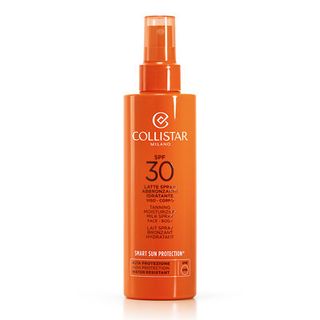
Collistar Tanning Moisturizing Milk Spray Face-Body SPF30
Works for
2 of 2 advertised claims delivered
Sun protectionSPF 30 · 5 UV filtersBroad spectrum
This product offers a good level of protection against both UVB and UVA rays.
This sunscreen uses organic (so-called "chemical") sunscreen filters. Organic, or "chemical" filters usually provide reliable sun protection and rarely leave a white cast. Sunscreens with organic filters can sting eyes.
This product can be considered "reef safe" because it does not contain the UV filters (oxybenzone and octinoxate) that can be harmful to coral reefs when present in the water in high concentrations.
Evens skin tone1 ingredient credited for this claimStrong support
“Contains the exclusive Unipertan, a special complex that accelerates and intensifies the skin pigmentation process.”
This product offers broad spectrum sun protection. It means that it can prevent hyperpigmentation and help keep the skin tone even (sun damage is the main factor causing age spots, darkening of post-acne marks and other discolorations).
Anti-agingNot advertised by the brand · 4 ingredients credited for this claimStrong support
This product can help prevent early signs of skin aging because it offers a good level of broad spectrum sun protection. Sun damage is the main cause of premature skin aging, and protecting your skin from the sun is the best anti-aging strategy.
These ingredients in the product might also be helpful for reducing and preventing fine lines, wrinkles, and skin elasticity, even though there is no conclusive evidence for their effectiveness: adenosine triphosphate.
MoisturizingNot advertised by the brand · 15 ingredients credited for this claimGood support
This product can help improve hydration of the skin with the two types of ingredients.
The first type is called “humectants”:
these ingredients help attract water.
When humectants are on the surface of the skin, they “pull in” the moisture from the outside environment, or from
within deeper layers of the skin. The following ingredients in this product do the job:
arginine, glycerin.
This product also contains ingredients called “occlusives”. They help reduce the speed with which our skin loses moisture to the outside environment. These ingredients also help soften the upper layer of the skin, so it feels less tight and nicer to the touch. The following ingredients in this product do the job: arginine, helianthus annuus seed oil.
Can it cause trouble?
Irritancy9 strong irritants: Parfum, Alpha-isomethyl ionone + 7 more — patch-test recommendedHigh risk
ComedogenicClean of flagged comedogenic ingredientsNone flagged
User reviews
Be the first — your take helps the next person decide.
Ingredients
Filter by role to see what each ingredient is doing.
Water~45–55%
Dibutyl adipate~5.9–7.2%
- Irritation risk
- Low
Helps soften the upper layer of the skin and create a nice product consistency
More about Dibutyl adipateDiethylamino hydroxybenzoyl hexyl benzoate~4.4–5.4%
- Irritation risk
- Medium
Uvinul A Plus. A new generation broad spectrum sunscreen that offers an effective protection especially in the UVA range. It is stable in formulations. Unfortunately, is not approved by the FDA (US) yet
More about Diethylamino hydroxybenzoyl hexyl benzoateEthylhexyl salicylate~3.5–4.3%
- Irritation risk
- Low
Octisalate. A UV filter. It offers some protection against the sun rays that cause sunburn (UVB), but does not protect against the most aging sun rays (UVA). It loses its effectiveness quickly when exposed to sunlight. It is an organic, or so called "chemical" sunscreen
More about Ethylhexyl salicylateBis-ethylhexyloxyphenol methoxyphenyl triazine~3–3.7%
- Irritation risk
- Medium
Tinosorb S. One of the most effective broad spectrum sunscreen ingredients. Protects from both UVA and UVB rays. It is photostable. Unfortunately, not approved by FDA (US) yet.
More about Bis-ethylhexyloxyphenol methoxyphenyl triazineGlycerin~2–2.4%
- Irritation risk
- Low
One of the best moisturizing ingredients. Naturally present in skin. It attracts water to the upper layer of the skin working as a humectant
More about GlycerinPentylene glycol~1.7–2%
- Irritation risk
- Medium
Used to preserve products, dissolve other ingredients and create a nice product texture
More about Pentylene glycolDiethylhexyl butamido triazone~2–2.4%
- Irritation risk
- Medium
Uvasorb HEB. A UV filter. Is effective against UVB and UVA II rays (but not UVA I). It is photostable. Unfortunately, is not approved by FDA (US) yet
More about Diethylhexyl butamido triazonePolyester-5~1.2–1.5%
- Irritation risk
- Low
C15-19 alkane~0.8–1.2%
- Irritation risk
- Low
Helps soften the upper layer of the skin and create a nice product texture
More about C15-19 alkaneEthylhexyl triazone~1.1–1.3%
- Irritation risk
- Medium
Uvinul T. A UV filter. Effective against UVB rays. It is photostable. Can increase water resistance properties of the sunscreen. Unfortunately, not approved by the FDA (US) yet
More about Ethylhexyl triazoneDicaprylyl ether~0.55–0.8%
- Irritation risk
- Low
Helps soften the upper layer of the skin while creating a non-greasy feel on the skin. Helps to dissolve other ingredients
More about Dicaprylyl etherAcrylates/c12-22 alkyl methacrylate copolymer~0.45–0.7%
- Irritation risk
- Low
Phenoxyethanol~0.35–0.65%
- Irritation risk
- Low
A preservative. It helps prevent bacterial growth in cosmetic products
More about PhenoxyethanolPolyglyceryl-3 cocoate~0.35–0.65%
- Irritation risk
- Medium
Helps oil and water mix together
More about Polyglyceryl-3 cocoate1,2-hexanediol~0.3–0.55%
Potassium cetyl phosphate~0.3–0.6%
- Irritation risk
- Medium
Helps oil and water mix together
More about Potassium cetyl phosphateSodium stearoyl glutamate~0.3–0.6%
- Irritation risk
- Medium
Helps oil and water mix together
More about Sodium stearoyl glutamateParfum~0.2–0.4%
- Irritation risk
- High
An aromatic blend of unspecified and possibly irritating ingredients
More about ParfumAcrylates/beheneth-25 methacrylate copolymer~0.2–0.4%
- Irritation risk
- Low
Hydroxyacetophenone~0.2–0.35%
Caprylyl glycol~0.2–0.4%
- Irritation risk
- Medium
Helps preserve products and creates a nice product texture
More about Caprylyl glycolChlorphenesin~0.15–0.3%
Polyacrylate crosspolymer-6~0.2–0.35%
- Irritation risk
- Low
Arginine~0.15–0.3%
- Irritation risk
- Low
An amino acid that is naturally present in skin and helps keep it hydrated. When used together with AHAs, it can reduce their irritating effect on the skin
More about ArginineCoco-glucoside~0.25–0.45%
- Irritation risk
- High
Used as a cleansing agent (surfactant) in cleansers. Helps water and oil mix together in lotions. Can be irritating
More about Coco-glucosideTetrasodium glutamate diacetate~0.15–0.3%
- Irritation risk
- Low
Helps stabilize the product formulation
More about Tetrasodium glutamate diacetateLecithin~0.2–0.4%
- Irritation risk
- Low
Used mostly for creating emulsions - helping oil and water mix together. Helps soften the upper layer of the skin
More about LecithinSodium hydroxide~0.2–0.35%
Disodium lauryl sulfosuccinate~0.25–0.45%
- Irritation risk
- Medium
Used as a cleansing agent. Helps water and oil mix together
More about Disodium lauryl sulfosuccinateButylene glycol~0.2–0.35%
- Irritation risk
- Low
Used to create a nice product texture and help delivery of other ingredients. Might be somewhat helpful in attracting water to the upper layer of the skin
More about Butylene glycolEctoin~0.15–0.3%
- Irritation risk
- Low
Softens the upper layer of the skin and can support skin barrier function
More about EctoinAcetyl tyrosine~0.15–0.3%
- Irritation risk
- Low
Tocopherol~0.2–0.35%
- Irritation risk
- Low
Pure form of vitamin E. Can help moisturise and protect the skin from free radicals. Often used to help stabilise other ingredients or the formula itself
More about TocopherolCanola oil~0.2–0.4%
- Irritation risk
- Medium
A plant oil that can help soften the upper layer of the skin
More about Canola oilAscorbyl palmitate~0.2–0.35%
- Irritation risk
- Medium
Being a lipid soluble form of vitamin C, it is more stable and can penetrate the skin better than L-Ascorbic acid. It is effective in protecting the skin from free radicals, as well as evening the skin tone, but is less effective in stimulating collagen production compared to L-Ascorbic acid.
More about Ascorbyl palmitateHydrolyzed vegetable protein~0.15–0.3%
Adenosine triphosphate~0.15–0.3%
Citric acid~0.2–0.35%
- Irritation risk
- Medium
Can work as an exfoliant but is typically used to adjust the product pH
More about Citric acidRiboflavin~0.15–0.3%
- Irritation risk
- Low
Caprylic/capric triglyceride~0.25–0.45%
- Irritation risk
- Medium
A good mix of fatty acids that forms a protective layer on the skin. Improves the shelf life of products. Derived from coconut and glycerin
More about Caprylic/capric triglycerideDaucus carota sativa root extract~0.15–0.3%
- Irritation risk
- Low
Carrot extract. Might have anti-oxidant properties and be used to add orange color
More about Daucus carota sativa root extractDaucus carota sativa seed oil~0.2–0.4%
- Irritation risk
- Low
A plant oil that might help neutralize free radicals and have an anti-bacterial effect
More about Daucus carota sativa seed oilAscorbyl tetraisopalmitate~0.2–0.4%
- Irritation risk
- Medium
A vitamin C derivative. Studies show that is might be effective in reducing hyperpigmentation, but there are no studies confirming that it is effectively converted into the bioavailable form of Vitamin C in skin. It is not clear how this derivative compares in effectiveness to the topical application of bioavailable form of vitamin C (L-ascorbic acid)
More about Ascorbyl tetraisopalmitateCarbomer~0.2–0.35%
- Irritation risk
- Low
Helps create a thicker or gel-like product texture. It is not a surfactant but can be used in gentle cleansing formulations
More about CarbomerTocopheryl acetate~0.2–0.35%
- Irritation risk
- Medium
A more stable but less bio-available form of vitamin E compared to Tocopherol. Might help moisturize and protect the skin from free radicals, but mostly used in low concentrations to stabilize other ingredients.
More about Tocopheryl acetateHelianthus annuus seed oil~0.2–0.4%
- Irritation risk
- Low
A great emollient due to its high linoleic acid content. One of the most effective plant oils in helping skin hydration and repairing skin barrier function
More about Helianthus annuus seed oilBeta-carotene~0.2–0.35%
Dna~0.2–0.35%
- Irritation risk
- Low
Alpha-isomethyl ionone~0.15–0.3%
- Irritation risk
- High
A fragrance. Potential allergen and can be irritating
More about Alpha-isomethyl iononeBenzyl salicylate~0.15–0.3%
Citronellol~0.15–0.25%
Eugenol~0.15–0.25%
Geraniol~0.15–0.25%
Hydroxycitronellal~0.15–0.25%
- Irritation risk
- High
A fragrance. A likely allergen and can be irritating
More about HydroxycitronellalLimonene~0.1–0.15%
- Irritation risk
- High
A common frangrance that can easily irritate skin, especially if exposed to air, light or heat
More about LimoneneLinalool~0.1–0.15%
Ingredient list view
Water, Dibutyl adipate, Diethylamino hydroxybenzoyl hexyl benzoate, Ethylhexyl salicylate, Bis-ethylhexyloxyphenol methoxyphenyl triazine, Glycerin, Pentylene glycol, Diethylhexyl butamido triazone, Polyester-5, C15-19 alkane, Ethylhexyl triazone, Dicaprylyl ether, Acrylates/c12-22 alkyl methacrylate copolymer, Phenoxyethanol, Polyglyceryl-3 cocoate, 1,2-hexanediol, Potassium cetyl phosphate, Sodium stearoyl glutamate, Parfum, Acrylates/beheneth-25 methacrylate copolymer, Hydroxyacetophenone, Caprylyl glycol, Chlorphenesin, Polyacrylate crosspolymer-6, Arginine, Coco-glucoside, Tetrasodium glutamate diacetate, Lecithin, Sodium hydroxide, Disodium lauryl sulfosuccinate, Butylene glycol, Ectoin, Acetyl tyrosine, Tocopherol, Canola oil, Ascorbyl palmitate, Hydrolyzed vegetable protein, Adenosine triphosphate, Citric acid, Riboflavin, Caprylic/capric triglyceride, Daucus carota sativa root extract, Daucus carota sativa seed oil, Ascorbyl tetraisopalmitate, Carbomer, Tocopheryl acetate, Helianthus annuus seed oil, Beta-carotene, Dna, Alpha-isomethyl ionone, Benzyl salicylate, Citronellol, Eugenol, Geraniol, Hydroxycitronellal, Limonene, Linalool
Compare prices
Retailers ranked by price — lowest first.
Product summary
Based on the ingredient list, we assess that this product can provide reliable sun protection. We love that it can protect from both UVA and UVB rays (not all sunscreens with SPF ratings give UVA protection. UVA rays do not cause sunburn, but still damage our skin and lead to early aging).
Because it includes good moisturizing ingredients, it can also work as a hydrating day cream. Like all broad-spectrum sunscreens, this product helps prevent early signs of aging.
Sunscreen filters
This is a so-called "chemical" sunscreen. It means that it uses organic UV filters. They typically offer good sun protection and rarely leave a white cast, but they can be irritating for some people with sensitive skin. These are the sun protection ingredients in this sunscreen: tinosorb s 3.00% - 3.70%, uvinul a plus 4.40% - 5.40%, uvasorb heb 2.00% - 2.40%, octisalate 3.50% - 4.30% and uvinul t 1.10% - 1.30%.
Irritation risk
There are quite a few common irritants in this product, including ingredients without particular skin benefits. We would not recommend it for sensitive skin. We assess the overall irritancy of this sunscreen to be high. For a detailed overview of all potential irritants: click here
You can see the detailed formula review with the breakdown of all actives in the product and the full ingredient list with estimated concentrations in the tables below.
Price
The product retails from 28.80£ up to 32.83£ in the United Kingdom.
For a detailed price comparison: click here.
Sources cited in this review
Every concentration estimate and effectiveness label is anchored to one of these 17 studies and safety reviews.
- 1
- 2
- 3
- 4Allergen of the Year—Alkyl Glucosidepracticeupdate.com
- 5Vitamin E in dermatologyncbi.nlm.nih.gov
- 6Vitamin E and Skin Healthlpi.oregonstate.edu

Affiliate links · As an Amazon Associate, WIMJ earns from qualifying purchases.