Works for
1 of 1 advertised claim delivered
Moisturizing11 ingredients credited for this claimGood support
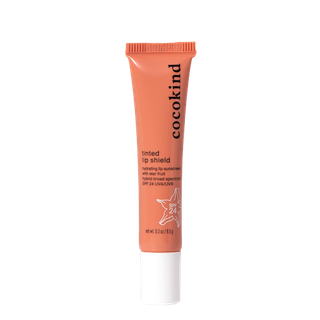
“this lip SPF protects against both UVA and UVB rays while providing a flattering tin t. a ntioxidant-rich starfruit moisturizes and adds an extra layer of protection.”
This product can help improve hydration of the skin with the two types of ingredients.
The first type is called “humectants”:
these ingredients help attract water.
When humectants are on the surface of the skin, they “pull in” the moisture from the outside environment, or from
within deeper layers of the skin. The following ingredients in this product do the job:
glycerin.
This product also contains ingredients called “occlusives”. They help reduce the speed with which our skin loses moisture to the outside environment. These ingredients also help soften the upper layer of the skin, so it feels less tight and nicer to the touch. The following ingredients in this product do the job: cocos nucifera oil, helianthus annuus seed oil.
Can it cause trouble?
Irritancy1 strong irritant: ParfumMedium risk
Comedogenic2 ingredients rated 2 or more on the 0–5 pore-clogging scale2 flagged
User reviews
Be the first — your take helps the next person decide.
Ingredients
Filter by role to see what each ingredient is doing.
Zinc oxide5.6%
- Irritation risk
- Low
A broad spectrum sunblock (protects from both UVA and UVB rays). Is suitable for most sensitive skins. In small concentrations, can be used as a colorant
More about Zinc oxideHomosalate8%
- Irritation risk
- Medium
A weak sunscreen that offers some protection against the sun rays that cause sunburn (UVB), but does not offer meaningful protection against protect against the most aging sun rays (UVA). It loses its effectiveness quickly when exposed to sunlight. It is an organic, or so called "chemical" sunscreen. When used in low concentrations, helps to stabilize the product formulation
More about HomosalateHelianthus annuus seed oil~23–34%
- Irritation risk
- Low
A great emollient due to its high linoleic acid content. One of the most effective plant oils in helping skin hydration and repairing skin barrier function
More about Helianthus annuus seed oilRicinus communis seed oil~4.7–7.1%
- Irritation risk
- Medium
A plant oil that can help soften the skin. It might be helpful in calming down inflammation, but solid research is lacking. Is often used in lip products to create the needed product consistency
More about Ricinus communis seed oilCocos nucifera oil~3.8–5.6%
- Irritation risk
- Low
- Comedogenicity
- 3/5
An emollient. Found to be as effective as a moisturizer for dry skin as mineral oil. Could be comedogenic
More about Cocos nucifera oilPolyhydroxystearic acid~2.5–3.7%
- Irritation risk
- Medium
Used to create a thicker product consistency and stabilize the formulation
More about Polyhydroxystearic acidSimmondsia chinensis seed oil~2.2–3.3%
- Irritation risk
- Medium
Softens the upper layer of skin and helps restore the healthy skin barrier. Has shown to help calm down inflammation in skin. It is a stable oil, meaning that it retains its properties even when exposed to air.
More about Simmondsia chinensis seed oilEuphorbia cerifera wax~2.1–3.2%
- Irritation risk
- Low
Butyrospermum parkii nut extract~1.5–2.2%
- Irritation risk
- Low
Squalane~1.3–2%
- Irritation risk
- Low
An oil naturally present in skin. Works as an emollient to soften the skin and form a protective layer on its surface without a greasy feeling.
More about SqualaneJojoba esters~1.1–1.6%
- Irritation risk
- Medium
An emollient made of jojoba oil. Helps soften the skin and support its barrier function
More about Jojoba estersRhus verniciflua peel wax~0.85–1.25%
- Irritation risk
- Low
Caprylic/capric triglyceride~0.55–1.3%
- Irritation risk
- Medium
A good mix of fatty acids that forms a protective layer on the skin. Improves the shelf life of products. Derived from coconut and glycerin
More about Caprylic/capric triglyceridePolyglyceryl-3 polyricinoleate~0.45–1%
- Irritation risk
- Medium
Helps oil and water mix together
More about Polyglyceryl-3 polyricinoleateIsostearic acid~0.45–1.05%
- Irritation risk
- Low
Used to create a nice product texture
More about Isostearic acidLecithin~0.35–0.85%
- Irritation risk
- Low
Used mostly for creating emulsions - helping oil and water mix together. Helps soften the upper layer of the skin
More about LecithinAscorbyl palmitate~0.3–0.75%
- Irritation risk
- Medium
Being a lipid soluble form of vitamin C, it is more stable and can penetrate the skin better than L-Ascorbic acid. It is effective in protecting the skin from free radicals, as well as evening the skin tone, but is less effective in stimulating collagen production compared to L-Ascorbic acid.
More about Ascorbyl palmitateGlycerin~0.35–0.8%
- Irritation risk
- Low
One of the best moisturizing ingredients. Naturally present in skin. It attracts water to the upper layer of the skin working as a humectant
More about GlycerinAverrhoa carambola fruit extract~0.2–0.8%
- Irritation risk
- Low
Tocopherol~0.2–0.75%
- Irritation risk
- Low
Pure form of vitamin E. Can help moisturise and protect the skin from free radicals. Often used to help stabilise other ingredients or the formula itself
More about TocopherolOctyldodecanol~0.15–0.65%
- Irritation risk
- Low
An emollient that helps to soften the skin and create a pleasant product texture and stabilize the formulation
More about OctyldodecanolSorbitan oleate~0.15–0.6%
- Irritation risk
- Medium
- Comedogenicity
- 2/5
Helps oil and water mix together
More about Sorbitan oleateAlumina~0.3–0.7%
- Irritation risk
- Low
The same compound that is used safely in dental implants and bone cements. In cosmetics, it is used to improve the consistency of products
More about AluminaMagnesium oxide~0.15–0.55%
- Irritation risk
- Low
Parfum~0.1–0.4%
- Irritation risk
- High
An aromatic blend of unspecified and possibly irritating ingredients
More about ParfumCi 77491~0.1–0.4%
- Irritation risk
- Low
A red colorant made of iron oxide. Typically is not irritating
More about Ci 77491Iron oxides~0.1–0.3%
- Irritation risk
- Low
An umbrella term for the following three colorants: CI 77491, CI 77492, CI 77499. They might be able to offer some protection against visible light, but the degree of the protection is not clear
More about Iron oxidesCi 77492~0.05–0.3%
Iron oxides~0.05–0.2%
- Irritation risk
- Low
An umbrella term for the following three colorants: CI 77491, CI 77492, CI 77499. They might be able to offer some protection against visible light, but the degree of the protection is not clear
More about Iron oxidesCi 77499~0.05–0.2%
Iron oxides~0.05–0.15%
- Irritation risk
- Low
An umbrella term for the following three colorants: CI 77491, CI 77492, CI 77499. They might be able to offer some protection against visible light, but the degree of the protection is not clear
More about Iron oxidesIngredient list view
Zinc oxide, Homosalate, Helianthus annuus seed oil, Ricinus communis seed oil, Cocos nucifera oil, Polyhydroxystearic acid, Simmondsia chinensis seed oil, Euphorbia cerifera wax, Butyrospermum parkii nut extract, Squalane, Jojoba esters, Rhus verniciflua peel wax, Caprylic/capric triglyceride, Polyglyceryl-3 polyricinoleate, Isostearic acid, Lecithin, Ascorbyl palmitate, Glycerin, Averrhoa carambola fruit extract, Tocopherol, Octyldodecanol, Sorbitan oleate, Alumina, Magnesium oxide, Parfum, Ci 77491, Iron oxides, Ci 77492, Iron oxides, Ci 77499, Iron oxides
Compare prices
Retailers ranked by price — lowest first.

Sources cited in this review
Every concentration estimate and effectiveness label is anchored to one of these 18 studies and safety reviews.
- 1A review of inorganic UV filters zinc oxide and titanium dioxideonlinelibrary.wiley.com
- 2
- 3
- 4
- 5
- 6

Affiliate links · As an Amazon Associate, WIMJ earns from qualifying purchases.