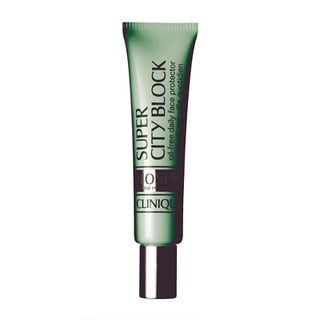
Clinique Super City Block SPF40
Works for
1 of 1 advertised claim delivered
Sun protectionSPF 40 · 4 UV filtersBroad spectrum
This product offers a good level of protection against both UVB and UVA rays.
This sunscreen uses organic (so-called "chemical") sunscreen filters. Organic, or "chemical" filters usually provide reliable sun protection and rarely leave a white cast. Sunscreens with organic filters can sting eyes.
Anti-agingNot advertised by the brand · 3 ingredients credited for this claimStrong support
This product can help prevent early signs of skin aging because it offers a good level of broad spectrum sun protection. Sun damage is the main cause of premature skin aging, and protecting your skin from the sun is the best anti-aging strategy.
Evens skin toneNot advertised by the brand · 4 ingredients credited for this claimStrong support
This product offers broad spectrum sun protection. It means that it can prevent hyperpigmentation and help keep the skin tone even (sun damage is the main factor causing age spots, darkening of post-acne marks and other discolorations).
MoisturizingNot advertised by the brand · 18 ingredients credited for this claimGood support
This product can help improve hydration of the skin with the two types of ingredients.
The first type is called “humectants”:
these ingredients help attract water.
When humectants are on the surface of the skin, they “pull in” the moisture from the outside environment, or from
within deeper layers of the skin. The following ingredients in this product do the job:
faex, saccharomyces lysate extract.
This product also contains ingredients called “occlusives”. They help reduce the speed with which our skin loses moisture to the outside environment. These ingredients also help soften the upper layer of the skin, so it feels less tight and nicer to the touch. The following ingredients in this product do the job: dimethicone, squalane.
Can it cause trouble?
Irritancy2 strong irritants: Citrus unshiu peel extract, Rosmarinus officinalis leaf extractMedium risk
Comedogenic1 ingredient rated 2 or more on the 0–5 pore-clogging scale1 flagged
User reviews
Be the first — your take helps the next person decide.
Ingredients
Filter by role to see what each ingredient is doing.
Ethylhexyl methoxycinnamate7.5%
- Irritation risk
- High
Octinoxate. When used in higher concentrations, works as a sunscreen protecting the skin from UVB rays. When used in lower concentration, helps to preserve the product formulation. Is shown to be harmful to coral reefs - consider avoiding bathing in coral reef areas when wearing a product with this ingredient. It can be irritating
More about Ethylhexyl methoxycinnamateEthylhexyl salicylate2%
- Irritation risk
- Low
Octisalate. A UV filter. It offers some protection against the sun rays that cause sunburn (UVB), but does not protect against the most aging sun rays (UVA). It loses its effectiveness quickly when exposed to sunlight. It is an organic, or so called "chemical" sunscreen
More about Ethylhexyl salicylateTitanium dioxide7.3%
- Irritation risk
- Low
Works as a UV filter when used in high concentrations. It is photostable and is effective mostly against the UVB light, with some protection in the UVA range. In small concentrations, used for its ability to improve the color of cosmetic products. Is usually well tolerated by the skin
More about Titanium dioxideZinc oxide9.6%
- Irritation risk
- Low
A broad spectrum sunblock (protects from both UVA and UVB rays). Is suitable for most sensitive skins. In small concentrations, can be used as a colorant
More about Zinc oxideWater~45–55%
Trioctyldodecyl citrate~7.1–8.7%
- Irritation risk
- Low
Butylene glycol~5.8–7%
- Irritation risk
- Low
Used to create a nice product texture and help delivery of other ingredients. Might be somewhat helpful in attracting water to the upper layer of the skin
More about Butylene glycolDimethicone~5.1–6.3%
- Irritation risk
- Low
A silicone that helps to reduce water loss from the surface of the skin. Can temporarily "fill in" lines and wrinkles, absorb oil, and create a nice product finish
More about DimethiconeOctyldodecyl neopentanoate~3.9–4.8%
- Irritation risk
- Low
An emollient that helps soften the skin. Often used to stabilize other ingredients, for example, sunscreen
More about Octyldodecyl neopentanoateSteareth-2~2.8–3.5%
Silica~2.5–3%
Rosa roxburghii fruit extract~1.9–2.4%
- Irritation risk
- Medium
A fruit extract that might help neutralize free radicals in skin, but evidence of effectiveness is missing
More about Rosa roxburghii fruit extractCitrus unshiu peel extract~1.7–2.1%
- Irritation risk
- High
Porphyra yezoensis extract~1.3–1.6%
- Irritation risk
- Low
- Comedogenicity
- 3/5
Helps attract water to the upper layer of the skin and might have some anti-oxidant properties
More about Porphyra yezoensis extractGlycyrrhiza glabra root extract~1–1.2%
- Irritation risk
- Medium
A plant extract that can help lighten the skin and calm down inflammation. Might be helpful in neutralizing free radicals
More about Glycyrrhiza glabra root extractSaccharomyces lysate extract~0.95–1.2%
- Irritation risk
- Low
Helps attract water to the upper layer of the skin. Can have some anti-inflammatory effect
More about Saccharomyces lysate extractCucumis sativus fruit extract~0.9–1.15%
- Irritation risk
- Medium
Might be somewhat helpful in reducing hyperpigmentation and neutralizing free radicals but its typical concentration in a product is too low for having an effect
More about Cucumis sativus fruit extractBetula alba bark extract~0.75–1.15%
- Irritation risk
- High
Has astringent properties. Creates a tightening and drying effect on the skin. Can be irritating
More about Betula alba bark extractHordeum vulgare extract~0.95–1.15%
- Irritation risk
- Medium
A plant extract that might have some anti-oxidant properties. Avoid if you are sensitive to gluten
More about Hordeum vulgare extractRosmarinus officinalis leaf extract~0.7–1.1%
- Irritation risk
- High
Can be helpful in reducing inflammation in skin, including inflamed acne. It can be irritating
More about Rosmarinus officinalis leaf extractHelianthus annuus seedcake~1–1.2%
Gentiana lutea root extract~0.7–1%
- Irritation risk
- Medium
A plant extract that can help strengthen the skin barrier function and improve skin moisture levels
More about Gentiana lutea root extractYeast extract~0.65–0.95%
- Irritation risk
- Low
Helps attract water to the upper layer of the skin and might have some anti-oxidant and skin lightening properties. It can help calm down inflammation in skin
More about Yeast extractFaex~0.6–0.9%
- Irritation risk
- Low
Yeast extract. Helps to attract water to the upper layer of the skin
More about FaexYeast extract~0.6–0.9%
- Irritation risk
- Low
Helps attract water to the upper layer of the skin and might have some anti-oxidant and skin lightening properties. It can help calm down inflammation in skin
More about Yeast extractSodium rna~0.6–0.9%
- Irritation risk
- Low
Is claimed to have anti-aging properties, but research about its effect in topical application is missing
More about Sodium rnaMagnesium ascorbyl phosphate~0.6–0.9%
- Irritation risk
- Medium
A derivative of vitamin C that is more stable, but less bioavailable than the pure form of vitamin C. It does not penetrate the skin well, but has been shown to convert to pure vitamin C once in skin. It can be helpful in stimulating collagen production and lightening the skin tone, but the required concentration is likely to be very high
More about Magnesium ascorbyl phosphateDipotassium glycyrrhizate~0.55–0.85%
- Irritation risk
- Low
A salt derived from licorice. Works as an emollient to soften the upper layer of the skin and can help calm down inflammation. Might be helpful for skin lightening
More about Dipotassium glycyrrhizateTocopheryl acetate~0.6–0.9%
- Irritation risk
- Medium
A more stable but less bio-available form of vitamin E compared to Tocopherol. Might help moisturize and protect the skin from free radicals, but mostly used in low concentrations to stabilize other ingredients.
More about Tocopheryl acetatePantethine~0.65–1%
- Irritation risk
- Low
Helps to hydrate the skin by improving its barrier funciton
More about PantethineSqualane~0.65–1%
- Irritation risk
- Low
An oil naturally present in skin. Works as an emollient to soften the skin and form a protective layer on its surface without a greasy feeling.
More about SqualanePolyglyceryl-6 polyricinoleate~0.6–0.9%
- Irritation risk
- Medium
Helps oil and water mix together
More about Polyglyceryl-6 polyricinoleatePropylene glycol dicaprate~0.65–1%
- Irritation risk
- Low
An emollient that helps soften the upper layer of the skin
More about Propylene glycol dicaprateChamomilla recutita flower extract~0.6–0.85%
- Irritation risk
- High
Plant extract that can have healing and anti-inflammatory properties. It is a potential allergen and can be irritating
More about Chamomilla recutita flower extractHexylene glycol~0.55–0.85%
- Irritation risk
- Medium
Helps create a more spreadable product texture
More about Hexylene glycolPeg/ppg-18/18 dimethicone~0.6–0.9%
- Irritation risk
- Low
A silicone that mixes with water creating nice light-weight product texture
More about Peg/ppg-18/18 dimethiconeCaprylyl glycol~0.6–0.9%
- Irritation risk
- Medium
Helps preserve products and creates a nice product texture
More about Caprylyl glycolBarium sulfate~0.6–0.85%
- Irritation risk
- Low
Polyethylene~0.8–1.15%
Magnesium aluminum silicate~0.6–0.85%
- Irritation risk
- Low
Might be helpful in restoring skin barrier function and, when combined with zinc carbonate and malonic acid, reducing fine lines and wrinkles by stimulating elastin production. Also helps stabilize the product formulation
More about Magnesium aluminum silicateLecithin~0.6–0.9%
- Irritation risk
- Low
Used mostly for creating emulsions - helping oil and water mix together. Helps soften the upper layer of the skin
More about LecithinCeteth-2~0.45–0.7%
Peg-40 stearate~0.5–0.7%
Sodium stearate~0.9–1.15%
Steareth-20~0.55–0.8%
Sorbitan tristearate~0.5–0.75%
- Irritation risk
- Medium
Helps oil and water mix together
More about Sorbitan tristearateIsopropyl titanium triisostearate~0.6–0.85%
- Irritation risk
- Medium
Helps water and oil mix together
More about Isopropyl titanium triisostearateXanthan gum~0.5–0.75%
- Irritation risk
- Low
Used to create a thicker product consistency
More about Xanthan gumStearic acid~0.6–0.9%
- Irritation risk
- Low
Helps oil and water mix together and works as an emollient
More about Stearic acidAluminum hydroxide~0.55–0.85%
- Irritation risk
- Low
Is used to add opaque (non-transparent) appearance to formulations. Can be used to coat other ingredients for even dispersion. This is a different ingredient compared to the ones used in antipersperants (aluminium chloride and aluminium chlorohydrate)
More about Aluminum hydroxideCitric acid~0.4–0.65%
- Irritation risk
- Medium
Can work as an exfoliant but is typically used to adjust the product pH
More about Citric acidDisodium edta~0.35–0.6%
Bht~0.3–0.55%
Phenoxyethanol~0.3–0.6%
- Irritation risk
- Low
A preservative. It helps prevent bacterial growth in cosmetic products
More about PhenoxyethanolMica~0.3–0.55%
- Irritation risk
- Low
Creates an illusion of smoother and more radiant skin tone. Adds shimmer to the skin by reflecting light
More about MicaIron oxides~0.15–0.3%
- Irritation risk
- Low
An umbrella term for the following three colorants: CI 77491, CI 77492, CI 77499. They might be able to offer some protection against visible light, but the degree of the protection is not clear
More about Iron oxidesTitanium dioxide~0.2–0.35%
- Irritation risk
- Low
Works as a UV filter when used in high concentrations. It is photostable and is effective mostly against the UVB light, with some protection in the UVA range. In small concentrations, used for its ability to improve the color of cosmetic products. Is usually well tolerated by the skin
More about Titanium dioxideIngredient list view
Ethylhexyl methoxycinnamate, Ethylhexyl salicylate, Titanium dioxide, Zinc oxide, Water, Trioctyldodecyl citrate, Butylene glycol, Dimethicone, Octyldodecyl neopentanoate, Steareth-2, Silica, Rosa roxburghii fruit extract, Citrus unshiu peel extract, Porphyra yezoensis extract, Glycyrrhiza glabra root extract, Saccharomyces lysate extract, Cucumis sativus fruit extract, Betula alba bark extract, Hordeum vulgare extract, Rosmarinus officinalis leaf extract, Helianthus annuus seedcake, Gentiana lutea root extract, Yeast extract, Faex, Yeast extract, Sodium rna, Magnesium ascorbyl phosphate, Dipotassium glycyrrhizate, Tocopheryl acetate, Pantethine, Squalane, Polyglyceryl-6 polyricinoleate, Propylene glycol dicaprate, Chamomilla recutita flower extract, Hexylene glycol, Peg/ppg-18/18 dimethicone, Caprylyl glycol, Barium sulfate, Polyethylene, Magnesium aluminum silicate, Lecithin, Ceteth-2, Peg-40 stearate, Sodium stearate, Steareth-20, Sorbitan tristearate, Isopropyl titanium triisostearate, Xanthan gum, Stearic acid, Aluminum hydroxide, Citric acid, Disodium edta, Bht, Phenoxyethanol, Mica, Iron oxides, Titanium dioxide
Compare prices
Retailers ranked by price — lowest first.
Affiliate links · prices updated regularly · As an Amazon Associate, WIMJ earns from qualifying purchases.
Product summary
The ingredient list suggests that this product can provide reliable sun protection. It can protect from both UVA and UVB rays. This is great news because not all sunscreens with SPF ratings give UVA protection. (UVA rays do not cause sunburn, but still damage our skin and lead to early aging).
Because it includes good moisturizing ingredients, it can also work as a hydrating day cream. Like all broad-spectrum sunscreens, this product has an anti-aging benefit.
Sunscreen filters
This is a "mixed" sunscreen in the sense that it uses both mineral and organic (so-called "chemical") sun filters. Here are the organic filters this product uses: octinoxate and octisalate. As for the mineral filters, this sunscreen uses both octinoxate and octisalate.
Irritation risk
There are some common irritants in this product, including ingredients that do not have benefits for the skin. We assess the overall irritancy of this sunscreen to be medium. For a detailed overview of all potential irritants: click here
You can see the detailed formula review with the breakdown of all actives in the product and the full ingredient list with estimated concentrations in the tables below.
Price
The product retails for 21.00£ in the United Kingdom.
For a detailed price comparison: click here.
Sources cited in this review
Every concentration estimate and effectiveness label is anchored to one of these 29 studies and safety reviews.
- 1A review of inorganic UV filters zinc oxide and titanium dioxideonlinelibrary.wiley.com
- 2
- 3
- 4
- 5
- 6

Affiliate links · As an Amazon Associate, WIMJ earns from qualifying purchases.