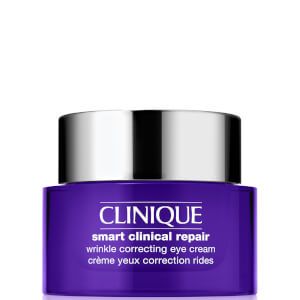
Clinique Smart Clinical Repair Wrinkle Correcting Eye Cream
Works for
2 of 2 advertised claims delivered
Moisturizing43 ingredients credited for this claimStrong support
“Smart Clinical Repair™ Wrinkle Correcting Eye Cream reduces the appearance of lines and wrinkles caused by your face's daily micro-movements, delivers rapid and long-lasting, smoothing hydration, visibly calms and soothes skin, and helps visibly depuff the eye area by gently massaging into skin.”
This product can help improve hydration of the skin with the two types of ingredients.
The first type is called “humectants”:
these ingredients help attract water.
When humectants are on the surface of the skin, they “pull in” the moisture from the outside environment, or from
within deeper layers of the skin. The following ingredients in this product do the job:
glycerin, glyceryl acrylate/acrylic acid copolymer.
This product also contains ingredients called “occlusives”. They help reduce the speed with which our skin loses moisture to the outside environment. These ingredients also help soften the upper layer of the skin, so it feels less tight and nicer to the touch. The following ingredients in this product do the job: butyrospermum parkii butter, cera alba.
The following ingredients in this product are especially good for supporting the skin barrier and helping with the hydration level: acetyl glucosamine, acetyl hexapeptide-8, acetyl octapeptide-3, palmitoyl hexapeptide-12, palmitoyl tetrapeptide-7, palmitoyl tripeptide-1
Anti-aging12 ingredients credited for this claimStrong support
“What it is: A wrinkle-fighting eye cream engineered to fortify and visibly smooth delicate eye-area skin.”
This product can help reduce and prevent fine lines and wrinkles, improve skin elasticity and firmness because it contains acetyl glucosamine, palmitoyl hexapeptide-12.
These ingredients in the product can also be helpful, even though there is less evidence for their effectiveness: acetyl hexapeptide-8, acetyl octapeptide-3, palmitoyl tetrapeptide-7, palmitoyl tripeptide-1.
Keep in mind that it typically takes at least 6 weeks to notice any results because the changes that are needed to improve fine lines and elasticity happen in the deeper layers of the skin. No topical anti-aging product can “erase” wrinkles or fully reverse signs of aging.
Evens skin toneNot advertised by the brand · 5 ingredients credited for this claimStrong support
This product can help reduce hypepigmentation and even out the skin tone because it contains the following effective ingredients: acetyl glucosamine
The following ingredient (ingredients) in this product might be helpful, but there is no evidence to confirm that it actually can help even out the skin tone: glycine soja seed extract.
Keep in mind that you would need to apply any topical skincare targetted at hypigmentation consistently for a couple of months to get a result. No topical skincare product can help get rid of hyperpigmentation (including post-acne marks and age spots) instantly.
Anti-oxidationNot advertised by the brand · 13 ingredients credited for this claimModerate support
This product contains antioxidants (camellia sinensis leaf extract) that might be able to help neutralize free radicals in skin to lessen the damage it gets from the UV light (sun). There is not enough evidence to confirm their effectiveness in skin though.
Can it cause trouble?
Irritancy1 strong irritant: Gelidiella acerosa extractMedium risk
Comedogenic4 ingredients rated 2 or more on the 0–5 pore-clogging scale4 flagged
User reviews
Be the first — your take helps the next person decide.
Ingredients
Filter by role to see what each ingredient is doing.
Water~45–55%
Tridecyl trimellitate~5.6–6.9%
- Irritation risk
- Medium
Used to create a thicker product consistency and soften the upper layer of the skin
More about Tridecyl trimellitateGlycerin~4.4–5.4%
- Irritation risk
- Low
One of the best moisturizing ingredients. Naturally present in skin. It attracts water to the upper layer of the skin working as a humectant
More about GlycerinNeopentyl glycol diethylhexanoate~3.5–4.2%
- Irritation risk
- Low
Polyglyceryl-6 distearate~2.6–3.1%
- Irritation risk
- Medium
Helps oil and water mix together while softening the upper layer of the skin
More about Polyglyceryl-6 distearateGlyceryl behenate~2.3–2.8%
- Irritation risk
- Medium
Used to create a thicker product consistency and help soften the upper layer of the skin
More about Glyceryl behenateMangifera indica seed butter~1.9–2.3%
- Irritation risk
- Low
Helps to soften the upper layer of the skin and might have some anti-oxidant effect
More about Mangifera indica seed butterPropanediol~1.6–2%
- Irritation risk
- Low
Acts as a solvent for other ingredients. Speeds up the absorption of other ingredients into the skin
More about PropanediolButyrospermum parkii butter~1.4–1.7%
- Irritation risk
- Low
- Comedogenicity
- 3/5
A great moisturising ingredient that softens the skin and reduces water loss from its upper layer. It also can be helpful in protecting skin from free radicals
More about Butyrospermum parkii butterCetearyl wheat straw glycosides~1.1–1.3%
- Irritation risk
- Medium
Helps water and oil mix together. Avoid if sensitive to gluten
More about Cetearyl wheat straw glycosidesHypnea musciformis extract~0.9–1.1%
- Irritation risk
- Low
- Comedogenicity
- 3/5
Might help to attract water to the upper layer of the skin
More about Hypnea musciformis extractGelidiella acerosa extract~0.7–1.05%
- Irritation risk
- High
An algae extract that can help attract water to the upper layer of the skin and have some anti-oxidant properties
More about Gelidiella acerosa extractPolygonum cuspidatum root extract~0.65–1%
- Irritation risk
- Medium
A plant extract that can contain resveratrol, an antioxidant that can help neutralize free radicals in skin. The effectiveness depends on the extract quality and concentration in the product
More about Polygonum cuspidatum root extractLaminaria digitata extract~0.6–0.9%
- Irritation risk
- Low
- Comedogenicity
- 3/5
Seaweed extract that helps the skin to attract water and make it more smooth for touch. Also shows promise of anti-aging properties, but good research is lacking at the moment
More about Laminaria digitata extractSaccharomyces lysate extract~0.55–0.85%
- Irritation risk
- Low
Helps attract water to the upper layer of the skin. Can have some anti-inflammatory effect
More about Saccharomyces lysate extractCamellia sinensis leaf extract~0.6–0.9%
- Irritation risk
- Low
Can contain potent anti-oxidant compounds (abbreviated ECG, GCG, EGC, and EGCG) that might help protect the skin from free radicals. Can help calm down inflammation and has some anti-bacterial properties. Unfortunately, these antioxidants are unstable and lose their effectiveness very quickly in products. The concentration of the antioxidant compounds in the extract also tends to be low to be effective in topical formulation
More about Camellia sinensis leaf extractSigesbeckia orientalis extract~0.55–0.8%
- Irritation risk
- Medium
A plant extract that can contain an anti-inflammatory compound
More about Sigesbeckia orientalis extractWhey protein~0.55–0.85%
- Irritation risk
- Low
A protein derived from milk. In skincare products, might help to soften the upper layer of the skin
More about Whey proteinPrunus amygdalus dulcis seed extract~0.5–0.75%
- Irritation risk
- Low
Almond extract (oil) - helps soften the upper layer of the skin
More about Prunus amygdalus dulcis seed extractAcetyl hexapeptide-8~0.45–0.7%
- Irritation risk
- Low
A type of peptide. Peptides are excellent moisturizers and might be able support collagen production reducing fine lines and wrinkles
More about Acetyl hexapeptide-8Acetyl octapeptide-3~0.45–0.65%
- Irritation risk
- Low
A type of peptide. Peptides are excellent moisturizers and might be able support collagen production reducing fine lines and wrinkles
More about Acetyl octapeptide-3Palmitoyl tripeptide-1~0.5–0.75%
- Irritation risk
- Low
A type of peptide. Peptides are excellent moisturizers and might be able support collagen production reducing fine lines and wrinkles
More about Palmitoyl tripeptide-1Palmitoyl tetrapeptide-7~0.45–0.7%
- Irritation risk
- Low
A type of peptide. Peptides are excellent moisturizers and might be able support collagen production reducing fine lines and wrinkles
More about Palmitoyl tetrapeptide-7Palmitoyl hexapeptide-12~0.45–0.65%
- Irritation risk
- Low
A type of peptide. Peptides are excellent moisturizers and might be able support collagen production reducing fine lines and wrinkles
More about Palmitoyl hexapeptide-12Phytosteryl/isostearyl/cetyl/stearyl/behenyl dimer dilinoleate~0.45–0.7%
- Irritation risk
- Low
Helps soften the upper layer of the skin and create a nice product consistency
More about Phytosteryl/isostearyl/cetyl/stearyl/behenyl dimer dilinoleateLactobacillus ferment~0.4–0.65%
- Irritation risk
- Low
A fermentation product created by bacteria Lactobacillus. The fermented product has anti-bacterial properties and might be helpful in calming down inflammation, but studies are lacking. Helps attract water to the upper layer of the skin. Can be used as a preservative
More about Lactobacillus fermentSodium hyaluronate~0.45–0.65%
- Irritation risk
- Low
One of the best moisturizing ingredients. Attracts water into the upper layer of the skin
More about Sodium hyaluronateTocopheryl acetate~0.45–0.65%
- Irritation risk
- Medium
A more stable but less bio-available form of vitamin E compared to Tocopherol. Might help moisturize and protect the skin from free radicals, but mostly used in low concentrations to stabilize other ingredients.
More about Tocopheryl acetateButylene glycol~0.45–0.65%
- Irritation risk
- Low
Used to create a nice product texture and help delivery of other ingredients. Might be somewhat helpful in attracting water to the upper layer of the skin
More about Butylene glycolCetearyl alcohol~0.5–0.75%
- Irritation risk
- Low
- Comedogenicity
- 2/5
A non-drying alcohol. Works as an emollient. Helps water and oil mix together and creates a nice product texture
More about Cetearyl alcoholCaffeine~0.4–0.65%
- Irritation risk
- Medium
Might be helpful in neutralizing free radicals. Can have a dehydration effect that might somewhat decrease the look of puffy eyes
More about CaffeineTetrahexyldecyl ascorbate~0.45–0.65%
- Irritation risk
- Medium
Being a lipid soluble form of vitamin C, it is more stable than ascorbic acid, but still degrades quickly and needs to be stabilized in a formulation with another ingredient. It is claimed to penetrate skin better than pure vitamin C and have the the similar benefits, but solid studies of its effectiveness are lacking. Is likely to require a higher concentration in a product than pure vitamin C to be effective. It might be able to help reduce pore clogging.
More about Tetrahexyldecyl ascorbateSucrose~0.4–0.6%
- Irritation risk
- Low
Can help attract water to the upper layer of the skin. In crystal form, it can work as a gentle exfoliant, gentler than the salt scrub. Helps stabilize the emulsion
More about SucroseAcetyl glucosamine~0.4–0.65%
- Irritation risk
- Low
An effective moisturizing ingredient that also has been shown to be effective in evening out the skin tone and reducing hyperpigmentation. It can help somewhat reduce wrinkles in skin
More about Acetyl glucosamineDipotassium glycyrrhizate~0.4–0.65%
- Irritation risk
- Low
A salt derived from licorice. Works as an emollient to soften the upper layer of the skin and can help calm down inflammation. Might be helpful for skin lightening
More about Dipotassium glycyrrhizateArachidyl glucoside~0.45–0.7%
Jojoba esters~0.45–0.7%
- Irritation risk
- Medium
An emollient made of jojoba oil. Helps soften the skin and support its barrier function
More about Jojoba estersTridecyl stearate~0.45–0.7%
- Irritation risk
- Medium
Used to create a thicker product consistency and soften the upper layer of the skin
More about Tridecyl stearateDipentaerythrityl hexacaprylate/hexacaprate~0.45–0.7%
- Irritation risk
- Low
Saccharum officinarum extract~0.4–0.65%
- Irritation risk
- Low
Sugar extract that helps attract water to the upper layer of the skin
More about Saccharum officinarum extractTrehalose~0.45–0.65%
- Irritation risk
- Low
A sugar that attracts water to the upper layer of the skin
More about TrehaloseEthylhexylglycerin~0.45–0.65%
Cholesterol~0.5–0.75%
- Irritation risk
- Low
An emollient that is naturally found in skin
More about CholesterolBisabolol~0.35–0.65%
- Irritation risk
- Low
An active component of chamomile plant that historically has been used to calm down irritated skin. A recent study shows that bisabolol indeed can have some anti-inflammatory effect on skin, even though conclusive data is lacking. Bisabolol has a sweet floral scent and can be added to products for its aromatic properties
More about BisabololPeg-8~0.45–0.65%
- Irritation risk
- Medium
Used to create a nice product consistency
More about Peg-8Cera alba~0.55–0.8%
- Irritation risk
- Medium
Forms a protective barrier that holds water and keeps dry skin hydrated. Keeps an emulsion from separating into its oil and liquid components, and increases the thickness of a product. Can be an allergen
More about Cera albaGlyceryl acrylate/acrylic acid copolymer~0.45–0.65%
- Irritation risk
- Medium
Helps attract water to the upper layer of the skin and provide a longer-lasting hydration. Can create a thicker product consistency
More about Glyceryl acrylate/acrylic acid copolymerGlycine soja seed extract~0.45–0.7%
- Irritation risk
- Medium
An emollient that helps soften the skin. Might be somewhat helpful in evening the skin tone.
More about Glycine soja seed extractCaprylyl glycol~0.45–0.7%
- Irritation risk
- Medium
Helps preserve products and creates a nice product texture
More about Caprylyl glycolTocopherol~0.45–0.65%
- Irritation risk
- Low
Pure form of vitamin E. Can help moisturise and protect the skin from free radicals. Often used to help stabilise other ingredients or the formula itself
More about TocopherolNylon-12~0.45–0.7%
Potassium cetyl phosphate~0.45–0.7%
- Irritation risk
- Medium
Helps oil and water mix together
More about Potassium cetyl phosphateGlyceryl polymethacrylate~0.45–0.7%
- Irritation risk
- Low
Used to create a nice product texture
More about Glyceryl polymethacrylateAcrylates/c10-30 alkyl acrylate crosspolymer~0.45–0.65%
- Irritation risk
- Medium
Maintains the texture of skincare products. Allows the product to spread evenly. Helps oil and water mix together
More about Acrylates/c10-30 alkyl acrylate crosspolymerAmmonium acryloyldimethyltaurate/vp copolymer~0.45–0.65%
- Irritation risk
- Low
Increases thickness of a product. Texture enhancer for oil-in-water emulsions
More about Ammonium acryloyldimethyltaurate/vp copolymerArachidyl alcohol~0.45–0.7%
- Irritation risk
- Low
Used to soften the upper layer of the skin and create a thicker product consistency
More about Arachidyl alcoholCetyl alcohol~0.45–0.7%
- Irritation risk
- Low
A non-drying alcohol that works to soften the skin and stabilize product formulations helping oil and water mix together
More about Cetyl alcoholPolyglyceryl-3 beeswax~0.45–0.65%
- Irritation risk
- Medium
Helps water and oil mix together. Could be an allergen (beeswax)
More about Polyglyceryl-3 beeswaxBehenyl alcohol~0.45–0.7%
- Irritation risk
- Low
Non-drying alcohol that helps water and oil mix together. Also serves as an emollient
More about Behenyl alcoholGlyceryl stearate~0.45–0.65%
- Irritation risk
- Low
An emollient that softens the skin and forms a protective layer on its surface. Helps water and oil mix together
More about Glyceryl stearateStearic acid~0.5–0.75%
- Irritation risk
- Low
Helps oil and water mix together and works as an emollient
More about Stearic acidCarbomer~0.3–0.55%
- Irritation risk
- Low
Helps create a thicker or gel-like product texture. It is not a surfactant but can be used in gentle cleansing formulations
More about CarbomerPolysorbate 20~0.3–0.6%
Sodium hydroxide~0.25–0.5%
Bht~0.2–0.35%
Disodium edta~0.2–0.35%
Sodium citrate~0.15–0.3%
- Irritation risk
- Medium
Helps to control the skin's pH level. Maintains the skin's natural film of amino-lactic acids and oils. Helps to preserve products
More about Sodium citratePotassium sorbate~0.2–0.35%
Sodium benzoate~0.15–0.25%
Phenoxyethanol~0.15–0.3%
- Irritation risk
- Low
A preservative. It helps prevent bacterial growth in cosmetic products
More about PhenoxyethanolIngredient list view
Water, Tridecyl trimellitate, Glycerin, Neopentyl glycol diethylhexanoate, Polyglyceryl-6 distearate, Glyceryl behenate, Mangifera indica seed butter, Propanediol, Butyrospermum parkii butter, Cetearyl wheat straw glycosides, Hypnea musciformis extract, Gelidiella acerosa extract, Polygonum cuspidatum root extract, Laminaria digitata extract, Saccharomyces lysate extract, Camellia sinensis leaf extract, Sigesbeckia orientalis extract, Whey protein, Prunus amygdalus dulcis seed extract, Acetyl hexapeptide-8, Acetyl octapeptide-3, Palmitoyl tripeptide-1, Palmitoyl tetrapeptide-7, Palmitoyl hexapeptide-12, Phytosteryl/isostearyl/cetyl/stearyl/behenyl dimer dilinoleate, Lactobacillus ferment, Sodium hyaluronate, Tocopheryl acetate, Butylene glycol, Cetearyl alcohol, Caffeine, Tetrahexyldecyl ascorbate, Sucrose, Acetyl glucosamine, Dipotassium glycyrrhizate, Arachidyl glucoside, Jojoba esters, Tridecyl stearate, Dipentaerythrityl hexacaprylate/hexacaprate, Saccharum officinarum extract, Trehalose, Ethylhexylglycerin, Cholesterol, Bisabolol, Peg-8, Cera alba, Glyceryl acrylate/acrylic acid copolymer, Glycine soja seed extract, Caprylyl glycol, Tocopherol, Nylon-12, Potassium cetyl phosphate, Glyceryl polymethacrylate, Acrylates/c10-30 alkyl acrylate crosspolymer, Ammonium acryloyldimethyltaurate/vp copolymer, Arachidyl alcohol, Cetyl alcohol, Polyglyceryl-3 beeswax, Behenyl alcohol, Glyceryl stearate, Stearic acid, Carbomer, Polysorbate 20, Sodium hydroxide, Bht, Disodium edta, Sodium citrate, Potassium sorbate, Sodium benzoate, Phenoxyethanol
Compare prices
Retailers ranked by price — lowest first.

Product summary
Based on the ingredient list, "Clinique - Smart Clinical Repair Wrinkle Correcting Eye Cream" can work well for skin moisturization. To work well, any moisturizer needs to include a combination of water-binding and emollient ingredients. Clinique - Smart Clinical Repair Wrinkle Correcting Eye Cream ticks this box. Acetyl glucosamine, acetyl hexapeptide-8, acetyl octapeptide-3, glycerin and glyceryl acrylate/acrylic acid copolymer in this product (humectants) attract water molecules to the upper layer of the skin (the water comes from the outside air or from the deeper layers of the skin if the air is dry). Palmitoyl tetrapeptide-7, palmitoyl tripeptide-1, cholesterol, jojoba esters and beeswax in this product help decrease the water evoporation from the skin, so that it stays hydrated for longer. These ingredients also soften the skin and take away the feeling of tightness and dryness.
Ingredient callouts
- This moisturizer also contains Peptides (palmitoyl tripeptide-1 0.50% - 0.75%, palmitoyl tetrapeptide-7 0.45% - 0.70%, palmitoyl hexapeptide-12 0.45% - 0.65%, acetyl octapeptide-3 0.45% - 0.65% and acetyl hexapeptide-8 0.45% - 0.70%). Peptides are a very big group of ingredients. They all consist of a different combination of aminoacids. Our skin produces Peptides naturally. Some of them work as natural antibiotics, promote wound-healing and production of collagen. The scientists are still studying how effective the topical application of Peptides is, but it is very likely that they are helpful. Peptides might be able to support skin barrier restoration and even have an anti-aging benefit. At the very least, they certainly help attract water to the skin and support the hydration in this way.
Irritation risk
This moisturizer contains actives that can be irritating. We assess the overall irritancy of this moisturizer to be medium. For a detailed overview of all potential irritants: click here
You can see the detailed formula review with the breakdown of all actives in the product and the full ingredient list with estimated concentrations in the tables below.
Price
The product retails for 84.80A$ in Australia, from 43.60£ up to 53.00£ in the United Kingdom, from 56.00$ up to 62.10$ in the United States and for 74.00CA$ in Canada.
For a detailed price comparison: click here.
Sources cited in this review
Every concentration estimate and effectiveness label is anchored to one of these 30 studies and safety reviews.
- 1
- 2Extraction and Characteristics of Seed Kernel Oil from Mangopdfs.semanticscholar.org
- 3
- 4
- 5Marine Bioactive Compounds and Their Health Benefits: A Reviewonlinelibrary.wiley.com
- 6

Affiliate links · As an Amazon Associate, WIMJ earns from qualifying purchases.