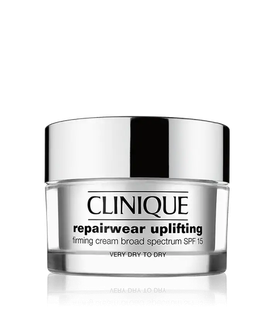
Clinique Repairwear Uplifting Firming Cream Broad Spectrum SPF 15
Works for
2 of 3 advertised claims delivered
Sun protectionSPF 15 · 3 UV filters · Partial spectrumWeak protectionSPF under 30
This product does not offer good protection against UVA rays.
Moisturizing31 ingredients credited for this claimStrong support
“Light, richly moisturizing cream visibly tightens, lifts and firms the face and neck to rebuild skin's youthful appearance with the added important SPF 15 protection benefit.”
This product can help improve hydration of the skin with the two types of ingredients.
The first type is called “humectants”:
these ingredients help attract water.
When humectants are on the surface of the skin, they “pull in” the moisture from the outside environment, or from
within deeper layers of the skin. The following ingredients in this product do the job:
glycerin, sodium hyaluronate.
This product also contains ingredients called “occlusives”. They help reduce the speed with which our skin loses moisture to the outside environment. These ingredients also help soften the upper layer of the skin, so it feels less tight and nicer to the touch. The following ingredients in this product do the job: dimethicone, methicone.
The following ingredients in this product are especially good for supporting the skin barrier and helping with the hydration level: acetyl hexapeptide-8, petrolatum
Anti-aging3 ingredients credited for this claimModerate support
“Light, richly moisturizing cream visibly tightens, lifts and firms the face and neck to rebuild skin's youthful appearance with the added important SPF 15 protection benefit.”
This product contains acetyl hexapeptide-8. This ingredient might be able to help reduce and prevent fine lines and wrinkles, improve skin elasticity and firmness, but there is not enough evidence that it actually works. The biggest anti-aging effect in this product comes from sun protection. Sun damage is the main factor causing early signs of skin aging. We, however, do not recommend using this product as a sunscreen because the protection it offers is not strong enough).
Can it cause trouble?
Irritancy2 strong irritants: Salvia sclarea extract, Commiphora mukul resin extractMedium risk
Comedogenic3 ingredients rated 2 or more on the 0–5 pore-clogging scale3 flagged
User reviews
Be the first — your take helps the next person decide.
Ingredients
Filter by role to see what each ingredient is doing.
Ethylhexyl methoxycinnamate7.5%
- Irritation risk
- High
Octinoxate. When used in higher concentrations, works as a sunscreen protecting the skin from UVB rays. When used in lower concentration, helps to preserve the product formulation. Is shown to be harmful to coral reefs - consider avoiding bathing in coral reef areas when wearing a product with this ingredient. It can be irritating
More about Ethylhexyl methoxycinnamateEthylhexyl salicylate3.5%
- Irritation risk
- Low
Octisalate. A UV filter. It offers some protection against the sun rays that cause sunburn (UVB), but does not protect against the most aging sun rays (UVA). It loses its effectiveness quickly when exposed to sunlight. It is an organic, or so called "chemical" sunscreen
More about Ethylhexyl salicylateWater~45–55%
Neopentyl glycol diheptanoate~4.3–5.2%
- Irritation risk
- Low
Helps soften the upper layer of the skin and create a nice product consistency
More about Neopentyl glycol diheptanoateSimmondsia chinensis butter~4.9–6%
- Irritation risk
- Medium
Helps soften the upper layer of the skin
More about Simmondsia chinensis butterGlycerin~3.7–4.5%
- Irritation risk
- Low
One of the best moisturizing ingredients. Naturally present in skin. It attracts water to the upper layer of the skin working as a humectant
More about GlycerinPetrolatum~3.3–4%
- Irritation risk
- Low
One of the most effective and the most studied occlusive ingredients that creates a protective layer on top of the skin preventing moisture loss
More about PetrolatumOctyldodecyl neopentanoate~2.3–2.8%
- Irritation risk
- Low
An emollient that helps soften the skin. Often used to stabilize other ingredients, for example, sunscreen
More about Octyldodecyl neopentanoateDi-c12-15 alkyl fumarate~1.7–2.1%
- Irritation risk
- Medium
Used to soften the upper layer of the skin and create a nice product texture
More about Di-c12-15 alkyl fumarateDimethicone~1.6–1.9%
- Irritation risk
- Low
A silicone that helps to reduce water loss from the surface of the skin. Can temporarily "fill in" lines and wrinkles, absorb oil, and create a nice product finish
More about DimethiconeHydrogenated lecithin~1.1–1.4%
- Irritation risk
- Low
Helps to retain moisture by creating a protective barrier on the skin. Rich in fatty acids. Improves product texture and helps with the penetration of other ingredients.
More about Hydrogenated lecithinButylene glycol~0.8–1.2%
- Irritation risk
- Low
Used to create a nice product texture and help delivery of other ingredients. Might be somewhat helpful in attracting water to the upper layer of the skin
More about Butylene glycolHydrogenated polyisobutene~0.7–1.05%
- Irritation risk
- Low
Used to improve the product consistency and soften the upper layer of the skin
More about Hydrogenated polyisobuteneHexyldecyl stearate~0.65–0.95%
- Irritation risk
- Medium
Helps create a nice product feeling on the skin and help soften its upper layer
More about Hexyldecyl stearateSigesbeckia orientalis extract~0.5–0.75%
- Irritation risk
- Medium
A plant extract that can contain an anti-inflammatory compound
More about Sigesbeckia orientalis extractWhey protein~0.55–0.85%
- Irritation risk
- Low
A protein derived from milk. In skincare products, might help to soften the upper layer of the skin
More about Whey proteinSalvia sclarea extract~0.45–0.7%
- Irritation risk
- High
Used as a fragrance. Can be irritating
More about Salvia sclarea extractChlorella vulgaris extract~0.45–0.7%
- Irritation risk
- Medium
- Comedogenicity
- 3/5
A plant extract that can help to attract water to the upper layer of the skin and might have some anti-oxidant and anti-inflammatory properties
More about Chlorella vulgaris extractCommiphora mukul resin extract~0.45–0.7%
- Irritation risk
- High
A plant extract might be helpful in neutralizing free radicals and reducing inflammation in skin
More about Commiphora mukul resin extractLitchi chinensis seed extract~0.35–0.65%
- Irritation risk
- Low
Laminaria digitata extract~0.3–0.6%
- Irritation risk
- Low
- Comedogenicity
- 3/5
Seaweed extract that helps the skin to attract water and make it more smooth for touch. Also shows promise of anti-aging properties, but good research is lacking at the moment
More about Laminaria digitata extractCladosiphon okamuranus extract~0.3–0.55%
- Irritation risk
- Low
Plankton extract~0.3–0.5%
- Irritation risk
- Medium
- Comedogenicity
- 3/5
Can help attract water to the upper layer of the skin
More about Plankton extractAstrocaryum murumuru seed butter~0.35–0.6%
- Irritation risk
- Medium
Helps soften the upper layer of the skin. Could be comedogenic due to the myrisic acid content
More about Astrocaryum murumuru seed butterAcetyl hexapeptide-8~0.25–0.45%
- Irritation risk
- Low
A type of peptide. Peptides are excellent moisturizers and might be able support collagen production reducing fine lines and wrinkles
More about Acetyl hexapeptide-8Lecithin~0.35–0.6%
- Irritation risk
- Low
Used mostly for creating emulsions - helping oil and water mix together. Helps soften the upper layer of the skin
More about LecithinPolyethylene~0.55–0.8%
Pentylene glycol~0.35–0.6%
- Irritation risk
- Medium
Used to preserve products, dissolve other ingredients and create a nice product texture
More about Pentylene glycolPotato starch modified~0.25–0.5%
- Irritation risk
- Low
Ergothioneine~0.3–0.6%
- Irritation risk
- Low
Can help neutralize free radicals in skin. Preliminary studies show that it can be more effective than coenzyme Q10 but studies on effective concentration for topical applications are lacking
More about ErgothioneineGlyceryl stearate~0.35–0.6%
- Irritation risk
- Low
An emollient that softens the skin and forms a protective layer on its surface. Helps water and oil mix together
More about Glyceryl stearateCaffeine~0.3–0.6%
- Irritation risk
- Medium
Might be helpful in neutralizing free radicals. Can have a dehydration effect that might somewhat decrease the look of puffy eyes
More about CaffeineSorbitol~0.25–0.45%
- Irritation risk
- Low
Helps attract water to the upper layer of the skin and improves the product texture
More about SorbitolBehenyl alcohol~0.35–0.6%
- Irritation risk
- Low
Non-drying alcohol that helps water and oil mix together. Also serves as an emollient
More about Behenyl alcoholSodium hyaluronate~0.25–0.45%
- Irritation risk
- Low
One of the best moisturizing ingredients. Attracts water into the upper layer of the skin
More about Sodium hyaluronateMethicone~0.3–0.55%
- Irritation risk
- Low
A type of silicone that helps soften the upper layer of the skin and reduces the water loss from the skin surface
More about MethiconeTocopheryl acetate~0.35–0.65%
- Irritation risk
- Medium
A more stable but less bio-available form of vitamin E compared to Tocopherol. Might help moisturize and protect the skin from free radicals, but mostly used in low concentrations to stabilize other ingredients.
More about Tocopheryl acetatePeg-100 stearate~0.3–0.6%
- Irritation risk
- Low
Helps oil and water mix togehter and creates a nice product texture
More about Peg-100 stearatePentaerythrityl tetraethylhexanoate~0.35–0.6%
- Irritation risk
- Low
Used to create a nice product consistency while softening the upper layer of the skin
More about Pentaerythrityl tetraethylhexanoateCaprylyl glycol~0.3–0.55%
- Irritation risk
- Medium
Helps preserve products and creates a nice product texture
More about Caprylyl glycolC12-16 alcohols~0.3–0.55%
- Irritation risk
- Medium
Helps soften the upper layer of the skin and improve the product's texture
More about C12-16 alcoholsCholesterol~0.3–0.6%
- Irritation risk
- Low
An emollient that is naturally found in skin
More about CholesterolCaprylic/capric triglyceride~0.3–0.6%
- Irritation risk
- Medium
A good mix of fatty acids that forms a protective layer on the skin. Improves the shelf life of products. Derived from coconut and glycerin
More about Caprylic/capric triglyceridePolysilicone-11~0.3–0.55%
- Irritation risk
- Low
A silicone that forms a light film on the skin surface helping to bind water and temporarily absorb oils creating a matt and powdery feel
More about Polysilicone-11Dextrin~0.15–0.25%
- Irritation risk
- Low
A sugar that is used to stabilize the product formulation. Can help attract water to the upper layer of the skin
More about DextrinPalmitic acid~0.25–0.4%
- Irritation risk
- Low
An emollient that is naturally present in skin and helps soften it
More about Palmitic acidTetrahexyldecyl ascorbate~0.25–0.45%
- Irritation risk
- Medium
Being a lipid soluble form of vitamin C, it is more stable than ascorbic acid, but still degrades quickly and needs to be stabilized in a formulation with another ingredient. It is claimed to penetrate skin better than pure vitamin C and have the the similar benefits, but solid studies of its effectiveness are lacking. Is likely to require a higher concentration in a product than pure vitamin C to be effective. It might be able to help reduce pore clogging.
More about Tetrahexyldecyl ascorbateHexylene glycol~0.1–0.25%
- Irritation risk
- Medium
Helps create a more spreadable product texture
More about Hexylene glycolCitric acid~0.25–0.45%
- Irritation risk
- Medium
Can work as an exfoliant but is typically used to adjust the product pH
More about Citric acidXanthan gum~0.25–0.45%
- Irritation risk
- Low
Used to create a thicker product consistency
More about Xanthan gumAlumina~0.35–0.65%
- Irritation risk
- Low
The same compound that is used safely in dental implants and bone cements. In cosmetics, it is used to improve the consistency of products
More about AluminaAmmonium acryloyldimethyltaurate/vp copolymer~0.2–0.35%
- Irritation risk
- Low
Increases thickness of a product. Texture enhancer for oil-in-water emulsions
More about Ammonium acryloyldimethyltaurate/vp copolymerSodium hydroxide~0.2–0.35%
Disodium edta~0.15–0.3%
Potassium sorbate~0.1–0.2%
Phenoxyethanol~0.1–0.2%
- Irritation risk
- Low
A preservative. It helps prevent bacterial growth in cosmetic products
More about PhenoxyethanolCi 14700~0.1–0.25%
Ci 19140~0.1–0.2%
Titanium dioxide1.7%
- Irritation risk
- Low
Works as a UV filter when used in high concentrations. It is photostable and is effective mostly against the UVB light, with some protection in the UVA range. In small concentrations, used for its ability to improve the color of cosmetic products. Is usually well tolerated by the skin
More about Titanium dioxideMica~0.1–0.15%
- Irritation risk
- Low
Creates an illusion of smoother and more radiant skin tone. Adds shimmer to the skin by reflecting light
More about MicaIngredient list view
Ethylhexyl methoxycinnamate, Ethylhexyl salicylate, Water, Neopentyl glycol diheptanoate, Simmondsia chinensis butter, Glycerin, Petrolatum, Octyldodecyl neopentanoate, Di-c12-15 alkyl fumarate, Dimethicone, Hydrogenated lecithin, Butylene glycol, Hydrogenated polyisobutene, Hexyldecyl stearate, Sigesbeckia orientalis extract, Whey protein, Salvia sclarea extract, Chlorella vulgaris extract, Commiphora mukul resin extract, Litchi chinensis seed extract, Laminaria digitata extract, Cladosiphon okamuranus extract, Plankton extract, Astrocaryum murumuru seed butter, Acetyl hexapeptide-8, Lecithin, Polyethylene, Pentylene glycol, Potato starch modified, Ergothioneine, Glyceryl stearate, Caffeine, Sorbitol, Behenyl alcohol, Sodium hyaluronate, Methicone, Tocopheryl acetate, Peg-100 stearate, Pentaerythrityl tetraethylhexanoate, Caprylyl glycol, C12-16 alcohols, Cholesterol, Caprylic/capric triglyceride, Polysilicone-11, Dextrin, Palmitic acid, Tetrahexyldecyl ascorbate, Hexylene glycol, Citric acid, Xanthan gum, Alumina, Ammonium acryloyldimethyltaurate/vp copolymer, Sodium hydroxide, Disodium edta, Potassium sorbate, Phenoxyethanol, Ci 14700, Ci 19140, Titanium dioxide, Mica
Compare prices
Retailers ranked by price — lowest first.


Product summary
We do not recommend "Clinique - Repairwear Uplifting Firming Cream Broad Spectrum SPF 15" because it does not provide good UVA protection. UVA sun rays don't burn the skin, but they still lead to photoaging and hyperpigmentation.
Because it includes good moisturizing ingredients, it can also work as a hydrating day cream.
Sunscreen filters
This sunscreen uses a mixture of both mineral and organic (so-called "chemical") UV filters. Here are the organic filters this product uses: octinoxate and octisalate. As for the mineral filters, this sunscreen uses titanium dioxide.
Irritation risk
There are some common irritants in this product, including ingredients that do not have benefits for the skin. We assess the overall irritancy of this moisturizer to be medium. For a detailed overview of all potential irritants: click here
You can see the detailed formula review with the breakdown of all actives in the product and the full ingredient list with estimated concentrations in the tables below.
Price
The product retails for 71.00$ in the United States and for 78.00CA$ in Canada.
For a detailed price comparison: click here.
Sources cited in this review
Every concentration estimate and effectiveness label is anchored to one of these 19 studies and safety reviews.
- 1
- 2
- 3
- 4Final Report on the Safety Assessment of Dimethicone Copolyoljournals.sagepub.com
- 5
- 6Safety Assessment of Alkyl Esters as Used in Cosmeticsjournals.sagepub.com

Affiliate links · As an Amazon Associate, WIMJ earns from qualifying purchases.