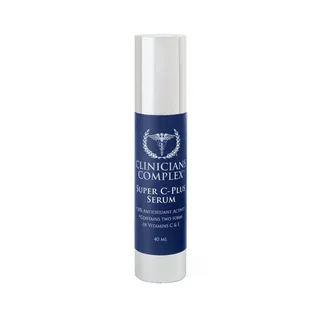
Clinicians Complex Super C-Plus Serum
Works for
Anti-agingAscorbic acid, Vitis vinifera seed extract + 4 moreWorks well
“Formulated with L-Ascorbic Acid and Tetrahexyldecyl Ascorbate (two potent forms of Vitamin C), the luxurious serum effectively protects against external aggressors while minimizing the appearance of fine lines, wrinkles and discoloration with continued use.”
This product can help reduce and prevent fine lines and wrinkles, improve skin elasticity and firmness because it contains ascorbic acid, tetrahexyldecyl ascorbate.
These ingredients in the product can also be helpful, even though there is less evidence for their effectiveness: retinyl palmitate, tocotrienols, vitis vinifera seed extract.
Keep in mind that it typically takes at least 6 weeks to notice any results because the changes that are needed to improve fine lines and elasticity happen in the deeper layers of the skin. No topical anti-aging product can “erase” wrinkles or fully reverse signs of aging.
Evens skin toneAscorbic acid, Tetrahexyldecyl ascorbate + 2 moreWorks well
“Formulated with L-Ascorbic Acid and Tetrahexyldecyl Ascorbate (two potent forms of Vitamin C), the luxurious serum effectively protects against external aggressors while minimizing the appearance of fine lines, wrinkles and discoloration with continued use.”
This product can help reduce hypepigmentation and even out the skin tone because it contains the following effective ingredients: ascorbic acid.
In addition, this product contains tetrahexyldecyl ascorbate. This ingredient (ingredients) might help reduce hyperpigmentation, but the effect, if any, is likely to be small.
The following ingredient (ingredients) in this product might be helpful, but there is no evidence to confirm that it actually can help even out the skin tone: punica granatum extract, retinyl palmitate.
Keep in mind that you would need to apply any topical skincare targetted at hypigmentation consistently for a couple of months to get a result. No topical skincare product can help get rid of hyperpigmentation (including post-acne marks and age spots) instantly.
MoisturizingMethicone, Dimethicone crosspolymer + 3 moreWorks
“A cross polymer delivery system ensures ingredients are infused efficiently into skin, rejuvenating and locking in moisture to inspire a supple-looking complexion.”
This product can help soften the skin and reduce its moisture loss with emollients and occlusives: methicone, vaccinium macrocarpon seed oil.
Keep in mind that this product does not contain effective ingredients to attract water to the upper layer of the skin. This is why an additional product with humectants like glycerin or hyaluronic acid can be helpful (apply it before this product for the best results).
Anti-oxidationSide benefit · Ascorbic acid, Vitis vinifera seed extract + 8 moreWorks well
This product contains antioxidants (ascorbic acid, tetrahexyldecyl ascorbate, tocotrienols, vitis vinifera seed extract) that can help neutralize free radicals in skin. By doing so, they can lessen the damage the skin gets from the UV light (sun).
The following ingredients - camellia sinensis extract, punica granatum extract, vaccinium macrocarpon seed oil also can have an antioxidant effect, but there is less evidence to confirm their effectiveness in skin.
Can it cause trouble?
Irritancy3 strong irritants: Rosa damascena extract, Retinyl palmitate + 1 more — patch-test recommendedHigh risk
ComedogenicClean of flagged comedogenic ingredientsNone flagged

User reviews
Be the first — your take helps the next person decide.
Ingredients
Filter by role to see what each ingredient is doing.
Methicone~22–34%
- Irritation risk
- Low
A type of silicone that helps soften the upper layer of the skin and reduces the water loss from the skin surface
More about MethiconeDimethicone crosspolymer~4.7–7%
- Irritation risk
- Low
Used to create a thicker product texture. Helps soften the upper layer of the skin and might be able to prevent moisture loss from its surface
More about Dimethicone crosspolymerVitis vinifera seed extract~4.5–6.7%
- Irritation risk
- Low
A plant extract that contains resveratrol and other anti-oxidant compounds that can help neutralize free radicals, reduce inflammation in skin and even out its tone. Can be also used to stabilize the product formulation
More about Vitis vinifera seed extractTetrahexyldecyl ascorbate~3.8–5.7%
- Irritation risk
- Medium
Being a lipid soluble form of vitamin C, it is more stable than ascorbic acid, but still degrades quickly and needs to be stabilized in a formulation with another ingredient. It is claimed to penetrate skin better than pure vitamin C and have the the similar benefits, but solid studies of its effectiveness are lacking. Is likely to require a higher concentration in a product than pure vitamin C to be effective. It might be able to help reduce pore clogging.
More about Tetrahexyldecyl ascorbateAscorbic acid~3.2–4.9%
- Irritation risk
- High
The most well-researched antioxidant that works in skin. Helps neutralize free radicals supporting collagen production, helping to even out the skin tone and preventing early signs of aging
More about Ascorbic acidTocotrienols~2.4–3.6%
- Irritation risk
- Low
A type of vitamin E that is more powerful in neutralizing free radicals compared to its other forms
More about TocotrienolsCamellia sinensis extract~1.7–2.5%
- Irritation risk
- Low
Tea extract. Might be helpful in neutralizing free radicals in skin
More about Camellia sinensis extractRosa damascena extract~1.5–2.2%
- Irritation risk
- High
Oil of a very fragrant pink rose used as fragrance in cosmetics. Extensive research has shown it has mixed benefits. In the pro column, inhaling this flower’s scent seems to have relaxing properties and the plant’s petals contain skin-soothing and antioxidant compounds that can benefit skin. On the flipside, the numerous chemicals that create this rose’s distinctive fragrance pose a risk of causing skin aggravation.
More about Rosa damascena extractTocopheryl acetate~1–1.45%
- Irritation risk
- Medium
A more stable but less bio-available form of vitamin E compared to Tocopherol. Might help moisturize and protect the skin from free radicals, but mostly used in low concentrations to stabilize other ingredients.
More about Tocopheryl acetateRetinyl palmitate~0.8–1.25%
- Irritation risk
- High
Three steps removed from the active form of vitamin A - retinoic acid. To have an effect in the skin, it first needs to be converted twice to become the retinoic acid. This means it is less potent than retinol, but could also be less irritating. Once converted to the retinoic acid in the skin, it helps against all signs of aging, improves skin cell turnover and helps fight blemishes and clogged pores. However, in many cosmetic formulations, it is used in a concentration that is too low to have the full effect
More about Retinyl palmitateVaccinium myrtillus seed extract~0.5–1.2%
- Irritation risk
- Low
Rosa damascena flower oil~0.45–1.05%
- Irritation risk
- High
Used as a fragrance. Can be irritating
More about Rosa damascena flower oilVaccinium macrocarpon seed oil~0.5–1.15%
- Irritation risk
- Medium
A plant oil that can help neutralize free radicals, soften the upper layer of the skin, and support skin's barrier function
More about Vaccinium macrocarpon seed oilSalix alba extract~0.4–0.9%
- Irritation risk
- Low
Rosa damascena extract~0.35–0.75%
- Irritation risk
- High
Oil of a very fragrant pink rose used as fragrance in cosmetics. Extensive research has shown it has mixed benefits. In the pro column, inhaling this flower’s scent seems to have relaxing properties and the plant’s petals contain skin-soothing and antioxidant compounds that can benefit skin. On the flipside, the numerous chemicals that create this rose’s distinctive fragrance pose a risk of causing skin aggravation.
More about Rosa damascena extractPunica granatum extract~0.2–0.75%
- Irritation risk
- Medium
A plant extract that can help neutralize free radicals in skin and even out the skin tone, but is typically used in products in a concentration that is too low to be effective
More about Punica granatum extractVaccinium angustifolium fruit extract~0.15–0.65%
- Irritation risk
- Medium
A plant extract tha can have anti-oxidant properties, but evidence of effectiveness in skin is lacking
More about Vaccinium angustifolium fruit extractSilica~0.3–0.7%
Phenoxyethanol~0.1–0.4%
- Irritation risk
- Low
A preservative. It helps prevent bacterial growth in cosmetic products
More about PhenoxyethanolBenzyl alcohol~0.1–0.3%
- Irritation risk
- High
A preservative. Can be used to mask unpleasant smell. Can be irritating
More about Benzyl alcoholPotassium sorbate~0.1–0.3%
Tocopherol~0.05–0.25%
- Irritation risk
- Low
Pure form of vitamin E. Can help moisturise and protect the skin from free radicals. Often used to help stabilise other ingredients or the formula itself
More about TocopherolRosa damascena extract~0.05–0.2%
- Irritation risk
- High
Oil of a very fragrant pink rose used as fragrance in cosmetics. Extensive research has shown it has mixed benefits. In the pro column, inhaling this flower’s scent seems to have relaxing properties and the plant’s petals contain skin-soothing and antioxidant compounds that can benefit skin. On the flipside, the numerous chemicals that create this rose’s distinctive fragrance pose a risk of causing skin aggravation.
More about Rosa damascena extractIngredient list view
Methicone, Dimethicone crosspolymer, Vitis vinifera seed extract, Tetrahexyldecyl ascorbate, Ascorbic acid, Tocotrienols, Camellia sinensis extract, Rosa damascena extract, Tocopheryl acetate, Retinyl palmitate, Vaccinium myrtillus seed extract, Rosa damascena flower oil, Vaccinium macrocarpon seed oil, Salix alba extract, Rosa damascena extract, Punica granatum extract, Vaccinium angustifolium fruit extract, Silica, Phenoxyethanol, Benzyl alcohol, Potassium sorbate, Tocopherol, Rosa damascena extract
Compare prices
Retailers ranked by price — lowest first.
Worth comparing, line by line.
Match % combines shared ingredients, the first five ingredients, shared actives and hero ingredients, irritancy (lower counts in the alternative's favour), texture and body area. Only products in the same routine step are compared.
| Clinicians ComplexSuper C-Plus SerumYOUR PRODUCT | Glow Jar8% AM Vitamin C Serum | SkinMedicaVitamin C Plus E Complex | Skin ScriptVitamin C/Green Tea Serum | |
|---|---|---|---|---|
| Match | — | 84% | 84% | 80% |
| Price | — | $41.38 | $103.36 | — |
| Shared key ingredients | — | 2 of 9 | 2 of 9 | 3 of 9 |
| Key difference | — | Salicylic Acid | Bisabolol | Copper Tripeptide-1 |
| Irritancy | High | Low | Low | High |
| Drying alcohol | — | — | — | Contains drying alcohol |
| View product | Shop | Shop | Shop |


More alternatives: Maelove Glow Makermarie veronique Vitamins C+E+Ferulic Serum
Product summary
"Clinicians Complex - Super C-Plus Serum" could be helpful for: Anti-inflammatory, Moisturizing, Anti-aging and Evens skin tone, but its actives are not the most effective or are not well-studied.
Ingredient callouts
- This product also contains Vitamin C (Ascorbic Acid) 3.20% - 4.90% It can be helpful in stimulating collagen production, neutralizing free radicals in skin and improving pigmentation marks. We recommend to use up this product quickly after opening: Ascorbic Acid degrades fast when it gets in contact with air and light. The moment the product turns orange, it is a sign that a significant share of the vitamin C in it is no longer effective.
- This product includes a form of Retinoids (vitamin A) - retinyl palmitate 0.80% - 1.25%, but this type of vitamin A is not very effective. It could in theory help with fine lines and wrinkles, but the effect is most likely minimal.
Price
The product retails from 74.48$ up to 80.00$ in the United States and for 98.00CA$ in Canada.
For a detailed price comparison: click here.
Sources cited in this review
Every concentration estimate and effectiveness label is anchored to one of these 19 studies and safety reviews.
- 1
- 2
- 3
- 4
- 5
- 6Safety Assessment of Tocopherols and Tocotrienols as Used in Cosmeticsjournals.sagepub.com

Affiliate links · As an Amazon Associate, WIMJ earns from qualifying purchases.