Works for
1 of 1 advertised claim delivered
Anti-aging5 ingredients credited for this claimModerate support
“Formulated to target crow's feet, dark circles, and puffiness, this powerful peptide blend gets straight to work to create firmer skin.”
This product contains caprooyl tetrapeptide-3, copper tripeptide-1, palmitoyl tripeptide-38. These ingredients might be able to help reduce and prevent fine lines and wrinkles, improve skin elasticity and firmness, but there is not enough evidence that it actually works.
MoisturizingNot advertised by the brand · 17 ingredients credited for this claimStrong support
This product can help improve hydration of the skin with the two types of ingredients.
The first type is called “humectants”:
these ingredients help attract water.
When humectants are on the surface of the skin, they “pull in” the moisture from the outside environment, or from
within deeper layers of the skin. The following ingredients in this product do the job:
glycerin, isomalt.
This product also contains ingredients called “occlusives”. They help reduce the speed with which our skin loses moisture to the outside environment. These ingredients also help soften the upper layer of the skin, so it feels less tight and nicer to the touch. The following ingredients in this product do the job: caprooyl tetrapeptide-3, aloe barbadensis leaf extract.
The following ingredients in this product are especially good for supporting the skin barrier and helping with the hydration level: caprooyl tetrapeptide-3, copper tripeptide-1, palmitoyl tripeptide-38, panthenol
Can it cause trouble?
Irritancy11 flagged ingredientsMedium risk
ComedogenicClean of flagged comedogenic ingredientsNone flagged
User reviews
Be the first — your take helps the next person decide.
Ingredients
Filter by role to see what each ingredient is doing.
Water~45–55%
Glycerin~4.3–5.3%
- Irritation risk
- Low
One of the best moisturizing ingredients. Naturally present in skin. It attracts water to the upper layer of the skin working as a humectant
More about GlycerinPropanediol~3.9–4.8%
- Irritation risk
- Low
Acts as a solvent for other ingredients. Speeds up the absorption of other ingredients into the skin
More about PropanediolSodium acrylates copolymer~2.9–3.5%
- Irritation risk
- Medium
Used to create a thicker product consistency
More about Sodium acrylates copolymerPolysorbate 20~2.2–2.7%
Aloe barbadensis leaf extract~1.9–2.4%
- Irritation risk
- Medium
Traditionally used to treat sunburns, dermatitis and inflammation, but evidence for its effectiveness is lacking. The extract can contain humectants that help attract water into the skin
More about Aloe barbadensis leaf extractLactic acid~1.5–1.9%
- Irritation risk
- Medium
An exfoliating and moisturizing alpha-hydroxy acid (AHA). Typically causes less irritation than other AHAs, for example, glycolic acid. At high concentrations (about 15%), lactic acid can help reduce lines and wrinkles. Recent studies show that lactic acid can support the "good" bacteria living on skin's surface (healthy skin microbiome)
More about Lactic acidCitric acid~1.3–1.6%
- Irritation risk
- Medium
Can work as an exfoliant but is typically used to adjust the product pH
More about Citric acidPanthenol~1.1–1.4%
- Irritation risk
- Low
Helps attract water to the upper layer of the skin and can help improve skin barrier function
More about PanthenolSodium hyaluronate~0.8–1.2%
- Irritation risk
- Low
One of the best moisturizing ingredients. Attracts water into the upper layer of the skin
More about Sodium hyaluronateCurcuma wenyujin/curcuma kwangsiensis rhizome extract~0.65–0.95%
- Irritation risk
- Low
Physcomitrella patens protonema extract~0.55–0.8%
- Irritation risk
- Low
Isomalt~0.5–0.7%
- Irritation risk
- Low
Helps attract water to the upper layer of the skin
More about IsomaltMedicago sativa seed extract~0.45–0.65%
- Irritation risk
- Low
Hydrolyzed lupine protein~0.35–0.65%
- Irritation risk
- Low
Palmitoyl tripeptide-38~0.4–0.6%
- Irritation risk
- Low
A type of peptide. Peptides are excellent moisturizers and might be able support collagen production reducing fine lines and wrinkles
More about Palmitoyl tripeptide-38Caprooyl tetrapeptide-3~0.45–0.65%
- Irritation risk
- Low
A type of peptide. Peptides are excellent moisturizers and might be able support collagen production reducing fine lines and wrinkles
More about Caprooyl tetrapeptide-3Copper tripeptide-1~0.3–0.6%
- Irritation risk
- Low
A naturally occurring peptide. One of the most studied peptides in dermatology. It is sometimes abbreviated GHK-Cu. Belongs to the class of carrier peptides. It stimulates both synthesis and breakdown of collagen in skin. It is released in skin wounds and inflammation to support healing. It accelerates wound-healing of the skin and can stimulate hair growth. There are preliminary studies that confirm that copper tripeptide can help support collagen production reducing fine lines and wrinkles and decrease inflammation in skin.
More about Copper tripeptide-1Caprylhydroxamic acid~0.3–0.55%
1,2-hexanediol~0.3–0.5%
Angelica polymorpha sinensis root extract~0.25–0.5%
- Irritation risk
- Low
Butylene glycol~0.25–0.5%
- Irritation risk
- Low
Used to create a nice product texture and help delivery of other ingredients. Might be somewhat helpful in attracting water to the upper layer of the skin
More about Butylene glycolPhospholipids~0.25–0.45%
- Irritation risk
- Low
Emollients that are naturaly present in skin. In addition, they help water and oil mix together in the product
More about PhospholipidsMaltodextrin~0.25–0.45%
- Irritation risk
- Low
Used to stabilize the product formulation and can help absorb oil
More about MaltodextrinSwertia chirata extract~0.25–0.45%
- Irritation risk
- Medium
A plant extract that can have an anti-bacterial and anti-inflammatory effect, but evidence of effectiveness is lacking
More about Swertia chirata extractMangifera indica fruit extract~0.25–0.45%
- Irritation risk
- Medium
A fruit extract that might help attract water to the upper layer of the skin. There is no evidence of other benefits in skin
More about Mangifera indica fruit extractCamellia sinensis leaf extract~0.25–0.45%
- Irritation risk
- Low
Can contain potent anti-oxidant compounds (abbreviated ECG, GCG, EGC, and EGCG) that might help protect the skin from free radicals. Can help calm down inflammation and has some anti-bacterial properties. Unfortunately, these antioxidants are unstable and lose their effectiveness very quickly in products. The concentration of the antioxidant compounds in the extract also tends to be low to be effective in topical formulation
More about Camellia sinensis leaf extractGleditsia triacanthos seed extract~0.25–0.45%
- Irritation risk
- Low
Saccharide isomerate~0.2–0.4%
- Irritation risk
- Low
Helps attract water to the upper layer of the skin
More about Saccharide isomerateSodium citrate~0.2–0.4%
- Irritation risk
- Medium
Helps to control the skin's pH level. Maintains the skin's natural film of amino-lactic acids and oils. Helps to preserve products
More about Sodium citrateHydroxypropyl cyclodextrin~0.25–0.45%
- Irritation risk
- Medium
Used to stabilize product formulations and help soften the upper layer of the skin
More about Hydroxypropyl cyclodextrinMica~0.25–0.45%
- Irritation risk
- Low
Creates an illusion of smoother and more radiant skin tone. Adds shimmer to the skin by reflecting light
More about MicaLecithin~0.25–0.45%
- Irritation risk
- Low
Used mostly for creating emulsions - helping oil and water mix together. Helps soften the upper layer of the skin
More about LecithinCaprylyl glycol~0.2–0.35%
- Irritation risk
- Medium
Helps preserve products and creates a nice product texture
More about Caprylyl glycolCaprylhydroxamic acid~0.1–0.2%
Titanium dioxide~0.2–0.35%
- Irritation risk
- Low
Works as a UV filter when used in high concentrations. It is photostable and is effective mostly against the UVB light, with some protection in the UVA range. In small concentrations, used for its ability to improve the color of cosmetic products. Is usually well tolerated by the skin
More about Titanium dioxideIron oxides~0.05–0.1%
- Irritation risk
- Low
An umbrella term for the following three colorants: CI 77491, CI 77492, CI 77499. They might be able to offer some protection against visible light, but the degree of the protection is not clear
More about Iron oxidesIngredient list view
Water, Glycerin, Propanediol, Sodium acrylates copolymer, Polysorbate 20, Aloe barbadensis leaf extract, Lactic acid, Citric acid, Panthenol, Sodium hyaluronate, Curcuma wenyujin/curcuma kwangsiensis rhizome extract, Physcomitrella patens protonema extract, Isomalt, Medicago sativa seed extract, Hydrolyzed lupine protein, Palmitoyl tripeptide-38, Caprooyl tetrapeptide-3, Copper tripeptide-1, Caprylhydroxamic acid, 1,2-hexanediol, Angelica polymorpha sinensis root extract, Butylene glycol, Phospholipids, Maltodextrin, Swertia chirata extract, Mangifera indica fruit extract, Camellia sinensis leaf extract, Gleditsia triacanthos seed extract, Saccharide isomerate, Sodium citrate, Hydroxypropyl cyclodextrin, Mica, Lecithin, Caprylyl glycol, Caprylhydroxamic acid, Titanium dioxide, Iron oxides
Compare prices
Retailers ranked by price — lowest first.

Product summary
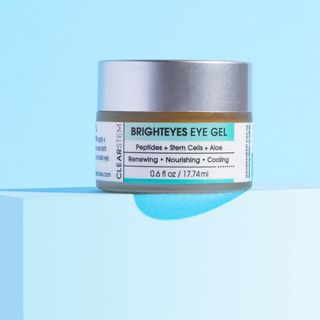
Based on the ingredients included, "CLEARSTEM - BRIGHTEYES Eye Gel" works well for moisturizing the skin. To work well, any moisturizer needs to include a combination of water-binding and emollient ingredients. CLEARSTEM - BRIGHTEYES Eye Gel ticks this box. Humectants in this product (panthenol, glycerin, isomalt, saccharide isomerate and sodium hyaluronate) help to increase the water content in the upper layer of the skin. (These ingredients do so by "capturing" water molecules from the outside air or from within the deeper layers of the skin). Emollients in this formulation (caprooyl tetrapeptide-3, aloe barbadensis leaf extract, caprylyl glycol and hydroxypropyl cyclodextrin) help to reduce the moisture loss from the skin. They also soften the skin surface and relieve the feeling of dryness and tightness.
Ingredient callouts
- This product contains acids (lactic acid 1.50% - 1.90%). Their concentration is low, and they will not have a strong exfoliating effect. Instead, they work to support the skin natural acid mantle and to attract water (as humectants). Lactic acid is particularly good in attracting water to the upper layer of the skin and improving the skin barrier.
- We like that this moisturizer contains peptides (copper tripeptide-1 0.30% - 0.60%, caprooyl tetrapeptide-3 0.45% - 0.65% and palmitoyl tripeptide-38 0.40% - 0.60%). There are many different kind of Peptides and they are naturally present in our skin. They all are a combination of aminoacids. Some of them work as natural antibiotics, promote wound-healing and production of collagen. The science is still not settled on how effective Peptides are in skincare, but it is very likely that they have a benefit. Peptides might help restore the skin barrier and fight the signs of aging. At the very least, Peptides work as humectants: they attract water to the upper layer of the skin and improve its hydration.
- Panthenol (pro-vitamin B5) at about 1.10% - 1.40% concentration. In this concentration, Panthenol works effectively to improve the skin barrier and reduce inflammation.
Irritation risk
This product does not contain known common irritants and is suitable for sensitive skin. We assess the overall irritancy of this moisturizer to be medium. For a detailed overview of all potential irritants: click here
You can see the detailed formula review with the breakdown of all actives in the product and the full ingredient list with estimated concentrations in the tables below.
Price
The product retails for 54.00$ in the United States.
For a detailed price comparison: click here.
Sources cited in this review
Every concentration estimate and effectiveness label is anchored to one of these 16 studies and safety reviews.
- 1
- 2
- 3Epidermal and dermal effects of topical lactic acidncbi.nlm.nih.gov
- 4Dual Effects of Alpha-Hydroxy Acids on the Skinpdfs.semanticscholar.org
- 5Skin moisturizing effects of panthenol-based formulationspdfs.semanticscholar.org
- 6

Affiliate links · As an Amazon Associate, WIMJ earns from qualifying purchases.