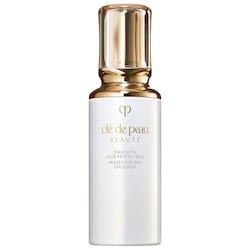
Clé de Peau Beauté Protective Day Emulsion
Works for
2 of 3 advertised claims delivered
Evens skin tonePotassium methoxysalicylateStrong evidence
“- 4MSK (Potassium 4-Methoxysalicylate): An intensive brightening ingredient to diminish the look of dark spots.”
This product can help reduce hypepigmentation and even out the skin tone because it contains the following effective ingredients: potassium methoxysalicylate
Keep in mind that you would need to apply any topical skincare targetted at hypigmentation consistently for a couple of months to get a result. No topical skincare product can help get rid of hyperpigmentation (including post-acne marks and age spots) instantly.
MoisturizingCeramide np, Dimethicone + 17 moreStrong evidence
“What it is: A lightweight daytime emulsion that nourishes with 24 hours of hydration and strengthens the skin barrier so skin feels plumper and more resilient.”
This product can help improve hydration of the skin with the two types of ingredients.
The first type is called “humectants”:
these ingredients help attract water.
When humectants are on the surface of the skin, they “pull in” the moisture from the outside environment, or from
within deeper layers of the skin. The following ingredients in this product do the job:
diglycerin, glycerin.
This product also contains ingredients called “occlusives”. They help reduce the speed with which our skin loses moisture to the outside environment. These ingredients also help soften the upper layer of the skin, so it feels less tight and nicer to the touch. The following ingredients in this product do the job: dimethicone, c13-16 isoparaffin.
The following ingredients in this product are especially good for supporting the skin barrier and helping with the hydration level: ceramide np
Anti-agingTocopherolLimited evidence
“- Plumpness is visibly increased by 29%, along with improved elasticity, fine lines, pores, brightness, and smoothness”
This product does not contain ingredients that are able to reduce fine lines and wrinkles or help with skin elasticity, but it can improve the look of the skin temporarily through moisturization. Well-moisturized skin might also be able to repair the sun damage better.
This ingredient ginkgo biloba leaf extract might be able to help neutralize free radicals in skin and help it fight off some of the sun damage.
Anti-oxidationNot advertised by the brand · Ginkgo biloba leaf extract, Rosa roxburghii fruit extract + 6 moreModerate evidence
This product contains antioxidants (ginkgo biloba leaf extract) that might be able to help neutralize free radicals in skin to lessen the damage it gets from the UV light (sun). There is not enough evidence to confirm their effectiveness in skin though.
Can it cause trouble?
Irritancy4 strong irritants: Alcohol denat., Lilium candidum flower extract + 2 more — patch-test recommendedHigh risk
ComedogenicClean of flagged comedogenic ingredientsNone flagged


User reviews
Be the first — your take helps the next person decide.
Ingredients
Filter by role to see what each ingredient is doing.
Butyl methoxydibenzoylmethane2.5%
- Irritation risk
- Medium
Avobenzone. An organic, or so-called "chemical" UV filter. Protects against both UVA and UVB rays. Needs to be combined with other filters in a formulation to be stable.
More about Butyl methoxydibenzoylmethaneEthylhexyl methoxycinnamate4.9%
- Irritation risk
- High
Octinoxate. When used in higher concentrations, works as a sunscreen protecting the skin from UVB rays. When used in lower concentration, helps to preserve the product formulation. Is shown to be harmful to coral reefs - consider avoiding bathing in coral reef areas when wearing a product with this ingredient. It can be irritating
More about Ethylhexyl methoxycinnamateOctocrylene5%
- Irritation risk
- Medium
A weak sunscreen that protects against the sun rays that cause sunburn (UVB) and is somewhat effective against the UVA rays. It is quite stable and can help stabilize other, more vulnerable, sunscreen ingredients like Avobenzone. It is an organic, or so called "chemical" sunscreen
More about OctocryleneWater~45–55%
Dipropylene glycol~5.8–7.1%
- Irritation risk
- Low
Helps to dissolve other ingredients in a formulation. Slows down the rate of product drying
More about Dipropylene glycolButylene glycol~4.7–5.7%
- Irritation risk
- Low
Used to create a nice product texture and help delivery of other ingredients. Might be somewhat helpful in attracting water to the upper layer of the skin
More about Butylene glycolAlcohol denat.~3.8–4.7%
- Irritation risk
- High
Produces temporary toning effect. Can help dissolve other ingredients or preserve products
More about Alcohol denat.Glycerin~2.8–3.5%
- Irritation risk
- Low
One of the best moisturizing ingredients. Naturally present in skin. It attracts water to the upper layer of the skin working as a humectant
More about GlycerinDiisopropyl sebacate~2.1–2.6%
- Irritation risk
- Low
Helps soften the upper layer of the skin without creatng a greasy finish
More about Diisopropyl sebacateC12-15 alkyl benzoate~1.6–1.9%
- Irritation risk
- Low
Enhances the product texture and makes it more spreadable. Helps reduce water loss from the outer layer of skin. Extands the shelf life by preventing bacteria growth
More about C12-15 alkyl benzoateSilica~1.4–1.7%
Diglycerin~0.9–1.1%
- Irritation risk
- Low
Helps attract water to the upper layer of the skin
More about DiglycerinDimethicone~0.75–1.1%
- Irritation risk
- Low
A silicone that helps to reduce water loss from the surface of the skin. Can temporarily "fill in" lines and wrinkles, absorb oil, and create a nice product finish
More about DimethiconeTrehalose~0.6–0.85%
- Irritation risk
- Low
A sugar that attracts water to the upper layer of the skin
More about TrehalosePotassium methoxysalicylate~0.5–0.75%
- Irritation risk
- Medium
Can help reduce hyperpigmentation
More about Potassium methoxysalicylatePhytosteryl macadamiate~0.5–0.75%
- Irritation risk
- Low
Helps soften the upper layer of the skin
More about Phytosteryl macadamiatePeg-6~0.35–0.65%
- Irritation risk
- Low
Helps to dissolve other ingredients and attract water to the upper layer of the skin
More about Peg-6Peg-32~0.3–0.55%
- Irritation risk
- Low
Helps dissolve other ingredients and attract water to the upper layer of the skin
More about Peg-32Oryzanol~0.3–0.55%
- Irritation risk
- Low
An anti-oxidant that helps stabilize product formulations. Might help neutralise free radicals in skin
More about OryzanolTocopheryl acetate~0.3–0.6%
- Irritation risk
- Medium
A more stable but less bio-available form of vitamin E compared to Tocopherol. Might help moisturize and protect the skin from free radicals, but mostly used in low concentrations to stabilize other ingredients.
More about Tocopheryl acetatePeg/ppg-17/4 dimethyl ether~0.3–0.55%
Trimethylsiloxysilicate~0.3–0.6%
- Irritation risk
- Low
A type of silicone that helps create a nice product consistency and support the delivery of other ingredients
More about TrimethylsiloxysilicateGinkgo biloba leaf extract~0.25–0.45%
- Irritation risk
- High
A plant extract that might help neutralize free radicals and reduce inflammation in skin. It can be irritating
More about Ginkgo biloba leaf extractCrataegus monogyna flower extract~0.25–0.45%
- Irritation risk
- Low
Panax ginseng root extract~0.3–0.55%
- Irritation risk
- High
A plant extract that might have some anti-inflammatory properties, but solid evidence is lacking. It can be irritating
More about Panax ginseng root extractOnonis spinosa root extract~0.2–0.4%
- Irritation risk
- Low
Hydrangea serrata leaf extract~0.2–0.4%
- Irritation risk
- Low
Rosa canina fruit extract~0.2–0.4%
- Irritation risk
- Medium
A plant extract that might have some anti-oxidant properties, but evidence is lacking
More about Rosa canina fruit extractSaxifraga sarmentosa extract~0.2–0.4%
- Irritation risk
- Low
Zanthoxylum piperitum peel extract~0.2–0.4%
- Irritation risk
- Low
Hibiscus esculentus fruit extract~0.2–0.4%
- Irritation risk
- High
A plant extract that might help to neutralize free radicals. It can be irritating
More about Hibiscus esculentus fruit extractSodium acetylated hyaluronate~0.2–0.4%
- Irritation risk
- Low
A type of hyaluronic acid that works as an excellent moisturizer by attracting water into the upper layer of the skin. Is typically feels less sticky on the skin compared to the usual hyaluronic acid
More about Sodium acetylated hyaluronateRosa roxburghii fruit extract~0.2–0.4%
- Irritation risk
- Medium
A fruit extract that might help neutralize free radicals in skin, but evidence of effectiveness is missing
More about Rosa roxburghii fruit extractLilium candidum flower extract~0.2–0.4%
Bupleurum falcatum root extract~0.2–0.4%
- Irritation risk
- High
A plant extract that might help to attract water to the upper layer of the skin, but it is not well studied. It can be irritating
More about Bupleurum falcatum root extractPetrolatum~0.3–0.55%
- Irritation risk
- Low
One of the most effective and the most studied occlusive ingredients that creates a protective layer on top of the skin preventing moisture loss
More about PetrolatumHydrogenated polydecene~0.25–0.5%
- Irritation risk
- Low
Helps to soften the upper layer of the skin and create a nice product texture
More about Hydrogenated polydecenePeg-10 phytosterol~0.25–0.45%
- Irritation risk
- Medium
Helps oil and water mix together
More about Peg-10 phytosterolSuccinoglycan~0.25–0.45%
Mica~0.25–0.5%
- Irritation risk
- Low
Creates an illusion of smoother and more radiant skin tone. Adds shimmer to the skin by reflecting light
More about MicaPeg-6 distearate~0.25–0.45%
Beheneth-10~0.25–0.45%
Carbomer~0.25–0.45%
- Irritation risk
- Low
Helps create a thicker or gel-like product texture. It is not a surfactant but can be used in gentle cleansing formulations
More about CarbomerAlcohol~0.25–0.45%
- Irritation risk
- High
Can be drying and contribute to skin irritation. Used in formulars to dissolve other ingredients, create a thinner product consistency or for its antibacterial properties
More about AlcoholPeg/ppg-19/19 dimethicone~0.25–0.45%
Stearic acid~0.35–0.65%
- Irritation risk
- Low
Helps oil and water mix together and works as an emollient
More about Stearic acidDextrin palmitate/ethylhexanoate~0.25–0.45%
Hydroxypropyl methylcellulose stearoxy ether~0.25–0.45%
- Irritation risk
- Low
Helps create a thicker product formulation
More about Hydroxypropyl methylcellulose stearoxy etherCeramide np~0.3–0.55%
- Irritation risk
- Low
A type of lipid similar to ceramides naturally present in skin. Helps to soften the upper layer of the skin and supports the skin barrier function to keep it hydrated. Can help to prevent inflammation in skin
More about Ceramide npPotassium hydroxide~0.2–0.4%
C13-16 isoparaffin~0.25–0.5%
- Irritation risk
- Low
Is mostly used to dissolve other ingredients. Helps soften the upper layer of the skin. It might be comedogenic when used in high concentrations
More about C13-16 isoparaffinBht~0.2–0.35%
Sodium metaphosphate~0.25–0.45%
Disodium edta~0.2–0.4%
C10-13 isoparaffin~0.2–0.4%
- Irritation risk
- Low
Sodium metabisulfite~0.1–0.2%
Tocopherol~0.2–0.4%
- Irritation risk
- Low
Pure form of vitamin E. Can help moisturise and protect the skin from free radicals. Often used to help stabilise other ingredients or the formula itself
More about TocopherolPhenoxyethanol~0.15–0.3%
- Irritation risk
- Low
A preservative. It helps prevent bacterial growth in cosmetic products
More about PhenoxyethanolParfum~0.1–0.25%
- Irritation risk
- High
An aromatic blend of unspecified and possibly irritating ingredients
More about ParfumTitanium dioxide~0.25–0.45%
- Irritation risk
- Low
Works as a UV filter when used in high concentrations. It is photostable and is effective mostly against the UVB light, with some protection in the UVA range. In small concentrations, used for its ability to improve the color of cosmetic products. Is usually well tolerated by the skin
More about Titanium dioxideIron oxides~0.15–0.25%
- Irritation risk
- Low
An umbrella term for the following three colorants: CI 77491, CI 77492, CI 77499. They might be able to offer some protection against visible light, but the degree of the protection is not clear
More about Iron oxidesCi 17200~0.1–0.25%
Ci 19140~0.1–0.25%
Ingredient list view
Butyl methoxydibenzoylmethane, Ethylhexyl methoxycinnamate, Octocrylene, Water, Dipropylene glycol, Butylene glycol, Alcohol denat., Glycerin, Diisopropyl sebacate, C12-15 alkyl benzoate, Silica, Diglycerin, Dimethicone, Trehalose, Potassium methoxysalicylate, Phytosteryl macadamiate, Peg-6, Peg-32, Oryzanol, Tocopheryl acetate, Peg/ppg-17/4 dimethyl ether, Trimethylsiloxysilicate, Ginkgo biloba leaf extract, Crataegus monogyna flower extract, Panax ginseng root extract, Ononis spinosa root extract, Hydrangea serrata leaf extract, Rosa canina fruit extract, Saxifraga sarmentosa extract, Zanthoxylum piperitum peel extract, Hibiscus esculentus fruit extract, Sodium acetylated hyaluronate, Rosa roxburghii fruit extract, Lilium candidum flower extract, Bupleurum falcatum root extract, Petrolatum, Hydrogenated polydecene, Peg-10 phytosterol, Succinoglycan, Mica, Peg-6 distearate, Beheneth-10, Carbomer, Alcohol, Peg/ppg-19/19 dimethicone, Stearic acid, Dextrin palmitate/ethylhexanoate, Hydroxypropyl methylcellulose stearoxy ether, Ceramide np, Potassium hydroxide, C13-16 isoparaffin, Bht, Sodium metaphosphate, Disodium edta, C10-13 isoparaffin, Sodium metabisulfite, Tocopherol, Phenoxyethanol, Parfum, Titanium dioxide, Iron oxides, Ci 17200, Ci 19140
Compare prices
Retailers ranked by price — lowest first.
Worth comparing, line by line.
Match % combines shared ingredients, the first five ingredients, shared actives and hero ingredients, irritancy (lower counts in the alternative's favour), texture and body area. Only products in the same routine step are compared.
| Clé de Peau BeautéProtective Day EmulsionYOUR PRODUCT | CurelUltra Healing Lotion for Extra Dry Skin | Regimen LabC.R.E.A.M | |
|---|---|---|---|
| Match | — | 52% | 52% |
| Price | $164.34 | $2.79−$161.55 | $44.00−$120.34 |
| Shared key ingredients | — | 4 of 16 | 4 of 16 |
| Key difference | — | Ceramide Ap | Isosorbide Dicaprylate |
| Irritancy | High | Medium | Medium |
| Drying alcohol | Contains drying alcohol | Contains drying alcohol | — |
| View product | Shop | Shop |

Sources cited in this review
Every concentration estimate and effectiveness label is anchored to one of these 24 studies and safety reviews.
- 1
- 2
- 3Final Report on the Safety Assessment of Dimethicone Copolyoljournals.sagepub.com
- 4
- 5Safety Assessment of Phytosterols as Used in Cosmeticscir-safety.org
- 6

Affiliate links · As an Amazon Associate, WIMJ earns from qualifying purchases.