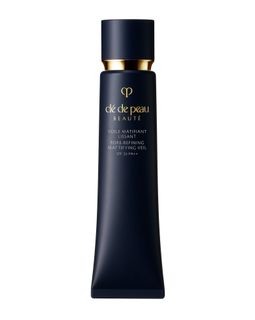
Clé de Peau Beauté Pore-Refining Mattifying Veil
Works for
1 of 2 advertised claims delivered
Sun protectionSPF 25 · 5 UV filters · Broad spectrumWeak protectionSPF under 30
This product offers broad spectrum sun protection, but it is weak. We recommend to use a broad spectrum sunscreen with at least SPF 30.
MoisturizingPeg-10 dimethicone, Polymethylsilsesquioxane + 11 moreGood evidence
“Creamy and luxurious, the Pore-Refining Mattifying Veil cloaks skin in a soft, hydrating and mattifying blanket without feeling greasy or heavy.”
This product can help improve hydration of the skin with the two types of ingredients.
The first type is called “humectants”:
these ingredients help attract water.
When humectants are on the surface of the skin, they “pull in” the moisture from the outside environment, or from
within deeper layers of the skin. The following ingredients in this product do the job:
glycerin, glycine.
This product also contains ingredients called “occlusives”. They help reduce the speed with which our skin loses moisture to the outside environment. These ingredients also help soften the upper layer of the skin, so it feels less tight and nicer to the touch. The following ingredients in this product do the job: dimethicone, peg-10 dimethicone.
Can it cause trouble?
Irritancy5 strong irritants: Parfum, Citronellol + 3 more — patch-test recommendedHigh risk
ComedogenicClean of flagged comedogenic ingredientsNone flagged
User reviews
Be the first — your take helps the next person decide.
Ingredients
Filter by role to see what each ingredient is doing.
Dimethicone~25–30%
- Irritation risk
- Low
A silicone that helps to reduce water loss from the surface of the skin. Can temporarily "fill in" lines and wrinkles, absorb oil, and create a nice product finish
More about DimethiconeWater~13–16%
Dipropylene glycol~5.9–7.2%
- Irritation risk
- Low
Helps to dissolve other ingredients in a formulation. Slows down the rate of product drying
More about Dipropylene glycolEthylhexyl methoxycinnamate~4.5–5.4%
- Irritation risk
- High
Octinoxate. When used in higher concentrations, works as a sunscreen protecting the skin from UVB rays. When used in lower concentration, helps to preserve the product formulation. Is shown to be harmful to coral reefs - consider avoiding bathing in coral reef areas when wearing a product with this ingredient. It can be irritating
More about Ethylhexyl methoxycinnamateMethyl methacrylate crosspolymer~3–3.7%
- Irritation risk
- Low
Helps thicken the product consistency
More about Methyl methacrylate crosspolymerEthylhexyl salicylate~2.8–3.4%
- Irritation risk
- Low
Octisalate. A UV filter. It offers some protection against the sun rays that cause sunburn (UVB), but does not protect against the most aging sun rays (UVA). It loses its effectiveness quickly when exposed to sunlight. It is an organic, or so called "chemical" sunscreen
More about Ethylhexyl salicylateDimethicone crosspolymer~1.8–2.2%
- Irritation risk
- Low
Used to create a thicker product texture. Helps soften the upper layer of the skin and might be able to prevent moisture loss from its surface
More about Dimethicone crosspolymerOctocrylene~2.1–2.6%
- Irritation risk
- Medium
A weak sunscreen that protects against the sun rays that cause sunburn (UVB) and is somewhat effective against the UVA rays. It is quite stable and can help stabilize other, more vulnerable, sunscreen ingredients like Avobenzone. It is an organic, or so called "chemical" sunscreen
More about OctocryleneButyl methoxydibenzoylmethane~1.8–2.2%
- Irritation risk
- Medium
Avobenzone. An organic, or so-called "chemical" UV filter. Protects against both UVA and UVB rays. Needs to be combined with other filters in a formulation to be stable.
More about Butyl methoxydibenzoylmethaneGlycerin~1.2–1.5%
- Irritation risk
- Low
One of the best moisturizing ingredients. Naturally present in skin. It attracts water to the upper layer of the skin working as a humectant
More about GlycerinPolysorbate 20~1–1.2%
Dipeptide-15~0.75–1.1%
- Irritation risk
- Low
Barium sulfate~0.8–1.2%
- Irritation risk
- Low
Peg-10 dimethicone~0.7–1.05%
- Irritation risk
- Low
A silicone that works to soften the upper layer of the skin and reduce its water loss
More about Peg-10 dimethiconePpg-17~0.6–0.95%
- Irritation risk
- Low
Peg-20 glyceryl isostearate~0.65–0.95%
Ammonium acryloyldimethyltaurate/vp copolymer~0.6–0.9%
- Irritation risk
- Low
Increases thickness of a product. Texture enhancer for oil-in-water emulsions
More about Ammonium acryloyldimethyltaurate/vp copolymerPhenoxyethanol~0.6–0.9%
- Irritation risk
- Low
A preservative. It helps prevent bacterial growth in cosmetic products
More about PhenoxyethanolPpg-8-ceteth-20~0.6–0.9%
Isostearic acid~0.6–0.9%
- Irritation risk
- Low
Used to create a nice product texture
More about Isostearic acidAmmonium acryloyldimethyltaurate/beheneth-25 methacrylate crosspolymer~0.5–0.75%
- Irritation risk
- Medium
Used to stabilize product formulations
More about Ammonium acryloyldimethyltaurate/beheneth-25 methacrylate crosspolymerMethylparaben~0.15–0.3%
Sodium metaphosphate~0.5–0.7%
Trehalose~0.45–0.7%
- Irritation risk
- Low
A sugar that attracts water to the upper layer of the skin
More about TrehaloseArgania spinosa kernel oil~0.5–0.75%
- Irritation risk
- Medium
An emollient that helps soften the upper layer of the skin. Might have some weak anti-oxidant properties
More about Argania spinosa kernel oilEthylparaben~0.2–0.4%
Sodium citrate~0.45–0.7%
- Irritation risk
- Medium
Helps to control the skin's pH level. Maintains the skin's natural film of amino-lactic acids and oils. Helps to preserve products
More about Sodium citrateParfum~0.45–0.65%
- Irritation risk
- High
An aromatic blend of unspecified and possibly irritating ingredients
More about ParfumCitric acid~0.45–0.7%
- Irritation risk
- Medium
Can work as an exfoliant but is typically used to adjust the product pH
More about Citric acidPeg-60 hydrogenated castor oil~0.5–0.75%
- Irritation risk
- Medium
Helps oil and water mix together
More about Peg-60 hydrogenated castor oilTitanium dioxide~0.55–0.85%
- Irritation risk
- Low
Works as a UV filter when used in high concentrations. It is photostable and is effective mostly against the UVB light, with some protection in the UVA range. In small concentrations, used for its ability to improve the color of cosmetic products. Is usually well tolerated by the skin
More about Titanium dioxideBht~0.5–0.75%
Butylene glycol~0.45–0.7%
- Irritation risk
- Low
Used to create a nice product texture and help delivery of other ingredients. Might be somewhat helpful in attracting water to the upper layer of the skin
More about Butylene glycolCitronellol~0.4–0.65%
Geraniol~0.4–0.6%
Linalool~0.35–0.65%
Iron oxides~0.35–0.6%
- Irritation risk
- Low
An umbrella term for the following three colorants: CI 77491, CI 77492, CI 77499. They might be able to offer some protection against visible light, but the degree of the protection is not clear
More about Iron oxidesSilica~0.55–0.85%
Theanine~0.45–0.65%
- Irritation risk
- Low
Peg/ppg-14/7 dimethyl ether~0.45–0.7%
- Irritation risk
- Low
An emollient that helps soften the skin. It also forms a protective on its surface to reduce water loss
More about Peg/ppg-14/7 dimethyl etherGlycine~0.35–0.65%
- Irritation risk
- Low
Helps to attract water to the upper layer of the skin and can help restore the skin barrier function
More about GlycineAluminum hydroxide~0.45–0.7%
- Irritation risk
- Low
Is used to add opaque (non-transparent) appearance to formulations. Can be used to coat other ingredients for even dispersion. This is a different ingredient compared to the ones used in antipersperants (aluminium chloride and aluminium chlorohydrate)
More about Aluminum hydroxideTriethoxycaprylylsilane~0.35–0.6%
- Irritation risk
- Low
A type of silicone that helps oil and water mix well together. Helps to disperse other ingredients, e.g. pigments, evenly in a formulation
More about TriethoxycaprylylsilaneTocopherol~0.3–0.6%
- Irritation risk
- Low
Pure form of vitamin E. Can help moisturise and protect the skin from free radicals. Often used to help stabilise other ingredients or the formula itself
More about TocopherolRosa roxburghii fruit extract~0.3–0.55%
- Irritation risk
- Medium
A fruit extract that might help neutralize free radicals in skin, but evidence of effectiveness is missing
More about Rosa roxburghii fruit extractMica~0.35–0.65%
- Irritation risk
- Low
Creates an illusion of smoother and more radiant skin tone. Adds shimmer to the skin by reflecting light
More about MicaAngelica acutiloba root extract~0.2–0.4%
- Irritation risk
- Low
Hydrolyzed silk~0.2–0.35%
- Irritation risk
- Medium
Can help attract water to the upper layer of the skin
More about Hydrolyzed silkHydrolyzed conchiolin protein~0.2–0.4%
Polymethylsilsesquioxane~0.25–0.45%
- Irritation risk
- Low
A silicone that improves product texture and helps dissolve other ingredients. Can form a non-greasy film on the skin to prevent moisture loss
More about PolymethylsilsesquioxaneDimethicone/vinyl dimethicone crosspolymer~0.15–0.25%
- Irritation risk
- Low
Used to stabilize product formulations and create a nice product texture
More about Dimethicone/vinyl dimethicone crosspolymerPerilla ocymoides leaf extract~0.15–0.3%
- Irritation risk
- High
A plant extract that might help neutralize free radicals in skin but solid research is lacking. Contains a number of volatile compounds and could be irritating
More about Perilla ocymoides leaf extractIngredient list view
Dimethicone, Water, Dipropylene glycol, Ethylhexyl methoxycinnamate, Methyl methacrylate crosspolymer, Ethylhexyl salicylate, Dimethicone crosspolymer, Octocrylene, Butyl methoxydibenzoylmethane, Glycerin, Polysorbate 20, Dipeptide-15, Barium sulfate, Peg-10 dimethicone, Ppg-17, Peg-20 glyceryl isostearate, Ammonium acryloyldimethyltaurate/vp copolymer, Phenoxyethanol, Ppg-8-ceteth-20, Isostearic acid, Ammonium acryloyldimethyltaurate/beheneth-25 methacrylate crosspolymer, Methylparaben, Sodium metaphosphate, Trehalose, Argania spinosa kernel oil, Ethylparaben, Sodium citrate, Parfum, Citric acid, Peg-60 hydrogenated castor oil, Titanium dioxide, Bht, Butylene glycol, Citronellol, Geraniol, Linalool, Iron oxides, Silica, Theanine, Peg/ppg-14/7 dimethyl ether, Glycine, Aluminum hydroxide, Triethoxycaprylylsilane, Tocopherol, Rosa roxburghii fruit extract, Mica, Angelica acutiloba root extract, Hydrolyzed silk, Hydrolyzed conchiolin protein, Polymethylsilsesquioxane, Dimethicone/vinyl dimethicone crosspolymer, Perilla ocymoides leaf extract
Compare prices
Retailers ranked by price — lowest first.
Affiliate links · prices updated regularly · As an Amazon Associate, WIMJ earns from qualifying purchases.
Product summary
"Clé de Peau Beauté - Pore-Refining Mattifying Veil" "is a broad spectrum sunscreen meaning that it protects both from UVB rays (" burning "- they cause sunburn) and UVA rays (" aging "- they don't cause sunburn but lead to premature aging and pigmentation issues). However, this moisturizer does not offer enough sun protection. We recommend to use a sunscreen with at least SPF 30 daily.
It contains good moisturizing ingredients and can double as a hydrating day cream.
Sunscreen filters
This sunscreen uses a mixture of both mineral and organic (so-called" chemical ") UV filters. Here are the organic filters this product uses: avobenzone, octisalate and octocrylene. As for the mineral filters, this sunscreen uses titanium dioxide.
Irritation risk
We assess the overall irritancy of this moisturizer to be high. For a detailed overview of all potential irritants: click here
You can see the detailed formula review with the breakdown of all actives in the product and the full ingredient list with estimated concentrations in the tables below.
Price
The product retails for 80.00$ in the United States and for 55.00£ in the United Kingdom.
For a detailed price comparison: click here.
Sources cited in this review
Every concentration estimate and effectiveness label is anchored to one of these 15 studies and safety reviews.
- 1
- 2Final Report on the Safety Assessment of Dimethicone Copolyoljournals.sagepub.com
- 3
- 4
- 5
- 6

Affiliate links · As an Amazon Associate, WIMJ earns from qualifying purchases.