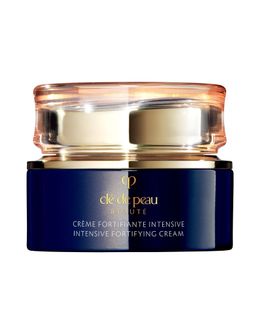
Clé de Peau Beauté Intensive Fortifying Cream
Works for
3 of 3 advertised claims delivered
Evens skin tonePotassium methoxysalicylate, Dipotassium glycyrrhizateStrong evidence
“Working to diminish the look of hyperpigmentation and fine lines, this rich and luxurious formula replenishes skin and feeds it with intense moisture for a dewy, hydrated finish, which is bolstered by the brand’s ‘Skin Empowering Illuminator’ complex.”
This product can help reduce hypepigmentation and even out the skin tone because it contains the following effective ingredients: potassium methoxysalicylate
Keep in mind that you would need to apply any topical skincare targetted at hypigmentation consistently for a couple of months to get a result. No topical skincare product can help get rid of hyperpigmentation (including post-acne marks and age spots) instantly.
Anti-agingSerine, TocopherolModerate evidence
“Drawing from this knowledge and using state-of-the-art technology, our exclusive ingredient, Skin-Empowering Illuminator, was specially developed to enhance skin s intuitive ability to repair and defend itself, for the most radiantly youthful look.”
This product contains serine. This ingredient might be able to help reduce and prevent fine lines and wrinkles, improve skin elasticity and firmness, but there is not enough evidence that it actually works.
MoisturizingDimethicone, Glycine + 21 moreGood evidence
“Contains Ononis Spinosa Root extract and Abelmoschus Esculentus extract, which intensively target specific collagens and proteins that are critical to the skin* Utilizing breakthrough technology, this cream is formulated to help diminish the advancement of daily UV damage during the night.”
This product can help improve hydration of the skin with the two types of ingredients.
The first type is called “humectants”:
these ingredients help attract water.
When humectants are on the surface of the skin, they “pull in” the moisture from the outside environment, or from
within deeper layers of the skin. The following ingredients in this product do the job:
glycerin, glycine.
This product also contains ingredients called “occlusives”. They help reduce the speed with which our skin loses moisture to the outside environment. These ingredients also help soften the upper layer of the skin, so it feels less tight and nicer to the touch. The following ingredients in this product do the job: dimethicone, phytosteryl macadamiate.
Can it cause trouble?
Irritancy12 strong irritants: Alcohol denat., Parfum + 10 more — patch-test recommendedHigh risk
Comedogenic1 ingredient rated 2 or more on the 0–5 pore-clogging scale1 flagged
User reviews
Be the first — your take helps the next person decide.
Ingredients
Filter by role to see what each ingredient is doing.
Water~40–60%
Butylene glycol~4.4–6.6%
- Irritation risk
- Low
Used to create a nice product texture and help delivery of other ingredients. Might be somewhat helpful in attracting water to the upper layer of the skin
More about Butylene glycolGlycerin~2.8–4.3%
- Irritation risk
- Low
One of the best moisturizing ingredients. Naturally present in skin. It attracts water to the upper layer of the skin working as a humectant
More about GlycerinDimethicone~2.4–3.6%
- Irritation risk
- Low
A silicone that helps to reduce water loss from the surface of the skin. Can temporarily "fill in" lines and wrinkles, absorb oil, and create a nice product finish
More about DimethiconeAlcohol denat.~1.6–2.5%
- Irritation risk
- High
Produces temporary toning effect. Can help dissolve other ingredients or preserve products
More about Alcohol denat.Triethylhexanoin~1–1.6%
- Irritation risk
- Medium
Helps soften the upper layer of the skin
More about TriethylhexanoinPeg/ppg-14/7 dimethyl ether~1–1.5%
- Irritation risk
- Low
An emollient that helps soften the skin. It also forms a protective on its surface to reduce water loss
More about Peg/ppg-14/7 dimethyl etherHydrogenated polydecene~1.1–1.6%
- Irritation risk
- Low
Helps to soften the upper layer of the skin and create a nice product texture
More about Hydrogenated polydecenePhytosteryl macadamiate~0.9–1.35%
- Irritation risk
- Low
Helps soften the upper layer of the skin
More about Phytosteryl macadamiateBehenyl alcohol~0.5–1.2%
- Irritation risk
- Low
Non-drying alcohol that helps water and oil mix together. Also serves as an emollient
More about Behenyl alcoholGlyceryl stearate se~0.3–0.75%
- Irritation risk
- Low
- Comedogenicity
- 2/5
Used to stabilize the product formulations and works as an emollient
More about Glyceryl stearate seTrehalose~0.15–0.55%
- Irritation risk
- Low
A sugar that attracts water to the upper layer of the skin
More about TrehalosePotassium methoxysalicylate~0.1–0.35%
- Irritation risk
- Medium
Can help reduce hyperpigmentation
More about Potassium methoxysalicylateMethyl methacrylate crosspolymer~0.05–0.3%
- Irritation risk
- Low
Helps thicken the product consistency
More about Methyl methacrylate crosspolymerStearyl alcohol~0.05–0.3%
- Irritation risk
- Low
An emollient that helps soften the skin
More about Stearyl alcoholDimethylacrylamide/sodium acryloyldimethyltaurate crosspolymer~0.05–0.2%
- Irritation risk
- Low
Polysorbate 60~0.05–0.25%
Peg-40 stearate~0.05–0.25%
Phenoxyethanol~0.05–0.25%
- Irritation risk
- Low
A preservative. It helps prevent bacterial growth in cosmetic products
More about PhenoxyethanolHydrogenated palm oil~0.05–0.3%
- Irritation risk
- Low
Helps soften the upper layer of the skin
More about Hydrogenated palm oilElaeis guineensis kernel oil~0.05–0.25%
- Irritation risk
- Low
Helps soften the upper layer of the skin
More about Elaeis guineensis kernel oilElaeis guineensis oil~0.05–0.2%
- Irritation risk
- Low
Helps soften the upper layer of the skin
More about Elaeis guineensis oilTheanine~0.01–0.1%
- Irritation risk
- Low
Sorbitan tristearate~0.05–0.1%
- Irritation risk
- Medium
Helps oil and water mix together
More about Sorbitan tristearateTrisodium edta~0.01–0.05%
Peg/ppg-17/4 dimethyl ether~0.01–0.05%
Tocopheryl acetate~0.05–0.1%
- Irritation risk
- Medium
A more stable but less bio-available form of vitamin E compared to Tocopherol. Might help moisturize and protect the skin from free radicals, but mostly used in low concentrations to stabilize other ingredients.
More about Tocopheryl acetateParfum~0.01–0.05%
- Irritation risk
- High
An aromatic blend of unspecified and possibly irritating ingredients
More about ParfumSodium citrate~0.01–0.1%
- Irritation risk
- Medium
Helps to control the skin's pH level. Maintains the skin's natural film of amino-lactic acids and oils. Helps to preserve products
More about Sodium citratePolyquaternium-51~0.05–0.15%
- Irritation risk
- Low
An emollient that helps create a nice silky finish on the skin
More about Polyquaternium-51Alcohol~0.05–0.1%
- Irritation risk
- High
Can be drying and contribute to skin irritation. Used in formulars to dissolve other ingredients, create a thinner product consistency or for its antibacterial properties
More about AlcoholCitric acid~0.01–0.1%
- Irritation risk
- Medium
Can work as an exfoliant but is typically used to adjust the product pH
More about Citric acidSilica~0.1–0.35%
Xanthan gum~0.05–0.1%
- Irritation risk
- Low
Used to create a thicker product consistency
More about Xanthan gumSodium metaphosphate~0.05–0.15%
Ectoin~0.01–0.05%
- Irritation risk
- Low
Softens the upper layer of the skin and can support skin barrier function
More about EctoinDipotassium glycyrrhizate~0.01–0.1%
- Irritation risk
- Low
A salt derived from licorice. Works as an emollient to soften the upper layer of the skin and can help calm down inflammation. Might be helpful for skin lightening
More about Dipotassium glycyrrhizateAlpha-isomethyl ionone~0.01–0.05%
- Irritation risk
- High
A fragrance. Potential allergen and can be irritating
More about Alpha-isomethyl iononeCitronellol~0.01–0.1%
Linalool~0.01–0.1%
Sodium metabisulfite~0.05–0.15%
Geraniol~0.01–0.1%
Benzyl benzoate~0.01–0.1%
- Irritation risk
- High
Fragrance with sweet balsamic smell. Help to preserve products and dissolve other ingredients. Could trigger allergic reactions and be irritating
More about Benzyl benzoateAngelica acutiloba root extract~0.05–0.1%
- Irritation risk
- Low
Olea europaea leaf extract~0.01–0.05%
- Irritation risk
- Medium
A plant extract that might have some anti-oxidant and anti-inflammatory properties but evidence for effectiveness in skin is missing
More about Olea europaea leaf extractLimonene~0.01–0.1%
- Irritation risk
- High
A common frangrance that can easily irritate skin, especially if exposed to air, light or heat
More about LimonenePaeonia albiflora root extract~0.05–0.1%
- Irritation risk
- Low
Panax ginseng root extract~0.05–0.2%
- Irritation risk
- High
A plant extract that might have some anti-inflammatory properties, but solid evidence is lacking. It can be irritating
More about Panax ginseng root extractHydrolyzed silk~0.05–0.15%
- Irritation risk
- Medium
Can help attract water to the upper layer of the skin
More about Hydrolyzed silkSerine~0.05–0.1%
- Irritation risk
- Low
An amino-acid that helps to attract water to the upper layer of the skin. In combination with other amino-acids, might help to reduce fine lines and wrinkles
More about SerineGlycine~0.05–0.1%
- Irritation risk
- Low
Helps to attract water to the upper layer of the skin and can help restore the skin barrier function
More about GlycineRubus suavissimus leaf extract~0.05–0.1%
- Irritation risk
- Low
Ononis spinosa root extract~0.01–0.1%
- Irritation risk
- Low
Iron oxides~0.05–0.1%
- Irritation risk
- Low
An umbrella term for the following three colorants: CI 77491, CI 77492, CI 77499. They might be able to offer some protection against visible light, but the degree of the protection is not clear
More about Iron oxidesCi 77491~0.05–0.15%
- Irritation risk
- Low
A red colorant made of iron oxide. Typically is not irritating
More about Ci 77491Tocopherol~0.05–0.2%
- Irritation risk
- Low
Pure form of vitamin E. Can help moisturise and protect the skin from free radicals. Often used to help stabilise other ingredients or the formula itself
More about TocopherolIron oxides~0.05–0.2%
- Irritation risk
- Low
An umbrella term for the following three colorants: CI 77491, CI 77492, CI 77499. They might be able to offer some protection against visible light, but the degree of the protection is not clear
More about Iron oxidesCi 77492~0.05–0.2%
Cinnamomum cassia bark extract~0.05–0.3%
Lavandula angustifolia oil~0.05–0.2%
- Irritation risk
- High
An essential oil. Potential allergen and can be irritating. It has some anti-bacterial properties
More about Lavandula angustifolia oilRosa canina fruit extract~0.05–0.2%
- Irritation risk
- Medium
A plant extract that might have some anti-oxidant properties, but evidence is lacking
More about Rosa canina fruit extractHibiscus esculentus fruit extract~0.05–0.25%
- Irritation risk
- High
A plant extract that might help to neutralize free radicals. It can be irritating
More about Hibiscus esculentus fruit extractFagus sylvatica bud extract~0.05–0.3%
- Irritation risk
- Low
Sodium acetylated hyaluronate~0.05–0.3%
- Irritation risk
- Low
A type of hyaluronic acid that works as an excellent moisturizer by attracting water into the upper layer of the skin. Is typically feels less sticky on the skin compared to the usual hyaluronic acid
More about Sodium acetylated hyaluronatePerilla ocymoides leaf extract~0.05–0.3%
- Irritation risk
- High
A plant extract that might help neutralize free radicals in skin but solid research is lacking. Contains a number of volatile compounds and could be irritating
More about Perilla ocymoides leaf extractBenzoic acid~0.05–0.25%
Uncaria gambir extract~0.05–0.25%
- Irritation risk
- High
A plant extract that might be helpful in neutralizing free radicals, but solid research is missing. Can be irritating
More about Uncaria gambir extractRosa roxburghii fruit extract~0.05–0.25%
- Irritation risk
- Medium
A fruit extract that might help neutralize free radicals in skin, but evidence of effectiveness is missing
More about Rosa roxburghii fruit extractHydrolyzed conchiolin protein~0.05–0.1%
Bupleurum falcatum root extract~0.05–0.1%
- Irritation risk
- High
A plant extract that might help to attract water to the upper layer of the skin, but it is not well studied. It can be irritating
More about Bupleurum falcatum root extractIngredient list view
Water, Butylene glycol, Glycerin, Dimethicone, Alcohol denat., Triethylhexanoin, Peg/ppg-14/7 dimethyl ether, Hydrogenated polydecene, Phytosteryl macadamiate, Behenyl alcohol, Glyceryl stearate se, Trehalose, Potassium methoxysalicylate, Methyl methacrylate crosspolymer, Stearyl alcohol, Dimethylacrylamide/sodium acryloyldimethyltaurate crosspolymer, Polysorbate 60, Peg-40 stearate, Phenoxyethanol, Hydrogenated palm oil, Elaeis guineensis kernel oil, Elaeis guineensis oil, Theanine, Sorbitan tristearate, Trisodium edta, Peg/ppg-17/4 dimethyl ether, Tocopheryl acetate, Parfum, Sodium citrate, Polyquaternium-51, Alcohol, Citric acid, Silica, Xanthan gum, Sodium metaphosphate, Ectoin, Dipotassium glycyrrhizate, Alpha-isomethyl ionone, Citronellol, Linalool, Sodium metabisulfite, Geraniol, Benzyl benzoate, Angelica acutiloba root extract, Olea europaea leaf extract, Limonene, Paeonia albiflora root extract, Panax ginseng root extract, Hydrolyzed silk, Serine, Glycine, Rubus suavissimus leaf extract, Ononis spinosa root extract, Iron oxides, Ci 77491, Tocopherol, Iron oxides, Ci 77492, Cinnamomum cassia bark extract, Lavandula angustifolia oil, Rosa canina fruit extract, Hibiscus esculentus fruit extract, Fagus sylvatica bud extract, Sodium acetylated hyaluronate, Perilla ocymoides leaf extract, Benzoic acid, Uncaria gambir extract, Rosa roxburghii fruit extract, Hydrolyzed conchiolin protein, Bupleurum falcatum root extract
Compare prices
Retailers ranked by price — lowest first.

Sources cited in this review
Every concentration estimate and effectiveness label is anchored to one of these 30 studies and safety reviews.
- 1
- 2
- 3Final Report on the Safety Assessment of Dimethicone Copolyoljournals.sagepub.com
- 4
- 5Safety Assessment of Polyene Group as Used in Cosmeticscir-safety.org
- 6Safety Assessment of Phytosterols as Used in Cosmeticscir-safety.org

Affiliate links · As an Amazon Associate, WIMJ earns from qualifying purchases.