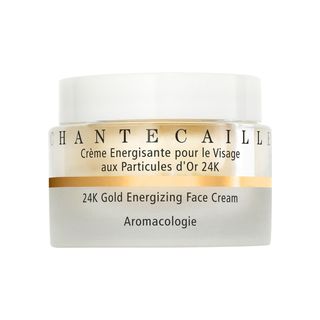
Chantecaille 24K Gold Energizing Face Cream
Works for
2 of 3 advertised claims delivered
MoisturizingPalmitoyl tripeptide-5, Acetyl heptapeptide-9 + 30 moreStrong evidence
“24K Gold Energizing Face Cream”
This product can help improve hydration of the skin with the two types of ingredients.
The first type is called “humectants”:
these ingredients help attract water.
When humectants are on the surface of the skin, they “pull in” the moisture from the outside environment, or from
within deeper layers of the skin. The following ingredients in this product do the job:
glycerin, sodium hyaluronate.
This product also contains ingredients called “occlusives”. They help reduce the speed with which our skin loses moisture to the outside environment. These ingredients also help soften the upper layer of the skin, so it feels less tight and nicer to the touch. The following ingredients in this product do the job: dimethicone, dimethiconol.
The following ingredients in this product are especially good for supporting the skin barrier and helping with the hydration level: acetyl heptapeptide-9, palmitoyl tripeptide-5
Anti-agingPalmitoyl tripeptide-5, Acetyl heptapeptide-9 + 8 moreModerate evidence
“A luxurious treatment balm infused with 24-karat gold and a vegan gold peptide to create unparalleled anti-aging power.”
This product contains acetyl heptapeptide-9, palmitoyl tripeptide-5. These ingredients might be able to help reduce and prevent fine lines and wrinkles, improve skin elasticity and firmness, but there is not enough evidence that it actually works.
Evens skin toneCamellia sinensis leaf extract, Ascorbic acid + 1 moreWeak evidence
“Maintain skin’s natural health and vitality while reducing multiple signs of ageing with Chantecaille Nano Gold Energising Cream, a luxurious balm formulated with a high concentration of botanical ingredients that cares for and repairs skin.Containing a blend of 24-k gold and silk, which boast antioxidant and anti-inflammatory properties, this cream brightens and evens skin tone while stimulating natural collagen production.”
Effective ingredients missing or their concentration is too low
Can it cause trouble?
Irritancy11 strong irritants: Rosa damascena flower water, Rosa damascena flower oil + 9 more — patch-test recommendedHigh risk
Comedogenic5 ingredients rated 2 or more on the 0–5 pore-clogging scale5 flagged
User reviews
Be the first — your take helps the next person decide.
Ingredients
Filter by role to see what each ingredient is doing.
Rosa damascena flower water~28–34%
- Irritation risk
- High
Used to add a nice rose smell to the product. Might help attract water to the upper layer of the skin and have some anti-oxidant effect. Can be irritating
More about Rosa damascena flower waterCyclopentasiloxane~6.5–7.9%
- Irritation risk
- Low
A silicone that helps improve the product texture and spreadability. Can absorb oil creating a short-term mattifying effect on the skin
More about CyclopentasiloxaneGlycerin~5–6.1%
- Irritation risk
- Low
One of the best moisturizing ingredients. Naturally present in skin. It attracts water to the upper layer of the skin working as a humectant
More about GlycerinGlyceryl stearate se~3.6–4.4%
- Irritation risk
- Low
- Comedogenicity
- 2/5
Used to stabilize the product formulations and works as an emollient
More about Glyceryl stearate sePropanediol~2.8–3.4%
- Irritation risk
- Low
Acts as a solvent for other ingredients. Speeds up the absorption of other ingredients into the skin
More about PropanediolEthylhexyl palmitate~2.3–2.8%
- Irritation risk
- Low
- Comedogenicity
- 3/5
An emollient that helps soften the skin and create a nice product texture
More about Ethylhexyl palmitatePeg-40 stearate~1.7–2.1%
Myristyl myristate~1.7–2.1%
- Irritation risk
- Medium
- Comedogenicity
- 3/5
An emollient. Is not recommended for acne-prone skin as it can be comedogenic
More about Myristyl myristateCetyl alcohol~1.3–1.6%
- Irritation risk
- Low
A non-drying alcohol that works to soften the skin and stabilize product formulations helping oil and water mix together
More about Cetyl alcoholSorbitan tristearate~0.9–1.1%
- Irritation risk
- Medium
Helps oil and water mix together
More about Sorbitan tristearateStearic acid~0.8–1.15%
- Irritation risk
- Low
Helps oil and water mix together and works as an emollient
More about Stearic acidButyrospermum parkii butter~0.65–0.95%
- Irritation risk
- Low
- Comedogenicity
- 3/5
A great moisturising ingredient that softens the skin and reduces water loss from its upper layer. It also can be helpful in protecting skin from free radicals
More about Butyrospermum parkii butterDimethicone~0.55–0.85%
- Irritation risk
- Low
A silicone that helps to reduce water loss from the surface of the skin. Can temporarily "fill in" lines and wrinkles, absorb oil, and create a nice product finish
More about DimethiconeMethyl methacrylate crosspolymer~0.6–0.9%
- Irritation risk
- Low
Helps thicken the product consistency
More about Methyl methacrylate crosspolymerPolyacrylamide~0.6–0.9%
- Irritation risk
- Medium
Used to improve product texture and help oil and water mix together
More about PolyacrylamideCaprylyl glycol~0.45–0.65%
- Irritation risk
- Medium
Helps preserve products and creates a nice product texture
More about Caprylyl glycolDiphenyl dimethicone~0.45–0.7%
Sorbitol~0.3–0.55%
- Irritation risk
- Low
Helps attract water to the upper layer of the skin and improves the product texture
More about SorbitolPpg-25-laureth-25~0.2–0.4%
Mica~0.3–0.6%
- Irritation risk
- Low
Creates an illusion of smoother and more radiant skin tone. Adds shimmer to the skin by reflecting light
More about MicaC13-14 isoparaffin~0.3–0.55%
- Irritation risk
- Low
Helps soften the upper layer of the skin, dissolve other ingredients and create a thicker product consistency
More about C13-14 isoparaffinButylene glycol~0.2–0.4%
- Irritation risk
- Low
Used to create a nice product texture and help delivery of other ingredients. Might be somewhat helpful in attracting water to the upper layer of the skin
More about Butylene glycolPullulan~0.35–0.6%
- Irritation risk
- High
Creates a thin drying film on the skin resulting in a short-term tightening effect
More about PullulanBisabolol~0.2–0.35%
- Irritation risk
- Low
An active component of chamomile plant that historically has been used to calm down irritated skin. A recent study shows that bisabolol indeed can have some anti-inflammatory effect on skin, even though conclusive data is lacking. Bisabolol has a sweet floral scent and can be added to products for its aromatic properties
More about BisabololBorago officinalis seed oil~0.3–0.5%
- Irritation risk
- Low
A plant oil that is effective in reducing irritation in skin, restore the barrier function and support its hydration
More about Borago officinalis seed oilOenothera biennis oil~0.3–0.5%
- Irritation risk
- Medium
Helps soften the upper layer of the skin and can support skin barrier function
More about Oenothera biennis oilCi 77891~0.2–0.35%
- Irritation risk
- Low
Titanium dioxide~0.3–0.55%
- Irritation risk
- Low
Works as a UV filter when used in high concentrations. It is photostable and is effective mostly against the UVB light, with some protection in the UVA range. In small concentrations, used for its ability to improve the color of cosmetic products. Is usually well tolerated by the skin
More about Titanium dioxideSqualane~0.3–0.55%
- Irritation risk
- Low
An oil naturally present in skin. Works as an emollient to soften the skin and form a protective layer on its surface without a greasy feeling.
More about SqualaneXanthan gum~0.2–0.4%
- Irritation risk
- Low
Used to create a thicker product consistency
More about Xanthan gumDimethiconol~0.3–0.5%
- Irritation risk
- Low
A silicone that makes products more spreadable and keeps skin smooth. Helps to add gloss to skin and may visually fill in fine lines/wrinkles for short time
More about DimethiconolAscorbyl tetraisopalmitate~0.25–0.5%
- Irritation risk
- Medium
A vitamin C derivative. Studies show that is might be effective in reducing hyperpigmentation, but there are no studies confirming that it is effectively converted into the bioavailable form of Vitamin C in skin. It is not clear how this derivative compares in effectiveness to the topical application of bioavailable form of vitamin C (L-ascorbic acid)
More about Ascorbyl tetraisopalmitateLaureth-7~0.25–0.4%
Sodium polyacrylate~0.45–0.65%
- Irritation risk
- Low
Used to create a gel-like product texture, as well as to stabilize emulsions
More about Sodium polyacrylateTocopheryl acetate~0.25–0.4%
- Irritation risk
- Medium
A more stable but less bio-available form of vitamin E compared to Tocopherol. Might help moisturize and protect the skin from free radicals, but mostly used in low concentrations to stabilize other ingredients.
More about Tocopheryl acetateMaltodextrin~0.35–0.6%
- Irritation risk
- Low
Used to stabilize the product formulation and can help absorb oil
More about MaltodextrinHexylene glycol~0.25–0.45%
- Irritation risk
- Medium
Helps create a more spreadable product texture
More about Hexylene glycolRosa damascena flower oil~0.25–0.45%
- Irritation risk
- High
Used as a fragrance. Can be irritating
More about Rosa damascena flower oilAcacia dealbata flower wax~0.3–0.55%
- Irritation risk
- Low
Citrus aurantium dulcis peel oil~0.25–0.45%
- Irritation risk
- High
An essentil oil from orange peel. Potential allergen and can be irritating
More about Citrus aurantium dulcis peel oilJasminum grandiflorum flower wax~0.25–0.45%
- Irritation risk
- Low
Nannochloropsis oculata extract~0.25–0.45%
- Irritation risk
- Low
A microalgae extract that helps to attact water to the upper layer of the skin
More about Nannochloropsis oculata extractPanthenol~0.25–0.45%
- Irritation risk
- Low
Helps attract water to the upper layer of the skin and can help improve skin barrier function
More about PanthenolPhytic acid~0.25–0.5%
- Irritation risk
- Medium
An alpha-hydroxy acid (AHA), but is mostly used to stabilize product formulations in cosmetics
More about Phytic acidSodium hyaluronate~0.25–0.45%
- Irritation risk
- Low
One of the best moisturizing ingredients. Attracts water into the upper layer of the skin
More about Sodium hyaluronatePelargonium graveolens oil~0.25–0.45%
Palmitoyl tripeptide-5~0.25–0.5%
- Irritation risk
- Low
A type of peptide. Peptides are excellent moisturizers and might be able support collagen production reducing fine lines and wrinkles
More about Palmitoyl tripeptide-5Peg-8~0.25–0.5%
- Irritation risk
- Medium
Used to create a nice product consistency
More about Peg-8Ci 77491~0.25–0.5%
- Irritation risk
- Low
A red colorant made of iron oxide. Typically is not irritating
More about Ci 77491Iron oxides~0.25–0.45%
- Irritation risk
- Low
An umbrella term for the following three colorants: CI 77491, CI 77492, CI 77499. They might be able to offer some protection against visible light, but the degree of the protection is not clear
More about Iron oxidesRosmarinus officinalis extract~0.25–0.45%
- Irritation risk
- High
Alcohol~0.25–0.5%
- Irritation risk
- High
Can be drying and contribute to skin irritation. Used in formulars to dissolve other ingredients, create a thinner product consistency or for its antibacterial properties
More about AlcoholEscin~0.25–0.45%
- Irritation risk
- High
A compound obtained from horse chestnut. It is claimed that this chemical can improve circulation, but there is no evidence available that it works in skin
More about EscinTocopherol~0.25–0.5%
- Irritation risk
- Low
Pure form of vitamin E. Can help moisturise and protect the skin from free radicals. Often used to help stabilise other ingredients or the formula itself
More about TocopherolRuscus aculeatus root extract~0.25–0.45%
- Irritation risk
- Low
Ammonium glycyrrhizate~0.25–0.5%
- Irritation risk
- Low
Centella asiatica extract~0.3–0.55%
- Irritation risk
- Medium
A plant extract that has been shown to be able to reduce inflammation in skin, support restoration of skin barrier function, as well as support collagen production. Contains active compounds called centelloids: asiaticoside, madecasosside, asiatic acid and madecassic acid. Might be helpful in preventing stretch marks. It can be itself be irritating though.
More about Centella asiatica extractChlorella vulgaris extract~0.25–0.5%
- Irritation risk
- Medium
- Comedogenicity
- 3/5
A plant extract that can help to attract water to the upper layer of the skin and might have some anti-oxidant and anti-inflammatory properties
More about Chlorella vulgaris extractHydrolyzed yeast protein~0.25–0.5%
- Irritation risk
- Low
Ascorbyl palmitate~0.25–0.45%
- Irritation risk
- Medium
Being a lipid soluble form of vitamin C, it is more stable and can penetrate the skin better than L-Ascorbic acid. It is effective in protecting the skin from free radicals, as well as evening the skin tone, but is less effective in stimulating collagen production compared to L-Ascorbic acid.
More about Ascorbyl palmitateCalendula officinalis flower extract~0.25–0.45%
- Irritation risk
- High
A plant extract that has some anti-oxidant and anti-bacterial properties. Can be irritating
More about Calendula officinalis flower extractEchinacea angustifolia root extract~0.25–0.5%
- Irritation risk
- Low
Nicotiana sylvestris leaf cell culture~0.3–0.6%
- Irritation risk
- Medium
Has been claimed to have an ability to protect collagen and stimulate its production in skin but further research is lacking so far
More about Nicotiana sylvestris leaf cell culturePlantago lanceolata leaf extract~0.25–0.5%
- Irritation risk
- Medium
A plant extract that might have anti-oxidant properties
More about Plantago lanceolata leaf extractSodium citrate~0.25–0.45%
- Irritation risk
- Medium
Helps to control the skin's pH level. Maintains the skin's natural film of amino-lactic acids and oils. Helps to preserve products
More about Sodium citrateAnanas sativus fruit extract~0.25–0.5%
- Irritation risk
- Medium
A fruit extract that might help to attract water to the upper layer of the skin, but there is no evidence for any other benefits to the skin
More about Ananas sativus fruit extractGlyceryl caprylate~0.35–0.65%
- Irritation risk
- Low
An emollient that can also help water and oil mix together, as well as prevent bacteria growth in products
More about Glyceryl caprylateAscorbic acid~0.25–0.45%
- Irritation risk
- High
The most well-researched antioxidant that works in skin. Helps neutralize free radicals supporting collagen production, helping to even out the skin tone and preventing early signs of aging
More about Ascorbic acidCitric acid~0.25–0.45%
- Irritation risk
- Medium
Can work as an exfoliant but is typically used to adjust the product pH
More about Citric acidCamellia sinensis leaf extract~0.25–0.5%
- Irritation risk
- Low
Can contain potent anti-oxidant compounds (abbreviated ECG, GCG, EGC, and EGCG) that might help protect the skin from free radicals. Can help calm down inflammation and has some anti-bacterial properties. Unfortunately, these antioxidants are unstable and lose their effectiveness very quickly in products. The concentration of the antioxidant compounds in the extract also tends to be low to be effective in topical formulation
More about Camellia sinensis leaf extractAcetyl heptapeptide-9~0.25–0.5%
- Irritation risk
- Low
A type of peptide. Peptides are excellent moisturizers and might be able support collagen production reducing fine lines and wrinkles
More about Acetyl heptapeptide-9Colloidal gold~0.25–0.5%
- Irritation risk
- Low
Citronellol~0.2–0.4%
Geraniol~0.2–0.4%
Linalool~0.2–0.4%
Citral~0.2–0.4%
Phenoxyethanol~0.25–0.45%
- Irritation risk
- Low
A preservative. It helps prevent bacterial growth in cosmetic products
More about PhenoxyethanolSodium benzoate~0.2–0.4%
Potassium sorbate~0.2–0.35%
Benzyl alcohol~0.15–0.25%
- Irritation risk
- High
A preservative. Can be used to mask unpleasant smell. Can be irritating
More about Benzyl alcoholSodium dehydroacetate~0.15–0.25%
Sorbic acid~0.15–0.3%
Undecylenic acid~0.1–0.2%
Benzoic acid79%
Ingredient list view
Rosa damascena flower water, Cyclopentasiloxane, Glycerin, Glyceryl stearate se, Propanediol, Ethylhexyl palmitate, Peg-40 stearate, Myristyl myristate, Cetyl alcohol, Sorbitan tristearate, Stearic acid, Butyrospermum parkii butter, Dimethicone, Methyl methacrylate crosspolymer, Polyacrylamide, Caprylyl glycol, Diphenyl dimethicone, Sorbitol, Ppg-25-laureth-25, Mica, C13-14 isoparaffin, Butylene glycol, Pullulan, Bisabolol, Borago officinalis seed oil, Oenothera biennis oil, Ci 77891, Titanium dioxide, Squalane, Xanthan gum, Dimethiconol, Ascorbyl tetraisopalmitate, Laureth-7, Sodium polyacrylate, Tocopheryl acetate, Maltodextrin, Hexylene glycol, Rosa damascena flower oil, Acacia dealbata flower wax, Unknown, Citrus aurantium dulcis peel oil, Unknown, Jasminum grandiflorum flower wax, Nannochloropsis oculata extract, Panthenol, Phytic acid, Sodium hyaluronate, Pelargonium graveolens oil, Palmitoyl tripeptide-5, Peg-8, Ci 77491, Iron oxides, Rosmarinus officinalis extract, Alcohol, Escin, Tocopherol, Ruscus aculeatus root extract, Ammonium glycyrrhizate, Centella asiatica extract, Chlorella vulgaris extract, Hydrolyzed yeast protein, Ascorbyl palmitate, Calendula officinalis flower extract, Echinacea angustifolia root extract, Nicotiana sylvestris leaf cell culture, Plantago lanceolata leaf extract, Sodium citrate, Ananas sativus fruit extract, Glyceryl caprylate, Ascorbic acid, Citric acid, Camellia sinensis leaf extract, Acetyl heptapeptide-9, Colloidal gold, Citronellol, Geraniol, Linalool, Citral, Phenoxyethanol, Sodium benzoate, Potassium sorbate, Benzyl alcohol, Sodium dehydroacetate, Sorbic acid, Undecylenic acid, Benzoic acid, Unknown
Compare prices
Retailers ranked by price — lowest first.


Product summary
"Chantecaille - 24K Gold Energizing Face Cream" has a good moisturizing formula. This moisturizer uses a good combo of humectants and emollients. These both types of ingredients are essentials for improving the skin hydration and keeping the skin barrier healthy. Humectants in this product (glycerin, sodium hyaluronate, butylene glycol, caprylyl glycol and peg-8) help to increase the water content in the upper layer of the skin. (These ingredients do so by "capturing" water molecules from the outside air or from within the deeper layers of the skin). Borago officinalis seed oil, oenothera biennis oil, dimethicone, dimethiconol and myristyl myristate in this product help decrease the water evoporation from the skin, so that it stays hydrated for longer. These ingredients also soften the skin and take away the feeling of tightness and dryness.
Ingredient callouts
- This product also contains Vitamin C (Ascorbic Acid). It can be an effective active for anti-aging and evening out the skin tone, but in this moisturizer it is used for stabilizing other ingredients in the formulation. In this concentration (0.25% - 0.45%) it cannot have a noticeable benefit for the skin.
- We like that this moisturizer contains peptides (acetyl heptapeptide-9 0.25% - 0.50% and palmitoyl tripeptide-5 0.25% - 0.50%). There are many different kind of Peptides and they are naturally present in our skin. They all are a combination of aminoacids. Some of them work as natural antibiotics, promote wound-healing and production of collagen. The science is still not settled on how effective Peptides are in skincare, but it is very likely that they have a benefit. Peptides might help restore the skin barrier and fight the signs of aging. At the very least, Peptides work as humectants: they attract water to the upper layer of the skin and improve its hydration.
Irritation risk
There are quite a few common irritants in this product, including ingredients without particular skin benefits. We would not recommend it for sensitive skin. We assess the overall irritancy of this moisturizer to be high. For a detailed overview of all potential irritants: click here
You can see the detailed formula review with the breakdown of all actives in the product and the full ingredient list with estimated concentrations in the tables below.
About the brand
According to Cruelty-Free Kitty "Chantecaille" is cruelty free, but its parent company is not.
Price
The product retails from 425.00$ up to 566.00$ in the United States and from 375.00£ up to 2765.00£ in the United Kingdom.
For a detailed price comparison: click here.
Sources cited in this review
Every concentration estimate and effectiveness label is anchored to one of these 34 studies and safety reviews.
- 1
- 2
- 3
- 4
- 5Final Report on the Safety Assessment of Dimethicone Copolyoljournals.sagepub.com
- 6Safety Assessment of Isoparaffins as Used in Cosmeticsjournals.sagepub.com

Affiliate links · As an Amazon Associate, WIMJ earns from qualifying purchases.