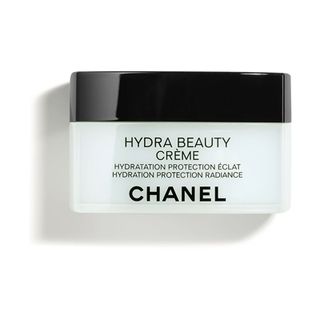
CHANEL Hydra Beauty Creme Hydration Protection Radiance
Works for
1 of 1 advertised claim delivered
MoisturizingSodium hyaluronate, Dimethicone + 15 moreGood evidence
“HYDRA BEAUTY CRÈME is the radiance enhancing moisturiser for women in search of intense hydration backed by advanced antioxidant protection.”
This product can help improve hydration of the skin with the two types of ingredients.
The first type is called “humectants”:
these ingredients help attract water.
When humectants are on the surface of the skin, they “pull in” the moisture from the outside environment, or from
within deeper layers of the skin. The following ingredients in this product do the job:
glycerin, saccharide isomerate.
This product also contains ingredients called “occlusives”. They help reduce the speed with which our skin loses moisture to the outside environment. These ingredients also help soften the upper layer of the skin, so it feels less tight and nicer to the touch. The following ingredients in this product do the job: dimethicone, octyldodecyl neopentanoate.
Anti-oxidationNot advertised by the brand · Camellia japonica flower extract, Zingiber officinale root extract + 3 moreModerate evidence
This product contains antioxidants (camellia japonica flower extract) that might be able to help neutralize free radicals in skin to lessen the damage it gets from the UV light (sun). There is not enough evidence to confirm their effectiveness in skin though.
Can it cause trouble?
Irritancy2 strong irritants: Zingiber officinale root extract, ParfumMedium risk
Comedogenic1 ingredient rated 2 or more on the 0–5 pore-clogging scale1 flagged
User reviews
Ingredients
Filter by role to see what each ingredient is doing.
Water~45–55%
Glycerin~4.7–5.7%
- Irritation risk
- Low
One of the best moisturizing ingredients. Naturally present in skin. It attracts water to the upper layer of the skin working as a humectant
More about GlycerinOctyldodecyl neopentanoate~4.2–5.1%
- Irritation risk
- Low
An emollient that helps soften the skin. Often used to stabilize other ingredients, for example, sunscreen
More about Octyldodecyl neopentanoateHydrogenated polyisobutene~3.2–3.9%
- Irritation risk
- Low
Used to improve the product consistency and soften the upper layer of the skin
More about Hydrogenated polyisobuteneSilica~2.4–3%
C12-15 alkyl benzoate~2–2.4%
- Irritation risk
- Low
Enhances the product texture and makes it more spreadable. Helps reduce water loss from the outer layer of skin. Extands the shelf life by preventing bacteria growth
More about C12-15 alkyl benzoatePentylene glycol~1.7–2.1%
- Irritation risk
- Medium
Used to preserve products, dissolve other ingredients and create a nice product texture
More about Pentylene glycolOctyldodecanol~1.5–1.8%
- Irritation risk
- Low
An emollient that helps to soften the skin and create a pleasant product texture and stabilize the formulation
More about OctyldodecanolPeg-40 stearate~1.3–1.5%
Camellia kissi seed oil~1–1.3%
- Irritation risk
- Low
Glyceryl stearate~0.8–1.2%
- Irritation risk
- Low
An emollient that softens the skin and forms a protective layer on its surface. Helps water and oil mix together
More about Glyceryl stearateAmmonium acryloyldimethyltaurate/vp copolymer~0.65–0.95%
- Irritation risk
- Low
Increases thickness of a product. Texture enhancer for oil-in-water emulsions
More about Ammonium acryloyldimethyltaurate/vp copolymerZingiber officinale root extract~0.55–0.8%
- Irritation risk
- High
A plant extract that can contain an irritating essential oil. Might have some anti-oxidant effect, but evidence is lacking
More about Zingiber officinale root extractCamellia japonica flower extract~0.55–0.85%
- Irritation risk
- High
A plant extract that might help neutralize free radicals in skin
More about Camellia japonica flower extractButyrospermum parkii butter~0.55–0.8%
- Irritation risk
- Low
- Comedogenicity
- 3/5
A great moisturising ingredient that softens the skin and reduces water loss from its upper layer. It also can be helpful in protecting skin from free radicals
More about Butyrospermum parkii butterPhytosteryl canola glycerides~0.5–0.75%
- Irritation risk
- Low
Helps soften the upper layer of the skin
More about Phytosteryl canola glyceridesPhenoxyethanol~0.5–0.75%
- Irritation risk
- Low
A preservative. It helps prevent bacterial growth in cosmetic products
More about PhenoxyethanolSaccharide isomerate~0.45–0.65%
- Irritation risk
- Low
Helps attract water to the upper layer of the skin
More about Saccharide isomerateCetyl alcohol~0.45–0.65%
- Irritation risk
- Low
A non-drying alcohol that works to soften the skin and stabilize product formulations helping oil and water mix together
More about Cetyl alcoholSteareth-2~0.3–0.6%
Dimethicone~0.35–0.65%
- Irritation risk
- Low
A silicone that helps to reduce water loss from the surface of the skin. Can temporarily "fill in" lines and wrinkles, absorb oil, and create a nice product finish
More about DimethiconeParfum~0.25–0.5%
- Irritation risk
- High
An aromatic blend of unspecified and possibly irritating ingredients
More about ParfumCaprylyl glycol~0.3–0.55%
- Irritation risk
- Medium
Helps preserve products and creates a nice product texture
More about Caprylyl glycolSodium carbomer~0.25–0.5%
Lauroyl lysine~0.25–0.5%
- Irritation risk
- Low
Helps soften the upper layer of the skin and creates a nice product texture
More about Lauroyl lysinePropylene glycol~0.25–0.45%
- Irritation risk
- High
Helps oil and water mix together and can enhance the penetration of other ingredients into the skin. It can be irritating
More about Propylene glycolPeg-12~0.25–0.45%
- Irritation risk
- Low
Pentaerythrityl tetra-di-t-butyl hydroxyhydrocinnamate~0.25–0.45%
- Irritation risk
- Low
Used to increase stability of product formulations
More about Pentaerythrityl tetra-di-t-butyl hydroxyhydrocinnamateSodium hyaluronate~0.25–0.4%
- Irritation risk
- Low
One of the best moisturizing ingredients. Attracts water into the upper layer of the skin
More about Sodium hyaluronateSodium citrate~0.2–0.4%
- Irritation risk
- Medium
Helps to control the skin's pH level. Maintains the skin's natural film of amino-lactic acids and oils. Helps to preserve products
More about Sodium citratePhytic acid~0.2–0.35%
- Irritation risk
- Medium
An alpha-hydroxy acid (AHA), but is mostly used to stabilize product formulations in cosmetics
More about Phytic acidCitric acid~0.15–0.3%
- Irritation risk
- Medium
Can work as an exfoliant but is typically used to adjust the product pH
More about Citric acidTocopherol~0.15–0.3%
- Irritation risk
- Low
Pure form of vitamin E. Can help moisturise and protect the skin from free radicals. Often used to help stabilise other ingredients or the formula itself
More about TocopherolAscorbyl palmitate~0.1–0.2%
- Irritation risk
- Medium
Being a lipid soluble form of vitamin C, it is more stable and can penetrate the skin better than L-Ascorbic acid. It is effective in protecting the skin from free radicals, as well as evening the skin tone, but is less effective in stimulating collagen production compared to L-Ascorbic acid.
More about Ascorbyl palmitateSodium benzoate~0.1–0.2%
Ingredient list view
Water, Glycerin, Octyldodecyl neopentanoate, Hydrogenated polyisobutene, Silica, C12-15 alkyl benzoate, Pentylene glycol, Octyldodecanol, Peg-40 stearate, Camellia kissi seed oil, Glyceryl stearate, Ammonium acryloyldimethyltaurate/vp copolymer, Zingiber officinale root extract, Camellia japonica flower extract, Butyrospermum parkii butter, Phytosteryl canola glycerides, Phenoxyethanol, Saccharide isomerate, Cetyl alcohol, Steareth-2, Dimethicone, Parfum, Caprylyl glycol, Sodium carbomer, Lauroyl lysine, Propylene glycol, Peg-12, Pentaerythrityl tetra-di-t-butyl hydroxyhydrocinnamate, Sodium hyaluronate, Sodium citrate, Phytic acid, Citric acid, Tocopherol, Ascorbyl palmitate, Sodium benzoate
Compare prices
Retailers ranked by price — lowest first.

Sources cited in this review
Every concentration estimate and effectiveness label is anchored to one of these 17 studies and safety reviews.
- 1
- 2
- 3
- 4
- 5
- 6

Affiliate links · As an Amazon Associate, WIMJ earns from qualifying purchases.