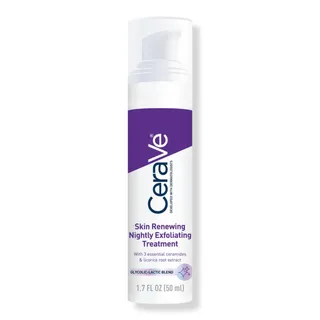
CeraVe Skin Renewing Nightly Exfoliating Treatment
Works for
ExfoliationGlycolic acid, Lactic acidWorks well
“Skin Renewing Nightly Exfoliating Treatment”
This product can help exfoliate the skin. In other words, it helps break down the bonds between dead cells on the surface of the skin and speed up the skin turnover. Skin often appears softer and brighter after exfoliation, but overdoing it can result in disrupted skin barrier. The following ingredient is doing the exfoliating job in this product: glycolic acid, lactic acid.
Anti-agingGlycolic acid, Lactic acidWorks well
“With continued use, skin looks healthier, radiance is improved, and signs of aging such as the appearance of wrinkles, dullness, dark spots and enlarged pores are reduced.”
This product can help reduce and prevent fine lines and wrinkles, improve skin elasticity and firmness because it contains glycolic acid.
These ingredients in the product can also be helpful, even though there is less evidence for their effectiveness: lactic acid.
Keep in mind that it typically takes at least 6 weeks to notice any results because the changes that are needed to improve fine lines and elasticity happen in the deeper layers of the skin. No topical anti-aging product can “erase” wrinkles or fully reverse signs of aging.
MoisturizingCeramide np, Ceramide ap + 12 moreWorks well
“The creamy, hydrating skin treatment is non-comedogenic, fragrance-free and suitable for all skin types, including sensitive skin.”
This product can help improve hydration of the skin with the two types of ingredients.
The first type is called “humectants”:
these ingredients help attract water.
When humectants are on the surface of the skin, they “pull in” the moisture from the outside environment, or from
within deeper layers of the skin. The following ingredients in this product do the job:
dipotassium glycyrrhizate, glycerin.
This product also contains ingredients called “occlusives”. They help reduce the speed with which our skin loses moisture to the outside environment. These ingredients also help soften the upper layer of the skin, so it feels less tight and nicer to the touch. The following ingredients in this product do the job: dimethicone, cholesterol.
The following ingredients in this product are especially good for supporting the skin barrier and helping with the hydration level: ceramide ap, ceramide eop, ceramide np, phytosphingosine
Evens skin toneGlycolic acid, Lactic acid + 2 moreWorks well
“Potent, yet gentle and lightweight, this multi-tasking, overnight AHA serum is formulated with 3 essential ceramides that work together to lock in skins moisture and help restore your skin’s protective barrier, hyaluronic acid and licorice root extract to help maintain the protective skin barrier, immediately boost skin hydration and help visibly brighten and even skin tone after 8 weeks of use.*”
This product can help reduce hypepigmentation and even out the skin tone because it contains the following effective ingredients: glycolic acid, lactic acid
The following ingredient (ingredients) in this product might be helpful, but there is no evidence to confirm that it actually can help even out the skin tone: dipotassium glycyrrhizate, phenylethyl resorcinol.
Keep in mind that you would need to apply any topical skincare targetted at hypigmentation consistently for a couple of months to get a result. No topical skincare product can help get rid of hyperpigmentation (including post-acne marks and age spots) instantly.
Can it cause trouble?
Irritancy11 flagged ingredientsLow risk
Comedogenic2 ingredients rated 2 or more on the 0–5 pore-clogging scale2 flagged
User reviews
Be the first — your take helps the next person decide.
Ingredients
Filter by role to see what each ingredient is doing.
Water~40–60%
Glycerin~3.8–5.8%
- Irritation risk
- Low
One of the best moisturizing ingredients. Naturally present in skin. It attracts water to the upper layer of the skin working as a humectant
More about GlycerinCetearyl ethylhexanoate~3.7–5.5%
- Irritation risk
- Low
An emollient that helps soften the skin
More about Cetearyl ethylhexanoateCetearyl alcohol~2.2–3.3%
- Irritation risk
- Low
- Comedogenicity
- 2/5
A non-drying alcohol. Works as an emollient. Helps water and oil mix together and creates a nice product texture
More about Cetearyl alcoholDimethicone~2.1–3.2%
- Irritation risk
- Low
A silicone that helps to reduce water loss from the surface of the skin. Can temporarily "fill in" lines and wrinkles, absorb oil, and create a nice product finish
More about DimethiconeGlycolic acid~1.7–2.5%
- Irritation risk
- High
An alpha-hydroxy acid (AHA) that helps to remove the dead skin cells on the surface of the skin reveling a more even, smoother complexation. It is also able to stimulate collagen production with long-term use. Could help to reduce pore congestion. It can be irritating to the skin. Apply sunscreen daily if using products with glycolic acid
More about Glycolic acidLactic acid~1.4–2.1%
- Irritation risk
- Medium
An exfoliating and moisturizing alpha-hydroxy acid (AHA). Typically causes less irritation than other AHAs, for example, glycolic acid. At high concentrations (about 15%), lactic acid can help reduce lines and wrinkles. Recent studies show that lactic acid can support the "good" bacteria living on skin's surface (healthy skin microbiome)
More about Lactic acidSodium hydroxide~1.3–1.9%
Dipotassium glycyrrhizate~1–1.5%
- Irritation risk
- Low
A salt derived from licorice. Works as an emollient to soften the upper layer of the skin and can help calm down inflammation. Might be helpful for skin lightening
More about Dipotassium glycyrrhizatePolyacrylate crosspolymer-6~0.85–1.25%
- Irritation risk
- Low
Ceramide np~0.55–1.25%
- Irritation risk
- Low
A type of lipid similar to ceramides naturally present in skin. Helps to soften the upper layer of the skin and supports the skin barrier function to keep it hydrated. Can help to prevent inflammation in skin
More about Ceramide npCeramide ap~0.45–1%
- Irritation risk
- Low
A type of lipid similar to ceramides naturally present in skin. Helps to soften the upper layer of the skin and supports the skin barrier function to keep it hydrated. Can help to prevent inflammation in skin
More about Ceramide apCeramide eop~0.4–0.9%
- Irritation risk
- Low
A type of lipid similar to ceramides naturally present in skin. Helps to soften the upper layer of the skin and supports the skin barrier function to keep it hydrated. Can help to prevent inflammation in skin
More about Ceramide eopCarbomer~0.35–0.8%
- Irritation risk
- Low
Helps create a thicker or gel-like product texture. It is not a surfactant but can be used in gentle cleansing formulations
More about CarbomerCetearyl glucoside~0.3–0.75%
- Irritation risk
- Medium
Helps water and oil in the product mix well together and improves product texture
More about Cetearyl glucosideBehentrimonium methosulfate~0.3–0.7%
- Irritation risk
- Medium
Helps oil and water mix together
More about Behentrimonium methosulfateTriethyl citrate~0.15–0.7%
Sodium hyaluronate~0.15–0.7%
- Irritation risk
- Low
One of the best moisturizing ingredients. Attracts water into the upper layer of the skin
More about Sodium hyaluronateSodium lauroyl lactylate~0.15–0.65%
- Irritation risk
- Medium
Helps water and oil mix together
More about Sodium lauroyl lactylateCholesterol~0.15–0.65%
- Irritation risk
- Low
An emollient that is naturally found in skin
More about CholesterolPhenoxyethanol~0.15–0.5%
- Irritation risk
- Low
A preservative. It helps prevent bacterial growth in cosmetic products
More about PhenoxyethanolPhenylethyl resorcinol~0.15–0.5%
- Irritation risk
- High
Might help reduce hyperpigmentation in skin and help neutralize free radicals
More about Phenylethyl resorcinolIsopropyl myristate~0.15–0.55%
- Irritation risk
- Low
- Comedogenicity
- 3/5
An emollient that helps soften the skin. Could be comedogenic
More about Isopropyl myristateCaprylyl glycol~0.1–0.45%
- Irritation risk
- Medium
Helps preserve products and creates a nice product texture
More about Caprylyl glycolCitric acid~0.1–0.3%
- Irritation risk
- Medium
Can work as an exfoliant but is typically used to adjust the product pH
More about Citric acidTrisodium ethylenediamine disuccinate~0.05–0.3%
- Irritation risk
- Medium
Used to improve stability of the formulation
More about Trisodium ethylenediamine disuccinateXanthan gum~0.05–0.25%
- Irritation risk
- Low
Used to create a thicker product consistency
More about Xanthan gumPhytosphingosine~0.1–0.3%
- Irritation risk
- Low
A type of lipid that is naturally present in skin. It might help in repairing skin barrier function and has anti-bacterial effect
More about PhytosphingosineBenzoic acid~0.05–0.2%
Ingredient list view
Water, Glycerin, Cetearyl ethylhexanoate, Cetearyl alcohol, Dimethicone, Glycolic acid, Lactic acid, Sodium hydroxide, Dipotassium glycyrrhizate, Polyacrylate crosspolymer-6, Ceramide np, Ceramide ap, Ceramide eop, Carbomer, Cetearyl glucoside, Behentrimonium methosulfate, Triethyl citrate, Sodium hyaluronate, Sodium lauroyl lactylate, Cholesterol, Phenoxyethanol, Phenylethyl resorcinol, Isopropyl myristate, Caprylyl glycol, Citric acid, Trisodium ethylenediamine disuccinate, Xanthan gum, Phytosphingosine, Benzoic acid
Compare prices
Retailers ranked by price — lowest first.

Worth comparing, line by line.
Match % combines shared ingredients, the first five ingredients, shared actives and hero ingredients, irritancy (lower counts in the alternative's favour), texture and body area. Only products in the same routine step are compared.
| CeraVeSkin Renewing Nightly Exfoliating TreatmentYOUR PRODUCT | AcneFree Dermatology Inspired CareBlackhead Removing Scrub With Charcoal | Dr. Emi ArpaAbsolut A Retinal Serum | Irritated.FACE + BODY SERUM | |
|---|---|---|---|---|
| Match | — | 48% | 48% | 47% |
| Price | $23.86 | — | — | $79.95+$56.09 |
| Shared key ingredients | — | 7 of 13 | 7 of 13 | 8 of 13 |
| Key difference | — | Salicylic Acid | Palmitoyl Pentapeptide-4 | Colloidal Oatmeal |
| Irritancy | Low | Low | Low | Low |
| Drying alcohol | — | — | — | — |
| View product | Shop | Shop | Shop |


More alternatives: Balance Active Formula Ceramides Skin Barrier SerumApothaka Skincare Barrier Support Serum
Product summary
"CeraVe - Skin Renewing Nightly Exfoliating Treatment" is effective for: Exfoliation, Evens skin tone, Anti-aging and Moisturizing
Ingredient callouts
- This product contains acids (lactic acid 1.40% - 2.10% and glycolic acid 1.70% - 2.50%). Their concentration is low, and they will not have a strong exfoliating effect. Instead, they work to support the skin natural acid mantle and to attract water (as humectants). Lactic acid is particularly good in attracting water to the upper layer of the skin and improving the skin barrier.
- Ceramides (ceramide np 0.55% - 1.25%, phytosphingosine 0.10% - 0.30%, ceramide eop 0.40% - 0.90% and ceramide ap 0.40% - 0.95%). Ceramides are a type of lipids that our skin produces itself. They are a building block of the skin's barrier. Ceramides used in skincare are synthetic or extracted from plants. They work well for softening the skin surface and "patch holes" in the skin's barrier.
- Dipotassium Glycyrrhizate in this product (1.00% - 1.50%) can also further help improve the skin barrier. It might be able to calm down inflammation and reduce sensitivity. Dipotassium Glycyrrhizate is an active compound from the licorice root.
- Humectants (glycerin 3.80% - 5.80%, dipotassium glycyrrhizate 1.00% - 1.50% and sodium hyaluronate 0.15% - 0.70%). These ingredients help attract water to the upper layer of the skin and improve the skin hydration.
Sources cited in this review
Every concentration estimate and effectiveness label is anchored to one of these 16 studies and safety reviews.
- 1
- 2
- 3Final Report on the Safety Assessment of Dimethicone Copolyoljournals.sagepub.com
- 4
- 5Glycolic acid peel therapy – a current reviewncbi.nlm.nih.gov
- 6

Affiliate links · As an Amazon Associate, WIMJ earns from qualifying purchases.