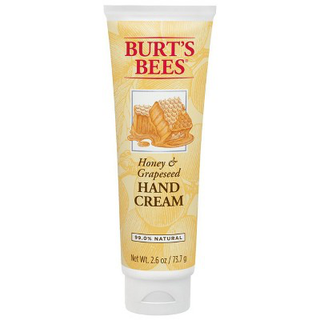
Burt's Bees Honey and Grapeseed Oil Hand Cream
Works for
1 of 1 advertised claim delivered
Moisturizing21 ingredients credited for this claimGood support
“Honey and Grapeseed Oil Hand Cream”
This product can help improve hydration of the skin with the two types of ingredients.
The first type is called “humectants”:
these ingredients help attract water.
When humectants are on the surface of the skin, they “pull in” the moisture from the outside environment, or from
within deeper layers of the skin. The following ingredients in this product do the job:
arginine, biosaccharide gum-1.
This product also contains ingredients called “occlusives”. They help reduce the speed with which our skin loses moisture to the outside environment. These ingredients also help soften the upper layer of the skin, so it feels less tight and nicer to the touch. The following ingredients in this product do the job: arginine, butyrospermum parkii butter.
Can it cause trouble?
Irritancy3 strong irritants: Parfum, Sodium anisate + 1 more — patch-test recommendedHigh risk
Comedogenic3 ingredients rated 2 or more on the 0–5 pore-clogging scale3 flagged
User reviews
Be the first — your take helps the next person decide.
Ingredients
Filter by role to see what each ingredient is doing.
Water~40–60%
Glycerin~4.1–6.2%
- Irritation risk
- Low
One of the best moisturizing ingredients. Naturally present in skin. It attracts water to the upper layer of the skin working as a humectant
More about GlycerinHelianthus annuus seed oil~3.7–5.6%
- Irritation risk
- Low
A great emollient due to its high linoleic acid content. One of the most effective plant oils in helping skin hydration and repairing skin barrier function
More about Helianthus annuus seed oilCetyl alcohol~2.2–3.3%
- Irritation risk
- Low
A non-drying alcohol that works to soften the skin and stabilize product formulations helping oil and water mix together
More about Cetyl alcoholCocos nucifera oil~2.1–3.1%
- Irritation risk
- Low
- Comedogenicity
- 3/5
An emollient. Found to be as effective as a moisturizer for dry skin as mineral oil. Could be comedogenic
More about Cocos nucifera oilAdansonia digitata oil~1.7–2.6%
- Irritation risk
- Low
Baobab oil. Helps soften the upper layer of the skin
More about Adansonia digitata oilCaprylic/capric triglyceride~1.5–2.3%
- Irritation risk
- Medium
A good mix of fatty acids that forms a protective layer on the skin. Improves the shelf life of products. Derived from coconut and glycerin
More about Caprylic/capric triglycerideTheobroma grandiflorum seed butter~1.3–1.9%
- Irritation risk
- Medium
Helps soften the upper layer of the skin and might as well help to attract moisture to its upper layer
More about Theobroma grandiflorum seed butterButyrospermum parkii butter~1.1–1.7%
- Irritation risk
- Low
- Comedogenicity
- 3/5
A great moisturising ingredient that softens the skin and reduces water loss from its upper layer. It also can be helpful in protecting skin from free radicals
More about Butyrospermum parkii butterParfum~0.85–1.25%
- Irritation risk
- High
An aromatic blend of unspecified and possibly irritating ingredients
More about ParfumGlyceryl stearate citrate~0.55–1.25%
- Irritation risk
- Low
Helps oil and water mix together while softening the upper layer of the skin
More about Glyceryl stearate citrateStearic acid~0.5–1.2%
- Irritation risk
- Low
Helps oil and water mix together and works as an emollient
More about Stearic acidSucrose stearate~0.4–1%
Vitis vinifera seed oil~0.4–0.9%
- Irritation risk
- Medium
A great emollient that can also have anti-oxidant properties
More about Vitis vinifera seed oilHoney~0.3–0.75%
- Irritation risk
- Low
Helps attract water to the skin and might have some anti-bacterial properties. Can be an allergen
More about HoneyHelianthus annuus seed wax~0.35–0.8%
- Irritation risk
- Low
Helps soften the upper layer of the skin and support skin's barrier function while creating a thicker product consistency
More about Helianthus annuus seed waxGlycine soja oil~0.3–0.75%
- Irritation risk
- Medium
- Comedogenicity
- 2/5
A good emollient that helps soften the skin and helps repair its barrier function. It can clog pores if used in high concentrations.
More about Glycine soja oilAcacia decurrens flower wax~0.2–0.75%
Tocopherol~0.2–0.7%
- Irritation risk
- Low
Pure form of vitamin E. Can help moisturise and protect the skin from free radicals. Often used to help stabilise other ingredients or the formula itself
More about TocopherolJojoba esters~0.2–0.75%
- Irritation risk
- Medium
An emollient made of jojoba oil. Helps soften the skin and support its barrier function
More about Jojoba estersGlyceryl caprylate~0.2–0.7%
- Irritation risk
- Low
An emollient that can also help water and oil mix together, as well as prevent bacteria growth in products
More about Glyceryl caprylateSucrose polystearate~0.15–0.65%
- Irritation risk
- Medium
Helps oil and water mix together
More about Sucrose polystearateXanthan gum~0.15–0.55%
- Irritation risk
- Low
Used to create a thicker product consistency
More about Xanthan gumArginine~0.1–0.45%
- Irritation risk
- Low
An amino acid that is naturally present in skin and helps keep it hydrated. When used together with AHAs, it can reduce their irritating effect on the skin
More about ArginineLactic acid~0.1–0.5%
- Irritation risk
- Medium
An exfoliating and moisturizing alpha-hydroxy acid (AHA). Typically causes less irritation than other AHAs, for example, glycolic acid. At high concentrations (about 15%), lactic acid can help reduce lines and wrinkles. Recent studies show that lactic acid can support the "good" bacteria living on skin's surface (healthy skin microbiome)
More about Lactic acidPolyglycerin-3~0.15–0.5%
- Irritation risk
- Low
Helps to attract water to the upper layer of the skin
More about Polyglycerin-3Biosaccharide gum-1~0.1–0.45%
- Irritation risk
- Low
Helps attract water to the upper layer of the skin and is claimed to provide a longer-lasting hydration because of its ability to create a water-binding film on the surface of the skin
More about Biosaccharide gum-1Magnesium aluminum silicate~0.1–0.45%
- Irritation risk
- Low
Might be helpful in restoring skin barrier function and, when combined with zinc carbonate and malonic acid, reducing fine lines and wrinkles by stimulating elastin production. Also helps stabilize the product formulation
More about Magnesium aluminum silicateSodium stearoyl lactylate~0.1–0.35%
- Irritation risk
- Medium
Helps oil and water mix together
More about Sodium stearoyl lactylateSodium anisate~0.1–0.3%
Sodium levulinate~0.05–0.25%
Phenoxyethanol~0.05–0.25%
- Irritation risk
- Low
A preservative. It helps prevent bacterial growth in cosmetic products
More about PhenoxyethanolCoumarin~0.05–0.1%
Ingredient list view
Water, Glycerin, Helianthus annuus seed oil, Cetyl alcohol, Cocos nucifera oil, Adansonia digitata oil, Caprylic/capric triglyceride, Theobroma grandiflorum seed butter, Butyrospermum parkii butter, Parfum, Glyceryl stearate citrate, Stearic acid, Sucrose stearate, Vitis vinifera seed oil, Honey, Helianthus annuus seed wax, Glycine soja oil, Acacia decurrens flower wax, Tocopherol, Jojoba esters, Glyceryl caprylate, Sucrose polystearate, Xanthan gum, Arginine, Lactic acid, Polyglycerin-3, Biosaccharide gum-1, Magnesium aluminum silicate, Sodium stearoyl lactylate, Sodium anisate, Sodium levulinate, Phenoxyethanol, Coumarin
Compare prices
Retailers ranked by price — lowest first.
.png)

Sources cited in this review
Every concentration estimate and effectiveness label is anchored to one of these 14 studies and safety reviews.
- 1
- 2
- 3
- 4Effect of topically applied lipids on surfactant-irritated skinonlinelibrary.wiley.com
- 5
- 6

Affiliate links · As an Amazon Associate, WIMJ earns from qualifying purchases.