Works for
1 of 1 advertised claim delivered
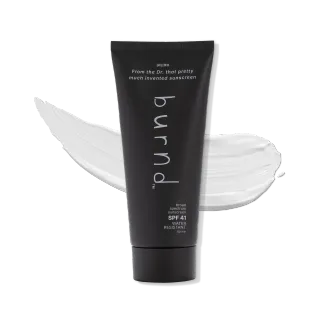
Sun protectionSPF 41 · 3 UV filtersBroad spectrum
This product offers a good level of protection against both UVB and UVA rays.
This sunscreen uses organic (so-called "chemical") sunscreen filters. Organic, or "chemical" filters usually provide reliable sun protection and rarely leave a white cast. Sunscreens with organic filters can sting eyes.
Evens skin toneNot advertised by the brand · No ingredient credited for this claimStrong evidence
This product offers broad spectrum sun protection. It means that it can prevent hyperpigmentation and help keep the skin tone even (sun damage is the main factor causing age spots, darkening of post-acne marks and other discolorations).
Anti-agingNot advertised by the brand · Ascorbyl palmitateStrong evidence
This product can help prevent early signs of skin aging because it offers a good level of broad spectrum sun protection. Sun damage is the main cause of premature skin aging, and protecting your skin from the sun is the best anti-aging strategy.
MoisturizingNot advertised by the brand · Glycerin, Beeswax + 5 moreGood evidence
This product can help improve hydration of the skin with the two types of ingredients.
The first type is called “humectants”:
these ingredients help attract water.
When humectants are on the surface of the skin, they “pull in” the moisture from the outside environment, or from
within deeper layers of the skin. The following ingredients in this product do the job:
glycerin, caprylyl glycol.
This product also contains ingredients called “occlusives”. They help reduce the speed with which our skin loses moisture to the outside environment. These ingredients also help soften the upper layer of the skin, so it feels less tight and nicer to the touch. The following ingredients in this product do the job: beeswax, bis-peg-12 dimethicone.
Can it cause trouble?
Irritancy11 flagged ingredientsLow risk
ComedogenicClean of flagged comedogenic ingredientsNone flagged
User reviews
Be the first — your take helps the next person decide.
Ingredients
Filter by role to see what each ingredient is doing.
Zinc oxide8.1%
- Irritation risk
- Low
A broad spectrum sunblock (protects from both UVA and UVB rays). Is suitable for most sensitive skins. In small concentrations, can be used as a colorant
More about Zinc oxideEthylhexyl methoxycinnamate7.5%
- Irritation risk
- High
Octinoxate. When used in higher concentrations, works as a sunscreen protecting the skin from UVB rays. When used in lower concentration, helps to preserve the product formulation. Is shown to be harmful to coral reefs - consider avoiding bathing in coral reef areas when wearing a product with this ingredient. It can be irritating
More about Ethylhexyl methoxycinnamateHomosalate8%
- Irritation risk
- Medium
A weak sunscreen that offers some protection against the sun rays that cause sunburn (UVB), but does not offer meaningful protection against protect against the most aging sun rays (UVA). It loses its effectiveness quickly when exposed to sunlight. It is an organic, or so called "chemical" sunscreen. When used in low concentrations, helps to stabilize the product formulation
More about HomosalateCyclopentasiloxane~24–36%
- Irritation risk
- Low
A silicone that helps improve the product texture and spreadability. Can absorb oil creating a short-term mattifying effect on the skin
More about CyclopentasiloxanePolysilicone-11~4.7–7%
- Irritation risk
- Low
A silicone that forms a light film on the skin surface helping to bind water and temporarily absorb oils creating a matt and powdery feel
More about Polysilicone-11Ascorbyl palmitate~3.9–5.9%
- Irritation risk
- Medium
Being a lipid soluble form of vitamin C, it is more stable and can penetrate the skin better than L-Ascorbic acid. It is effective in protecting the skin from free radicals, as well as evening the skin tone, but is less effective in stimulating collagen production compared to L-Ascorbic acid.
More about Ascorbyl palmitateHydrogenated castor oil~2.6–3.9%
- Irritation risk
- Medium
A plant oil that can help soften the skin. It might be helpful in calming down inflammation, but solid research is lacking. Is often used in lip products to create the needed product consistency
More about Hydrogenated castor oilTocopheryl acetate~2.1–3.1%
- Irritation risk
- Medium
A more stable but less bio-available form of vitamin E compared to Tocopherol. Might help moisturize and protect the skin from free radicals, but mostly used in low concentrations to stabilize other ingredients.
More about Tocopheryl acetateMethylpropanediol~1.7–2.6%
Propanediol~1.5–2.3%
- Irritation risk
- Low
Acts as a solvent for other ingredients. Speeds up the absorption of other ingredients into the skin
More about PropanediolCaprylyl glycol~1.3–2%
- Irritation risk
- Medium
Helps preserve products and creates a nice product texture
More about Caprylyl glycolEthylhexylglycerin~1.1–1.6%
Water~0.85–1.3%
Bis-peg-12 dimethicone~0.55–1.3%
- Irritation risk
- Low
A type of silicone. Helps soften the upper layer of the skin
More about Bis-peg-12 dimethiconeBeeswax~0.5–1.15%
- Irritation risk
- Low
Forms a protective barrier that holds water and keeps dry skin hydrated. Keeps an emulsion from separating into its oil and liquid components, and increases the thickness of a product. Can be an allergen
More about BeeswaxPeg/ppg-20/15 dimethicone~0.4–0.95%
- Irritation risk
- Medium
Helps oil and water mix together
More about Peg/ppg-20/15 dimethiconePeg-30 dipolyhydroxystearate~0.35–0.8%
- Irritation risk
- Medium
Helps oil and water mix together
More about Peg-30 dipolyhydroxystearateSilica~0.45–1.05%
Sodium chloride~0.2–0.75%
- Irritation risk
- Low
Used to stabilize mixtures of oil and water, and create thicker, gel-like product textures
More about Sodium chlorideTriethoxycaprylylsilane~0.15–0.6%
- Irritation risk
- Low
A type of silicone that helps oil and water mix well together. Helps to disperse other ingredients, e.g. pigments, evenly in a formulation
More about TriethoxycaprylylsilaneCaprylhydroxamic acid~0.1–0.4%
Caprylyl glycol~0.1–0.45%
- Irritation risk
- Medium
Helps preserve products and creates a nice product texture
More about Caprylyl glycolGlycerin~0.1–0.35%
- Irritation risk
- Low
One of the best moisturizing ingredients. Naturally present in skin. It attracts water to the upper layer of the skin working as a humectant
More about GlycerinIngredient list view
Zinc oxide, Ethylhexyl methoxycinnamate, Homosalate, Cyclopentasiloxane, Polysilicone-11, Ascorbyl palmitate, Hydrogenated castor oil, Tocopheryl acetate, Methylpropanediol, Propanediol, Caprylyl glycol, Ethylhexylglycerin, Water, Unknown, Bis-peg-12 dimethicone, Beeswax, Peg/ppg-20/15 dimethicone, Peg-30 dipolyhydroxystearate, Silica, Sodium chloride, Triethoxycaprylylsilane, Caprylhydroxamic acid, Caprylyl glycol, Glycerin
Compare prices
Retailers ranked by price — lowest first.

Affiliate links · prices updated regularly
Sources cited in this review
Every concentration estimate and effectiveness label is anchored to one of these 10 studies and safety reviews.
- 1A review of inorganic UV filters zinc oxide and titanium dioxideonlinelibrary.wiley.com
- 2
- 3
- 4
- 5
- 6

Affiliate links · As an Amazon Associate, WIMJ earns from qualifying purchases.