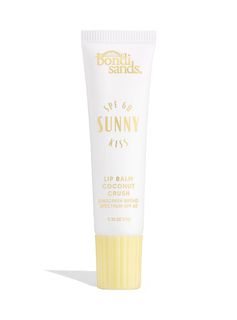
Bondi Sands Sunny Kiss SPF 60 Coconut Crush Lip Balm

Bondi Sands Sunny Kiss SPF 60 Coconut Crush Lip Balm

SPF 60Efficacy60/100IrritancyMedium·4 UV filters
Edit

Works for

1 of 2 advertised claims delivered

Sun protection
SPF 60 · 4 UV filters · Broad spectrum
Weak protectionLow filter dose
SPF 60Broad spectrumChemical filtersNo white cast

This product can be considered "reef safe" because it does not contain the UV filters (oxybenzone and octinoxate) that can be harmful to coral reefs when present in the water in high concentrations.

UV spectrum
UVB290–320 nmUVA II320–340 nmUVA I340–400 nm
Uvinul T
Octocrylene
Tinosorb S
Avobenzone
FilterCoverageWhat it doesEst. amount
Uvinul TEthylhexyl TriazoneUVB Photo-stable Uvinul T. A UV filter. Effective against UVB rays. It is photostable. Can increase water resistance properties of the sunscreen. Unfortunately, not approved by the FDA (US) yet~0.55–1.35%
OctocryleneUVB Photo-stable A weak sunscreen that protects against the sun rays that cause sunburn (UVB) and is somewhat effective against the UVA rays. It is quite stable and can help stabilize other, more vulnerable, sunscreen ingredients like Avobenzone. It is an organic, or so called "chemical" sunscreen~0.8–1.2%
Tinosorb SBis-ethylhexyloxyphenol Methoxyphenyl TriazineUVBUVA Photo-stable Tinosorb S. One of the most effective broad spectrum sunscreen ingredients. Protects from both UVA and UVB rays. It is photostable. Unfortunately, not approved by FDA (US) yet.~0.4–0.9%
AvobenzoneButyl MethoxydibenzoylmethaneUVA1Avobenzone. An organic, or so-called "chemical" UV filter. Protects against both UVA and UVB rays. Needs to be combined with other filters in a formulation to be stable.~0.9–1.3%
~ marks concentrations estimated from label position and typical use levels
Reef-safe
No oxybenzone or octinoxate — the two filters banned in Hawaii, Florida Keys and Aruba.
Moisturizing
12 ingredients credited for this claim
Good support
What the product description says
“nourishing sun protection”
Source: Bondi Sands US

This product can help improve hydration of the skin with the two types of ingredients.

The first type is called “humectants”:
these ingredients help attract water. When humectants are on the surface of the skin, they “pull in” the moisture from the outside environment, or from within deeper layers of the skin. The following ingredients in this product do the job: erythritol, glycerin.

This product also contains ingredients called “occlusives”. They help reduce the speed with which our skin loses moisture to the outside environment. These ingredients also help soften the upper layer of the skin, so it feels less tight and nicer to the touch. The following ingredients in this product do the job: butyrospermum parkii butter, cera microcristallina.

GlycerinKey active· HumectantEffect: HighOne of the best moisturizing ingredients. Naturally present in skin. It attracts water to the upper layer of the skin working as a humectant~0.15–0.5%
Ricinus communis seed oilKey active· Emollient, OcclusiveEffect: HighA plant oil that can help soften the skin. It might be helpful in calming down inflammation, but solid research is lacking. Is often used in lip products to create the needed product consistency~25–37%
Butyrospermum parkii butterKey active· Emollient, OcclusiveEffect: HighA great moisturising ingredient that softens the skin and reduces water loss from its upper layer. It also can be helpful in protecting skin from free radicals~1.3–2%
Cera microcristallinaKey active· Emollient, OcclusiveEffect: HighHelps to soften the upper layer of the skin, reduce water loss from its surface and create a thicker product consistency~4.7–7.1%
ErythritolKey active· HumectantEffect: HighHelps to attract water to the upper layer of the skin~0.1–0.35%
Synthetic beeswaxKey activeEffect: HighHelps soften the upper layer of the skin~1.6–2.3%
Cetyl palmitateKey active· EmollientEffect: MediumAn emollient that helps soften the skin and is used to improve product texture and stability~2.7–4.1%
Hydrogenated polydecene· EmollientEffect: LowHelps to soften the upper layer of the skin and create a nice product texture~3.6–5.4%
Octyldodecanol· EmollientEffect: LowAn emollient that helps to soften the skin and create a pleasant product texture and stabilize the formulation~5.3–8%
Cocoglycerides· EmollientEffect: LowHelp soften the upper layer of the skin and make it easier for oil and water mix together. Recently, a rising number of allergic reactions to cocoglycerides and other coconut-derived surfactants has been reported. As there is a significant overlap between frequent irritants and allergens, we flag this ingredient for attention of those with very sensitive, reactive skin~2.1–3.2%
Butylene glycol· HumectantEffect: LowUsed to create a nice product texture and help delivery of other ingredients. Might be somewhat helpful in attracting water to the upper layer of the skin~1.3–2%
Simmondsia chinensis seed oilUnder-dosedEffect: HighSoftens the upper layer of skin and helps restore the healthy skin barrier. Has shown to help calm down inflammation in skin. It is a stable oil, meaning that it retains its properties even when exposed to air.~0.85–1.3%

Can it cause trouble?

Irritancy
1 strong irritant: Parfum
Medium risk
We flagged 11 ingredients with irritancy potential. Severity depends on your sensitivity threshold; the table lists the worst offenders first.
IngredientFunctionIrritationEst. amount
CocoglyceridesHelp soften the upper layer of the skin and make it easier for oil and water mix together. Recently, a rising number of allergic reactions to cocoglycerides and other coconut-derived surfactants has been reported. As there is a significant overlap between frequent irritants and allergens, we flag this ingredient for attention of those with very sensitive, reactive skinHigh~2.1–3.2%est.
TriacetinUsed to dissolve other ingredientsHigh~0.5–1.2%est.
ParfumAn aromatic blend of unspecified and possibly irritating ingredientsHigh~0.15–0.55%est.
Ricinus communis seed oilA plant oil that can help soften the skin. It might be helpful in calming down inflammation, but solid research is lacking. Is often used in lip products to create the needed product consistencyMedium~25–37%est.
Simmondsia chinensis seed oilSoftens the upper layer of skin and helps restore the healthy skin barrier. Has shown to help calm down inflammation in skin. It is a stable oil, meaning that it retains its properties even when exposed to air.Medium~0.85–1.3%est.
Butyl methoxydibenzoylmethaneAvobenzone. An organic, or so-called "chemical" UV filter. Protects against both UVA and UVB rays. Needs to be combined with other filters in a formulation to be stable.Medium~0.9–1.3%est.
OctocryleneA weak sunscreen that protects against the sun rays that cause sunburn (UVB) and is somewhat effective against the UVA rays. It is quite stable and can help stabilize other, more vulnerable, sunscreen ingredients like Avobenzone. It is an organic, or so called "chemical" sunscreenMedium~0.8–1.2%est.
Ethylhexyl triazoneUvinul T. A UV filter. Effective against UVB rays. It is photostable. Can increase water resistance properties of the sunscreen. Unfortunately, not approved by the FDA (US) yetMedium~0.55–1.35%est.
Peg-30 dipolyhydroxystearateHelps oil and water mix togetherMedium~0.4–0.9%est.
Bis-ethylhexyloxyphenol methoxyphenyl triazineTinosorb S. One of the most effective broad spectrum sunscreen ingredients. Protects from both UVA and UVB rays. It is photostable. Unfortunately, not approved by FDA (US) yet.Medium~0.4–0.9%est.
Tocopheryl acetateA more stable but less bio-available form of vitamin E compared to Tocopherol. Might help moisturize and protect the skin from free radicals, but mostly used in low concentrations to stabilize other ingredients.Medium~0.15–0.55%est.
Comedogenic
1 ingredient rated 2 or more on the 0–5 pore-clogging scale
1 flagged
These ingredients have a comedogenic rating of 2 or more on a 0–5 scale; the table shows each one's rating. In leave-on products they can clog pores in acne-prone skin.
IngredientFunctionRatingEst. amount
Butyrospermum parkii butterA great moisturising ingredient that softens the skin and reduces water loss from its upper layer. It also can be helpful in protecting skin from free radicals3/5~1.3–2%est.
Edit
Cheaper Alternatives
Similar formulations, better price
No cheaper similar product found.

User reviews

Would you recommend?
No community reviews yet.

Be the first — your take helps the next person decide.

Write a review · ~30s

Ingredients

Filter by role to see what each ingredient is doing.

Ricinus communis seed oil~25–37%
Key activeIrritant · medium
Irritation risk
Medium
Works for
MoisturizingAnti-inflammatory

A plant oil that can help soften the skin. It might be helpful in calming down inflammation, but solid research is lacking. Is often used in lip products to create the needed product consistency

More about Ricinus communis seed oil
Octyldodecanol~5.3–8%
Formula
Irritation risk
Low
Works for
Moisturizing

An emollient that helps to soften the skin and create a pleasant product texture and stabilize the formulation

More about Octyldodecanol
Cera microcristallina~4.7–7.1%
Key active
Irritation risk
Low
Works for
Moisturizing

Helps to soften the upper layer of the skin, reduce water loss from its surface and create a thicker product consistency

More about Cera microcristallina
Hydrogenated polydecene~3.6–5.4%
Formula
Irritation risk
Low
Works for
Moisturizing

Helps to soften the upper layer of the skin and create a nice product texture

More about Hydrogenated polydecene
Cetyl palmitate~2.7–4.1%
Key active
Irritation risk
Low
Works for
Moisturizing

An emollient that helps soften the skin and is used to improve product texture and stability

More about Cetyl palmitate
Cocoglycerides~2.1–3.2%
Irritant · high
Irritation risk
High
Works for
CleansingMoisturizing

Help soften the upper layer of the skin and make it easier for oil and water mix together. Recently, a rising number of allergic reactions to cocoglycerides and other coconut-derived surfactants has been reported. As there is a significant overlap between frequent irritants and allergens, we flag this ingredient for attention of those with very sensitive, reactive skin

More about Cocoglycerides
Synthetic beeswax~1.6–2.3%
Key active
Irritation risk
Low
Works for
Moisturizing

Helps soften the upper layer of the skin

More about Synthetic beeswax
Butylene glycol~1.3–2%
Formula
Irritation risk
Low
Works for
Moisturizing

Used to create a nice product texture and help delivery of other ingredients. Might be somewhat helpful in attracting water to the upper layer of the skin

More about Butylene glycol
Butyrospermum parkii butter~1.3–2%
Key activeComedogenic 3/5
Irritation risk
Low
Comedogenicity
3/5
Works for
MoisturizingAnti-agingAnti-oxidation

A great moisturising ingredient that softens the skin and reduces water loss from its upper layer. It also can be helpful in protecting skin from free radicals

More about Butyrospermum parkii butter
Silica~1.2–1.8%
Formula
Irritation risk
Low

Used to absorb oil and can temporarily mattify skin

More about Silica
Simmondsia chinensis seed oil~0.85–1.3%
Under-dosedIrritant · medium
Irritation risk
Medium
Works for
Moisturizing

Softens the upper layer of skin and helps restore the healthy skin barrier. Has shown to help calm down inflammation in skin. It is a stable oil, meaning that it retains its properties even when exposed to air.

More about Simmondsia chinensis seed oil
Butyl methoxydibenzoylmethane~0.9–1.3%
UV filterKey activeIrritant · medium
Irritation risk
Medium
Works for
Sun protection

Avobenzone. An organic, or so-called "chemical" UV filter. Protects against both UVA and UVB rays. Needs to be combined with other filters in a formulation to be stable.

More about Butyl methoxydibenzoylmethane
Octocrylene~0.8–1.2%
UV filterKey activeIrritant · medium
Irritation risk
Medium
Works for
Sun protection

A weak sunscreen that protects against the sun rays that cause sunburn (UVB) and is somewhat effective against the UVA rays. It is quite stable and can help stabilize other, more vulnerable, sunscreen ingredients like Avobenzone. It is an organic, or so called "chemical" sunscreen

More about Octocrylene
Ethylhexyl triazone~0.55–1.35%
UV filterKey activeIrritant · medium
Irritation risk
Medium
Works for
Sun protection

Uvinul T. A UV filter. Effective against UVB rays. It is photostable. Can increase water resistance properties of the sunscreen. Unfortunately, not approved by the FDA (US) yet

More about Ethylhexyl triazone
Triacetin~0.5–1.2%
Irritant · high
Irritation risk
High

Used to dissolve other ingredients

More about Triacetin
Peg-30 dipolyhydroxystearate~0.4–0.9%
Irritant · medium
Irritation risk
Medium
Works for
Cleansing

Helps oil and water mix together

More about Peg-30 dipolyhydroxystearate
Triacontanyl pvp~0.4–0.95%
Formula
Bis-ethylhexyloxyphenol methoxyphenyl triazine~0.4–0.9%
UV filterKey activeIrritant · medium
Irritation risk
Medium
Works for
Sun protection

Tinosorb S. One of the most effective broad spectrum sunscreen ingredients. Protects from both UVA and UVB rays. It is photostable. Unfortunately, not approved by FDA (US) yet.

More about Bis-ethylhexyloxyphenol methoxyphenyl triazine
Parfum~0.15–0.55%
Irritant · high
Irritation risk
High

An aromatic blend of unspecified and possibly irritating ingredients

More about Parfum
Saccharin~0.15–0.6%
Formula
Irritation risk
Low
More about Saccharin
Tocopheryl acetate~0.15–0.55%
Irritant · medium
Irritation risk
Medium
Works for
Anti-oxidation

A more stable but less bio-available form of vitamin E compared to Tocopherol. Might help moisturize and protect the skin from free radicals, but mostly used in low concentrations to stabilize other ingredients.

More about Tocopheryl acetate
Glycerin~0.15–0.5%
Key active
Irritation risk
Low
Works for
Moisturizing

One of the best moisturizing ingredients. Naturally present in skin. It attracts water to the upper layer of the skin working as a humectant

More about Glycerin
Water~0.1–0.4%
Formula
Irritation risk
Low

Plain old water

More about Water
Erythritol~0.1–0.35%
Key active
Irritation risk
Low
Works for
Moisturizing

Helps to attract water to the upper layer of the skin

More about Erythritol
Hibiscus sabdariffa fruit extract~0.05–0.3%
Formula
Vanillin~0.05–0.25%
Formula
Irritation risk
Low
More about Vanillin
Ingredient list view

Ricinus communis seed oil, Octyldodecanol, Cera microcristallina, Hydrogenated polydecene, Cetyl palmitate, Cocoglycerides, Synthetic beeswax, Butylene glycol, Butyrospermum parkii butter, Silica, Simmondsia chinensis seed oil, Butyl methoxydibenzoylmethane, Octocrylene, Ethylhexyl triazone, Triacetin, Peg-30 dipolyhydroxystearate, Triacontanyl pvp, Bis-ethylhexyloxyphenol methoxyphenyl triazine, Parfum, Saccharin, Tocopheryl acetate, Glycerin, Water, Erythritol, Hibiscus sabdariffa fruit extract, Vanillin

Compare prices

Retailers ranked by price — lowest first.

Bondi Sands US
$7.50
Buy

Affiliate links · prices updated regularly

Cheaper alternatives? See how this stacks up against similar formulas.
We compare ingredient profiles across our catalog — pick the closest match for your budget.
Open dupe finder
Bondi Sands Sunny Kiss SPF 60 Coconut Crush Lip Balm
Bondi SandsSunny Kiss SPF 60 Coconut Crush Lip Balm

Affiliate links · As an Amazon Associate, WIMJ earns from qualifying purchases.

As an Amazon Associate, WIMJ earns from qualifying purchases.