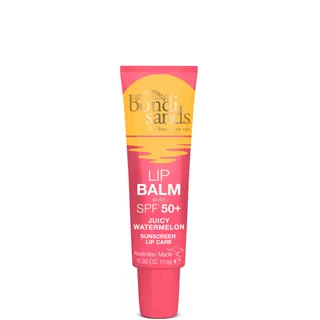
Bondi Sands SPF50+ Watermelon Lip Balm
Works for
Sun protectionSPF 50 · 4 UV filters · Broad spectrumWeak protectionLow filter dose
This product can be considered "reef safe" because it does not contain the UV filters (oxybenzone and octinoxate) that can be harmful to coral reefs when present in the water in high concentrations.
MoisturizingSide benefit the brand mentions · Ricinus communis seed oil, Synthetic beeswax + 8 moreWorks
“Jojoba Oil feeds essential moisture deep into the dermis, softening the skin.”
This product can help soften the skin and reduce its moisture loss with emollients and occlusives: butyrospermum parkii butter, cera microcristallina.
Keep in mind that this product does not contain effective ingredients to attract water to the upper layer of the skin. This is why an additional product with humectants like glycerin or hyaluronic acid can be helpful (apply it before this product for the best results).
Can it cause trouble?
Irritancy1 strong irritant: AromaMedium risk
Comedogenic1 ingredient rated 2 or more on the 0–5 pore-clogging scale1 flagged
User reviews
Be the first — your take helps the next person decide.
Ingredients
Filter by role to see what each ingredient is doing.
Ricinus communis seed oil~25–37%
- Irritation risk
- Medium
A plant oil that can help soften the skin. It might be helpful in calming down inflammation, but solid research is lacking. Is often used in lip products to create the needed product consistency
More about Ricinus communis seed oilOctyldodecanol~5.7–8.6%
- Irritation risk
- Low
An emollient that helps to soften the skin and create a pleasant product texture and stabilize the formulation
More about OctyldodecanolSynthetic beeswax~4.8–7.2%
- Irritation risk
- Low
Helps soften the upper layer of the skin
More about Synthetic beeswaxHydrogenated polydecene~3.8–5.8%
- Irritation risk
- Low
Helps to soften the upper layer of the skin and create a nice product texture
More about Hydrogenated polydeceneCera microcristallina~3.3–5%
- Irritation risk
- Low
Helps to soften the upper layer of the skin, reduce water loss from its surface and create a thicker product consistency
More about Cera microcristallinaCocoglycerides~2.6–3.8%
- Irritation risk
- High
Help soften the upper layer of the skin and make it easier for oil and water mix together. Recently, a rising number of allergic reactions to cocoglycerides and other coconut-derived surfactants has been reported. As there is a significant overlap between frequent irritants and allergens, we flag this ingredient for attention of those with very sensitive, reactive skin
More about CocoglyceridesButylene glycol~1.8–2.7%
- Irritation risk
- Low
Used to create a nice product texture and help delivery of other ingredients. Might be somewhat helpful in attracting water to the upper layer of the skin
More about Butylene glycolCetyl palmitate~1.6–2.4%
- Irritation risk
- Low
An emollient that helps soften the skin and is used to improve product texture and stability
More about Cetyl palmitateButyrospermum parkii butter~1.4–2.1%
- Irritation risk
- Low
- Comedogenicity
- 3/5
A great moisturising ingredient that softens the skin and reduces water loss from its upper layer. It also can be helpful in protecting skin from free radicals
More about Butyrospermum parkii butterSimmondsia chinensis seed oil~1.1–1.7%
- Irritation risk
- Medium
Softens the upper layer of skin and helps restore the healthy skin barrier. Has shown to help calm down inflammation in skin. It is a stable oil, meaning that it retains its properties even when exposed to air.
More about Simmondsia chinensis seed oilButyl methoxydibenzoylmethane~1.1–1.6%
- Irritation risk
- Medium
Avobenzone. An organic, or so-called "chemical" UV filter. Protects against both UVA and UVB rays. Needs to be combined with other filters in a formulation to be stable.
More about Butyl methoxydibenzoylmethaneEthylhexyl triazone~0.9–1.35%
- Irritation risk
- Medium
Uvinul T. A UV filter. Effective against UVB rays. It is photostable. Can increase water resistance properties of the sunscreen. Unfortunately, not approved by the FDA (US) yet
More about Ethylhexyl triazoneOctocrylene~0.85–1.3%
- Irritation risk
- Medium
A weak sunscreen that protects against the sun rays that cause sunburn (UVB) and is somewhat effective against the UVA rays. It is quite stable and can help stabilize other, more vulnerable, sunscreen ingredients like Avobenzone. It is an organic, or so called "chemical" sunscreen
More about OctocryleneAroma~0.45–1%
Peg-30 dipolyhydroxystearate~0.35–0.85%
- Irritation risk
- Medium
Helps oil and water mix together
More about Peg-30 dipolyhydroxystearateTriacontanyl pvp~0.35–0.85%
- Irritation risk
- Low
Bis-ethylhexyloxyphenol methoxyphenyl triazine~0.35–0.85%
- Irritation risk
- Medium
Tinosorb S. One of the most effective broad spectrum sunscreen ingredients. Protects from both UVA and UVB rays. It is photostable. Unfortunately, not approved by FDA (US) yet.
More about Bis-ethylhexyloxyphenol methoxyphenyl triazineTocopheryl acetate~0.15–0.5%
- Irritation risk
- Medium
A more stable but less bio-available form of vitamin E compared to Tocopherol. Might help moisturize and protect the skin from free radicals, but mostly used in low concentrations to stabilize other ingredients.
More about Tocopheryl acetateSaccharin~0.1–0.45%
- Irritation risk
- Low
Ingredient list view
Ricinus communis seed oil, Octyldodecanol, Synthetic beeswax, Hydrogenated polydecene, Cera microcristallina, Cocoglycerides, Butylene glycol, Cetyl palmitate, Butyrospermum parkii butter, Simmondsia chinensis seed oil, Butyl methoxydibenzoylmethane, Ethylhexyl triazone, Octocrylene, Aroma, Peg-30 dipolyhydroxystearate, Triacontanyl pvp, Bis-ethylhexyloxyphenol methoxyphenyl triazine, Tocopheryl acetate, Saccharin, Unknown
Compare prices
Retailers ranked by price — lowest first.

Worth comparing, line by line.
Match % combines shared ingredients, the first five ingredients, shared actives and hero ingredients, irritancy (lower counts in the alternative's favour), texture and body area. Only products in the same routine step are compared.
| Bondi SandsSPF50+ Watermelon Lip BalmYOUR PRODUCT | REVOLUTION SKINCARESPF 30 Lip Balm | FOTOPROTECTORProtector Labial SPF 50 | LavozonOctocrylene-Free Sun Stick - SPF 50 | |
|---|---|---|---|---|
| Match | — | 37% | 36% | 32% |
| Price | — | $8.03 | — | — |
| Shared key ingredients | — | 6 of 9 | 5 of 9 | 5 of 9 |
| Key difference | — | Cocos Nucifera Oil | Lanolin | Caprylic/Capric Triglyceride |
| Irritancy | Medium | Medium | Medium | Low |
| SPF | SPF 50 | SPF 30 | SPF 50 | SPF 50 |
| Drying alcohol | — | — | — | Contains drying alcohol |
| View product | Shop | Shop | Shop |




More alternatives: ISDIN Lippenbalsam LSF 50Ultrasun Lip Protection SPF 50
Product summary
"Bondi Sands - SPF50+ Watermelon Lip Balm" is using UV filters in a relatively low concentration. Because of this, it might not be able to provide reliable sun protection.
Sunscreen filters
This is a so-called "chemical" sunscreen. It means that it uses organic UV filters. They typically offer good sun protection and rarely leave a white cast, but they can be irritating for some people with sensitive skin. The UV filters in this sunscreen are: tinosorb s 0.40% - 0.95%, avobenzone 1.20% - 1.80% and octocrylene 0.90% - 1.35%.
Irritation risk
It contains some common irritants, including those without a benefit for the skin. We assess the overall irritancy of this lip sunscreen to be medium. For a detailed overview of all potential irritants: click here
You can see the detailed formula review with the breakdown of all actives in the product and the full ingredient list with estimated concentrations in the tables below.
Price
The product retails for 4.99£ in the United Kingdom.
For a detailed price comparison: click here.
Sources cited in this review
Every concentration estimate and effectiveness label is anchored to one of these 4 studies and safety reviews.
- 1
- 2
- 3
- 4Safety Assessment of Polyene Group as Used in Cosmeticscir-safety.org

Affiliate links · As an Amazon Associate, WIMJ earns from qualifying purchases.