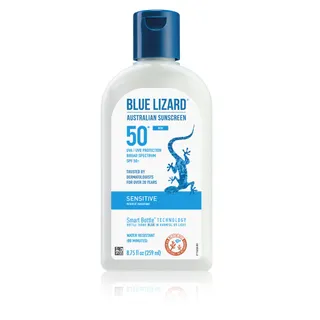
Blue Lizard Sensitive Mineral Sunscreen * SPF 50+ | Bottle
Works for
Sun protectionSPF 50 · 3 UV filtersBroad spectrum
This product offers a good level of protection against both UVB and UVA rays.
This sunscreen uses organic (so-called "chemical") sunscreen filters. Organic, or "chemical" filters usually provide reliable sun protection and rarely leave a white cast. Sunscreens with organic filters can sting eyes.
This product can be considered "reef safe" because it does not contain the UV filters (oxybenzone and octinoxate) that can be harmful to coral reefs when present in the water in high concentrations.
Evens skin toneNot advertised by the brand · No ingredient credited for this claimWorks well
This product offers broad spectrum sun protection. It means that it can prevent hyperpigmentation and help keep the skin tone even (sun damage is the main factor causing age spots, darkening of post-acne marks and other discolorations).
MoisturizingNot advertised by the brand · C12-15 alkyl benzoate, Cetyl dimethicone + 9 moreWorks
This product can help soften the skin and reduce its moisture loss with emollients and occlusives: dimethicone, cetyl dimethicone.
Keep in mind that this product does not contain effective ingredients to attract water to the upper layer of the skin. This is why an additional product with humectants like glycerin or hyaluronic acid can be helpful (apply it before this product for the best results).
Can it cause trouble?
Irritancy11 flagged ingredientsLow risk
Comedogenic1 ingredient rated 2 or more on the 0–5 pore-clogging scale1 flagged
User reviews
1 of 1 community members would buy it again.
Ingredients
Filter by role to see what each ingredient is doing.
Zinc oxide10%
- Irritation risk
- Low
A broad spectrum sunblock (protects from both UVA and UVB rays). Is suitable for most sensitive skins. In small concentrations, can be used as a colorant
More about Zinc oxideTitanium dioxide8%
- Irritation risk
- Low
Works as a UV filter when used in high concentrations. It is photostable and is effective mostly against the UVB light, with some protection in the UVA range. In small concentrations, used for its ability to improve the color of cosmetic products. Is usually well tolerated by the skin
More about Titanium dioxide1,2-hexanediol~24–36%
Aloe barbadensis leaf juice powder~7–10.6%
- Irritation risk
- Medium
Traditionally used to treat sunburns, dermatitis and inflammation, but evidence for its effectiveness is lacking. The extract can contain humectants that help attract water into the skin
More about Aloe barbadensis leaf juice powderAlumina~4.2–6.4%
- Irritation risk
- Low
The same compound that is used safely in dental implants and bone cements. In cosmetics, it is used to improve the consistency of products
More about AluminaAluminum stearate~2.9–4.4%
- Irritation risk
- Medium
Used to help evenly disperse other ingredients (for example, pigment) in a formulation
More about Aluminum stearateButyloctyl salicylate~2.3–3.4%
- Irritation risk
- Medium
A synthetic ester of salicylic acid that is used to help disperse pigments and boost effectiveness of sunscreen ingredients. It is able to absorb UV light (working as an organic, or chemical filter), but is not approved as a sunscreen ingredient on its own
More about Butyloctyl salicylateC12-15 alkyl benzoate~1.9–2.9%
- Irritation risk
- Low
Enhances the product texture and makes it more spreadable. Helps reduce water loss from the outer layer of skin. Extands the shelf life by preventing bacteria growth
More about C12-15 alkyl benzoateCaprylyl glycol~1.7–2.5%
- Irritation risk
- Medium
Helps preserve products and creates a nice product texture
More about Caprylyl glycolCetyl dimethicone~1.5–2.2%
- Irritation risk
- Low
A type of silicone. Helps soften the upper layer of the skin and creates a nice, light product texture
More about Cetyl dimethiconeCetyl peg/ppg-10/1 dimethicone~1.1–1.7%
- Irritation risk
- Low
A type of silicone that helps water and oil mix together. Can help to soften upper layer of the skin
More about Cetyl peg/ppg-10/1 dimethiconeDimethicone~1–1.5%
- Irritation risk
- Low
A silicone that helps to reduce water loss from the surface of the skin. Can temporarily "fill in" lines and wrinkles, absorb oil, and create a nice product finish
More about DimethiconeDisodium edta~0.5–1%
Ethylhexyl palmitate~0.5–1.1%
- Irritation risk
- Low
- Comedogenicity
- 3/5
An emollient that helps soften the skin and create a nice product texture
More about Ethylhexyl palmitateEthylhexyl stearate~0.4–0.9%
- Irritation risk
- Low
Helps soften the upper layer of the skin
More about Ethylhexyl stearateEuphorbia cerifera wax~0.35–0.85%
- Irritation risk
- Low
Hexyl laurate~0.35–0.8%
- Irritation risk
- Medium
Helps soften the upper layer of the skin and create a nice product consistency
More about Hexyl laurateHydroxyacetophenone~0.3–0.7%
Methyl glucose dioleate~0.3–0.75%
- Irritation risk
- Low
Octyldodecyl neopentanoate~0.35–0.75%
- Irritation risk
- Low
An emollient that helps soften the skin. Often used to stabilize other ingredients, for example, sunscreen
More about Octyldodecyl neopentanoatePeg-7 hydrogenated castor oil~0.2–0.75%
Polyglyceryl-4 isostearate~0.2–0.75%
- Irritation risk
- Medium
Helps water and oil mix together
More about Polyglyceryl-4 isostearatePolyhydroxystearic acid~0.15–0.7%
- Irritation risk
- Medium
Used to create a thicker product consistency and stabilize the formulation
More about Polyhydroxystearic acidPropanediol~0.15–0.65%
- Irritation risk
- Low
Acts as a solvent for other ingredients. Speeds up the absorption of other ingredients into the skin
More about PropanediolTocopherol~0.1–0.45%
- Irritation risk
- Low
Pure form of vitamin E. Can help moisturise and protect the skin from free radicals. Often used to help stabilise other ingredients or the formula itself
More about TocopherolTocopheryl acetate~0.1–0.45%
- Irritation risk
- Medium
A more stable but less bio-available form of vitamin E compared to Tocopherol. Might help moisturize and protect the skin from free radicals, but mostly used in low concentrations to stabilize other ingredients.
More about Tocopheryl acetateTriethoxycaprylylsilane~0.1–0.3%
- Irritation risk
- Low
A type of silicone that helps oil and water mix well together. Helps to disperse other ingredients, e.g. pigments, evenly in a formulation
More about TriethoxycaprylylsilaneTrimethylsiloxysilicate~0.1–0.35%
- Irritation risk
- Low
A type of silicone that helps create a nice product consistency and support the delivery of other ingredients
More about TrimethylsiloxysilicateVp/hexadecene copolymer~0.05–0.25%
- Irritation risk
- Low
Creates a nice product texture and can support water-resistance of sunscreens
More about Vp/hexadecene copolymerWater~0.05–0.15%
Ingredient list view
Zinc oxide, Titanium dioxide, 1,2-hexanediol, Aloe barbadensis leaf juice powder, Alumina, Aluminum stearate, Butyloctyl salicylate, C12-15 alkyl benzoate, Caprylyl glycol, Cetyl dimethicone, Cetyl peg/ppg-10/1 dimethicone, Dimethicone, Disodium edta, Ethylhexyl palmitate, Ethylhexyl stearate, Euphorbia cerifera wax, Hexyl laurate, Hydroxyacetophenone, Methyl glucose dioleate, Octyldodecyl neopentanoate, Peg-7 hydrogenated castor oil, Polyglyceryl-4 isostearate, Polyhydroxystearic acid, Propanediol, Tocopherol, Tocopheryl acetate, Triethoxycaprylylsilane, Trimethylsiloxysilicate, Vp/hexadecene copolymer, Water
Compare prices
Retailers ranked by price — lowest first.

Worth comparing, line by line.
Match % combines shared ingredients, the first five ingredients, shared actives and hero ingredients, irritancy (lower counts in the alternative's favour), texture and body area. Only products in the same routine step are compared.
| Blue LizardSensitive Mineral Sunscreen * SPF 50+ | BottleYOUR PRODUCT | Eau Thermale AveneMineral Light Hydrating Sunscreen Lotion SPF 50+ | Banana BoatSimply Protect Kids Sunscreen Lotion, SPF 50 | La Roche-PosayAnthelios Mineral Zinc Oxide Sunscreen SPF 50 | |
|---|---|---|---|---|
| Match | — | 41% | 38% | 37% |
| Price | $37.00 | $36.00−$1.00 | $17.90−$19.10 | $29.99−$7.01 |
| Shared key ingredients | — | 6 of 6 | 4 of 6 | 4 of 6 |
| Key difference | — | Cera Alba | Caprylic/Capric Triglyceride | Vitamin E |
| Irritancy | Low | Low | Low | Low |
| SPF | SPF 50 | SPF 50 | SPF 50 | SPF 50 |
| Drying alcohol | — | — | — | — |
| View product | Shop | Shop | Shop |


More alternatives: Neutrogena Mineral Ultra Sheer Dry-Touch SPF 30 Sunscreen LotionEltaMD UV Replenish Broad-Spectrum SPF 44
Product summary
The ingredient list suggests that "Blue Lizard - Sensitive Mineral Sunscreen * SPF 50+ | Bottle" can provide reliable sun protection. It can protect from both UVA and UVB rays. This is great news because not all sunscreens with SPF ratings give UVA protection. (UVA rays do not cause sunburn, but still damage our skin and lead to early aging).
It contains good moisturizing ingredients and can double as a hydrating day cream.
Sunscreen filters
This product is a mineral sunscreen. It uses titanium dioxide and zinc oxide for sun protection. Both titanium dioxide and zinc oxide almost never irritate even the most sensitive skin and eyes, but can leave a white cast.
Irritation risk
This product does not contain known common irritants and is suitable for sensitive skin. We assess the overall irritancy of this sunscreen to be low. For a detailed overview of all potential irritants: click here
You can see the detailed formula review with the breakdown of all actives in the product and the full ingredient list with estimated concentrations in the tables below.
What our users say
Based on 1 review 100% recommend this product- When it comes to comedogenicity, the reviewer believes that it clogs pores.
- As for the white cast, it did not leave a noticeable white residue for the reviewer.
- When it comes to using this sunscreen under makeup, the user found that it pills under a foundation.
- As for using this sunscreen in the eye area, the reviewer reported that it stings eyes.
Price
The product retails from 15.00$ up to 34.00$ in the United States, for 14.97CA$ in Canada, for 45.00A$ in Australia and for 13.49£ in the United Kingdom.
For a detailed price comparison: click here.
Sources cited in this review
Every concentration estimate and effectiveness label is anchored to one of these 13 studies and safety reviews.
- 1A review of inorganic UV filters zinc oxide and titanium dioxideonlinelibrary.wiley.com
- 2
- 3
- 4
- 5
- 6

Affiliate links · As an Amazon Associate, WIMJ earns from qualifying purchases.