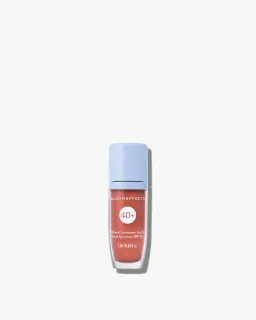
Bloomeffects Tulipscreen Hydrating Lip Oil SPF 40+
Works for
Sun protectionSPF 40 · 3 UV filtersBroad spectrum
This product offers a good level of protection against both UVB and UVA rays.
This sunscreen uses organic (so-called "chemical") sunscreen filters. Organic, or "chemical" filters usually provide reliable sun protection and rarely leave a white cast. Sunscreens with organic filters can sting eyes.
This product can be considered "reef safe" because it does not contain the UV filters (oxybenzone and octinoxate) that can be harmful to coral reefs when present in the water in high concentrations.
Anti-agingSide benefit · Limnanthes alba seed oilWorks well
This product can help prevent early signs of skin aging because it offers a good level of broad spectrum sun protection. Sun damage is the main cause of premature skin aging, and protecting your skin from the sun is the best anti-aging strategy.
MoisturizingSide benefit the brand mentions · Squalane, Limnanthes alba seed oil + 8 moreWorks
“Tulipscreen Hydrating Lip Oil SPF 40+”
This product can help improve hydration of the skin with the two types of ingredients.
The first type is called “humectants”:
these ingredients help attract water.
When humectants are on the surface of the skin, they “pull in” the moisture from the outside environment, or from
within deeper layers of the skin. The following ingredients in this product do the job:
glycerin, sodium hyaluronate.
This product also contains ingredients called “occlusives”. They help reduce the speed with which our skin loses moisture to the outside environment. These ingredients also help soften the upper layer of the skin, so it feels less tight and nicer to the touch. The following ingredients in this product do the job: caprylic/capric triglyceride, squalane.
Can it cause trouble?
Irritancy1 strong irritant: ParfumMedium risk
Comedogenic1 ingredient rated 2 or more on the 0–5 pore-clogging scale1 flagged
User reviews
Be the first — your take helps the next person decide.
Ingredients
Filter by role to see what each ingredient is doing.
Zinc oxide~44–54%
- Irritation risk
- Low
A broad spectrum sunblock (protects from both UVA and UVB rays). Is suitable for most sensitive skins. In small concentrations, can be used as a colorant
More about Zinc oxideSqualane~5.8–7.1%
- Irritation risk
- Low
An oil naturally present in skin. Works as an emollient to soften the skin and form a protective layer on its surface without a greasy feeling.
More about SqualaneIsohexadecane~4.4–5.4%
- Irritation risk
- Low
Improves the texture of the product and helps soften the skin. Helps oil and water mix together and can be used as a cleansing agent
More about IsohexadecaneLimnanthes alba seed oil~3.3–4%
- Irritation risk
- Low
This oil's cmposition is closest to rapeseed oil. It is a very stable oil and serves as an emoillient
More about Limnanthes alba seed oilCaprylic/capric triglyceride~2.5–3.1%
- Irritation risk
- Medium
A good mix of fatty acids that forms a protective layer on the skin. Improves the shelf life of products. Derived from coconut and glycerin
More about Caprylic/capric triglycerideButyloctyl salicylate~2–2.5%
- Irritation risk
- Medium
A synthetic ester of salicylic acid that is used to help disperse pigments and boost effectiveness of sunscreen ingredients. It is able to absorb UV light (working as an organic, or chemical filter), but is not approved as a sunscreen ingredient on its own
More about Butyloctyl salicylateC12-15 alkyl benzoate~1.7–2.1%
- Irritation risk
- Low
Enhances the product texture and makes it more spreadable. Helps reduce water loss from the outer layer of skin. Extands the shelf life by preventing bacteria growth
More about C12-15 alkyl benzoateEthylene/propylene/styrene copolymer~1.5–1.8%
- Irritation risk
- Low
Used to create a thicker product consistency
More about Ethylene/propylene/styrene copolymerCalcium sodium borosilicate~1.3–1.6%
Methylpropanediol~1–1.3%
Iron oxides~0.8–1.2%
- Irritation risk
- Low
An umbrella term for the following three colorants: CI 77491, CI 77492, CI 77499. They might be able to offer some protection against visible light, but the degree of the protection is not clear
More about Iron oxidesSilica~1–1.2%
Polyglyceryl-4 diisostearate/polyhydroxystearate/sebacate~0.6–0.95%
- Irritation risk
- Medium
Helps water and oil mix together
More about Polyglyceryl-4 diisostearate/polyhydroxystearate/sebacateTulipa gesneriana/kaurmanniana meristem cell lysate filtrate extract~0.6–0.9%
Butylene/ethylene/styrene copolymer~0.55–0.8%
- Irritation risk
- Low
Used to create a gel-like product texture
More about Butylene/ethylene/styrene copolymerCaprylyl glycol~0.55–0.85%
- Irritation risk
- Medium
Helps preserve products and creates a nice product texture
More about Caprylyl glycolBisabolol~0.45–0.7%
- Irritation risk
- Low
An active component of chamomile plant that historically has been used to calm down irritated skin. A recent study shows that bisabolol indeed can have some anti-inflammatory effect on skin, even though conclusive data is lacking. Bisabolol has a sweet floral scent and can be added to products for its aromatic properties
More about BisabololSynthetic fluorphlogopite~0.5–0.75%
- Irritation risk
- Low
A mineral that is used as an optical filter (makes the skin looks nicer through light reflection) and to improve the texture of cosmetic products
More about Synthetic fluorphlogopiteLecithin~0.5–0.75%
- Irritation risk
- Low
Used mostly for creating emulsions - helping oil and water mix together. Helps soften the upper layer of the skin
More about LecithinMica~0.45–0.65%
- Irritation risk
- Low
Creates an illusion of smoother and more radiant skin tone. Adds shimmer to the skin by reflecting light
More about MicaAluminum hydroxide~0.45–0.65%
- Irritation risk
- Low
Is used to add opaque (non-transparent) appearance to formulations. Can be used to coat other ingredients for even dispersion. This is a different ingredient compared to the ones used in antipersperants (aluminium chloride and aluminium chlorohydrate)
More about Aluminum hydroxideCi 16035~0.35–0.65%
Water~0.3–0.55%
Titanium dioxide~0.45–0.65%
- Irritation risk
- Low
Works as a UV filter when used in high concentrations. It is photostable and is effective mostly against the UVB light, with some protection in the UVA range. In small concentrations, used for its ability to improve the color of cosmetic products. Is usually well tolerated by the skin
More about Titanium dioxidePhenylpropanol~0.3–0.55%
- Irritation risk
- High
Helps mask the smell of other ingredients and helps preserve the product formulation
More about PhenylpropanolPentaerythrityl tetra-di-t-butyl hydroxyhydrocinnamate~0.35–0.6%
- Irritation risk
- Low
Used to increase stability of product formulations
More about Pentaerythrityl tetra-di-t-butyl hydroxyhydrocinnamateTin oxide~0.45–0.7%
- Irritation risk
- Low
A colorant that can add a pearl-like appearance to the formulation
More about Tin oxideGlycerin~0.35–0.6%
- Irritation risk
- Low
One of the best moisturizing ingredients. Naturally present in skin. It attracts water to the upper layer of the skin working as a humectant
More about GlycerinHydrogenated lecithin~0.3–0.55%
- Irritation risk
- Low
Helps to retain moisture by creating a protective barrier on the skin. Rich in fatty acids. Improves product texture and helps with the penetration of other ingredients.
More about Hydrogenated lecithinSodium sulfate~0.3–0.55%
- Irritation risk
- Medium
Used to improve the product consistency and stabilize formulations
More about Sodium sulfateSodium chloride~0.3–0.55%
- Irritation risk
- Low
Used to stabilize mixtures of oil and water, and create thicker, gel-like product textures
More about Sodium chlorideSodium lactate~0.25–0.45%
- Irritation risk
- Medium
Helps attract water to the upper layer of the skin. Is often used to adjust the pH level of the product
More about Sodium lactateSodium gluconate~0.25–0.45%
Leuconostoc/radish root ferment filtrate~0.2–0.4%
- Irritation risk
- Medium
A preservative that comes from radishes fermented by a bacteria. New research suggests that the preservation properties in the ingredient come from an ammonium salt that is not present naturally in radish root but used in its cultivation. Is problematic because the exact amount of the preservative agents is difficult to determine
More about Leuconostoc/radish root ferment filtratePhenethyl alcohol~0.2–0.35%
Sodium hyaluronate~0.15–0.3%
- Irritation risk
- Low
One of the best moisturizing ingredients. Attracts water into the upper layer of the skin
More about Sodium hyaluronatePotassium sorbate~0.15–0.3%
Citric acid~0.1–0.2%
- Irritation risk
- Medium
Can work as an exfoliant but is typically used to adjust the product pH
More about Citric acidParfum~0.1–0.15%
- Irritation risk
- High
An aromatic blend of unspecified and possibly irritating ingredients
More about ParfumSodium hydroxide~0.1–0.15%
Ingredient list view
Zinc oxide, Squalane, Isohexadecane, Limnanthes alba seed oil, Caprylic/capric triglyceride, Butyloctyl salicylate, C12-15 alkyl benzoate, Ethylene/propylene/styrene copolymer, Calcium sodium borosilicate, Methylpropanediol, Iron oxides, Silica, Polyglyceryl-4 diisostearate/polyhydroxystearate/sebacate, Tulipa gesneriana/kaurmanniana meristem cell lysate filtrate extract, Butylene/ethylene/styrene copolymer, Caprylyl glycol, Bisabolol, Synthetic fluorphlogopite, Lecithin, Mica, Aluminum hydroxide, Ci 16035, Water, Titanium dioxide, Phenylpropanol, Pentaerythrityl tetra-di-t-butyl hydroxyhydrocinnamate, Tin oxide, Glycerin, Hydrogenated lecithin, Sodium sulfate, Sodium chloride, Sodium lactate, Sodium gluconate, Leuconostoc/radish root ferment filtrate, Phenethyl alcohol, Sodium hyaluronate, Potassium sorbate, Citric acid, Parfum, Sodium hydroxide
Compare prices
Retailers ranked by price — lowest first.

Worth comparing, line by line.
Match % combines shared ingredients, the first five ingredients, shared actives and hero ingredients, irritancy (lower counts in the alternative's favour), texture and body area. Only products in the same routine step are compared.
| BloomeffectsTulipscreen Hydrating Lip Oil SPF 40+YOUR PRODUCT | OdaciteSPF50 Color Balm | Cream Blush | ColorescienceSunforgettable Total Protection Color Balm SPF50 - Berry | Laboratoires de BiarritzOrganic Alga Maris Ocean and Mountain Lip Balm SPF30 | |
|---|---|---|---|---|
| Match | — | 32% | 32% | 30% |
| Price | $23.20 | $10.35−$12.85 | $42.00+$18.80 | — |
| Shared key ingredients | — | 4 of 10 | 5 of 10 | 3 of 10 |
| Key difference | — | Polyglyceryl-2 Dipolyhydroxystearate | Copernicia Cerifera Wax | Linoleic Acid |
| Irritancy | Medium | Low | Medium | Low |
| SPF | SPF 40 | SPF 50 | SPF 50 | SPF 30 |
| Drying alcohol | — | — | — | — |
| View product | Shop | Shop | Shop |


More alternatives: Hello Sunday The One For Your Lips SPF50Cetaphil Sheer Mineral* Sunscreen Stick SPF 50
Sources cited in this review
Every concentration estimate and effectiveness label is anchored to one of these 16 studies and safety reviews.
- 1A review of inorganic UV filters zinc oxide and titanium dioxideonlinelibrary.wiley.com
- 2
- 3
- 4
- 5
- 6

Affiliate links · As an Amazon Associate, WIMJ earns from qualifying purchases.