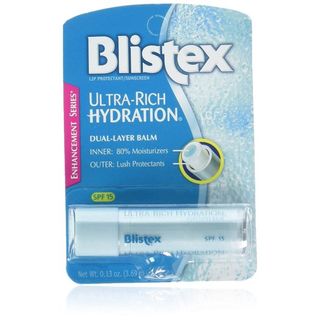
Blistex Ultra-Rich Hydration Dual Layer Lip Balm, SPF 15, One Lip Balm Stick
Works for
1 of 2 advertised claims delivered
Sun protectionSPF 15 · 3 UV filters · Partial spectrumWeak protectionSPF under 30
This product does not offer good protection against UVA rays.
MoisturizingTriticum vulgare germ oil, Phenyl trimethicone + 22 moreGood evidence
“Ultra-Rich Hydration Dual Layer Lip Balm, SPF 15, One Lip Balm Stick”
This product can help soften the skin and reduce its moisture loss with emollients and occlusives: beeswax, bis-diglyceryl polyacyladipate-2.
Keep in mind that this product does not contain effective ingredients to attract water to the upper layer of the skin. This is why an additional product with humectants like glycerin or hyaluronic acid can be helpful (apply it before this product for the best results).
Can it cause trouble?
Irritancy1 strong irritant: AromaMedium risk
Comedogenic7 ingredients rated 2 or more on the 0–5 pore-clogging scale7 flagged
User reviews
Be the first — your take helps the next person decide.
Ingredients
Filter by role to see what each ingredient is doing.
Aloe barbadensis leaf extract~26–31%
- Irritation risk
- Medium
Traditionally used to treat sunburns, dermatitis and inflammation, but evidence for its effectiveness is lacking. The extract can contain humectants that help attract water into the skin
More about Aloe barbadensis leaf extractAlumina~4.9–6%
- Irritation risk
- Low
The same compound that is used safely in dental implants and bone cements. In cosmetics, it is used to improve the consistency of products
More about AluminaArachidyl alcohol~5.1–6.3%
- Irritation risk
- Low
Used to soften the upper layer of the skin and create a thicker product consistency
More about Arachidyl alcoholArachidyl glucoside~3.7–4.6%
Beeswax~3.3–4%
- Irritation risk
- Low
Forms a protective barrier that holds water and keeps dry skin hydrated. Keeps an emulsion from separating into its oil and liquid components, and increases the thickness of a product. Can be an allergen
More about BeeswaxBehenyl alcohol~2.4–2.9%
- Irritation risk
- Low
Non-drying alcohol that helps water and oil mix together. Also serves as an emollient
More about Behenyl alcoholBis-diglyceryl polyacyladipate-2~1.8–2.2%
- Irritation risk
- Low
Helps soften the upper layer of the skin and reduce water loss from its surface
More about Bis-diglyceryl polyacyladipate-2Blue 1 lake~1.2–1.5%
Butyrospermum parkii butter~1.3–1.6%
- Irritation risk
- Low
- Comedogenicity
- 3/5
A great moisturising ingredient that softens the skin and reduces water loss from its upper layer. It also can be helpful in protecting skin from free radicals
More about Butyrospermum parkii butterCeresin~1.1–1.3%
Cetyl dimethicone~0.95–1.15%
- Irritation risk
- Low
A type of silicone. Helps soften the upper layer of the skin and creates a nice, light product texture
More about Cetyl dimethiconeCetyl palmitate~0.75–1.1%
- Irritation risk
- Low
An emollient that helps soften the skin and is used to improve product texture and stability
More about Cetyl palmitateChamomilla recutita flower extract~0.6–0.85%
- Irritation risk
- High
Plant extract that can have healing and anti-inflammatory properties. It is a potential allergen and can be irritating
More about Chamomilla recutita flower extractAroma~0.55–0.8%
Helianthus annuus seed oil~0.55–0.85%
- Irritation risk
- Low
A great emollient due to its high linoleic acid content. One of the most effective plant oils in helping skin hydration and repairing skin barrier function
More about Helianthus annuus seed oilHydrogenated castor oil~0.6–0.85%
- Irritation risk
- Medium
A plant oil that can help soften the skin. It might be helpful in calming down inflammation, but solid research is lacking. Is often used in lip products to create the needed product consistency
More about Hydrogenated castor oilHydrogenated polyisobutene~0.55–0.8%
- Irritation risk
- Low
Used to improve the product consistency and soften the upper layer of the skin
More about Hydrogenated polyisobuteneIsopropyl myristate~0.5–0.8%
- Irritation risk
- Low
- Comedogenicity
- 3/5
An emollient that helps soften the skin. Could be comedogenic
More about Isopropyl myristateIsostearoyl hydrolyzed silk~0.4–0.65%
- Irritation risk
- Low
Jojoba esters~0.5–0.75%
- Irritation risk
- Medium
An emollient made of jojoba oil. Helps soften the skin and support its barrier function
More about Jojoba estersMicrocrystalline wax~0.45–0.65%
Olea europaea fruit oil~0.45–0.65%
- Irritation risk
- Medium
An emollient that helps soften the skin but is not effective for restoring its barrier function. Might be helpful to calm down inflammation
More about Olea europaea fruit oilParaffin~0.3–0.5%
- Irritation risk
- Low
Prevents water loss from the skin surface and thickens the product consistency
More about ParaffinPentaerythrityl tetraethylhexanoate~0.45–0.65%
- Irritation risk
- Low
Used to create a nice product consistency while softening the upper layer of the skin
More about Pentaerythrityl tetraethylhexanoatePetrolatum~0.45–0.65%
- Irritation risk
- Low
One of the most effective and the most studied occlusive ingredients that creates a protective layer on top of the skin preventing moisture loss
More about PetrolatumPhenoxyethanol~0.35–0.6%
- Irritation risk
- Low
A preservative. It helps prevent bacterial growth in cosmetic products
More about PhenoxyethanolPhenyl trimethicone~0.4–0.6%
- Irritation risk
- Low
A type of silicone that can decrease loss of moisture from the skin surface. It helps create a nice product texture
More about Phenyl trimethiconePolyhydroxystearic acid~0.4–0.6%
- Irritation risk
- Medium
Used to create a thicker product consistency and stabilize the formulation
More about Polyhydroxystearic acidSaccharin~0.35–0.65%
- Irritation risk
- Low
Silica~0.5–0.8%
Theobroma cacao seed butter~0.45–0.65%
- Irritation risk
- Low
- Comedogenicity
- 3/5
Helps soften the upper layer of the skin and can be helpful in restoring the skin barrier function. Might have some anti-oxidant effect
More about Theobroma cacao seed butterTitanium dioxide~0.4–0.65%
- Irritation risk
- Low
Works as a UV filter when used in high concentrations. It is photostable and is effective mostly against the UVB light, with some protection in the UVA range. In small concentrations, used for its ability to improve the color of cosmetic products. Is usually well tolerated by the skin
More about Titanium dioxideTocopheryl acetate~0.3–0.6%
- Irritation risk
- Medium
A more stable but less bio-available form of vitamin E compared to Tocopherol. Might help moisturize and protect the skin from free radicals, but mostly used in low concentrations to stabilize other ingredients.
More about Tocopheryl acetateTriticum vulgare germ oil~0.45–0.65%
- Irritation risk
- Low
- Comedogenicity
- 3/5
A good emoillient. Contains vitamin E which can help neutralise free radicals, however the oil is unstable. Avoid if you have gluten or wheat sensitivity (including food allergies).
More about Triticum vulgare germ oilDimethicone2%
- Irritation risk
- Low
A silicone that helps to reduce water loss from the surface of the skin. Can temporarily "fill in" lines and wrinkles, absorb oil, and create a nice product finish
More about DimethiconeEthylhexyl methoxycinnamate6.6%
- Irritation risk
- High
Octinoxate. When used in higher concentrations, works as a sunscreen protecting the skin from UVB rays. When used in lower concentration, helps to preserve the product formulation. Is shown to be harmful to coral reefs - consider avoiding bathing in coral reef areas when wearing a product with this ingredient. It can be irritating
More about Ethylhexyl methoxycinnamateEthylhexyl salicylate4.4%
- Irritation risk
- Low
Octisalate. A UV filter. It offers some protection against the sun rays that cause sunburn (UVB), but does not protect against the most aging sun rays (UVA). It loses its effectiveness quickly when exposed to sunlight. It is an organic, or so called "chemical" sunscreen
More about Ethylhexyl salicylateAlumina~0.55–0.8%
- Irritation risk
- Low
The same compound that is used safely in dental implants and bone cements. In cosmetics, it is used to improve the consistency of products
More about AluminaArachidyl alcohol~0.45–0.7%
- Irritation risk
- Low
Used to soften the upper layer of the skin and create a thicker product consistency
More about Arachidyl alcoholArachidyl glucoside~0.35–0.65%
Beeswax~0.45–0.7%
- Irritation risk
- Low
Forms a protective barrier that holds water and keeps dry skin hydrated. Keeps an emulsion from separating into its oil and liquid components, and increases the thickness of a product. Can be an allergen
More about BeeswaxBehenyl alcohol~0.45–0.7%
- Irritation risk
- Low
Non-drying alcohol that helps water and oil mix together. Also serves as an emollient
More about Behenyl alcoholBis-diglyceryl polyacyladipate-2~0.45–0.7%
- Irritation risk
- Low
Helps soften the upper layer of the skin and reduce water loss from its surface
More about Bis-diglyceryl polyacyladipate-2Blue 1 lake~0.35–0.6%
Butyrospermum parkii butter~0.45–0.7%
- Irritation risk
- Low
- Comedogenicity
- 3/5
A great moisturising ingredient that softens the skin and reduces water loss from its upper layer. It also can be helpful in protecting skin from free radicals
More about Butyrospermum parkii butterCaprylic/capric triglyceride~0.45–0.7%
- Irritation risk
- Medium
A good mix of fatty acids that forms a protective layer on the skin. Improves the shelf life of products. Derived from coconut and glycerin
More about Caprylic/capric triglycerideCeresin~0.35–0.65%
Cetyl dimethicone~0.45–0.7%
- Irritation risk
- Low
A type of silicone. Helps soften the upper layer of the skin and creates a nice, light product texture
More about Cetyl dimethiconeCetyl palmitate~0.45–0.7%
- Irritation risk
- Low
An emollient that helps soften the skin and is used to improve product texture and stability
More about Cetyl palmitateChamomilla recutita flower extract~0.35–0.6%
- Irritation risk
- High
Plant extract that can have healing and anti-inflammatory properties. It is a potential allergen and can be irritating
More about Chamomilla recutita flower extractAroma~0.35–0.6%
Helianthus annuus seed oil~0.45–0.65%
- Irritation risk
- Low
A great emollient due to its high linoleic acid content. One of the most effective plant oils in helping skin hydration and repairing skin barrier function
More about Helianthus annuus seed oilHydrogenated castor oil~0.45–0.7%
- Irritation risk
- Medium
A plant oil that can help soften the skin. It might be helpful in calming down inflammation, but solid research is lacking. Is often used in lip products to create the needed product consistency
More about Hydrogenated castor oilHydrogenated polyisobutene~0.45–0.65%
- Irritation risk
- Low
Used to improve the product consistency and soften the upper layer of the skin
More about Hydrogenated polyisobuteneJojoba esters~0.45–0.65%
- Irritation risk
- Medium
An emollient made of jojoba oil. Helps soften the skin and support its barrier function
More about Jojoba estersMicrocrystalline wax~0.4–0.6%
Olea europaea fruit oil~0.4–0.6%
- Irritation risk
- Medium
An emollient that helps soften the skin but is not effective for restoring its barrier function. Might be helpful to calm down inflammation
More about Olea europaea fruit oilParaffin~0.3–0.55%
- Irritation risk
- Low
Prevents water loss from the skin surface and thickens the product consistency
More about ParaffinPentaerythrityl tetraethylhexanoate~0.45–0.7%
- Irritation risk
- Low
Used to create a nice product consistency while softening the upper layer of the skin
More about Pentaerythrityl tetraethylhexanoatePetrolatum~0.5–0.75%
- Irritation risk
- Low
One of the most effective and the most studied occlusive ingredients that creates a protective layer on top of the skin preventing moisture loss
More about PetrolatumPhenoxyethanol~0.4–0.6%
- Irritation risk
- Low
A preservative. It helps prevent bacterial growth in cosmetic products
More about PhenoxyethanolPhenyl trimethicone~0.35–0.6%
- Irritation risk
- Low
A type of silicone that can decrease loss of moisture from the skin surface. It helps create a nice product texture
More about Phenyl trimethiconePolyhydroxystearic acid~0.3–0.55%
- Irritation risk
- Medium
Used to create a thicker product consistency and stabilize the formulation
More about Polyhydroxystearic acidSaccharin~0.25–0.5%
- Irritation risk
- Low
Stearic acid~0.55–0.8%
- Irritation risk
- Low
Helps oil and water mix together and works as an emollient
More about Stearic acidTheobroma cacao seed butter~0.35–0.65%
- Irritation risk
- Low
- Comedogenicity
- 3/5
Helps soften the upper layer of the skin and can be helpful in restoring the skin barrier function. Might have some anti-oxidant effect
More about Theobroma cacao seed butterTitanium dioxide~0.2–0.4%
- Irritation risk
- Low
Works as a UV filter when used in high concentrations. It is photostable and is effective mostly against the UVB light, with some protection in the UVA range. In small concentrations, used for its ability to improve the color of cosmetic products. Is usually well tolerated by the skin
More about Titanium dioxideTocopheryl acetate~0.2–0.4%
- Irritation risk
- Medium
A more stable but less bio-available form of vitamin E compared to Tocopherol. Might help moisturize and protect the skin from free radicals, but mostly used in low concentrations to stabilize other ingredients.
More about Tocopheryl acetateTriticum vulgare germ oil~0.25–0.5%
- Irritation risk
- Low
- Comedogenicity
- 3/5
A good emoillient. Contains vitamin E which can help neutralise free radicals, however the oil is unstable. Avoid if you have gluten or wheat sensitivity (including food allergies).
More about Triticum vulgare germ oilIngredient list view
Aloe barbadensis leaf extract, Alumina, Arachidyl alcohol, Arachidyl glucoside, Beeswax, Behenyl alcohol, Bis-diglyceryl polyacyladipate-2, Blue 1 lake, Butyrospermum parkii butter, Ceresin, Cetyl dimethicone, Cetyl palmitate, Chamomilla recutita flower extract, Aroma, Helianthus annuus seed oil, Hydrogenated castor oil, Hydrogenated polyisobutene, Isopropyl myristate, Isostearoyl hydrolyzed silk, Jojoba esters, Microcrystalline wax, Olea europaea fruit oil, Paraffin, Pentaerythrityl tetraethylhexanoate, Petrolatum, Phenoxyethanol, Phenyl trimethicone, Polyhydroxystearic acid, Saccharin, Silica, Theobroma cacao seed butter, Titanium dioxide, Tocopheryl acetate, Triticum vulgare germ oil, Dimethicone, Ethylhexyl methoxycinnamate, Ethylhexyl salicylate, Alumina, Arachidyl alcohol, Arachidyl glucoside, Beeswax, Behenyl alcohol, Bis-diglyceryl polyacyladipate-2, Blue 1 lake, Butyrospermum parkii butter, Caprylic/capric triglyceride, Ceresin, Cetyl dimethicone, Cetyl palmitate, Chamomilla recutita flower extract, Aroma, Helianthus annuus seed oil, Hydrogenated castor oil, Hydrogenated polyisobutene, Jojoba esters, Microcrystalline wax, Olea europaea fruit oil, Paraffin, Pentaerythrityl tetraethylhexanoate, Petrolatum, Phenoxyethanol, Phenyl trimethicone, Polyhydroxystearic acid, Saccharin, Stearic acid, Theobroma cacao seed butter, Titanium dioxide, Tocopheryl acetate, Triticum vulgare germ oil
Compare prices
Retailers ranked by price — lowest first.

Affiliate links · prices updated regularly
Product summary
We do not recommend "Blistex - Ultra-Rich Hydration Dual Layer Lip Balm, SPF 15, One Lip Balm Stick" because it does not provide good UVA protection. UVA sun rays don't burn the skin, but they still lead to photoaging and hyperpigmentation.
Sunscreen filters
This sunscreen uses a mixture of both mineral and organic (so-called "chemical") UV filters. Here are the organic filters this product uses: octinoxate and octisalate. As for the mineral filters, this sunscreen uses titanium dioxide.
Irritation risk
This formulation includes some common irritants, including ingredients that do not provide a benefit for the skin. We assess the overall irritancy of this lip product to be medium. For a detailed overview of all potential irritants: click here
You can see the detailed formula review with the breakdown of all actives in the product and the full ingredient list with estimated concentrations in the tables below.
Price
The product retails for 2.94$ in the United States.
For a detailed price comparison: click here.
Sources cited in this review
Every concentration estimate and effectiveness label is anchored to one of these 15 studies and safety reviews.
- 1
- 2
- 3
- 4
- 5Effect of topically applied lipids on surfactant-irritated skinonlinelibrary.wiley.com
- 6

Affiliate links · As an Amazon Associate, WIMJ earns from qualifying purchases.