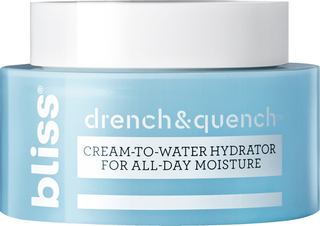
Bliss Drench & Quench Moisturizer
Works for
1 of 1 advertised claim delivered
MoisturizingPetrolatum, Paraffinum liquidum + 11 moreStrong evidence
“Drench & Quench Moisturizer”
This product can help improve hydration of the skin with the two types of ingredients.
The first type is called “humectants”:
these ingredients help attract water.
When humectants are on the surface of the skin, they “pull in” the moisture from the outside environment, or from
within deeper layers of the skin. The following ingredients in this product do the job:
glycerin, butylene glycol.
This product also contains ingredients called “occlusives”. They help reduce the speed with which our skin loses moisture to the outside environment. These ingredients also help soften the upper layer of the skin, so it feels less tight and nicer to the touch. The following ingredients in this product do the job: dimethicone, cyclopentasiloxane.
The following ingredients in this product are especially good for supporting the skin barrier and helping with the hydration level: paraffinum liquidum, petrolatum, urea
Anti-agingNot advertised by the brand · Retinyl palmitate, Tocopherol + 1 moreModerate evidence
This product contains retinyl palmitate. This ingredient might be able to help reduce and prevent fine lines and wrinkles, improve skin elasticity and firmness, but there is not enough evidence that it actually works.
Evens skin toneNot advertised by the brand · Retinyl palmitate, Tetrahexyldecyl ascorbateModerate evidence
The following ingredient (ingredients) in this product might be helpful, but there is no evidence to confirm that it actually works: retinyl palmitate.
Can it cause trouble?
Irritancy11 strong irritants: Dmdm hydantoin, Passiflora incarnata seed oil + 9 more — patch-test recommendedHigh risk
Comedogenic3 ingredients rated 2 or more on the 0–5 pore-clogging scale3 flagged


User reviews
Be the first — your take helps the next person decide.
Ingredients
Filter by role to see what each ingredient is doing.
Sodium lauryl sulfate~25–38%
- Irritation risk
- High
- Comedogenicity
- 3/5
A cleansing agent (SLS). It can be irritating
More about Sodium lauryl sulfateSodium laureth sulfate~8.7–13%
- Irritation risk
- High
- Comedogenicity
- 2/5
Works as a foaming cleansing agent
More about Sodium laureth sulfateDmdm hydantoin~0.3–0.6%
- Irritation risk
- High
A preservative that releases formaldehyde and can be irritating
More about Dmdm hydantoinUrea~3–4.5%
- Irritation risk
- Low
Naturally present in skin (urea makes up about 7% of natural moisturizing factors in skin). Attracts water to the upper layer of the skin. Also has a positive effect on the skin barrier beyond the humectant action. Can enhance penetration of other ingredients. Is an exfoliating ingredient when used in high concentrations
More about UreaPetrolatum~2.6–3.8%
- Irritation risk
- Low
One of the most effective and the most studied occlusive ingredients that creates a protective layer on top of the skin preventing moisture loss
More about PetrolatumParaffinum liquidum~2.1–3.2%
- Irritation risk
- Low
Mineral oil. One of the most effective and well studied occlusive and emollient moisturizing ingredients. Helps reduce moisture loss in skin and repair skin barrier function
More about Paraffinum liquidumFormaldehyde~1.2–1.9%
- Irritation risk
- Low
Water~1.2–1.9%
Cyclopentasiloxane~1.1–1.6%
- Irritation risk
- Low
A silicone that helps improve the product texture and spreadability. Can absorb oil creating a short-term mattifying effect on the skin
More about CyclopentasiloxaneGlycerin~0.9–1.35%
- Irritation risk
- Low
One of the best moisturizing ingredients. Naturally present in skin. It attracts water to the upper layer of the skin working as a humectant
More about GlycerinButylene glycol~0.5–1.15%
- Irritation risk
- Low
Used to create a nice product texture and help delivery of other ingredients. Might be somewhat helpful in attracting water to the upper layer of the skin
More about Butylene glycolDimethicone~0.5–1.15%
- Irritation risk
- Low
A silicone that helps to reduce water loss from the surface of the skin. Can temporarily "fill in" lines and wrinkles, absorb oil, and create a nice product finish
More about DimethiconeHydrogenated polyisobutene~0.45–1%
- Irritation risk
- Low
Used to improve the product consistency and soften the upper layer of the skin
More about Hydrogenated polyisobutenePassiflora incarnata seed oil~0.35–0.85%
- Irritation risk
- High
A plant oil that can help soften the upper layer of the skin. Contains essential oil that can be irritating
More about Passiflora incarnata seed oilChamomilla recutita flower extract~0.35–0.8%
- Irritation risk
- High
Plant extract that can have healing and anti-inflammatory properties. It is a potential allergen and can be irritating
More about Chamomilla recutita flower extractTocopheryl acetate~0.35–0.8%
- Irritation risk
- Medium
A more stable but less bio-available form of vitamin E compared to Tocopherol. Might help moisturize and protect the skin from free radicals, but mostly used in low concentrations to stabilize other ingredients.
More about Tocopheryl acetateRetinyl palmitate~0.3–0.7%
- Irritation risk
- High
Three steps removed from the active form of vitamin A - retinoic acid. To have an effect in the skin, it first needs to be converted twice to become the retinoic acid. This means it is less potent than retinol, but could also be less irritating. Once converted to the retinoic acid in the skin, it helps against all signs of aging, improves skin cell turnover and helps fight blemishes and clogged pores. However, in many cosmetic formulations, it is used in a concentration that is too low to have the full effect
More about Retinyl palmitateTetrahexyldecyl ascorbate~0.3–0.75%
- Irritation risk
- Medium
Being a lipid soluble form of vitamin C, it is more stable than ascorbic acid, but still degrades quickly and needs to be stabilized in a formulation with another ingredient. It is claimed to penetrate skin better than pure vitamin C and have the the similar benefits, but solid studies of its effectiveness are lacking. Is likely to require a higher concentration in a product than pure vitamin C to be effective. It might be able to help reduce pore clogging.
More about Tetrahexyldecyl ascorbateCaprylic/capric triglyceride~0.35–0.85%
- Irritation risk
- Medium
A good mix of fatty acids that forms a protective layer on the skin. Improves the shelf life of products. Derived from coconut and glycerin
More about Caprylic/capric triglycerideSilybum marianum seed oil~0.2–0.7%
- Irritation risk
- High
A plant oil that contains essential oils that can be irritating. Can help soften the upper layer of the skin. Might have some anti-oxidant activity but evidence is lacking
More about Silybum marianum seed oilTocopherol~0.2–0.7%
- Irritation risk
- Low
Pure form of vitamin E. Can help moisturise and protect the skin from free radicals. Often used to help stabilise other ingredients or the formula itself
More about TocopherolPorphyra umbilicalis extract~0.2–0.7%
- Irritation risk
- Low
- Comedogenicity
- 3/5
An algae extract that can help attract water to the upper layer of the skin. Might have an anti-oxidant effect in skin but evidence is lacking
More about Porphyra umbilicalis extractCommiphora mukul resin extract~0.2–0.8%
- Irritation risk
- High
A plant extract might be helpful in neutralizing free radicals and reducing inflammation in skin
More about Commiphora mukul resin extractRosa multiflora fruit extract~0.15–0.7%
Nannochloropsis oculata extract~0.15–0.65%
- Irritation risk
- Low
A microalgae extract that helps to attact water to the upper layer of the skin
More about Nannochloropsis oculata extractDimethicone/peg-10/15 crosspolymer~0.15–0.65%
Sodium chloride~0.2–0.75%
- Irritation risk
- Low
Used to stabilize mixtures of oil and water, and create thicker, gel-like product textures
More about Sodium chlorideNylon-12~0.2–0.75%
Dimethicone/vinyl dimethicone crosspolymer~0.15–0.65%
- Irritation risk
- Low
Used to stabilize product formulations and create a nice product texture
More about Dimethicone/vinyl dimethicone crosspolymerPotassium sorbate~0.3–0.6%
Dipropylene glycol~0.15–0.55%
- Irritation risk
- Low
Helps to dissolve other ingredients in a formulation. Slows down the rate of product drying
More about Dipropylene glycolParfum~0.15–0.55%
- Irritation risk
- High
An aromatic blend of unspecified and possibly irritating ingredients
More about ParfumGuar hydroxypropyltrimonium chloride~0.15–0.6%
- Irritation risk
- Low
Helps water and oil mix together and create a nice product texture
More about Guar hydroxypropyltrimonium chloridePolysorbate 20~0.15–0.65%
Phenoxyethanol~0.15–0.55%
- Irritation risk
- Low
A preservative. It helps prevent bacterial growth in cosmetic products
More about PhenoxyethanolBenzyl alcohol~0.1–0.4%
- Irritation risk
- High
A preservative. Can be used to mask unpleasant smell. Can be irritating
More about Benzyl alcoholSodium citrate~0.1–0.45%
- Irritation risk
- Medium
Helps to control the skin's pH level. Maintains the skin's natural film of amino-lactic acids and oils. Helps to preserve products
More about Sodium citrateChlorphenesin~0.05–0.3%
Linalool~0.05–0.25%
Butylphenyl methylpropional~0.1–0.3%
- Irritation risk
- High
A fragrance. Can trigger allergic reactions and be irritating
More about Butylphenyl methylpropionalAlpha-isomethyl ionone~0.1–0.3%
- Irritation risk
- High
A fragrance. Potential allergen and can be irritating
More about Alpha-isomethyl iononeLimonene~0.05–0.15%
- Irritation risk
- High
A common frangrance that can easily irritate skin, especially if exposed to air, light or heat
More about LimoneneCi 42090~0.05–0.2%
Ingredient list view
Sodium lauryl sulfate, Sodium laureth sulfate, Dmdm hydantoin, Urea, Petrolatum, Paraffinum liquidum, Unknown, Formaldehyde, Water, Cyclopentasiloxane, Glycerin, Butylene glycol, Dimethicone, Hydrogenated polyisobutene, Passiflora incarnata seed oil, Chamomilla recutita flower extract, Tocopheryl acetate, Retinyl palmitate, Tetrahexyldecyl ascorbate, Caprylic/capric triglyceride, Silybum marianum seed oil, Tocopherol, Porphyra umbilicalis extract, Commiphora mukul resin extract, Rosa multiflora fruit extract, Nannochloropsis oculata extract, Dimethicone/peg-10/15 crosspolymer, Sodium chloride, Nylon-12, Dimethicone/vinyl dimethicone crosspolymer, Potassium sorbate, Dipropylene glycol, Parfum, Guar hydroxypropyltrimonium chloride, Polysorbate 20, Phenoxyethanol, Benzyl alcohol, Sodium citrate, Chlorphenesin, Linalool, Butylphenyl methylpropional, Alpha-isomethyl ionone, Limonene, Ci 42090
Compare prices
Retailers ranked by price — lowest first.
Affiliate links · prices updated regularly · As an Amazon Associate, WIMJ earns from qualifying purchases.
Worth comparing, line by line.
Match % combines shared ingredients, the first five ingredients, shared actives and hero ingredients, irritancy (lower counts in the alternative's favour), texture and body area. Only products in the same routine step are compared.
| BlissDrench & Quench MoisturizerYOUR PRODUCT | NEOSTRATAHydra Filling Cream | CliniqueDDMID Moisturizing Lotion + Uneven Texure Concentrate | anna lotanGolden Night Cream | |
|---|---|---|---|---|
| Match | — | 59% | 54% | 54% |
| Price | $28.00 | $52.00+$24.00 | — | — |
| Shared key ingredients | — | 5 of 9 | 5 of 9 | 6 of 9 |
| Key difference | — | Palmitoyl Tripeptide-1 | Lactic Acid | Niacinamide |
| Irritancy | High | Medium | Medium | High |
| Drying alcohol | — | — | — | Contains drying alcohol |
| View product | Shop | Shop | Shop |


Product summary
Based on the ingredient list, "Bliss - Drench & Quench Moisturizer" can work well for skin moisturization. This moisturizer uses a good combo of humectants and emollients. These both types of ingredients are essentials for improving the skin hydration and keeping the skin barrier healthy. Urea, glycerin and butylene glycol in this product (humectants) attract water molecules to the upper layer of the skin (the water comes from the outside air or from the deeper layers of the skin if the air is dry). Paraffinum liquidum, petrolatum, dimethicone, cyclopentasiloxane and hydrogenated polyisobutene in this product help decrease the water evoporation from the skin, so that it stays hydrated for longer. These ingredients also soften the skin and take away the feeling of tightness and dryness.
Ingredient callouts
- this moisturizer includes a form of retinoids (vitamin A) - retinyl palmitate 0.30% - 0.70%, but this type of vitamin A is not very effective. It could in theory help with fine lines and wrinkles, but the effect is most likely minimal.
Irritation risk
This moisturizer contains a bunch of common irritants, including ingredients that do not provide any known benefit for the skin. It might not be the best choice if your skin is sensitive. We assess the overall irritancy of this moisturizer to be high. For a detailed overview of all potential irritants: click here
You can see the detailed formula review with the breakdown of all actives in the product and the full ingredient list with estimated concentrations in the tables below.
Price
The product retails for 35.00A$ in Australia, from 24.00$ up to 36.99$ in the United States and for 29.95£ in the United Kingdom.
For a detailed price comparison: click here.
Sources cited in this review
Every concentration estimate and effectiveness label is anchored to one of these 19 studies and safety reviews.
- 1Surfactants and experimental irritant contact dermatitisncbi.nlm.nih.gov
- 2Topical urea in skincare: A reviewpubmed.ncbi.nlm.nih.gov
- 3A review on the extensive skin benefits of mineral oilncbi.nlm.nih.gov
- 4
- 5
- 6Final Report on the Safety Assessment of Dimethicone Copolyoljournals.sagepub.com

Affiliate links · As an Amazon Associate, WIMJ earns from qualifying purchases.