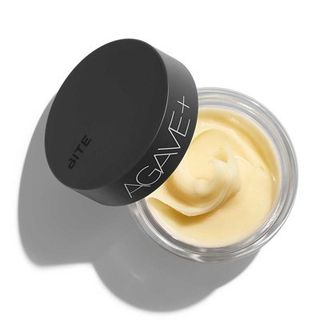
Bite Beauty Agave + Nightime Therapy Balm to Oil Texture
Works for
1 of 1 advertised claim delivered
MoisturizingCarthamus tinctorius seed oil, Squalane + 9 moreGood evidence
“Sunflower, Safflower and Jojoba seed oils help seal in moisture all night long.”
This product can help soften the skin and reduce its moisture loss with emollients and occlusives: helianthus annuus seed oil, ricinus communis seed oil.
Keep in mind that this product does not contain effective ingredients to attract water to the upper layer of the skin. This is why an additional product with humectants like glycerin or hyaluronic acid can be helpful (apply it before this product for the best results).
Can it cause trouble?
Irritancy4 strong irritants: Aroma, Parfum + 2 more — patch-test recommendedHigh risk
Comedogenic2 ingredients rated 2 or more on the 0–5 pore-clogging scale2 flagged
User reviews
Be the first — your take helps the next person decide.
Ingredients
Filter by role to see what each ingredient is doing.
Ricinus communis seed oil~25–37%
- Irritation risk
- Medium
A plant oil that can help soften the skin. It might be helpful in calming down inflammation, but solid research is lacking. Is often used in lip products to create the needed product consistency
More about Ricinus communis seed oilTriisostearoyl polyglyceryl-3 dimer dilinoleate~7.1–10.7%
- Irritation risk
- Low
Oleic/linoleic/linolenic polyglycerides~4.6–7%
- Irritation risk
- Low
Helps soften the upper layer of the skin
More about Oleic/linoleic/linolenic polyglyceridesSqualane~4–5.9%
- Irritation risk
- Low
An oil naturally present in skin. Works as an emollient to soften the skin and form a protective layer on its surface without a greasy feeling.
More about SqualaneGlyceryl rosinate~3.1–4.7%
- Irritation risk
- Low
Hydrogenated vegetable oil~2.4–3.5%
- Irritation risk
- Low
- Comedogenicity
- 2/5
An oil from a mixture of different vegetables. Helps soften the upper layer of the skin
More about Hydrogenated vegetable oilRhus verniciflua peel cera~1.9–2.8%
- Irritation risk
- Low
Helianthus annuus seed oil~1.7–2.6%
- Irritation risk
- Low
A great emollient due to its high linoleic acid content. One of the most effective plant oils in helping skin hydration and repairing skin barrier function
More about Helianthus annuus seed oilPhytosteryl canola glycerides~1.2–1.9%
- Irritation risk
- Low
Helps soften the upper layer of the skin
More about Phytosteryl canola glyceridesCarthamus tinctorius seed oil~1.1–1.7%
- Irritation risk
- Low
An emollient that helps soften the skin and might help calm down inflammation
More about Carthamus tinctorius seed oilAroma~0.85–1.3%
Parfum~0.5–1.2%
- Irritation risk
- High
An aromatic blend of unspecified and possibly irritating ingredients
More about ParfumSimmondsia chinensis seed oil~0.6–1.35%
- Irritation risk
- Medium
Softens the upper layer of skin and helps restore the healthy skin barrier. Has shown to help calm down inflammation in skin. It is a stable oil, meaning that it retains its properties even when exposed to air.
More about Simmondsia chinensis seed oilPhospholipids~0.5–1.15%
- Irritation risk
- Low
Emollients that are naturaly present in skin. In addition, they help water and oil mix together in the product
More about PhospholipidsPolyglyceryl-3 diisostearate~0.5–1.1%
- Irritation risk
- Medium
- Comedogenicity
- 3/5
Helps oil and water mix together
More about Polyglyceryl-3 diisostearateCaprylic/capric triglyceride~0.5–1.15%
- Irritation risk
- Medium
A good mix of fatty acids that forms a protective layer on the skin. Improves the shelf life of products. Derived from coconut and glycerin
More about Caprylic/capric triglycerideTocopherol~0.35–0.85%
- Irritation risk
- Low
Pure form of vitamin E. Can help moisturise and protect the skin from free radicals. Often used to help stabilise other ingredients or the formula itself
More about TocopherolPunica granatum flower extract~0.35–0.8%
- Irritation risk
- Low
Ascorbyl palmitate~0.3–0.7%
- Irritation risk
- Medium
Being a lipid soluble form of vitamin C, it is more stable and can penetrate the skin better than L-Ascorbic acid. It is effective in protecting the skin from free radicals, as well as evening the skin tone, but is less effective in stimulating collagen production compared to L-Ascorbic acid.
More about Ascorbyl palmitateAgave tequilana leaf extract~0.15–0.6%
- Irritation risk
- Low
Momordica grosvenorii fruit extract~0.15–0.5%
- Irritation risk
- Low
Chamomilla recutita flower extract~0.1–0.45%
- Irritation risk
- High
Plant extract that can have healing and anti-inflammatory properties. It is a potential allergen and can be irritating
More about Chamomilla recutita flower extractTocopheryl acetate~0.1–0.35%
- Irritation risk
- Medium
A more stable but less bio-available form of vitamin E compared to Tocopherol. Might help moisturize and protect the skin from free radicals, but mostly used in low concentrations to stabilize other ingredients.
More about Tocopheryl acetateLimonene~0.05–0.25%
- Irritation risk
- High
A common frangrance that can easily irritate skin, especially if exposed to air, light or heat
More about LimoneneLinalool~0.05–0.2%
Ingredient list view
Ricinus communis seed oil, Triisostearoyl polyglyceryl-3 dimer dilinoleate, Oleic/linoleic/linolenic polyglycerides, Squalane, Glyceryl rosinate, Hydrogenated vegetable oil, Unknown, Rhus verniciflua peel cera, Helianthus annuus seed oil, Phytosteryl canola glycerides, Carthamus tinctorius seed oil, Aroma, Parfum, Simmondsia chinensis seed oil, Phospholipids, Polyglyceryl-3 diisostearate, Caprylic/capric triglyceride, Tocopherol, Punica granatum flower extract, Ascorbyl palmitate, Agave tequilana leaf extract, Momordica grosvenorii fruit extract, Chamomilla recutita flower extract, Tocopheryl acetate, Limonene, Linalool
Compare prices
Retailers ranked by price — lowest first.
Sources cited in this review
Every concentration estimate and effectiveness label is anchored to one of these 9 studies and safety reviews.
- 1
- 2
- 3
- 4
- 5
- 6Effect of topically applied lipids on surfactant-irritated skinonlinelibrary.wiley.com

Affiliate links · As an Amazon Associate, WIMJ earns from qualifying purchases.