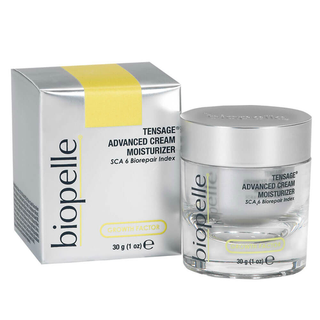
Biopelle Tensage Advanced Cream Moisturizer
Works for
2 of 3 advertised claims delivered
Moisturizing22 ingredients credited for this claimStrong support
“Biopelle Tensage Advanced Cream Moisturizer nourishes and hydrates to promote a youthful, revitalized complexion.”
This product can help improve hydration of the skin with the two types of ingredients.
The first type is called “humectants”:
these ingredients help attract water.
When humectants are on the surface of the skin, they “pull in” the moisture from the outside environment, or from
within deeper layers of the skin. The following ingredients in this product do the job:
alanine, aspartic acid.
This product also contains ingredients called “occlusives”. They help reduce the speed with which our skin loses moisture to the outside environment. These ingredients also help soften the upper layer of the skin, so it feels less tight and nicer to the touch. The following ingredients in this product do the job: caprylic/capric triglyceride, limnanthes alba seed oil.
The following ingredients in this product are especially good for supporting the skin barrier and helping with the hydration level: urea
Anti-aging4 ingredients credited for this claimModerate support
“Lactic acid gently exfoliates, diminishing the appearance of fine lines and wrinkles while allantoin and vitamin E hydrate and condition, soothing and smoothing your skin for a supple texture and healthy, rejuvenated look.”
This product contains aspartic acid, serine. These ingredients might be able to help reduce and prevent fine lines and wrinkles, improve skin elasticity and firmness, but there is not enough evidence that it actually works.
Exfoliation3 ingredients credited for this claimLimited support
“Lactic acid gently exfoliates, diminishing the appearance of fine lines and wrinkles while allantoin and vitamin E hydrate and condition, soothing and smoothing your skin for a supple texture and healthy, rejuvenated look.”
This product might help exfoliate the skin with urea, but This ingredient is not the most effective.
Can it cause trouble?
Irritancy7 strong irritants: Parfum, Geraniol + 5 more — patch-test recommendedHigh risk
ComedogenicClean of flagged comedogenic ingredientsNone flagged

User reviews
Be the first — your take helps the next person decide.
Ingredients
Filter by role to see what each ingredient is doing.
Water~45–55%
C12-20 acid peg-8 ester~5.3–6.5%
- Irritation risk
- Medium
Helps oil and water mix together
More about C12-20 acid peg-8 esterSnail secretion filtrate~4.2–5.2%
- Irritation risk
- Medium
Typically contains hyaluronic acid that helps attract water to the upper layer of the skin. Might contain allantoin that is helpful in calming down inflammation. There is no evidence that it can have any further benefits for the skin, especially when used in skincare products
More about Snail secretion filtrateGlycerin~3.1–3.8%
- Irritation risk
- Low
One of the best moisturizing ingredients. Naturally present in skin. It attracts water to the upper layer of the skin working as a humectant
More about GlycerinHydrolyzed soy protein~2.4–2.9%
- Irritation risk
- Low
Helps attract water to the upper layer of the skin. Might have some anti-aging, anti-oxidant, and skin lightening properties, but solid evidence is missing
More about Hydrolyzed soy proteinPentylene glycol~2–2.4%
- Irritation risk
- Medium
Used to preserve products, dissolve other ingredients and create a nice product texture
More about Pentylene glycolHexylene glycol~1.6–1.9%
- Irritation risk
- Medium
Helps create a more spreadable product texture
More about Hexylene glycolSaccharide isomerate~1.4–1.7%
- Irritation risk
- Low
Helps attract water to the upper layer of the skin
More about Saccharide isomerateCaprylic/capric triglyceride~1.3–1.6%
- Irritation risk
- Medium
A good mix of fatty acids that forms a protective layer on the skin. Improves the shelf life of products. Derived from coconut and glycerin
More about Caprylic/capric triglycerideCetyl alcohol~1.1–1.3%
- Irritation risk
- Low
A non-drying alcohol that works to soften the skin and stabilize product formulations helping oil and water mix together
More about Cetyl alcoholLimnanthes alba seed oil~0.75–1.1%
- Irritation risk
- Low
This oil's cmposition is closest to rapeseed oil. It is a very stable oil and serves as an emoillient
More about Limnanthes alba seed oilPpg-15 stearyl ether~0.65–0.95%
- Irritation risk
- Low
Help soften the upper layer of the skin and create a nice product consistency
More about Ppg-15 stearyl etherPhenoxyethanol~0.5–0.75%
- Irritation risk
- Low
A preservative. It helps prevent bacterial growth in cosmetic products
More about PhenoxyethanolFructose~0.5–0.7%
- Irritation risk
- Low
Helps attract water to the upper layer of the skin
More about FructoseGlucose~0.45–0.65%
- Irritation risk
- Low
Helps attract water to the upper layer of the skin. Could be helpful in restoring the skin barrier function
More about GlucoseMaltodextrin~0.45–0.7%
- Irritation risk
- Low
Used to stabilize the product formulation and can help absorb oil
More about MaltodextrinTocopheryl acetate~0.45–0.65%
- Irritation risk
- Medium
A more stable but less bio-available form of vitamin E compared to Tocopherol. Might help moisturize and protect the skin from free radicals, but mostly used in low concentrations to stabilize other ingredients.
More about Tocopheryl acetateUrea~0.35–0.65%
- Irritation risk
- Low
Naturally present in skin (urea makes up about 7% of natural moisturizing factors in skin). Attracts water to the upper layer of the skin. Also has a positive effect on the skin barrier beyond the humectant action. Can enhance penetration of other ingredients. Is an exfoliating ingredient when used in high concentrations
More about UreaSodium citrate~0.3–0.6%
- Irritation risk
- Medium
Helps to control the skin's pH level. Maintains the skin's natural film of amino-lactic acids and oils. Helps to preserve products
More about Sodium citrateLactic acid~0.3–0.55%
- Irritation risk
- Medium
An exfoliating and moisturizing alpha-hydroxy acid (AHA). Typically causes less irritation than other AHAs, for example, glycolic acid. At high concentrations (about 15%), lactic acid can help reduce lines and wrinkles. Recent studies show that lactic acid can support the "good" bacteria living on skin's surface (healthy skin microbiome)
More about Lactic acidMethylparaben~0.15–0.3%
Serine~0.25–0.5%
- Irritation risk
- Low
An amino-acid that helps to attract water to the upper layer of the skin. In combination with other amino-acids, might help to reduce fine lines and wrinkles
More about SerineSodium lactate~0.25–0.5%
- Irritation risk
- Medium
Helps attract water to the upper layer of the skin. Is often used to adjust the pH level of the product
More about Sodium lactateSorbitol~0.25–0.5%
- Irritation risk
- Low
Helps attract water to the upper layer of the skin and improves the product texture
More about SorbitolPropylparaben~0.2–0.4%
Parfum~0.25–0.45%
- Irritation risk
- High
An aromatic blend of unspecified and possibly irritating ingredients
More about ParfumDextrin~0.25–0.5%
- Irritation risk
- Low
A sugar that is used to stabilize the product formulation. Can help attract water to the upper layer of the skin
More about DextrinSucrose~0.25–0.45%
- Irritation risk
- Low
Can help attract water to the upper layer of the skin. In crystal form, it can work as a gentle exfoliant, gentler than the salt scrub. Helps stabilize the emulsion
More about SucroseDisodium edta~0.25–0.45%
Sodium chloride~0.25–0.5%
- Irritation risk
- Low
Used to stabilize mixtures of oil and water, and create thicker, gel-like product textures
More about Sodium chlorideGeraniol~0.2–0.4%
Limonene~0.2–0.4%
- Irritation risk
- High
A common frangrance that can easily irritate skin, especially if exposed to air, light or heat
More about LimoneneAlanine~0.25–0.4%
- Irritation risk
- Low
An amino-acid that helps to attract water to the upper layer of the skin and might help to lighten the skin, but solid evidence is lacking
More about AlanineAspartic acid~0.2–0.4%
- Irritation risk
- Low
An amino-acid that helps increase skin hydration and might help to slightly improve skin firmness, potentially reducing lines and wrinkles
More about Aspartic acidGlutamic acid~0.2–0.4%
- Irritation risk
- Low
An amino-acid that helps attract water to the upper layer of the skin
More about Glutamic acidHexyl nicotinate~0.2–0.4%
- Irritation risk
- High
Might be able to enhance blood flow in the skin. Can be irritating and result in skin redness
More about Hexyl nicotinateHexyl cinnamal~0.15–0.25%
Allantoin~0.1–0.25%
- Irritation risk
- Low
Helps calm down inflammation in skin and can help reduce itching. Helps to repair the skin barrier and keep skin hydrated
More about AllantoinCitric acid~0.1–0.2%
- Irritation risk
- Medium
Can work as an exfoliant but is typically used to adjust the product pH
More about Citric acidLinalool~0.1–0.15%
Benzyl salicylate~0.1–0.15%
Ingredient list view
Water, C12-20 acid peg-8 ester, Snail secretion filtrate, Glycerin, Hydrolyzed soy protein, Pentylene glycol, Hexylene glycol, Saccharide isomerate, Caprylic/capric triglyceride, Cetyl alcohol, Limnanthes alba seed oil, Ppg-15 stearyl ether, Phenoxyethanol, Fructose, Glucose, Maltodextrin, Tocopheryl acetate, Urea, Sodium citrate, Lactic acid, Methylparaben, Serine, Sodium lactate, Sorbitol, Propylparaben, Parfum, Dextrin, Sucrose, Disodium edta, Sodium chloride, Geraniol, Limonene, Alanine, Aspartic acid, Glutamic acid, Hexyl nicotinate, Hexyl cinnamal, Allantoin, Citric acid, Linalool, Benzyl salicylate
Compare prices
Retailers ranked by price — lowest first.

Worth comparing, line by line.
Match % combines shared ingredients, the first five ingredients, shared actives and hero ingredients, irritancy (lower counts in the alternative's favour), texture and body area. Only products in the same routine step are compared.
| BiopelleTensage Advanced Cream MoisturizerYOUR PRODUCT | BiRetixIsorepair | The OrdinaryNatural Moisturizing Factors + PhytoCeramides | BaleaQ10 Anti-Wrinkle Night Cream | |
|---|---|---|---|---|
| Match | — | 55% | 51% | 51% |
| Price | $81.50 | $26.92−$54.58 | $10.80−$70.70 | $7.22−$74.28 |
| Shared key ingredients | — | 9 of 15 | 8 of 15 | 9 of 15 |
| Key difference | — | Gluconolactone | Anhydroxylitol | Panthenol |
| Irritancy | High | Medium | Medium | Medium |
| Drying alcohol | — | — | — | — |
| View product | Shop | Shop | Shop |

Sources cited in this review
Every concentration estimate and effectiveness label is anchored to one of these 20 studies and safety reviews.
- 1
- 2
- 3
- 4Extracts from Glycine max (soybean) induce elastin synthesis and inhibit elastase activityonlinelibrary.wiley.com
- 5
- 6Safety Assessment of Soy Peptides as Used in Cosmeticscir-safety.org

Affiliate links · As an Amazon Associate, WIMJ earns from qualifying purchases.