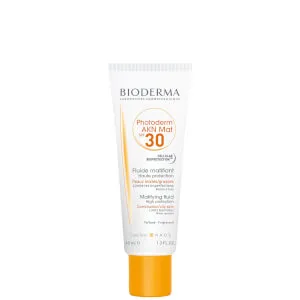
Bioderma Photoderm Anti-Blemish Sunscreen SPF30
Works for
Sun protectionSPF 30 · 3 UV filtersBroad spectrum
This product offers a good level of protection against both UVB and UVA rays.
This sunscreen uses organic (so-called "chemical") sunscreen filters. Organic, or "chemical" filters usually provide reliable sun protection and rarely leave a white cast. Sunscreens with organic filters can sting eyes.
This product can be considered "reef safe" because it does not contain the UV filters (oxybenzone and octinoxate) that can be harmful to coral reefs when present in the water in high concentrations.
Anti-agingGlycolic acid, RhamnoseWorks well
“Waterproof and photostable, the SPF30 formula contains a Cellular Bioprotection™ biological patent which activates skin's natural defences and protects against premature ageing, and a dual action Fluidactiv™ patent, which provides exclusive photo protection and prevents the clogging of pores to help inhibit the appearance of blemishes.”
This product can help reduce and prevent fine lines and wrinkles, improve skin elasticity and firmness because it contains glycolic acid.
Keep in mind that it typically takes at least 6 weeks to notice any results because the changes that are needed to improve fine lines and elasticity happen in the deeper layers of the skin. No topical anti-aging product can “erase” wrinkles or fully reverse signs of aging.
This product can also help prevent early signs of skin aging because it offers a good level of broad spectrum sun protection. Sun damage is the main cause of premature skin aging, and protecting your skin from the sun is the best anti-aging strategy.
Anti-blemishGlycolic acid, Ginkgo biloba leaf extractNot delivered
“Photoderm Anti-Blemish Sunscreen SPF30”
This product contains ingredients (glycolic acid) that could help reduce blemishes and clogged pores in theory, but there is not enough evidence that they actually work.
ExfoliationNot advertised by the brand · Glycolic acidWorks well
This product can help exfoliate the skin. In other words, it helps break down the bonds between dead cells on the surface of the skin and speed up the skin turnover. Skin often appears softer and brighter after exfoliation, but overdoing it can result in disrupted skin barrier. The following ingredient is doing the exfoliating job in this product: glycolic acid.
Evens skin toneNot advertised by the brand · Glycolic acidWorks well
This product offers broad spectrum sun protection. It means that it can prevent hyperpigmentation and help keep the skin tone even (sun damage is the main factor causing age spots, darkening of post-acne marks and other discolorations).
Anti-oxidationNot advertised by the brand · Ginkgo biloba leaf extract, Tocopheryl acetateMay help
This product contains antioxidants (ginkgo biloba leaf extract) that might be able to help neutralize free radicals in skin to lessen the damage it gets from the UV light (sun). There is not enough evidence to confirm their effectiveness in skin though.
MoisturizingNot advertised by the brand · Ectoin, Mannitol + 8 moreWorks
This product contains good ingredients to attract water to the upper layer of the skin. These ingredients are called "humectants": fructooligosaccharides, mannitol.
When humectants are on the surface of the skin, they “pull in” the moisture from the outside environment, or from within deeper layers of the skin. If the air is dry, humectants can speed up the moisture loss from the skin. This is why it is a good idea to use another product on top of this one to help "seal in" the moisture (look for ingredients like dimethicone, squalane, oils and butters).
Can it cause trouble?
Irritancy1 strong irritant: ParfumMedium risk
Comedogenic1 ingredient rated 2 or more on the 0–5 pore-clogging scale1 flagged
User reviews
Be the first — your take helps the next person decide.
Ingredients
Filter by role to see what each ingredient is doing.
Water~45–55%
Dicaprylyl carbonate~5.5–6.7%
- Irritation risk
- Low
Helps products spread more easily and works as an emollient to soften skin
More about Dicaprylyl carbonateOctocrylene~4.5–5.5%
- Irritation risk
- Medium
A weak sunscreen that protects against the sun rays that cause sunburn (UVB) and is somewhat effective against the UVA rays. It is quite stable and can help stabilize other, more vulnerable, sunscreen ingredients like Avobenzone. It is an organic, or so called "chemical" sunscreen
More about OctocryleneMethylene bis-benzotriazolyl tetramethylbutylphenol~3.6–4.4%
- Irritation risk
- Medium
Tinosorb M. A UV filter. Is effective against both UVA and UVB rays. It also provides some protection against visible light. It is photostable and can also be used to improve photostability of other sunscreen ingredients. Its physical properties help to create lightweight sunscreen formulations. It can leave a slight white cast. Unfortunately, it is not approved by the FDA (US) yet
More about Methylene bis-benzotriazolyl tetramethylbutylphenolButyl methoxydibenzoylmethane~3.1–3.8%
- Irritation risk
- Medium
Avobenzone. An organic, or so-called "chemical" UV filter. Protects against both UVA and UVB rays. Needs to be combined with other filters in a formulation to be stable.
More about Butyl methoxydibenzoylmethanePtfe~2–2.4%
Methyl methacrylate crosspolymer~1.7–2.1%
- Irritation risk
- Low
Helps thicken the product consistency
More about Methyl methacrylate crosspolymerC20-22 alkyl phosphate~1.4–1.7%
Silica~1.4–1.7%
Glyceryl stearate~0.95–1.15%
- Irritation risk
- Low
An emollient that softens the skin and forms a protective layer on its surface. Helps water and oil mix together
More about Glyceryl stearatePeg-100 stearate~0.7–1.05%
- Irritation risk
- Low
Helps oil and water mix togehter and creates a nice product texture
More about Peg-100 stearateTridecyl salicylate~0.5–0.75%
- Irritation risk
- Low
Tocopheryl acetate~0.45–0.65%
- Irritation risk
- Medium
A more stable but less bio-available form of vitamin E compared to Tocopherol. Might help moisturize and protect the skin from free radicals, but mostly used in low concentrations to stabilize other ingredients.
More about Tocopheryl acetateEctoin~0.35–0.6%
- Irritation risk
- Low
Softens the upper layer of the skin and can support skin barrier function
More about EctoinMannitol~0.3–0.55%
- Irritation risk
- Low
Helps to attract water to the upper layer of the skin
More about MannitolXylitol~0.3–0.55%
- Irritation risk
- Low
Helps attract water to the upper layer of the skin and repair the skin barrier function
More about XylitolRhamnose~0.3–0.55%
- Irritation risk
- Low
Helps oil and water mix together. It also helps attract water to the upper layer of the skin
More about RhamnoseFructooligosaccharides~0.25–0.5%
- Irritation risk
- Low
Help attract water to the upper layer of the skin
More about FructooligosaccharidesLaminaria ochroleuca extract~0.25–0.45%
- Irritation risk
- Low
- Comedogenicity
- 3/5
Helps attract water to the upper layer of the skin
More about Laminaria ochroleuca extractGlycolic acid~0.2–0.4%
- Irritation risk
- High
An alpha-hydroxy acid (AHA) that helps to remove the dead skin cells on the surface of the skin reveling a more even, smoother complexation. It is also able to stimulate collagen production with long-term use. Could help to reduce pore congestion. It can be irritating to the skin. Apply sunscreen daily if using products with glycolic acid
More about Glycolic acidGinkgo biloba leaf extract~0.2–0.35%
- Irritation risk
- High
A plant extract that might help neutralize free radicals and reduce inflammation in skin. It can be irritating
More about Ginkgo biloba leaf extractCitric acid~0.2–0.35%
- Irritation risk
- Medium
Can work as an exfoliant but is typically used to adjust the product pH
More about Citric acidDodecyl gallate~0.15–0.3%
- Irritation risk
- Low
C20-22 alcohols~0.15–0.3%
- Irritation risk
- Low
Decyl glucoside~0.25–0.45%
- Irritation risk
- High
Helps oil and water mix together. Can be irritating
More about Decyl glucosidePropylene glycol~0.15–0.3%
- Irritation risk
- High
Helps oil and water mix together and can enhance the penetration of other ingredients into the skin. It can be irritating
More about Propylene glycolHydroxyethyl acrylate/sodium acryloyldimethyl taurate copolymer~0.15–0.3%
- Irritation risk
- Medium
A gelling agent that thickens the product consistency and leaves the skin with a velvety finish
More about Hydroxyethyl acrylate/sodium acryloyldimethyl taurate copolymerXanthan gum~0.2–0.35%
- Irritation risk
- Low
Used to create a thicker product consistency
More about Xanthan gumCaprylic/capric triglyceride~0.2–0.4%
- Irritation risk
- Medium
A good mix of fatty acids that forms a protective layer on the skin. Improves the shelf life of products. Derived from coconut and glycerin
More about Caprylic/capric triglycerideParaffinum liquidum~0.2–0.35%
- Irritation risk
- Low
Mineral oil. One of the most effective and well studied occlusive and emollient moisturizing ingredients. Helps reduce moisture loss in skin and repair skin barrier function
More about Paraffinum liquidumSodium hydroxide~0.15–0.3%
Disodium edta~0.15–0.25%
Chlorphenesin~0.1–0.2%
Phenoxyethanol~0.1–0.2%
- Irritation risk
- Low
A preservative. It helps prevent bacterial growth in cosmetic products
More about PhenoxyethanolParfum~0.05–0.1%
- Irritation risk
- High
An aromatic blend of unspecified and possibly irritating ingredients
More about ParfumIngredient list view
Water, Dicaprylyl carbonate, Octocrylene, Methylene bis-benzotriazolyl tetramethylbutylphenol, Butyl methoxydibenzoylmethane, Ptfe, Methyl methacrylate crosspolymer, C20-22 alkyl phosphate, Silica, Glyceryl stearate, Peg-100 stearate, Tridecyl salicylate, Tocopheryl acetate, Ectoin, Mannitol, Xylitol, Rhamnose, Fructooligosaccharides, Laminaria ochroleuca extract, Glycolic acid, Ginkgo biloba leaf extract, Citric acid, Dodecyl gallate, C20-22 alcohols, Decyl glucoside, Propylene glycol, Hydroxyethyl acrylate/sodium acryloyldimethyl taurate copolymer, Xanthan gum, Caprylic/capric triglyceride, Paraffinum liquidum, Sodium hydroxide, Disodium edta, Chlorphenesin, Phenoxyethanol, Parfum
Compare prices
Retailers ranked by price — lowest first.


Worth comparing, line by line.
Match % combines shared ingredients, the first five ingredients, shared actives and hero ingredients, irritancy (lower counts in the alternative's favour), texture and body area. Only products in the same routine step are compared.
| BiodermaPhotoderm Anti-Blemish Sunscreen SPF30YOUR PRODUCT | Eveline CosmeticsPhotoderm MAX Tinted Cream SPF50+ Sensitive Skin #Golden Colour | NAOS STOREBioderma Photoderm KID Spray SPF 50+ sunscreen for babies and children | NiveaKids Protect & Care Sun Lotion SPF 50+ | |
|---|---|---|---|---|
| Match | — | 46% | 42% | 41% |
| Price | — | — | — | $5.37 |
| Shared key ingredients | — | 8 of 12 | 7 of 12 | 1 of 12 |
| Key difference | — | Tinosorb S | Uvinul T | Panthenol |
| Irritancy | Medium | Low | Low | Medium |
| SPF | SPF 30 | SPF 50 | SPF 50 | SPF 50 |
| Drying alcohol | — | — | — | Contains drying alcohol |
| View product | Shop | Shop | Shop |


More alternatives: Banana Boat Kids Free Clear Sunscreen Spray SPF 50Phasilab Instant Protect PM 2.5 SPF 50+ Tinted
Product summary
The ingredient list suggests that "Bioderma - Photoderm Anti-Blemish Sunscreen SPF30" can provide reliable sun protection. It can protect from both UVA and UVB rays. This is great news because not all sunscreens with SPF ratings give UVA protection. (UVA rays do not cause sunburn, but still damage our skin and lead to early aging).
As a plus, this sunscreen uses some of the new generation UV filters (Tinosorb M). These filters are more stable and more gentle on the skin.
It also works as a moisturizer, so you do not have to use an additional hydrating product. This product prevents early signs of aging by protecting against sun damage (all broad spectrum sunscreens do that).
Sunscreen filters
This is a so-called "chemical" sunscreen. It means that it uses organic UV filters. They typically offer good sun protection and rarely leave a white cast, but they can be irritating for some people with sensitive skin. The UV filters in this sunscreen are: avobenzone 3.10% - 3.80%, tinosorb m 3.60% - 4.40% and octocrylene 4.50% - 5.50%.
Irritation risk
This formulation includes some common irritants, including ingredients that do not provide a benefit for the skin. We assess the overall irritancy of this product to be medium. For a detailed overview of all potential irritants: click here
You can see the detailed formula review with the breakdown of all actives in the product and the full ingredient list with estimated concentrations in the tables below.
Price
The product retails for 16.00$ in the United States and for 16.00£ in the United Kingdom.
For a detailed price comparison: click here.
Sources cited in this review
Every concentration estimate and effectiveness label is anchored to one of these 12 studies and safety reviews.
- 1Safety Assessment of Fluoropolymers as Used in Cosmeticscir-safety.org
- 2Potentially beneficial effects of rhamnose on skin ageing: an in vitro and in vivo studypubmed.ncbi.nlm.nih.gov
- 3
- 4Glycolic acid peel therapy – a current reviewncbi.nlm.nih.gov
- 5
- 6

Affiliate links · As an Amazon Associate, WIMJ earns from qualifying purchases.