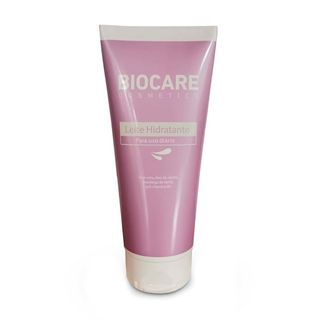
Biocare Cosmetics Moisturizing Milk
Works for
1 of 4 advertised claims delivered
Moisturizing17 ingredients credited for this claimStrong evidence
“Moisturizing Milk”
This product can help improve hydration of the skin with the two types of ingredients.
The first type is called “humectants”:
these ingredients help attract water.
When humectants are on the surface of the skin, they “pull in” the moisture from the outside environment, or from
within deeper layers of the skin. The following ingredients in this product do the job:
glycerin, sodium lactate.
This product also contains ingredients called “occlusives”. They help reduce the speed with which our skin loses moisture to the outside environment. These ingredients also help soften the upper layer of the skin, so it feels less tight and nicer to the touch. The following ingredients in this product do the job: butyrospermum parkii butter, caprylic/capric triglyceride.
The following ingredients in this product are especially good for supporting the skin barrier and helping with the hydration level: panthenol
Anti-aging3 ingredients credited for this claimLimited evidence
This product does not contain ingredients that are able to reduce fine lines and wrinkles or help with skin elasticity, but it can improve the look of the skin temporarily through moisturization. Well-moisturized skin might also be able to repair the sun damage better.This ingredient - butyrospermum parkii butter - could be helpful for preventing or repairing signs of aging in theory, but there is no evidence that it actually works.
Exfoliation1 ingredient credited for this claimWeak evidence
This product does not contain effective exfoliating ingredients. It might be able to deliver physical exfoliation, that is scrub off some of the dead cells on the surface of the skin. We do not recommend physical exfoliation, because it is not uniform (some bits of skin can get exfoliated too much while others not at all). It can also traumatize the skin and aggrevate acne and other skin conditions.
Evens skin tone1 ingredient credited for this claimWeak evidence
Effective ingredients missing or their concentration is too low
Can it cause trouble?
Irritancy11 strong irritants: Alcohol, Parfum + 9 more — patch-test recommendedHigh risk
Comedogenic5 ingredients rated 2 or more on the 0–5 pore-clogging scale5 flagged
User reviews
Be the first — your take helps the next person decide.
Ingredients
Filter by role to see what each ingredient is doing.
Water~45–55%
Glycine soja oil~5.5–6.7%
- Irritation risk
- Medium
- Comedogenicity
- 2/5
A good emollient that helps soften the skin and helps repair its barrier function. It can clog pores if used in high concentrations.
More about Glycine soja oilCaprylic/capric triglyceride~4.3–5.2%
- Irritation risk
- Medium
A good mix of fatty acids that forms a protective layer on the skin. Improves the shelf life of products. Derived from coconut and glycerin
More about Caprylic/capric triglycerideGlycerin~3–3.7%
- Irritation risk
- Low
One of the best moisturizing ingredients. Naturally present in skin. It attracts water to the upper layer of the skin working as a humectant
More about GlycerinHydrogenated coco-glycerides~2.4–2.9%
- Irritation risk
- Medium
Helps oil and water mix together while creating a nice finish on the skin
More about Hydrogenated coco-glyceridesIsoamyl laurate~2–2.4%
- Irritation risk
- Medium
Helps stabilize emulsions and create a nice product texture
More about Isoamyl laurateGlyceryl stearate citrate~1.7–2%
- Irritation risk
- Low
Helps oil and water mix together while softening the upper layer of the skin
More about Glyceryl stearate citrateCetyl alcohol~1.5–1.8%
- Irritation risk
- Low
A non-drying alcohol that works to soften the skin and stabilize product formulations helping oil and water mix together
More about Cetyl alcoholAloe barbadensis leaf water~1.2–1.4%
- Irritation risk
- Medium
Traditionally used to treat sunburns, dermatitis and inflammation, but data on its effectiveness is lacking. While the majority of the content is plain water, it can contain some goodies like vitamins, enzymes, minerals, and humectants that help attract water into the skin
More about Aloe barbadensis leaf waterButyrospermum parkii butter~1–1.2%
- Irritation risk
- Low
- Comedogenicity
- 3/5
A great moisturising ingredient that softens the skin and reduces water loss from its upper layer. It also can be helpful in protecting skin from free radicals
More about Butyrospermum parkii butterGlyceryl stearate se~0.7–1.05%
- Irritation risk
- Low
- Comedogenicity
- 2/5
Used to stabilize the product formulations and works as an emollient
More about Glyceryl stearate seCetearyl alcohol~0.65–1%
- Irritation risk
- Low
- Comedogenicity
- 2/5
A non-drying alcohol. Works as an emollient. Helps water and oil mix together and creates a nice product texture
More about Cetearyl alcoholLecithin~0.55–0.8%
- Irritation risk
- Low
Used mostly for creating emulsions - helping oil and water mix together. Helps soften the upper layer of the skin
More about LecithinAlcohol~0.45–0.7%
- Irritation risk
- High
Can be drying and contribute to skin irritation. Used in formulars to dissolve other ingredients, create a thinner product consistency or for its antibacterial properties
More about AlcoholTheobroma cacao seed butter~0.45–0.7%
- Irritation risk
- Low
- Comedogenicity
- 3/5
Helps soften the upper layer of the skin and can be helpful in restoring the skin barrier function. Might have some anti-oxidant effect
More about Theobroma cacao seed butterPanthenol~0.45–0.65%
- Irritation risk
- Low
Helps attract water to the upper layer of the skin and can help improve skin barrier function
More about PanthenolSodium pca~0.4–0.6%
- Irritation risk
- Low
Naturally present in skin and helps to attract water to its upper layer
More about Sodium pcaSimmondsia chinensis seed oil~0.45–0.65%
- Irritation risk
- Medium
Softens the upper layer of skin and helps restore the healthy skin barrier. Has shown to help calm down inflammation in skin. It is a stable oil, meaning that it retains its properties even when exposed to air.
More about Simmondsia chinensis seed oilSorbitan stearate~0.3–0.6%
Sucrose cocoate~0.3–0.55%
Lactic acid~0.25–0.5%
- Irritation risk
- Medium
An exfoliating and moisturizing alpha-hydroxy acid (AHA). Typically causes less irritation than other AHAs, for example, glycolic acid. At high concentrations (about 15%), lactic acid can help reduce lines and wrinkles. Recent studies show that lactic acid can support the "good" bacteria living on skin's surface (healthy skin microbiome)
More about Lactic acidParfum~0.25–0.45%
- Irritation risk
- High
An aromatic blend of unspecified and possibly irritating ingredients
More about ParfumXanthan gum~0.25–0.5%
- Irritation risk
- Low
Used to create a thicker product consistency
More about Xanthan gumSodium lactate~0.25–0.45%
- Irritation risk
- Medium
Helps attract water to the upper layer of the skin. Is often used to adjust the pH level of the product
More about Sodium lactateTocopherol~0.25–0.45%
- Irritation risk
- Low
Pure form of vitamin E. Can help moisturise and protect the skin from free radicals. Often used to help stabilise other ingredients or the formula itself
More about TocopherolImidazolidinyl urea~0.25–0.4%
- Irritation risk
- High
A preservative. Is more irritating than many other preservatives available
More about Imidazolidinyl ureaPhenoxyethanol~0.25–0.45%
- Irritation risk
- Low
A preservative. It helps prevent bacterial growth in cosmetic products
More about PhenoxyethanolEthylhexylglycerin~0.2–0.4%
Hexyl cinnamal~0.2–0.35%
Benzyl salicylate~0.15–0.3%
Limonene~0.15–0.3%
- Irritation risk
- High
A common frangrance that can easily irritate skin, especially if exposed to air, light or heat
More about LimoneneLinalool~0.15–0.25%
Alpha-isomethyl ionone~0.1–0.25%
- Irritation risk
- High
A fragrance. Potential allergen and can be irritating
More about Alpha-isomethyl iononeCitronellol~0.1–0.2%
Coumarin~0.05–0.15%
Eugenol~0.05–0.1%
Ingredient list view
Water, Glycine soja oil, Caprylic/capric triglyceride, Glycerin, Hydrogenated coco-glycerides, Isoamyl laurate, Glyceryl stearate citrate, Cetyl alcohol, Aloe barbadensis leaf water, Butyrospermum parkii butter, Glyceryl stearate se, Cetearyl alcohol, Lecithin, Alcohol, Theobroma cacao seed butter, Panthenol, Sodium pca, Simmondsia chinensis seed oil, Sorbitan stearate, Sucrose cocoate, Lactic acid, Parfum, Xanthan gum, Sodium lactate, Tocopherol, Imidazolidinyl urea, Phenoxyethanol, Ethylhexylglycerin, Hexyl cinnamal, Benzyl salicylate, Limonene, Linalool, Alpha-isomethyl ionone, Citronellol, Coumarin, Eugenol
Compare prices
Retailers ranked by price — lowest first.
Affiliate links · prices updated regularly
Worth comparing, line by line.
Match % combines shared ingredients, the first five ingredients, shared actives and hero ingredients, irritancy (lower counts in the alternative's favour), texture and body area. Only products in the same routine step are compared.
| Biocare CosmeticsMoisturizing MilkYOUR PRODUCT | January LabsRetexturizing Night Cream | QMS MedicosmeticsActive Exfoliant 11 % Resurfacing Fluid | CetaphilNourishing & Hydrating Lotion | |
|---|---|---|---|---|
| Match | — | 53% | 51% | 51% |
| Price | — | $86.00 | $118.98 | — |
| Shared key ingredients | — | 6 of 11 | 4 of 11 | 7 of 11 |
| Key difference | — | Niacinamide | Glycolic Acid | Niacinamide |
| Irritancy | High | Medium | Medium | Medium |
| Drying alcohol | Contains drying alcohol | — | Contains drying alcohol | — |
| View product | Shop | Shop | Shop |


Product summary
"Biocare Cosmetics - Moisturizing Milk" is effective for: Moisturizing
Sources cited in this review
Every concentration estimate and effectiveness label is anchored to one of these 8 studies and safety reviews.
- 1
- 2
- 3Skin moisturizing effects of panthenol-based formulationspdfs.semanticscholar.org
- 4
- 5Epidermal and dermal effects of topical lactic acidncbi.nlm.nih.gov
- 6Dual Effects of Alpha-Hydroxy Acids on the Skinpdfs.semanticscholar.org

Affiliate links · As an Amazon Associate, WIMJ earns from qualifying purchases.