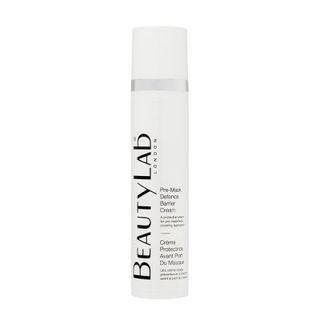
BeautyLab Pre Face-Covering Barrier Defence Cream
Works for
1 of 1 advertised claim delivered
Moisturizing13 ingredients credited for this claimStrong support
“Pre Face-Covering Barrier Defence Cream”
This product can help improve hydration of the skin with the two types of ingredients.
The first type is called “humectants”:
these ingredients help attract water.
When humectants are on the surface of the skin, they “pull in” the moisture from the outside environment, or from
within deeper layers of the skin. The following ingredients in this product do the job:
cyclomethicone, glycerin.
This product also contains ingredients called “occlusives”. They help reduce the speed with which our skin loses moisture to the outside environment. These ingredients also help soften the upper layer of the skin, so it feels less tight and nicer to the touch. The following ingredients in this product do the job: caprylic/capric triglyceride, dimethicone.
The following ingredients in this product are especially good for supporting the skin barrier and helping with the hydration level: ceramide ng
Can it cause trouble?
Irritancy7 flagged ingredientsLow risk
Comedogenic1 ingredient rated 2 or more on the 0–5 pore-clogging scale1 flagged
User reviews
Be the first — your take helps the next person decide.
Ingredients
Filter by role to see what each ingredient is doing.
Water~40–60%
Ethylene/propylene/styrene copolymer~6.1–9.1%
- Irritation risk
- Low
Used to create a thicker product consistency
More about Ethylene/propylene/styrene copolymerButylene/ethylene/styrene copolymer~4–6.1%
- Irritation risk
- Low
Used to create a gel-like product texture
More about Butylene/ethylene/styrene copolymerCaprylic/capric triglyceride~3–4.5%
- Irritation risk
- Medium
A good mix of fatty acids that forms a protective layer on the skin. Improves the shelf life of products. Derived from coconut and glycerin
More about Caprylic/capric triglycerideDimethicone~2.3–3.5%
- Irritation risk
- Low
A silicone that helps to reduce water loss from the surface of the skin. Can temporarily "fill in" lines and wrinkles, absorb oil, and create a nice product finish
More about DimethiconeCyclomethicone~1.8–2.7%
- Irritation risk
- Low
A type of silicone that leaves a nice silky finish on the skin and can help soften its upper layer
More about CyclomethiconeGlyceryl stearate se~1.5–2.3%
- Irritation risk
- Low
- Comedogenicity
- 2/5
Used to stabilize the product formulations and works as an emollient
More about Glyceryl stearate sePropylene glycol~1.2–1.9%
- Irritation risk
- High
Helps oil and water mix together and can enhance the penetration of other ingredients into the skin. It can be irritating
More about Propylene glycolCetyl alcohol~1.1–1.6%
- Irritation risk
- Low
A non-drying alcohol that works to soften the skin and stabilize product formulations helping oil and water mix together
More about Cetyl alcoholCeramide ng~0.9–1.35%
- Irritation risk
- Low
A type of lipid similar to ceramides naturally present in skin. Helps to soften the upper layer of the skin and supports the skin barrier function to keep it hydrated. Can help to prevent inflammation in skin
More about Ceramide ngGlycerin~0.55–1.3%
- Irritation risk
- Low
One of the best moisturizing ingredients. Naturally present in skin. It attracts water to the upper layer of the skin working as a humectant
More about GlycerinGlyceryl stearate~0.5–1.2%
- Irritation risk
- Low
An emollient that softens the skin and forms a protective layer on its surface. Helps water and oil mix together
More about Glyceryl stearatePeg-100 stearate~0.45–1.1%
- Irritation risk
- Low
Helps oil and water mix togehter and creates a nice product texture
More about Peg-100 stearateHydroxypropyl starch~0.35–0.8%
- Irritation risk
- Low
Aloe barbadensis leaf extract~0.35–0.85%
- Irritation risk
- Medium
Traditionally used to treat sunburns, dermatitis and inflammation, but evidence for its effectiveness is lacking. The extract can contain humectants that help attract water into the skin
More about Aloe barbadensis leaf extractPanthenol~0.15–0.65%
- Irritation risk
- Low
Helps attract water to the upper layer of the skin and can help improve skin barrier function
More about PanthenolPhenoxyethanol~0.1–0.5%
- Irritation risk
- Low
A preservative. It helps prevent bacterial growth in cosmetic products
More about PhenoxyethanolButylene glycol~0.1–0.45%
- Irritation risk
- Low
Used to create a nice product texture and help delivery of other ingredients. Might be somewhat helpful in attracting water to the upper layer of the skin
More about Butylene glycolCaprylyl glycol~0.1–0.45%
- Irritation risk
- Medium
Helps preserve products and creates a nice product texture
More about Caprylyl glycolLeuconostoc/radish root ferment filtrate~0.05–0.3%
- Irritation risk
- Medium
A preservative that comes from radishes fermented by a bacteria. New research suggests that the preservation properties in the ingredient come from an ammonium salt that is not present naturally in radish root but used in its cultivation. Is problematic because the exact amount of the preservative agents is difficult to determine
More about Leuconostoc/radish root ferment filtrateSodium cocoyl isethionate~0.1–0.45%
- Irritation risk
- Medium
Helps water and oil mix together. Can be used as a cleansing agent
More about Sodium cocoyl isethionateLactic acid~0.05–0.2%
- Irritation risk
- Medium
An exfoliating and moisturizing alpha-hydroxy acid (AHA). Typically causes less irritation than other AHAs, for example, glycolic acid. At high concentrations (about 15%), lactic acid can help reduce lines and wrinkles. Recent studies show that lactic acid can support the "good" bacteria living on skin's surface (healthy skin microbiome)
More about Lactic acidIngredient list view
Water, Ethylene/propylene/styrene copolymer, Butylene/ethylene/styrene copolymer, Caprylic/capric triglyceride, Dimethicone, Cyclomethicone, Glyceryl stearate se, Propylene glycol, Cetyl alcohol, Ceramide ng, Glycerin, Glyceryl stearate, Peg-100 stearate, Hydroxypropyl starch, Aloe barbadensis leaf extract, Panthenol, Phenoxyethanol, Butylene glycol, Caprylyl glycol, Leuconostoc/radish root ferment filtrate, Sodium cocoyl isethionate, Lactic acid
Compare prices
Retailers ranked by price — lowest first.
Product summary
Judging from the ingredient list, "BeautyLab - Pre Face-Covering Barrier Defence Cream" works well for improving skin hydration The formulation is based on a combination of good humectants and emollients. Both are needed to increase the skin hydration level. Humectants in this product (cyclomethicone, glycerin, butylene glycol and caprylyl glycol) help to increase the water content in the upper layer of the skin. (These ingredients do so by "capturing" water molecules from the outside air or from within the deeper layers of the skin). Ceramide ng, cyclomethicone, caprylic/capric triglyceride, dimethicone and cetyl alcohol in this product help decrease the water evoporation from the skin, so that it stays hydrated for longer. These ingredients also soften the skin and take away the feeling of tightness and dryness.
Ingredient callouts
- Another benefit is that this moisturizer contain ceramides (ceramide ng 0.90% - 1.35%). Ceramides are an important part of our natural skin barrier. The ceramides used in skincare are synthetic or come from plants. They help soften the skin and can help "fill the gaps" in the skin barrier, keeping the skin hydrated and resilient for longer.
Irritation risk
This formulation includes some common irritants, including ingredients that do not provide a benefit for the skin. We assess the overall irritancy of this moisturizer to be low. For a detailed overview of all potential irritants: click here
You can see the detailed formula review with the breakdown of all actives in the product and the full ingredient list with estimated concentrations in the tables below.
Price
The product retails for 25.00£ in the United Kingdom.
For a detailed price comparison: click here.
Sources cited in this review
Every concentration estimate and effectiveness label is anchored to one of these 14 studies and safety reviews.
- 1
- 2
- 3Final Report on the Safety Assessment of Dimethicone Copolyoljournals.sagepub.com
- 4Surfactants and experimental irritant contact dermatitisncbi.nlm.nih.gov
- 5Propylene Glycolpubmed.ncbi.nlm.nih.gov
- 6Skin-sensitizing and irritant properties of propylene glycolonlinelibrary.wiley.com

Affiliate links · As an Amazon Associate, WIMJ earns from qualifying purchases.