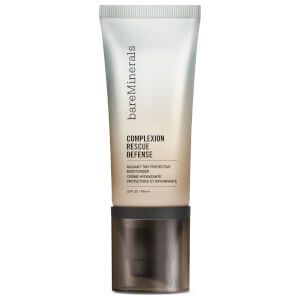
bareMinerals Complexion Rescue Defense SPF30
Works for
4 of 4 advertised claims delivered
Sun protectionSPF 30 · 2 UV filtersBroad spectrum
This product offers a good level of protection against both UVB and UVA rays.
It is a mineral sunscreen. In other words, it contains non-organic UV filters. It will probably not sting your eyes but might leave a white cast.
This product can be considered "reef safe" because it does not contain the UV filters (oxybenzone and octinoxate) that can be harmful to coral reefs when present in the water in high concentrations.
Anti-aging2 ingredients credited for this claimStrong support
“Formulated with SPF30 to defend against the damage and premature ageing caused by UV rays, the formula also utilises Sugar Molecules to help block pollution particles, whilst Cacao Extract protects against the Blue Light emitted by electronic screens.”
This product can help prevent early signs of skin aging because it offers a good level of broad spectrum sun protection. Sun damage is the main cause of premature skin aging, and protecting your skin from the sun is the best anti-aging strategy.
Evens skin tone1 ingredient credited for this claimStrong support
“The mineral-based sunscreen smooths quickly into skin to provide instant and lasting hydration, whilst helping to brighten and balance the skin tone.”
This product offers broad spectrum sun protection. It means that it can prevent hyperpigmentation and help keep the skin tone even (sun damage is the main factor causing age spots, darkening of post-acne marks and other discolorations).
Moisturizing25 ingredients credited for this claimStrong support
“The mineral-based sunscreen smooths quickly into skin to provide instant and lasting hydration, whilst helping to brighten and balance the skin tone.”
This product can help improve hydration of the skin with the two types of ingredients.
The first type is called “humectants”:
these ingredients help attract water.
When humectants are on the surface of the skin, they “pull in” the moisture from the outside environment, or from
within deeper layers of the skin. The following ingredients in this product do the job:
glycerin, lactobacillus ferment.
This product also contains ingredients called “occlusives”. They help reduce the speed with which our skin loses moisture to the outside environment. These ingredients also help soften the upper layer of the skin, so it feels less tight and nicer to the touch. The following ingredients in this product do the job: dimethicone, phytosteryl/octyldodecyl lauroyl glutamate.
The following ingredients in this product are especially good for supporting the skin barrier and helping with the hydration level: ceramide np
Anti-oxidationNot advertised by the brand · 8 ingredients credited for this claimModerate support
This product contains antioxidants (camellia japonica flower extract) that might be able to help neutralize free radicals in skin to lessen the damage it gets from the UV light (sun). There is not enough evidence to confirm their effectiveness in skin though.
Can it cause trouble?
Irritancy4 strong irritants: Parfum, Limonene + 2 more — patch-test recommendedHigh risk
Comedogenic3 ingredients rated 2 or more on the 0–5 pore-clogging scale3 flagged

User reviews
Be the first — your take helps the next person decide.
Ingredients
Filter by role to see what each ingredient is doing.
Zinc oxide12.48%
- Irritation risk
- Low
A broad spectrum sunblock (protects from both UVA and UVB rays). Is suitable for most sensitive skins. In small concentrations, can be used as a colorant
More about Zinc oxideWater~45–55%
C9-12 alkane~8.6–10.5%
Dimethicone~5.2–6.4%
- Irritation risk
- Low
A silicone that helps to reduce water loss from the surface of the skin. Can temporarily "fill in" lines and wrinkles, absorb oil, and create a nice product finish
More about DimethiconePropanediol~3.1–3.8%
- Irritation risk
- Low
Acts as a solvent for other ingredients. Speeds up the absorption of other ingredients into the skin
More about PropanediolGlycerin~2.4–2.9%
- Irritation risk
- Low
One of the best moisturizing ingredients. Naturally present in skin. It attracts water to the upper layer of the skin working as a humectant
More about GlycerinPeg-32~1.9–2.3%
- Irritation risk
- Low
Helps dissolve other ingredients and attract water to the upper layer of the skin
More about Peg-32Peg-6~1.7–2%
- Irritation risk
- Low
Helps to dissolve other ingredients and attract water to the upper layer of the skin
More about Peg-6Polyglyceryl-4 laurate/succinate~1.5–1.9%
Polysorbate 60~1.3–1.6%
Camellia japonica flower extract~1.1–1.4%
- Irritation risk
- High
A plant extract that might help neutralize free radicals in skin
More about Camellia japonica flower extractBupleurum falcatum root extract~0.75–1.15%
- Irritation risk
- High
A plant extract that might help to attract water to the upper layer of the skin, but it is not well studied. It can be irritating
More about Bupleurum falcatum root extractUndaria pinnatifida extract~0.65–1%
- Irritation risk
- Low
A seaweed extract that helps attract water to the upper layer of the skin and might have an anti-oxidant effect
More about Undaria pinnatifida extractHypericum erectum flower/leaf/stem extract~0.6–0.9%
- Irritation risk
- Low
Moringa oleifera seed extract~0.55–0.85%
- Irritation risk
- Medium
Helps soften the upper layer of the skin and might have some antioxidant effect
More about Moringa oleifera seed extractTheobroma cacao seed extract~0.55–0.85%
- Irritation risk
- Low
- Comedogenicity
- 3/5
Lactobacillus ferment~0.55–0.8%
- Irritation risk
- Low
A fermentation product created by bacteria Lactobacillus. The fermented product has anti-bacterial properties and might be helpful in calming down inflammation, but studies are lacking. Helps attract water to the upper layer of the skin. Can be used as a preservative
More about Lactobacillus fermentCeramide np~0.55–0.85%
- Irritation risk
- Low
A type of lipid similar to ceramides naturally present in skin. Helps to soften the upper layer of the skin and supports the skin barrier function to keep it hydrated. Can help to prevent inflammation in skin
More about Ceramide npManganese pca~0.5–0.75%
- Irritation risk
- Low
Helps attract water to the upper layer of the skin. Often used as a part of an ingredient complex Physiogenyl together with Sodium PCA, Magnesium PCA and Zinc PCA. The manufacturer claims that it does more than attracting water, but there is no evidence or studies supporting this claim
More about Manganese pcaButylene glycol~0.45–0.7%
- Irritation risk
- Low
Used to create a nice product texture and help delivery of other ingredients. Might be somewhat helpful in attracting water to the upper layer of the skin
More about Butylene glycolSuccinoglycan~0.45–0.65%
Biosaccharide gum-4~0.4–0.65%
Bisabolol~0.35–0.6%
- Irritation risk
- Low
An active component of chamomile plant that historically has been used to calm down irritated skin. A recent study shows that bisabolol indeed can have some anti-inflammatory effect on skin, even though conclusive data is lacking. Bisabolol has a sweet floral scent and can be added to products for its aromatic properties
More about BisabololAllantoin~0.35–0.6%
- Irritation risk
- Low
Helps calm down inflammation in skin and can help reduce itching. Helps to repair the skin barrier and keep skin hydrated
More about AllantoinPhytosteryl/octyldodecyl lauroyl glutamate~0.5–0.75%
- Irritation risk
- Low
A mix of amino acids and plant-based lipids. Helps to soften the upper layer of the skin and reduce water loss over time
More about Phytosteryl/octyldodecyl lauroyl glutamateAminopropyl dimethicone~0.45–0.65%
- Irritation risk
- Low
A type of silicone. Helps soften the upper layer of the skin and create a nice product texture
More about Aminopropyl dimethiconeLauryl betaine~0.5–0.8%
Cetyl stearate~0.5–0.7%
- Irritation risk
- Low
Isostearyl isostearate~0.45–0.7%
- Irritation risk
- Medium
- Comedogenicity
- 3/5
Helps soften the upper layer of the skin and improve the product texture. It can be comedogenic
More about Isostearyl isostearateAluminum hydroxide~0.5–0.7%
- Irritation risk
- Low
Is used to add opaque (non-transparent) appearance to formulations. Can be used to coat other ingredients for even dispersion. This is a different ingredient compared to the ones used in antipersperants (aluminium chloride and aluminium chlorohydrate)
More about Aluminum hydroxideDecyl isostearate~0.45–0.7%
- Irritation risk
- Low
Polyquaternium-51~0.45–0.7%
- Irritation risk
- Low
An emollient that helps create a nice silky finish on the skin
More about Polyquaternium-51Sodium hyaluronate~0.45–0.65%
- Irritation risk
- Low
One of the best moisturizing ingredients. Attracts water into the upper layer of the skin
More about Sodium hyaluronateAscorbyl glucoside~0.45–0.65%
- Irritation risk
- Medium
A vitamin C derivative that is more stable but less potent than pure form of vitamin C. Has a potential to boost collagen production, nutralise free radicals and reduce hyperpigmentation, but the required concentration is likely to be much higher than for the pure form of vitamin C, limiting the ingredient's effectiveness in products
More about Ascorbyl glucosideMica~0.5–0.7%
- Irritation risk
- Low
Creates an illusion of smoother and more radiant skin tone. Adds shimmer to the skin by reflecting light
More about MicaCellulose gum~0.45–0.7%
- Irritation risk
- Low
Used to create thicker product consistency and stabilize emulsions
More about Cellulose gumSilica~0.55–0.85%
Sodium pca~0.45–0.65%
- Irritation risk
- Low
Naturally present in skin and helps to attract water to its upper layer
More about Sodium pcaCoco-caprylate/caprate~0.45–0.7%
- Irritation risk
- Low
Helps to soften the upper layer of the skin without creating a greasy texture
More about Coco-caprylate/caprateDecyl glucoside~0.5–0.8%
- Irritation risk
- High
Helps oil and water mix together. Can be irritating
More about Decyl glucosidePotassium cetyl phosphate~0.45–0.7%
- Irritation risk
- Medium
Helps oil and water mix together
More about Potassium cetyl phosphateCetyl alcohol~0.5–0.75%
- Irritation risk
- Low
A non-drying alcohol that works to soften the skin and stabilize product formulations helping oil and water mix together
More about Cetyl alcoholIsohexadecane~0.55–0.8%
- Irritation risk
- Low
Improves the texture of the product and helps soften the skin. Helps oil and water mix together and can be used as a cleansing agent
More about IsohexadecaneCaprylyl glycol~0.45–0.7%
- Irritation risk
- Medium
Helps preserve products and creates a nice product texture
More about Caprylyl glycolHexylene glycol~0.4–0.65%
- Irritation risk
- Medium
Helps create a more spreadable product texture
More about Hexylene glycolSorbitan oleate~0.45–0.7%
- Irritation risk
- Medium
- Comedogenicity
- 2/5
Helps oil and water mix together
More about Sorbitan oleate1,2-hexanediol~0.45–0.65%
Sorbitan sesquiisostearate~0.45–0.7%
Sodium methyl stearoyl taurate~0.65–1%
Vp/eicosene copolymer~0.45–0.7%
- Irritation risk
- Medium
Used to improve the product adherence to the skin, for example, to pro-long the protective effect of sunscreens. Can be irritating to very sensitive skin
More about Vp/eicosene copolymerPolyacrylate crosspolymer-6~0.45–0.7%
- Irritation risk
- Low
T-butyl alcohol~0.4–0.6%
- Irritation risk
- Medium
Used to dissolve other ingredients and to improve smell of products. It could be irritating
More about T-butyl alcoholPolysorbate 80~0.45–0.7%
Disodium edta~0.45–0.65%
Dimethylacrylamide/sodium acryloyldimethyltaurate crosspolymer~0.45–0.65%
- Irritation risk
- Low
Polysilicone-11~0.45–0.7%
- Irritation risk
- Low
A silicone that forms a light film on the skin surface helping to bind water and temporarily absorb oils creating a matt and powdery feel
More about Polysilicone-11Disodium phosphate~0.4–0.65%
- Irritation risk
- Low
Helps adjust the product pH and stabilize the formulation
More about Disodium phosphateIsostearic acid~0.5–0.75%
- Irritation risk
- Low
Used to create a nice product texture
More about Isostearic acidSodium citrate~0.35–0.6%
- Irritation risk
- Medium
Helps to control the skin's pH level. Maintains the skin's natural film of amino-lactic acids and oils. Helps to preserve products
More about Sodium citrateHydrogen dimethicone~0.35–0.6%
- Irritation risk
- Low
Helps the function of sunscreen and pigment ingredients in the formulation
More about Hydrogen dimethiconeSodium acrylate/sodium acryloyldimethyl taurate copolymer~0.3–0.6%
- Irritation risk
- Low
Used to create a thicker product consistency
More about Sodium acrylate/sodium acryloyldimethyl taurate copolymerStearic acid~0.5–0.75%
- Irritation risk
- Low
Helps oil and water mix together and works as an emollient
More about Stearic acidCitric acid~0.3–0.55%
- Irritation risk
- Medium
Can work as an exfoliant but is typically used to adjust the product pH
More about Citric acidTriethoxycaprylylsilane~0.3–0.55%
- Irritation risk
- Low
A type of silicone that helps oil and water mix well together. Helps to disperse other ingredients, e.g. pigments, evenly in a formulation
More about TriethoxycaprylylsilaneTocopherol~0.3–0.55%
- Irritation risk
- Low
Pure form of vitamin E. Can help moisturise and protect the skin from free radicals. Often used to help stabilise other ingredients or the formula itself
More about TocopherolTin oxide~0.45–0.7%
- Irritation risk
- Low
A colorant that can add a pearl-like appearance to the formulation
More about Tin oxideAlcohol~0.25–0.5%
- Irritation risk
- High
Can be drying and contribute to skin irritation. Used in formulars to dissolve other ingredients, create a thinner product consistency or for its antibacterial properties
More about AlcoholParfum~0.2–0.4%
- Irritation risk
- High
An aromatic blend of unspecified and possibly irritating ingredients
More about ParfumLimonene~0.2–0.35%
- Irritation risk
- High
A common frangrance that can easily irritate skin, especially if exposed to air, light or heat
More about LimoneneLinalool~0.15–0.25%
Hexyl cinnamal~0.1–0.25%
Sodium benzoate~0.15–0.25%
Phenoxyethanol~0.15–0.3%
- Irritation risk
- Low
A preservative. It helps prevent bacterial growth in cosmetic products
More about PhenoxyethanolTitanium dioxide3.28%
- Irritation risk
- Low
Works as a UV filter when used in high concentrations. It is photostable and is effective mostly against the UVB light, with some protection in the UVA range. In small concentrations, used for its ability to improve the color of cosmetic products. Is usually well tolerated by the skin
More about Titanium dioxideIron oxides~0.1–0.15%
- Irritation risk
- Low
An umbrella term for the following three colorants: CI 77491, CI 77492, CI 77499. They might be able to offer some protection against visible light, but the degree of the protection is not clear
More about Iron oxidesIngredient list view
Zinc oxide, Water, C9-12 alkane, Dimethicone, Propanediol, Glycerin, Peg-32, Peg-6, Polyglyceryl-4 laurate/succinate, Polysorbate 60, Camellia japonica flower extract, Bupleurum falcatum root extract, Undaria pinnatifida extract, Hypericum erectum flower/leaf/stem extract, Moringa oleifera seed extract, Theobroma cacao seed extract, Lactobacillus ferment, Ceramide np, Manganese pca, Butylene glycol, Succinoglycan, Biosaccharide gum-4, Bisabolol, Allantoin, Phytosteryl/octyldodecyl lauroyl glutamate, Aminopropyl dimethicone, Lauryl betaine, Cetyl stearate, Isostearyl isostearate, Aluminum hydroxide, Decyl isostearate, Polyquaternium-51, Sodium hyaluronate, Ascorbyl glucoside, Mica, Cellulose gum, Silica, Sodium pca, Coco-caprylate/caprate, Decyl glucoside, Potassium cetyl phosphate, Cetyl alcohol, Isohexadecane, Caprylyl glycol, Hexylene glycol, Sorbitan oleate, 1,2-hexanediol, Sorbitan sesquiisostearate, Sodium methyl stearoyl taurate, Vp/eicosene copolymer, Polyacrylate crosspolymer-6, T-butyl alcohol, Polysorbate 80, Disodium edta, Dimethylacrylamide/sodium acryloyldimethyltaurate crosspolymer, Polysilicone-11, Disodium phosphate, Isostearic acid, Sodium citrate, Hydrogen dimethicone, Sodium acrylate/sodium acryloyldimethyl taurate copolymer, Stearic acid, Citric acid, Triethoxycaprylylsilane, Tocopherol, Tin oxide, Alcohol, Parfum, Limonene, Linalool, Hexyl cinnamal, Sodium benzoate, Phenoxyethanol, Titanium dioxide, Iron oxides
Compare prices
Retailers ranked by price — lowest first.
Affiliate links · prices updated regularly · As an Amazon Associate, WIMJ earns from qualifying purchases.
Worth comparing, line by line.
Match % combines shared ingredients, the first five ingredients, shared actives and hero ingredients, irritancy (lower counts in the alternative's favour), texture and body area. Only products in the same routine step are compared.
| bareMineralsComplexion Rescue Defense SPF30YOUR PRODUCT | ISNTREESensitive balancing spf 50 | CeraVeHydrating Mineral Face Sunscreen Lotion SPF 30 with Zinc Oxide | |
|---|---|---|---|
| Match | — | 53% | 52% |
| Price | $39.00 | — | $13.97−$25.03 |
| Shared key ingredients | — | 7 of 17 | 6 of 17 |
| Key difference | — | Phytosphingosine | Niacinamide |
| Irritancy | High | Low | Low |
| SPF | SPF 30 | SPF 50 | SPF 30 |
| Drying alcohol | Contains drying alcohol | — | — |
| View product | Shop | Shop |


Product summary
We believe that "bareMinerals - Complexion Rescue Defense SPF30" can provide reliable sun protection based on the ingredients listed. It can protect from both UVA and UVB rays. This is great news because not all sunscreens with SPF ratings give UVA protection. (UVA rays do not cause sunburn, but still damage our skin and lead to early aging).
Its formula is also hydrating, so you might not need an additional moistruizer during the day. This product prevents early signs of aging by protecting against sun damage (all broad spectrum sunscreens do that).
Sunscreen filters
It is a mineral sunscreen. It uses titanium dioxide and zinc oxide for sun protection. Both titanium dioxide and zinc oxide almost never irritate even the most sensitive skin and eyes, but can leave a white cast.
Irritation risk
This sunscreen contains a bunch of common irritants, including ingredients that do not provide any known benefit for the skin. It might not be the best choice if your skin is sensitive. We assess the overall irritancy of this product to be high. For a detailed overview of all potential irritants: click here
You can see the detailed formula review with the breakdown of all actives in the product and the full ingredient list with estimated concentrations in the tables below.
About the brand
According to Cruelty-Free Kitty "bareMinerals" is cruelty free, but its parent company is not.
Price
The product retails for 82.04A$ in Australia, for 25.00$ in the United States and for 35.00£ in the United Kingdom.
For a detailed price comparison: click here.
Sources cited in this review
Every concentration estimate and effectiveness label is anchored to one of these 31 studies and safety reviews.
- 1A review of inorganic UV filters zinc oxide and titanium dioxideonlinelibrary.wiley.com
- 2
- 3
- 4
- 5
- 6

Affiliate links · As an Amazon Associate, WIMJ earns from qualifying purchases.