Works for
1 of 2 advertised claims delivered
MoisturizingGlycerin, Prunus armeniaca kernel oil + 9 moreGood evidence
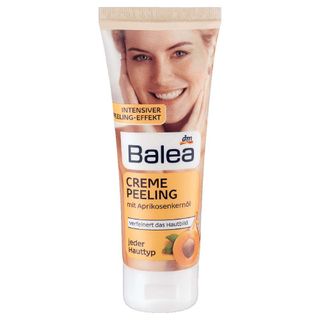
“Apricot Peeling Cream”
This product can help improve hydration of the skin with the two types of ingredients.
The first type is called “humectants”:
these ingredients help attract water.
When humectants are on the surface of the skin, they “pull in” the moisture from the outside environment, or from
within deeper layers of the skin. The following ingredients in this product do the job:
glycerin, hydrogenated starch hydrolysate.
This product also contains ingredients called “occlusives”. They help reduce the speed with which our skin loses moisture to the outside environment. These ingredients also help soften the upper layer of the skin, so it feels less tight and nicer to the touch. The following ingredients in this product do the job: glycine soja oil, persea gratissima oil.
ExfoliationNo ingredient credited for this claimNo evidence
“Balea apricot peeling cream refines the appearance of the skin.”
This product does not contain effective exfoliating ingredients. It might be able to deliver physical exfoliation, that is scrub off some of the dead cells on the surface of the skin. We do not recommend physical exfoliation, because it is not uniform (some bits of skin can get exfoliated too much while others not at all). It can also traumatize the skin and aggrevate acne and other skin conditions.
Can it cause trouble?
Irritancy1 strong irritant: ParfumMedium risk
Comedogenic2 ingredients rated 2 or more on the 0–5 pore-clogging scale2 flagged
User reviews
Be the first — your take helps the next person decide.
Ingredients
Filter by role to see what each ingredient is doing.
Water~40–60%
Glycine soja oil~4.7–7%
- Irritation risk
- Medium
- Comedogenicity
- 2/5
A good emollient that helps soften the skin and helps repair its barrier function. It can clog pores if used in high concentrations.
More about Glycine soja oilPumice~3.8–5.7%
- Irritation risk
- Low
Milled volcanic rock. Used as an abrasive for physical exfoliation
More about PumiceCetearyl alcohol~2.2–3.3%
- Irritation risk
- Low
- Comedogenicity
- 2/5
A non-drying alcohol. Works as an emollient. Helps water and oil mix together and creates a nice product texture
More about Cetearyl alcoholGlycerin~2.1–3.2%
- Irritation risk
- Low
One of the best moisturizing ingredients. Naturally present in skin. It attracts water to the upper layer of the skin working as a humectant
More about GlycerinStearic acid~1.8–2.7%
- Irritation risk
- Low
Helps oil and water mix together and works as an emollient
More about Stearic acidPersea gratissima oil~1.5–2.2%
- Irritation risk
- Medium
An emollient that helps soften the skin and could be helpful in repairing its barrier function
More about Persea gratissima oilPrunus armeniaca kernel oil~1.3–2%
- Irritation risk
- Medium
An emollient that helps soften the skin
More about Prunus armeniaca kernel oilHydrogenated starch hydrolysate~1–1.6%
- Irritation risk
- Low
Helps to attract water to the upper layer of the skin. Can add sweet taste to lip products
More about Hydrogenated starch hydrolysateCetearyl glucoside~0.85–1.25%
- Irritation risk
- Medium
Helps water and oil in the product mix well together and improves product texture
More about Cetearyl glucosideMagnesium aluminum silicate~0.55–1.3%
- Irritation risk
- Low
Might be helpful in restoring skin barrier function and, when combined with zinc carbonate and malonic acid, reducing fine lines and wrinkles by stimulating elastin production. Also helps stabilize the product formulation
More about Magnesium aluminum silicatePhenoxyethanol~0.4–1%
- Irritation risk
- Low
A preservative. It helps prevent bacterial growth in cosmetic products
More about PhenoxyethanolParfum~0.35–0.85%
- Irritation risk
- High
An aromatic blend of unspecified and possibly irritating ingredients
More about ParfumCetyl alcohol~0.4–1%
- Irritation risk
- Low
A non-drying alcohol that works to soften the skin and stabilize product formulations helping oil and water mix together
More about Cetyl alcoholSodium benzoate~0.25–0.5%
Sodium cetearyl sulfate~0.4–0.95%
- Irritation risk
- Medium
Helps water and oil mix together and works as a cleansing agent
More about Sodium cetearyl sulfateAcrylates/c10-30 alkyl acrylate crosspolymer~0.2–0.8%
- Irritation risk
- Medium
Maintains the texture of skincare products. Allows the product to spread evenly. Helps oil and water mix together
More about Acrylates/c10-30 alkyl acrylate crosspolymerLauryl glucoside~0.2–0.8%
Citric acid~0.1–0.5%
- Irritation risk
- Medium
Can work as an exfoliant but is typically used to adjust the product pH
More about Citric acidHydroxyethylcellulose~0.15–0.5%
- Irritation risk
- Low
Used to thicken product formulations and create gel-like textures
More about HydroxyethylcelluloseLecithin~0.15–0.6%
- Irritation risk
- Low
Used mostly for creating emulsions - helping oil and water mix together. Helps soften the upper layer of the skin
More about LecithinTocopherol~0.1–0.4%
- Irritation risk
- Low
Pure form of vitamin E. Can help moisturise and protect the skin from free radicals. Often used to help stabilise other ingredients or the formula itself
More about TocopherolAscorbyl palmitate~0.05–0.3%
- Irritation risk
- Medium
Being a lipid soluble form of vitamin C, it is more stable and can penetrate the skin better than L-Ascorbic acid. It is effective in protecting the skin from free radicals, as well as evening the skin tone, but is less effective in stimulating collagen production compared to L-Ascorbic acid.
More about Ascorbyl palmitateGlyceryl stearate~0.1–0.4%
- Irritation risk
- Low
An emollient that softens the skin and forms a protective layer on its surface. Helps water and oil mix together
More about Glyceryl stearateGlyceryl oleate~0.1–0.3%
- Irritation risk
- High
Helps oil and water mix together. Can be irritating
More about Glyceryl oleateSilver citrate~0.05–0.2%
- Irritation risk
- Low
Sodium hydroxide~0.05–0.15%
Ingredient list view
Water, Glycine soja oil, Pumice, Cetearyl alcohol, Glycerin, Stearic acid, Persea gratissima oil, Prunus armeniaca kernel oil, Hydrogenated starch hydrolysate, Cetearyl glucoside, Magnesium aluminum silicate, Phenoxyethanol, Parfum, Cetyl alcohol, Sodium benzoate, Sodium cetearyl sulfate, Acrylates/c10-30 alkyl acrylate crosspolymer, Lauryl glucoside, Citric acid, Hydroxyethylcellulose, Lecithin, Tocopherol, Ascorbyl palmitate, Glyceryl stearate, Glyceryl oleate, Silver citrate, Sodium hydroxide
Compare prices
Retailers ranked by price — lowest first.

Affiliate links · prices updated regularly
Sources cited in this review
Every concentration estimate and effectiveness label is anchored to one of these 8 studies and safety reviews.
- 1
- 2Safety assessment of hydrogenated starch hydrolysatesncbi.nlm.nih.gov
- 3
- 4
- 5Final Report on the Safety Assessment of Sodium Cetearyl Sulfate journals.sagepub.com
- 6Vitamin E in dermatologyncbi.nlm.nih.gov

Affiliate links · As an Amazon Associate, WIMJ earns from qualifying purchases.