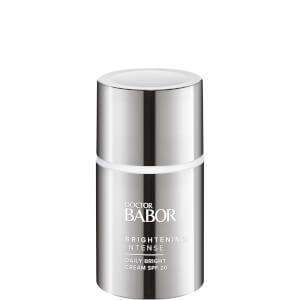
BABOR Daily Bright Cream SPF20
Works for
1 of 3 advertised claims delivered
Sun protectionSPF 20 · 5 UV filters · Broad spectrumWeak protectionSPF under 30
This product offers broad spectrum sun protection, but it is weak. We recommend to use a broad spectrum sunscreen with at least SPF 30.
This product can be considered "reef safe" because it does not contain the UV filters (oxybenzone and octinoxate) that can be harmful to coral reefs when present in the water in high concentrations.
Anti-aging3 ingredients credited for this claimModerate support
“Extracts of Broccoli, Citric Fruits and Aloe help to shield your base against harsh external aggressors, which is emphasised by SPF20 and brightening Vitamin C. A cocktail of UVA and UVB filters help to minimise the look of sun-related ageing, while Bright Effect Pigment helps to summon a lit-from-within glow.”
This product contains centella asiatica leaf extract. This ingredient might be able to help reduce and prevent fine lines and wrinkles, improve skin elasticity and firmness, but there is not enough evidence that it actually works. The biggest anti-aging effect in this product comes from sun protection. Sun damage is the main factor causing early signs of skin aging. We, however, do not recommend using this product as a sunscreen because the protection it offers is not strong enough).
Evens skin tone2 ingredients credited for this claimLimited support
“The fast-absorbing face cream utilises EXP Bright Complex, a blend of Exopolysaccharid + Phyto-Blend, to encourage a more even, balanced-looking complexion.”
This product contains ingredients () that could help reduce hyperpigmentation (for example, post-acne marks or age spots) in theory, but there is not enough evidence that they actually work.
The biggest effect for evening out skin tone in this product comes from sun protection. Sun damage is the main factor causing age spots, darkening of post-acne marks and other discolorations. This is why sun protection is the best strategy for maintaining an even skin tone. We, however, do not recommend using this product as a sunscreen because the protection it offers is not strong enough).
MoisturizingNot advertised by the brand · 11 ingredients credited for this claimStrong support
This product can help improve hydration of the skin with the two types of ingredients.
The first type is called “humectants”:
these ingredients help attract water.
When humectants are on the surface of the skin, they “pull in” the moisture from the outside environment, or from
within deeper layers of the skin. The following ingredients in this product do the job:
arginine, glycerin.
This product also contains ingredients called “occlusives”. They help reduce the speed with which our skin loses moisture to the outside environment. These ingredients also help soften the upper layer of the skin, so it feels less tight and nicer to the touch. The following ingredients in this product do the job: arginine, c12-15 alkyl benzoate.
The following ingredients in this product are especially good for supporting the skin barrier and helping with the hydration level: panthenol
Can it cause trouble?
Irritancy1 strong irritant: Calendula officinalis flower extractMedium risk
ComedogenicClean of flagged comedogenic ingredientsNone flagged


User reviews
Be the first — your take helps the next person decide.
Ingredients
Filter by role to see what each ingredient is doing.
Water~45–55%
Diisopropyl sebacate~5.5–6.7%
- Irritation risk
- Low
Helps soften the upper layer of the skin without creatng a greasy finish
More about Diisopropyl sebacateC12-15 alkyl benzoate~4.5–5.4%
- Irritation risk
- Low
Enhances the product texture and makes it more spreadable. Helps reduce water loss from the outer layer of skin. Extands the shelf life by preventing bacteria growth
More about C12-15 alkyl benzoateDiethylamino hydroxybenzoyl hexyl benzoate~3.6–4.4%
- Irritation risk
- Medium
Uvinul A Plus. A new generation broad spectrum sunscreen that offers an effective protection especially in the UVA range. It is stable in formulations. Unfortunately, is not approved by the FDA (US) yet
More about Diethylamino hydroxybenzoyl hexyl benzoatePhenylbenzimidazole sulfonic acid~3.3–4%
- Irritation risk
- Medium
Ensulizole. A UV filter that is effective against UVB rays. Does not protect against UVA light. It is photostable and can be used to help stabilize other sunscreen ingredients. It is water-soluble meaning that it can help create lighter sunscreen formulations
More about Phenylbenzimidazole sulfonic acidCetyl alcohol~2–2.5%
- Irritation risk
- Low
A non-drying alcohol that works to soften the skin and stabilize product formulations helping oil and water mix together
More about Cetyl alcoholArginine~1.7–2.1%
- Irritation risk
- Low
An amino acid that is naturally present in skin and helps keep it hydrated. When used together with AHAs, it can reduce their irritating effect on the skin
More about ArginineMethyl methacrylate crosspolymer~1.5–1.8%
- Irritation risk
- Low
Helps thicken the product consistency
More about Methyl methacrylate crosspolymerGlycerin~1.2–1.5%
- Irritation risk
- Low
One of the best moisturizing ingredients. Naturally present in skin. It attracts water to the upper layer of the skin working as a humectant
More about GlycerinBis-ethylhexyloxyphenol methoxyphenyl triazine~1.4–1.7%
- Irritation risk
- Medium
Tinosorb S. One of the most effective broad spectrum sunscreen ingredients. Protects from both UVA and UVB rays. It is photostable. Unfortunately, not approved by FDA (US) yet.
More about Bis-ethylhexyloxyphenol methoxyphenyl triazinePropanediol~0.7–1.05%
- Irritation risk
- Low
Acts as a solvent for other ingredients. Speeds up the absorption of other ingredients into the skin
More about PropanediolEthylhexyl triazone~0.9–1.1%
- Irritation risk
- Medium
Uvinul T. A UV filter. Effective against UVB rays. It is photostable. Can increase water resistance properties of the sunscreen. Unfortunately, not approved by the FDA (US) yet
More about Ethylhexyl triazoneGlyceryl stearate~0.55–0.85%
- Irritation risk
- Low
An emollient that softens the skin and forms a protective layer on its surface. Helps water and oil mix together
More about Glyceryl stearateSodium cetearyl sulfate~0.6–0.9%
- Irritation risk
- Medium
Helps water and oil mix together and works as a cleansing agent
More about Sodium cetearyl sulfatePanthenol~0.45–0.65%
- Irritation risk
- Low
Helps attract water to the upper layer of the skin and can help improve skin barrier function
More about PanthenolTocopheryl acetate~0.45–0.65%
- Irritation risk
- Medium
A more stable but less bio-available form of vitamin E compared to Tocopherol. Might help moisturize and protect the skin from free radicals, but mostly used in low concentrations to stabilize other ingredients.
More about Tocopheryl acetateEscin~0.4–0.6%
- Irritation risk
- High
A compound obtained from horse chestnut. It is claimed that this chemical can improve circulation, but there is no evidence available that it works in skin
More about EscinRuscus aculeatus root extract~0.3–0.55%
- Irritation risk
- Low
Magnesium ascorbyl phosphate~0.3–0.6%
- Irritation risk
- Medium
A derivative of vitamin C that is more stable, but less bioavailable than the pure form of vitamin C. It does not penetrate the skin well, but has been shown to convert to pure vitamin C once in skin. It can be helpful in stimulating collagen production and lightening the skin tone, but the required concentration is likely to be very high
More about Magnesium ascorbyl phosphateAloe barbadensis leaf extract~0.35–0.65%
- Irritation risk
- Medium
Traditionally used to treat sunburns, dermatitis and inflammation, but evidence for its effectiveness is lacking. The extract can contain humectants that help attract water into the skin
More about Aloe barbadensis leaf extractBioflavonoids~0.25–0.45%
- Irritation risk
- Low
Brassica oleracea italica extract~0.25–0.5%
- Irritation risk
- Medium
Might have some anti-inflammatory properties but research is lacking
More about Brassica oleracea italica extractAmmonium glycyrrhizate~0.25–0.45%
- Irritation risk
- Low
Saccharide isomerate~0.25–0.45%
- Irritation risk
- Low
Helps attract water to the upper layer of the skin
More about Saccharide isomerateCentella asiatica leaf extract~0.25–0.45%
- Irritation risk
- Medium
A plant extract that has been shown to be able to reduce inflammation in skin, support restoration of skin barrier function, as well as support collagen production. It can be irritating to sensitive skin. Might be helpful in preventing stretch marks. It could, however, itself be irritating.
More about Centella asiatica leaf extractHydrolyzed yeast protein~0.25–0.45%
- Irritation risk
- Low
Calendula officinalis flower extract~0.2–0.4%
- Irritation risk
- High
A plant extract that has some anti-oxidant and anti-bacterial properties. Can be irritating
More about Calendula officinalis flower extractSodium carboxymethyl betaglucan~0.25–0.45%
- Irritation risk
- Low
Phenoxyethanol~0.25–0.5%
- Irritation risk
- Low
A preservative. It helps prevent bacterial growth in cosmetic products
More about PhenoxyethanolButylene glycol~0.25–0.45%
- Irritation risk
- Low
Used to create a nice product texture and help delivery of other ingredients. Might be somewhat helpful in attracting water to the upper layer of the skin
More about Butylene glycolCarbomer~0.25–0.45%
- Irritation risk
- Low
Helps create a thicker or gel-like product texture. It is not a surfactant but can be used in gentle cleansing formulations
More about CarbomerXanthan gum~0.25–0.45%
- Irritation risk
- Low
Used to create a thicker product consistency
More about Xanthan gumSodium potassium aluminum silicate~0.25–0.45%
- Irritation risk
- Low
Ethylhexylglycerin~0.25–0.4%
Disodium edta~0.2–0.4%
Silica~0.35–0.65%
Phenethyl alcohol~0.2–0.4%
Pantolactone~0.2–0.35%
- Irritation risk
- Low
Helps attract water to the upper layer of the skin
More about PantolactoneCitric acid~0.15–0.3%
- Irritation risk
- Medium
Can work as an exfoliant but is typically used to adjust the product pH
More about Citric acidSodium citrate~0.15–0.25%
- Irritation risk
- Medium
Helps to control the skin's pH level. Maintains the skin's natural film of amino-lactic acids and oils. Helps to preserve products
More about Sodium citratePhosphoric acid~0.15–0.3%
Ascorbic acid~0.15–0.25%
- Irritation risk
- High
The most well-researched antioxidant that works in skin. Helps neutralize free radicals supporting collagen production, helping to even out the skin tone and preventing early signs of aging
More about Ascorbic acidTitanium dioxide~0.1–0.2%
- Irritation risk
- Low
Works as a UV filter when used in high concentrations. It is photostable and is effective mostly against the UVB light, with some protection in the UVA range. In small concentrations, used for its ability to improve the color of cosmetic products. Is usually well tolerated by the skin
More about Titanium dioxideCi 77891~0.1–0.15%
- Irritation risk
- Low
Ingredient list view
Water, Diisopropyl sebacate, C12-15 alkyl benzoate, Diethylamino hydroxybenzoyl hexyl benzoate, Phenylbenzimidazole sulfonic acid, Cetyl alcohol, Arginine, Methyl methacrylate crosspolymer, Glycerin, Bis-ethylhexyloxyphenol methoxyphenyl triazine, Propanediol, Ethylhexyl triazone, Glyceryl stearate, Sodium cetearyl sulfate, Panthenol, Tocopheryl acetate, Escin, Ruscus aculeatus root extract, Magnesium ascorbyl phosphate, Aloe barbadensis leaf extract, Bioflavonoids, Brassica oleracea italica extract, Ammonium glycyrrhizate, Saccharide isomerate, Centella asiatica leaf extract, Hydrolyzed yeast protein, Calendula officinalis flower extract, Sodium carboxymethyl betaglucan, Phenoxyethanol, Butylene glycol, Carbomer, Xanthan gum, Sodium potassium aluminum silicate, Ethylhexylglycerin, Disodium edta, Silica, Phenethyl alcohol, Pantolactone, Citric acid, Sodium citrate, Phosphoric acid, Ascorbic acid, Titanium dioxide, Ci 77891
Compare prices
Retailers ranked by price — lowest first.

Affiliate links · prices updated regularly
Worth comparing, line by line.
Match % combines shared ingredients, the first five ingredients, shared actives and hero ingredients, irritancy (lower counts in the alternative's favour), texture and body area. Only products in the same routine step are compared.
| BABORDaily Bright Cream SPF20YOUR PRODUCT | Dr. Barbara SturmSun Drops SPF 50 | UriageBariéderm Cica-Cream with Copper-Zinc SPF50+ | PolaarVery High Protection Sun Cream SPF50+ Without Perfume | |
|---|---|---|---|---|
| Match | — | 60% | 57% | 57% |
| Price | $87.25 | $150.00+$62.75 | $10.99−$76.26 | $29.08−$58.17 |
| Shared key ingredients | — | 9 of 11 | 2 of 11 | 5 of 11 |
| Key difference | — | Caprylic/Capric Triglyceride | Mineral Oil | Avobenzone |
| Irritancy | Medium | Low | Low | Low |
| SPF | SPF 20 | SPF 50 | SPF 50 | SPF 50 |
| Drying alcohol | — | — | — | — |
| View product | Shop | Shop | Shop |

Product summary
"BABOR - Daily Bright Cream SPF20" offers broad spectrum protection. It means that it protects from both UVA and UVB rays (you can remember UVB as "burning" sunlight - they cause sunburn. You can remember UVA rays as "aging" - they do not lead to sunburn, but they cause photodamage and contribute to early signs of skin aging and hyperpigmentation). On the negative side, the SPF of this moisturizer is not high enough. We recommend to use a sunscreen with at least SPF 30 daily.
It contains good moisturizing ingredients and can double as a hydrating day cream.
Sunscreen filters
This sunscreen uses a mixture of both mineral and organic (so-called "chemical") UV filters. Here are the organic filters this product uses: tinosorb s, uvinul a plus, uvinul t and ensulizole. As for the mineral filters, this sunscreen uses titanium dioxide.
Irritation risk
This moisturizer contains some common irritants, including those without a benefit for the skin. We assess the overall irritancy of this moisturizer to be medium. For a detailed overview of all potential irritants: click here
You can see the detailed formula review with the breakdown of all actives in the product and the full ingredient list with estimated concentrations in the tables below.
Price
The product retails for 66.00£ in the United Kingdom.
For a detailed price comparison: click here.
Sources cited in this review
Every concentration estimate and effectiveness label is anchored to one of these 14 studies and safety reviews.
- 1
- 2Final Report on the Safety Assessment of Sodium Cetearyl Sulfate journals.sagepub.com
- 3Skin moisturizing effects of panthenol-based formulationspdfs.semanticscholar.org
- 4
- 5
- 6Topical L-ascorbic acid: percutaneous absorption studiesncbi.nlm.nih.gov

Affiliate links · As an Amazon Associate, WIMJ earns from qualifying purchases.