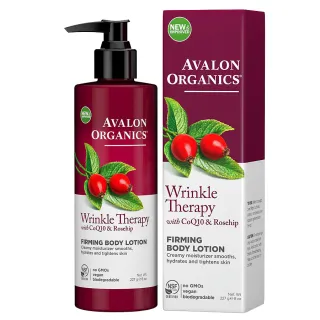
Avalon Organics Wrinkle Therapy Firming Body Lotion
Works for
2 of 2 advertised claims delivered
Anti-aging4 ingredients credited for this claimModerate support
“Fine lines and wrinkles result from the natural deceleration of skin metabolism over time.”
This product contains ubiquinone. This ingredient help neutralize free radicals in skin. By doing so, they might be able to prevent early signs of aging (like fine lines and wrinkles), at least to some extent. These ingredients will not be able to "reverse" signs of aging.
Moisturizing19 ingredients credited for this claimGood support
“Wrinkle Therapy Firming Body Lotion”
This product can help improve hydration of the skin with the two types of ingredients.
The first type is called “humectants”:
these ingredients help attract water.
When humectants are on the surface of the skin, they “pull in” the moisture from the outside environment, or from
within deeper layers of the skin. The following ingredients in this product do the job:
glycerin, sodium hyaluronate.
This product also contains ingredients called “occlusives”. They help reduce the speed with which our skin loses moisture to the outside environment. These ingredients also help soften the upper layer of the skin, so it feels less tight and nicer to the touch. The following ingredients in this product do the job: butyrospermum parkii butter, caprylic/capric triglyceride.
Anti-oxidationNot advertised by the brand · 11 ingredients credited for this claimStrong support
This product contains antioxidants (ubiquinone) that can help neutralize free radicals in skin. By doing so, they can lessen the damage the skin gets from the UV light (sun).
Can it cause trouble?
Irritancy9 strong irritants: Lavandula angustifolia oil, Arnica montana flower extract + 7 more — patch-test recommendedHigh risk
Comedogenic6 ingredients rated 2 or more on the 0–5 pore-clogging scale6 flagged
User reviews
Be the first — your take helps the next person decide.
Ingredients
Filter by role to see what each ingredient is doing.
Aloe barbadensis leaf water~23–34%
- Irritation risk
- Medium
Traditionally used to treat sunburns, dermatitis and inflammation, but data on its effectiveness is lacking. While the majority of the content is plain water, it can contain some goodies like vitamins, enzymes, minerals, and humectants that help attract water into the skin
More about Aloe barbadensis leaf waterGlycerin~4–6%
- Irritation risk
- Low
One of the best moisturizing ingredients. Naturally present in skin. It attracts water to the upper layer of the skin working as a humectant
More about GlycerinCarthamus tinctorius seed oil~4.4–6.5%
- Irritation risk
- Low
An emollient that helps soften the skin and might help calm down inflammation
More about Carthamus tinctorius seed oilGlyceryl stearate se~3.2–4.8%
- Irritation risk
- Low
- Comedogenicity
- 2/5
Used to stabilize the product formulations and works as an emollient
More about Glyceryl stearate seStearic acid~2.7–4.1%
- Irritation risk
- Low
Helps oil and water mix together and works as an emollient
More about Stearic acidCaprylic/capric triglyceride~2–3.1%
- Irritation risk
- Medium
A good mix of fatty acids that forms a protective layer on the skin. Improves the shelf life of products. Derived from coconut and glycerin
More about Caprylic/capric triglycerideBorago officinalis seed oil~1.4–2.1%
- Irritation risk
- Low
A plant oil that is effective in reducing irritation in skin, restore the barrier function and support its hydration
More about Borago officinalis seed oilButyrospermum parkii butter~1.3–2%
- Irritation risk
- Low
- Comedogenicity
- 3/5
A great moisturising ingredient that softens the skin and reduces water loss from its upper layer. It also can be helpful in protecting skin from free radicals
More about Butyrospermum parkii butterCocos nucifera oil~1.2–1.8%
- Irritation risk
- Low
- Comedogenicity
- 3/5
An emollient. Found to be as effective as a moisturizer for dry skin as mineral oil. Could be comedogenic
More about Cocos nucifera oilLavandula angustifolia oil~0.6–1.4%
- Irritation risk
- High
An essential oil. Potential allergen and can be irritating. It has some anti-bacterial properties
More about Lavandula angustifolia oilOlea europaea fruit oil~0.55–1.25%
- Irritation risk
- Medium
An emollient that helps soften the skin but is not effective for restoring its barrier function. Might be helpful to calm down inflammation
More about Olea europaea fruit oilPrunus amygdalus dulcis oil~0.45–1.1%
- Irritation risk
- Low
An emollient that softens the skin
More about Prunus amygdalus dulcis oilPersea gratissima oil~0.45–1%
- Irritation risk
- Medium
An emollient that helps soften the skin and could be helpful in repairing its barrier function
More about Persea gratissima oilRosa canina fruit oil~0.4–0.9%
- Irritation risk
- Medium
A great emollient. Contains vitamin E (tocopherol) which may give it some anti-oxidant properties. Can contain volatile compounds and can be irritating
More about Rosa canina fruit oilArnica montana flower extract~0.2–0.8%
- Irritation risk
- High
A plant extract that can be irritating. It can have some anti-bacterial properties, but there are no evidence of a beneficial effect for skin
More about Arnica montana flower extractCamellia sinensis leaf extract~0.4–0.9%
- Irritation risk
- Low
Can contain potent anti-oxidant compounds (abbreviated ECG, GCG, EGC, and EGCG) that might help protect the skin from free radicals. Can help calm down inflammation and has some anti-bacterial properties. Unfortunately, these antioxidants are unstable and lose their effectiveness very quickly in products. The concentration of the antioxidant compounds in the extract also tends to be low to be effective in topical formulation
More about Camellia sinensis leaf extractChamomilla recutita flower extract~0.2–0.8%
- Irritation risk
- High
Plant extract that can have healing and anti-inflammatory properties. It is a potential allergen and can be irritating
More about Chamomilla recutita flower extractChlorella pyrenoidosa extract~0.2–0.75%
- Irritation risk
- Low
- Comedogenicity
- 3/5
An algae extract. Can help attract water to the upper layer of the skin and might help neutralize free radicals in skin
More about Chlorella pyrenoidosa extractChondrus crispus extract~0.2–0.75%
- Irritation risk
- Low
- Comedogenicity
- 3/5
Red algae extract that helps attract water to the upper layer of the skin and create a nicer product consistency
More about Chondrus crispus extractEchinacea angustifolia extract~0.15–0.55%
- Irritation risk
- High
Plant extract that might contain antioxidants, have antibacterial effect and help reduce inflammation, but solid evidence is lacking. Can be irritating
More about Echinacea angustifolia extractLavandula angustifolia flower/leaf/stem extract~0.15–0.6%
Leucojum aestivum bulb extract~0.15–0.6%
- Irritation risk
- Low
Spirulina maxima extract~0.15–0.55%
- Irritation risk
- Low
- Comedogenicity
- 3/5
Tocopheryl acetate~0.2–0.75%
- Irritation risk
- Medium
A more stable but less bio-available form of vitamin E compared to Tocopherol. Might help moisturize and protect the skin from free radicals, but mostly used in low concentrations to stabilize other ingredients.
More about Tocopheryl acetateBisabolol~0.1–0.45%
- Irritation risk
- Low
An active component of chamomile plant that historically has been used to calm down irritated skin. A recent study shows that bisabolol indeed can have some anti-inflammatory effect on skin, even though conclusive data is lacking. Bisabolol has a sweet floral scent and can be added to products for its aromatic properties
More about BisabololCetyl alcohol~0.2–0.75%
- Irritation risk
- Low
A non-drying alcohol that works to soften the skin and stabilize product formulations helping oil and water mix together
More about Cetyl alcoholPhenethyl alcohol~0.15–0.55%
Potassium hydroxide~0.15–0.55%
Sodium chloride~0.15–0.6%
- Irritation risk
- Low
Used to stabilize mixtures of oil and water, and create thicker, gel-like product textures
More about Sodium chlorideSodium hyaluronate~0.1–0.5%
- Irritation risk
- Low
One of the best moisturizing ingredients. Attracts water into the upper layer of the skin
More about Sodium hyaluronateSodium stearoyl glutamate~0.3–0.75%
- Irritation risk
- Medium
Helps oil and water mix together
More about Sodium stearoyl glutamateStearyl alcohol~0.35–0.75%
- Irritation risk
- Low
An emollient that helps soften the skin
More about Stearyl alcoholUbiquinone~0.15–0.7%
- Irritation risk
- Low
Coenzyme Q10. It helps neutralize free radicals in skin, improves skin hydration and might be helpful agains fine lines and wrinkles. It can be an allergen
More about UbiquinoneXanthan gum~0.15–0.65%
- Irritation risk
- Low
Used to create a thicker product consistency
More about Xanthan gumAlcohol~0.15–0.6%
- Irritation risk
- High
Can be drying and contribute to skin irritation. Used in formulars to dissolve other ingredients, create a thinner product consistency or for its antibacterial properties
More about AlcoholBenzyl alcohol~0.1–0.45%
- Irritation risk
- High
A preservative. Can be used to mask unpleasant smell. Can be irritating
More about Benzyl alcoholPotassium sorbate~0.1–0.5%
Sodium benzoate~0.1–0.45%
Citral~0.1–0.4%
Citronellol~0.1–0.4%
Geraniol~0.1–0.35%
Linalool~0.1–0.35%
Ingredient list view
Aloe barbadensis leaf water, Glycerin, Carthamus tinctorius seed oil, Glyceryl stearate se, Stearic acid, Caprylic/capric triglyceride, Borago officinalis seed oil, Butyrospermum parkii butter, Cocos nucifera oil, Lavandula angustifolia oil, Olea europaea fruit oil, Prunus amygdalus dulcis oil, Persea gratissima oil, Rosa canina fruit oil, Arnica montana flower extract, Camellia sinensis leaf extract, Chamomilla recutita flower extract, Chlorella pyrenoidosa extract, Chondrus crispus extract, Echinacea angustifolia extract, Lavandula angustifolia flower/leaf/stem extract, Leucojum aestivum bulb extract, Spirulina maxima extract, Tocopheryl acetate, Bisabolol, Cetyl alcohol, Phenethyl alcohol, Potassium hydroxide, Sodium chloride, Sodium hyaluronate, Sodium stearoyl glutamate, Stearyl alcohol, Ubiquinone, Xanthan gum, Alcohol, Benzyl alcohol, Potassium sorbate, Sodium benzoate, Citral, Citronellol, Geraniol, Linalool
Compare prices
Retailers ranked by price — lowest first.

Sources cited in this review
Every concentration estimate and effectiveness label is anchored to one of these 16 studies and safety reviews.
- 1
- 2
- 3
- 4Use of “natural” oils for moisturization: Review of olive, coconut, and sunflower seed oilonlinelibrary.wiley.com
- 5
- 6Effects of Topical Arnica Gel on Post-Laser Treatment Bruisesonlinelibrary.wiley.com

Affiliate links · As an Amazon Associate, WIMJ earns from qualifying purchases.