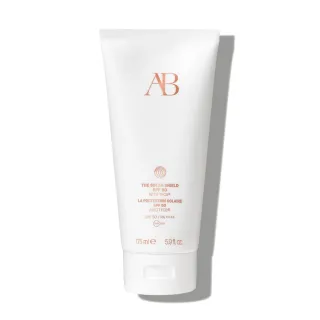
Augustinus Bader The Solar Shield SPF50
Works for
Sun protectionSPF 50 · 4 UV filtersBroad spectrum
This product offers a good level of protection against both UVB and UVA rays.
This sunscreen uses organic (so-called "chemical") sunscreen filters. Organic, or "chemical" filters usually provide reliable sun protection and rarely leave a white cast. Sunscreens with organic filters can sting eyes.
This product can be considered "reef safe" because it does not contain the UV filters (oxybenzone and octinoxate) that can be harmful to coral reefs when present in the water in high concentrations.
Evens skin toneCamellia sinensis leaf extractWorks well
“Helps reduce the appearance of dark spots and uneven skin tone”
This product offers broad spectrum sun protection. It means that it can prevent hyperpigmentation and help keep the skin tone even (sun damage is the main factor causing age spots, darkening of post-acne marks and other discolorations).
Anti-agingSide benefit · Alanyl glutamine, Camellia sinensis leaf extractWorks well
This product can help prevent early signs of skin aging because it offers a good level of broad spectrum sun protection. Sun damage is the main cause of premature skin aging, and protecting your skin from the sun is the best anti-aging strategy.
These ingredients in the product might also be helpful for reducing and preventing fine lines, wrinkles, and skin elasticity, even though there is no conclusive evidence for their effectiveness: alanyl glutamine.
Anti-oxidationSide benefit · Camellia sinensis leaf extract, Rubus idaeus seed oil + 5 moreMay help
This product contains antioxidants (camellia sinensis leaf extract, rubus idaeus seed oil) that might be able to help neutralize free radicals in skin to lessen the damage it gets from the UV light (sun). There is not enough evidence to confirm their effectiveness in skin though.
MoisturizingSide benefit the brand mentions · Diisopropyl sebacate, Cetearyl alcohol + 15 moreWorks
“Skin feels hydrated, resilient, and balanced, with a strengthened moisture barrier for long-lasting comfort, even during outdoor activity.”
This product can help improve hydration of the skin with the two types of ingredients.
The first type is called “humectants”:
these ingredients help attract water.
When humectants are on the surface of the skin, they “pull in” the moisture from the outside environment, or from
within deeper layers of the skin. The following ingredients in this product do the job:
alanyl glutamine, arginine.
This product also contains ingredients called “occlusives”. They help reduce the speed with which our skin loses moisture to the outside environment. These ingredients also help soften the upper layer of the skin, so it feels less tight and nicer to the touch. The following ingredients in this product do the job: arginine, helianthus annuus seed wax.
Can it cause trouble?
Irritancy2 strong irritants: Hibiscus sabdariffa flower extract, Rosmarinus officinalis leaf extractMedium risk
Comedogenic1 ingredient rated 2 or more on the 0–5 pore-clogging scale1 flagged
User reviews
Be the first — your take helps the next person decide.
Ingredients
Filter by role to see what each ingredient is doing.
Water~45–55%
Diisopropyl sebacate~5.9–7.2%
- Irritation risk
- Low
Helps soften the upper layer of the skin without creatng a greasy finish
More about Diisopropyl sebacateDiethylamino hydroxybenzoyl hexyl benzoate~4.7–5.7%
- Irritation risk
- Medium
Uvinul A Plus. A new generation broad spectrum sunscreen that offers an effective protection especially in the UVA range. It is stable in formulations. Unfortunately, is not approved by the FDA (US) yet
More about Diethylamino hydroxybenzoyl hexyl benzoateEthylhexyl triazone~3.7–4.5%
- Irritation risk
- Medium
Uvinul T. A UV filter. Effective against UVB rays. It is photostable. Can increase water resistance properties of the sunscreen. Unfortunately, not approved by the FDA (US) yet
More about Ethylhexyl triazoneHydrogenated castor oil/sebacic acid copolymer~2.4–3%
- Irritation risk
- Low
Bis-ethylhexyloxyphenol methoxyphenyl triazine~2.5–3.1%
- Irritation risk
- Medium
Tinosorb S. One of the most effective broad spectrum sunscreen ingredients. Protects from both UVA and UVB rays. It is photostable. Unfortunately, not approved by FDA (US) yet.
More about Bis-ethylhexyloxyphenol methoxyphenyl triazinePhenylbenzimidazole sulfonic acid~2.1–2.6%
- Irritation risk
- Medium
Ensulizole. A UV filter that is effective against UVB rays. Does not protect against UVA light. It is photostable and can be used to help stabilize other sunscreen ingredients. It is water-soluble meaning that it can help create lighter sunscreen formulations
More about Phenylbenzimidazole sulfonic acidPropanediol~1.5–1.8%
- Irritation risk
- Low
Acts as a solvent for other ingredients. Speeds up the absorption of other ingredients into the skin
More about PropanediolCetearyl alcohol~1.3–1.6%
- Irritation risk
- Low
- Comedogenicity
- 2/5
A non-drying alcohol. Works as an emollient. Helps water and oil mix together and creates a nice product texture
More about Cetearyl alcoholBehenyl alcohol~1–1.3%
- Irritation risk
- Low
Non-drying alcohol that helps water and oil mix together. Also serves as an emollient
More about Behenyl alcoholSodium stearoyl glutamate~0.75–1.1%
- Irritation risk
- Medium
Helps oil and water mix together
More about Sodium stearoyl glutamateGlyceryl stearate~0.65–0.95%
- Irritation risk
- Low
An emollient that softens the skin and forms a protective layer on its surface. Helps water and oil mix together
More about Glyceryl stearateJojoba esters~0.55–0.85%
- Irritation risk
- Medium
An emollient made of jojoba oil. Helps soften the skin and support its barrier function
More about Jojoba estersCaprylyl glycol~0.5–0.75%
- Irritation risk
- Medium
Helps preserve products and creates a nice product texture
More about Caprylyl glycolBisabolol~0.4–0.6%
- Irritation risk
- Low
An active component of chamomile plant that historically has been used to calm down irritated skin. A recent study shows that bisabolol indeed can have some anti-inflammatory effect on skin, even though conclusive data is lacking. Bisabolol has a sweet floral scent and can be added to products for its aromatic properties
More about BisabololGlyceryl caprylate~0.5–0.75%
- Irritation risk
- Low
An emollient that can also help water and oil mix together, as well as prevent bacteria growth in products
More about Glyceryl caprylateHydroxyacetophenone~0.45–0.65%
Sodium hydroxide~0.35–0.65%
Xanthan gum~0.35–0.6%
- Irritation risk
- Low
Used to create a thicker product consistency
More about Xanthan gumHelianthus annuus seed wax~0.35–0.6%
- Irritation risk
- Low
Helps soften the upper layer of the skin and support skin's barrier function while creating a thicker product consistency
More about Helianthus annuus seed waxSodium phytate~0.3–0.55%
Glycerin~0.3–0.6%
- Irritation risk
- Low
One of the best moisturizing ingredients. Naturally present in skin. It attracts water to the upper layer of the skin working as a humectant
More about GlycerinCaprylhydroxamic acid~0.25–0.5%
Tocopheryl acetate~0.25–0.5%
- Irritation risk
- Medium
A more stable but less bio-available form of vitamin E compared to Tocopherol. Might help moisturize and protect the skin from free radicals, but mostly used in low concentrations to stabilize other ingredients.
More about Tocopheryl acetateHydrolyzed rice protein~0.25–0.45%
- Irritation risk
- Low
Helps attract water to the upper layer of the skin. Might have some anti-oxidant properties
More about Hydrolyzed rice proteinMaltodextrin~0.25–0.5%
- Irritation risk
- Low
Used to stabilize the product formulation and can help absorb oil
More about MaltodextrinPolyglycerin-3~0.25–0.5%
- Irritation risk
- Low
Helps to attract water to the upper layer of the skin
More about Polyglycerin-3Osmanthus fragrans flower extract~0.25–0.5%
- Irritation risk
- Low
Rubus idaeus seed oil~0.3–0.55%
- Irritation risk
- Medium
A plant oil that might be able to help neutralize free radicals in skin
More about Rubus idaeus seed oilMoringa oleifera seed oil~0.3–0.55%
- Irritation risk
- Medium
A plant oil that helps soften the upper layer of the skin. Is unlikely to be helpful in restoring skin barrier function due to the low content of linoleic acid
More about Moringa oleifera seed oilCitric acid~0.25–0.45%
- Irritation risk
- Medium
Can work as an exfoliant but is typically used to adjust the product pH
More about Citric acidCamellia sinensis leaf extract~0.3–0.5%
- Irritation risk
- Low
Can contain potent anti-oxidant compounds (abbreviated ECG, GCG, EGC, and EGCG) that might help protect the skin from free radicals. Can help calm down inflammation and has some anti-bacterial properties. Unfortunately, these antioxidants are unstable and lose their effectiveness very quickly in products. The concentration of the antioxidant compounds in the extract also tends to be low to be effective in topical formulation
More about Camellia sinensis leaf extractHydrogenated lecithin~0.25–0.5%
- Irritation risk
- Low
Helps to retain moisture by creating a protective barrier on the skin. Rich in fatty acids. Improves product texture and helps with the penetration of other ingredients.
More about Hydrogenated lecithinErythritol~0.25–0.45%
- Irritation risk
- Low
Helps to attract water to the upper layer of the skin
More about ErythritolSodium benzoate~0.25–0.45%
Alanyl glutamine~0.25–0.45%
- Irritation risk
- Low
A type of peptide. Peptides are excellent moisturizers and might be able support collagen production reducing fine lines and wrinkles
More about Alanyl glutamineArginine~0.2–0.4%
- Irritation risk
- Low
An amino acid that is naturally present in skin and helps keep it hydrated. When used together with AHAs, it can reduce their irritating effect on the skin
More about ArginineOligopeptide-177~0.2–0.4%
- Irritation risk
- Low
Phenylalanine~0.2–0.4%
- Irritation risk
- Low
Potassium sorbate~0.15–0.3%
Sisymbrium irio seed oil~0.15–0.3%
- Irritation risk
- Low
A plant oil that helps soften the upper layer of the skin. Could help reduce inflammation due to high content of linolenic acid
More about Sisymbrium irio seed oilSodium chloride~0.2–0.35%
- Irritation risk
- Low
Used to stabilize mixtures of oil and water, and create thicker, gel-like product textures
More about Sodium chlorideHibiscus sabdariffa flower extract~0.15–0.3%
- Irritation risk
- High
A plant extract that can be irritating. It might contain a compound anthocyanin that could be helpful in neutralizing free radicals
More about Hibiscus sabdariffa flower extractRosmarinus officinalis leaf extract~0.1–0.2%
- Irritation risk
- High
Can be helpful in reducing inflammation in skin, including inflamed acne. It can be irritating
More about Rosmarinus officinalis leaf extractPolygonum tinctorium leaf/stem extract~0.1–0.25%
- Irritation risk
- Low
Ingredient list view
Water, Diisopropyl sebacate, Diethylamino hydroxybenzoyl hexyl benzoate, Ethylhexyl triazone, Hydrogenated castor oil/sebacic acid copolymer, Bis-ethylhexyloxyphenol methoxyphenyl triazine, Phenylbenzimidazole sulfonic acid, Propanediol, Cetearyl alcohol, Behenyl alcohol, Sodium stearoyl glutamate, Glyceryl stearate, Jojoba esters, Caprylyl glycol, Bisabolol, Glyceryl caprylate, Hydroxyacetophenone, Sodium hydroxide, Xanthan gum, Helianthus annuus seed wax, Sodium phytate, Glycerin, Caprylhydroxamic acid, Tocopheryl acetate, Hydrolyzed rice protein, Maltodextrin, Polyglycerin-3, Osmanthus fragrans flower extract, Rubus idaeus seed oil, Moringa oleifera seed oil, Citric acid, Camellia sinensis leaf extract, Hydrogenated lecithin, Erythritol, Sodium benzoate, Alanyl glutamine, Arginine, Oligopeptide-177, Phenylalanine, Potassium sorbate, Sisymbrium irio seed oil, Sodium chloride, Hibiscus sabdariffa flower extract, Rosmarinus officinalis leaf extract, Polygonum tinctorium leaf/stem extract
Compare prices
Retailers ranked by price — lowest first.

Worth comparing, line by line.
Match % combines shared ingredients, the first five ingredients, shared actives and hero ingredients, irritancy (lower counts in the alternative's favour), texture and body area. Only products in the same routine step are compared.
| Augustinus BaderThe Solar Shield SPF50YOUR PRODUCT | UltrasunSun Protection Extreme Very High Sun Protection for Sensitive Skin SPF50+ | TypologyCrème Solaire Corps SPF 30 à l'Aloe Vera | CeraVeInvisible Hydrating Fluid Sunscreen SPF 50 | |
|---|---|---|---|---|
| Match | — | 40% | 39% | 37% |
| Price | — | $24.94 | $19.90 | $18.73 |
| Shared key ingredients | — | 5 of 15 | 5 of 15 | 5 of 15 |
| Key difference | — | Caprylic/Capric Triglyceride | Butyrospermum Parkii Butter | Niacinamide |
| Irritancy | Medium | Low | Low | Low |
| SPF | SPF 50 | SPF 50 | SPF 30 | SPF 50 |
| Drying alcohol | — | Contains drying alcohol | — | — |
| View product | Shop | Shop | Shop |



More alternatives: Mustela Very High Protection Sun Lotion Baby-Children-Family SPF50+Bioderma Gevoelige Huid Zonnemelk SPF 50
Sources cited in this review
Every concentration estimate and effectiveness label is anchored to one of these 15 studies and safety reviews.
- 1
- 2
- 3
- 4
- 5
- 6

Affiliate links · As an Amazon Associate, WIMJ earns from qualifying purchases.