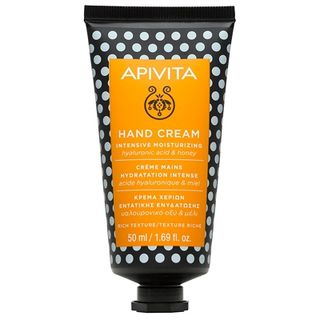
APIVITA HAND CARE Intensive Moisturizing Hand Cream with Hyaluronic Acid and Honey - Rich Texture
Works for
1 of 1 advertised claim delivered
Moisturizing24 ingredients credited for this claimStrong support
“HAND CARE Intensive Moisturizing Hand Cream with Hyaluronic Acid and Honey .”
This product can help improve hydration of the skin with the two types of ingredients.
The first type is called “humectants”:
these ingredients help attract water.
When humectants are on the surface of the skin, they “pull in” the moisture from the outside environment, or from
within deeper layers of the skin. The following ingredients in this product do the job:
glycerin, sodium hyaluronate.
This product also contains ingredients called “occlusives”. They help reduce the speed with which our skin loses moisture to the outside environment. These ingredients also help soften the upper layer of the skin, so it feels less tight and nicer to the touch. The following ingredients in this product do the job: beeswax, butyrospermum parkii butter.
The following ingredients in this product are especially good for supporting the skin barrier and helping with the hydration level: isosorbide dicaprylate, panthenol
Can it cause trouble?
Irritancy4 strong irritants: Citrus aurantium dulcis peel oil, Parfum + 2 more — patch-test recommendedHigh risk
Comedogenic4 ingredients rated 2 or more on the 0–5 pore-clogging scale4 flagged
User reviews
Be the first — your take helps the next person decide.
Ingredients
Filter by role to see what each ingredient is doing.
Water~45–55%
Cetearyl alcohol~5.4–6.6%
- Irritation risk
- Low
- Comedogenicity
- 2/5
A non-drying alcohol. Works as an emollient. Helps water and oil mix together and creates a nice product texture
More about Cetearyl alcoholPanthenol~4.1–5%
- Irritation risk
- Low
Helps attract water to the upper layer of the skin and can help improve skin barrier function
More about PanthenolIsoamyl laurate~3.1–3.8%
- Irritation risk
- Medium
Helps stabilize emulsions and create a nice product texture
More about Isoamyl lauratePropanediol dicaprylate~2.4–2.9%
- Irritation risk
- Low
Hydrogenated vegetable oil~1.9–2.4%
- Irritation risk
- Low
- Comedogenicity
- 2/5
An oil from a mixture of different vegetables. Helps soften the upper layer of the skin
More about Hydrogenated vegetable oilGlycerin~1.7–2.1%
- Irritation risk
- Low
One of the best moisturizing ingredients. Naturally present in skin. It attracts water to the upper layer of the skin working as a humectant
More about GlycerinIsosorbide dicaprylate~1.5–1.8%
- Irritation risk
- Low
Helps soften the upper layer of the skin. Early studies suggest that it can help strengthen the skin barrier
More about Isosorbide dicaprylateButyrospermum parkii butter~1.3–1.6%
- Irritation risk
- Low
- Comedogenicity
- 3/5
A great moisturising ingredient that softens the skin and reduces water loss from its upper layer. It also can be helpful in protecting skin from free radicals
More about Butyrospermum parkii butterTheobroma cacao seed butter~1–1.2%
- Irritation risk
- Low
- Comedogenicity
- 3/5
Helps soften the upper layer of the skin and can be helpful in restoring the skin barrier function. Might have some anti-oxidant effect
More about Theobroma cacao seed butterGlyceryl stearate~0.75–1.1%
- Irritation risk
- Low
An emollient that softens the skin and forms a protective layer on its surface. Helps water and oil mix together
More about Glyceryl stearatePeg-100 stearate~0.65–1%
- Irritation risk
- Low
Helps oil and water mix togehter and creates a nice product texture
More about Peg-100 stearatePolysorbate 60~0.55–0.8%
Mel~0.5–0.75%
- Irritation risk
- Low
Helps to soften the upper layer of the skin and attract water to it
More about MelHoney~0.4–0.65%
- Irritation risk
- Low
Helps attract water to the skin and might have some anti-bacterial properties. Can be an allergen
More about HoneyPropolis extract~0.45–0.65%
- Irritation risk
- High
A complex substance produced by honey bees. Can have anti-bacterial and some anti-oxidant effect. Is an allergen and can be irritating
More about Propolis extractOlea europaea fruit oil~0.4–0.65%
- Irritation risk
- Medium
An emollient that helps soften the skin but is not effective for restoring its barrier function. Might be helpful to calm down inflammation
More about Olea europaea fruit oilWater~0.35–0.6%
Persea gratissima oil~0.4–0.6%
- Irritation risk
- Medium
An emollient that helps soften the skin and could be helpful in repairing its barrier function
More about Persea gratissima oilHelianthus annuus seed oil~0.3–0.6%
- Irritation risk
- Low
A great emollient due to its high linoleic acid content. One of the most effective plant oils in helping skin hydration and repairing skin barrier function
More about Helianthus annuus seed oilSideritis perfoliata flower/leaf/stem extract~0.3–0.5%
- Irritation risk
- Low
Sideritis scardica flower/leaf/stem extract~0.25–0.5%
- Irritation risk
- Low
Sideritis raeseri flower/leaf/stem extract~0.25–0.45%
- Irritation risk
- Low
Aloe barbadensis leaf juice powder~0.25–0.45%
- Irritation risk
- Medium
Traditionally used to treat sunburns, dermatitis and inflammation, but evidence for its effectiveness is lacking. The extract can contain humectants that help attract water into the skin
More about Aloe barbadensis leaf juice powderSodium hyaluronate~0.25–0.45%
- Irritation risk
- Low
One of the best moisturizing ingredients. Attracts water into the upper layer of the skin
More about Sodium hyaluronateCera alba~0.35–0.65%
- Irritation risk
- Medium
Forms a protective barrier that holds water and keeps dry skin hydrated. Keeps an emulsion from separating into its oil and liquid components, and increases the thickness of a product. Can be an allergen
More about Cera albaBeeswax~0.3–0.55%
- Irritation risk
- Low
Forms a protective barrier that holds water and keeps dry skin hydrated. Keeps an emulsion from separating into its oil and liquid components, and increases the thickness of a product. Can be an allergen
More about BeeswaxCitrus aurantium dulcis peel oil~0.25–0.45%
- Irritation risk
- High
An essentil oil from orange peel. Potential allergen and can be irritating
More about Citrus aurantium dulcis peel oilHelianthus annuus seed oil~0.25–0.5%
- Irritation risk
- Low
A great emollient due to its high linoleic acid content. One of the most effective plant oils in helping skin hydration and repairing skin barrier function
More about Helianthus annuus seed oilOlea europaea fruit oil~0.25–0.45%
- Irritation risk
- Medium
An emollient that helps soften the skin but is not effective for restoring its barrier function. Might be helpful to calm down inflammation
More about Olea europaea fruit oilTocopheryl acetate~0.25–0.5%
- Irritation risk
- Medium
A more stable but less bio-available form of vitamin E compared to Tocopherol. Might help moisturize and protect the skin from free radicals, but mostly used in low concentrations to stabilize other ingredients.
More about Tocopheryl acetateTocopherol~0.25–0.45%
- Irritation risk
- Low
Pure form of vitamin E. Can help moisturise and protect the skin from free radicals. Often used to help stabilise other ingredients or the formula itself
More about TocopherolBiotin~0.25–0.45%
- Irritation risk
- Low
Might have some moisturising properties. Is not effective when applied topically beyond some moisturizing effect
More about BiotinXanthan gum~0.25–0.45%
- Irritation risk
- Low
Used to create a thicker product consistency
More about Xanthan gumPhytosterols~0.3–0.5%
- Irritation risk
- Medium
Lipids that work as an emollient and can be helpful in repairing skin barrier function
More about PhytosterolsPhospholipids~0.25–0.45%
- Irritation risk
- Low
Emollients that are naturaly present in skin. In addition, they help water and oil mix together in the product
More about PhospholipidsEthylhexylglycerin~0.2–0.4%
Disodium edta~0.2–0.4%
Hydrogenated polydecene~0.2–0.4%
- Irritation risk
- Low
Helps to soften the upper layer of the skin and create a nice product texture
More about Hydrogenated polydecenePolyglyceryl-10 stearate~0.2–0.4%
- Irritation risk
- Medium
Helps water and oil mix together and softens the upper layer of the skin
More about Polyglyceryl-10 stearatePeg-20 stearate~0.2–0.35%
Sodium acrylates copolymer~0.15–0.25%
- Irritation risk
- Medium
Used to create a thicker product consistency
More about Sodium acrylates copolymerHydroxyacetophenone~0.15–0.3%
Parfum~0.1–0.25%
- Irritation risk
- High
An aromatic blend of unspecified and possibly irritating ingredients
More about ParfumBenzyl salicylate~0.1–0.15%
Limonene~0.05–0.15%
- Irritation risk
- High
A common frangrance that can easily irritate skin, especially if exposed to air, light or heat
More about LimoneneIngredient list view
Water, Cetearyl alcohol, Panthenol, Isoamyl laurate, Propanediol dicaprylate, Hydrogenated vegetable oil, Glycerin, Isosorbide dicaprylate, Butyrospermum parkii butter, Theobroma cacao seed butter, Glyceryl stearate, Peg-100 stearate, Polysorbate 60, Mel, Honey, Propolis extract, Olea europaea fruit oil, Water, Persea gratissima oil, Helianthus annuus seed oil, Sideritis perfoliata flower/leaf/stem extract, Sideritis scardica flower/leaf/stem extract, Sideritis raeseri flower/leaf/stem extract, Aloe barbadensis leaf juice powder, Sodium hyaluronate, Cera alba, Beeswax, Citrus aurantium dulcis peel oil, Helianthus annuus seed oil, Olea europaea fruit oil, Tocopheryl acetate, Tocopherol, Biotin, Xanthan gum, Phytosterols, Phospholipids, Ethylhexylglycerin, Disodium edta, Hydrogenated polydecene, Polyglyceryl-10 stearate, Peg-20 stearate, Sodium acrylates copolymer, Hydroxyacetophenone, Parfum, Benzyl salicylate, Limonene
Compare prices
Retailers ranked by price — lowest first.
Product summary
Based on the ingredients included, "APIVITA - HAND CARE Intensive Moisturizing Hand Cream with Hyaluronic Acid and Honey - Rich Texture" works well for moisturizing the skin. The formulation is based on a combination of good humectants and emollients. Both are needed to increase the skin hydration level. Humectants in this product (panthenol, glycerin, sodium hyaluronate, honey and mel) help to increase the water content in the upper layer of the skin. (These ingredients do so by "capturing" water molecules from the outside air or from within the deeper layers of the skin). Emollients in this formulation (isosorbide dicaprylate, phytosterols, theobroma cacao seed butter, beeswax and butyrospermum parkii butter) help to reduce the moisture loss from the skin. They also soften the skin surface and relieve the feeling of dryness and tightness.
Ingredient callouts
- This formulation also uses an effective concentration of panthenol (pro-vitamin B5) - about 4.10% - 5.00%. Panthenol helps strengthen the skin barrier, improve hydration and reduce inflammation in skin.
Irritation risk
We assess the overall irritancy of this moisturizer to be high. For a detailed overview of all potential irritants: click here
You can see the detailed formula review with the breakdown of all actives in the product and the full ingredient list with estimated concentrations in the tables below.
Sources cited in this review
Every concentration estimate and effectiveness label is anchored to one of these 19 studies and safety reviews.
- 1Skin moisturizing effects of panthenol-based formulationspdfs.semanticscholar.org
- 2
- 3
- 4
- 5
- 6

Affiliate links · As an Amazon Associate, WIMJ earns from qualifying purchases.