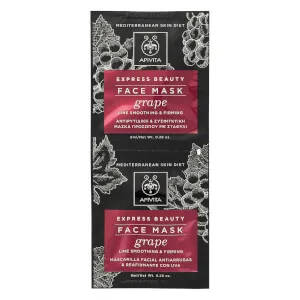
APIVITA Express Line Reducing Face Mask - Grape

APIVITA Express Line Reducing Face Mask - Grape

Efficacy75/100IrritancyHigh

Works for

Anti-aging
Dipalmitoyl hydroxyproline, Ubiquinone + 3 more
May help
What the product description says
“anti-ageing treatment for skin lacking firmness and elasticity”
Source: Lookfantastic

This product contains ubiquinone. This ingredient help neutralize free radicals in skin. By doing so, they might be able to prevent early signs of aging (like fine lines and wrinkles), at least to some extent. These ingredients will not be able to "reverse" signs of aging.

Dipalmitoyl hydroxyprolineEffect: LowIs claimed to stimulate collagen and elastin production, as well as work as an anti-oxidant. There is however not enough evidence for its effectiveness~2.3–2.8%
UbiquinoneEffect: LowCoenzyme Q10. It helps neutralize free radicals in skin, improves skin hydration and might be helpful agains fine lines and wrinkles. It can be an allergen~0.25–0.5%
Camellia sinensis leaf extractEffect: Low, below effective doseCan contain potent anti-oxidant compounds (abbreviated ECG, GCG, EGC, and EGCG) that might help protect the skin from free radicals. Can help calm down inflammation and has some anti-bacterial properties. Unfortunately, these antioxidants are unstable and lose their effectiveness very quickly in products. The concentration of the antioxidant compounds in the extract also tends to be low to be effective in topical formulation~0.25–0.5%
TocopherolEffect: Low, below effective dosePure form of vitamin E. Can help moisturise and protect the skin from free radicals. Often used to help stabilise other ingredients or the formula itself~0.25–0.5%
Retinyl palmitateUnder-dosedThree steps removed from the active form of vitamin A - retinoic acid. To have an effect in the skin, it first needs to be converted twice to become the retinoic acid. This means it is less potent than retinol, but could also be less irritating. Once converted to the retinoic acid in the skin, it helps against all signs of aging, improves skin cell turnover and helps fight blemishes and clogged pores. However, in many cosmetic formulations, it is used in a concentration that is too low to have the full effect~0.25–0.45%
Moisturizing
Glycerin, Hydrogenated vegetable oil + 19 more
Works
What the product description says
“hydrated”
Source: Lookfantastic

This product can help improve hydration of the skin with the two types of ingredients.

The first type is called “humectants”:
these ingredients help attract water. When humectants are on the surface of the skin, they “pull in” the moisture from the outside environment, or from within deeper layers of the skin. The following ingredients in this product do the job: glycerin, mannitol.

This product also contains ingredients called “occlusives”. They help reduce the speed with which our skin loses moisture to the outside environment. These ingredients also help soften the upper layer of the skin, so it feels less tight and nicer to the touch. The following ingredients in this product do the job: helianthus annuus seed oil, vitis vinifera seed oil.

GlycerinKey active· HumectantEffect: HighOne of the best moisturizing ingredients. Naturally present in skin. It attracts water to the upper layer of the skin working as a humectant~4.6–5.7%
Hydrogenated vegetable oilKey active· EmollientEffect: MediumAn oil from a mixture of different vegetables. Helps soften the upper layer of the skin~4.2–5.1%
Cetearyl alcoholKey active· EmollientEffect: MediumA non-drying alcohol. Works as an emollient. Helps water and oil mix together and creates a nice product texture~2.5–3.1%
Dipalmitoyl hydroxyprolineKey activeEffect: MediumIs claimed to stimulate collagen and elastin production, as well as work as an anti-oxidant. There is however not enough evidence for its effectiveness~2.3–2.8%
Olea europaea fruit oilKey active· EmollientEffect: MediumAn emollient that helps soften the skin but is not effective for restoring its barrier function. Might be helpful to calm down inflammation~1.6–1.9%
Vitis vinifera seed oilKey active· EmollientEffect: HighA great emollient that can also have anti-oxidant properties~1.2–1.5%
MannitolKey active· HumectantEffect: HighHelps to attract water to the upper layer of the skin~0.5–0.75%
Helianthus annuus seed oilKey active· Emollient, OcclusiveEffect: HighA great emollient due to its high linoleic acid content. One of the most effective plant oils in helping skin hydration and repairing skin barrier function~0.45–0.7%
PhospholipidsKey activeEffect: MediumEmollients that are naturaly present in skin. In addition, they help water and oil mix together in the product~0.3–0.55%
Cetyl palmitateKey active· EmollientEffect: MediumAn emollient that helps soften the skin and is used to improve product texture and stability~0.3–0.6%
Sodium hyaluronateKey active· HumectantEffect: HighOne of the best moisturizing ingredients. Attracts water into the upper layer of the skin~0.25–0.45%
UbiquinoneKey activeEffect: HighCoenzyme Q10. It helps neutralize free radicals in skin, improves skin hydration and might be helpful agains fine lines and wrinkles. It can be an allergen~0.25–0.5%
Dicaprylyl carbonate· EmollientEffect: LowHelps products spread more easily and works as an emollient to soften skin~1.5–1.8%
Caprylyl glycol· Humectant, EmollientEffect: LowHelps preserve products and creates a nice product texture~1–1.2%
Polyglyceryl-10 stearateEffect: LowHelps water and oil mix together and softens the upper layer of the skin~0.3–0.6%
Hydrogenated polyisobutene· Emollient, OcclusiveEffect: LowUsed to improve the product consistency and soften the upper layer of the skin~0.3–0.55%
Rosa damascena flower oilEffect: LowUsed as a fragrance. Can be irritating~0.25–0.45%
TocopherolEffect: Low, below effective dosePure form of vitamin E. Can help moisturise and protect the skin from free radicals. Often used to help stabilise other ingredients or the formula itself~0.25–0.5%
Camellia sinensis leaf extractEffect: Low, below effective doseCan contain potent anti-oxidant compounds (abbreviated ECG, GCG, EGC, and EGCG) that might help protect the skin from free radicals. Can help calm down inflammation and has some anti-bacterial properties. Unfortunately, these antioxidants are unstable and lose their effectiveness very quickly in products. The concentration of the antioxidant compounds in the extract also tends to be low to be effective in topical formulation~0.25–0.5%
PanthenolUnder-dosedHelps attract water to the upper layer of the skin and can help improve skin barrier function~0.25–0.5%
AllantoinUnder-dosedHelps calm down inflammation in skin and can help reduce itching. Helps to repair the skin barrier and keep skin hydrated~0.25–0.45%
Anti-oxidation
Side benefit · Ubiquinone, Dipalmitoyl hydroxyproline + 5 more
Works well

This product contains antioxidants (ubiquinone) that can help neutralize free radicals in skin. By doing so, they can lessen the damage the skin gets from the UV light (sun).

UbiquinoneKey activeEffect: HighCoenzyme Q10. It helps neutralize free radicals in skin, improves skin hydration and might be helpful agains fine lines and wrinkles. It can be an allergen~0.25–0.5%
Dipalmitoyl hydroxyprolineEffect: LowIs claimed to stimulate collagen and elastin production, as well as work as an anti-oxidant. There is however not enough evidence for its effectiveness~2.3–2.8%
Vitis vinifera seed oilEffect: LowA great emollient that can also have anti-oxidant properties~1.2–1.5%
Tocopheryl acetateEffect: Low, below effective doseA more stable but less bio-available form of vitamin E compared to Tocopherol. Might help moisturize and protect the skin from free radicals, but mostly used in low concentrations to stabilize other ingredients.~0.7–1.05%
BisabololEffect: Low, below effective doseAn active component of chamomile plant that historically has been used to calm down irritated skin. A recent study shows that bisabolol indeed can have some anti-inflammatory effect on skin, even though conclusive data is lacking. Bisabolol has a sweet floral scent and can be added to products for its aromatic properties~0.2–0.4%
TocopherolUnder-dosedPure form of vitamin E. Can help moisturise and protect the skin from free radicals. Often used to help stabilise other ingredients or the formula itself~0.25–0.5%
Camellia sinensis leaf extractUnder-dosedCan contain potent anti-oxidant compounds (abbreviated ECG, GCG, EGC, and EGCG) that might help protect the skin from free radicals. Can help calm down inflammation and has some anti-bacterial properties. Unfortunately, these antioxidants are unstable and lose their effectiveness very quickly in products. The concentration of the antioxidant compounds in the extract also tends to be low to be effective in topical formulation~0.25–0.5%

Can it cause trouble?

Irritancy
12 strong irritants: Retinyl palmitate, Rosa damascena flower oil + 10 more — patch-test recommended
High risk
We flagged 24 ingredients with irritancy potential. Severity depends on your sensitivity threshold; the table lists the worst offenders first.
IngredientFunctionIrritationEst. amount
Decyl glucosideHelps oil and water mix together. Can be irritatingHigh~0.55–0.8%est.
Retinyl palmitateThree steps removed from the active form of vitamin A - retinoic acid. To have an effect in the skin, it first needs to be converted twice to become the retinoic acid. This means it is less potent than retinol, but could also be less irritating. Once converted to the retinoic acid in the skin, it helps against all signs of aging, improves skin cell turnover and helps fight blemishes and clogged pores. However, in many cosmetic formulations, it is used in a concentration that is too low to have the full effectHigh~0.25–0.45%est.
Rosa damascena flower oilUsed as a fragrance. Can be irritatingHigh~0.25–0.45%est.
Pogostemon cablin leaf oilUsed as a fragranceHigh~0.25–0.5%est.
ParfumAn aromatic blend of unspecified and possibly irritating ingredientsHigh~0.2–0.4%est.
GeraniolA fragrance. Can be irritatingHigh~0.2–0.4%est.
HydroxycitronellalA fragrance. A likely allergen and can be irritatingHigh~0.2–0.4%est.
LinaloolA fragrance. Can be irritatingHigh~0.2–0.35%est.
Hexyl cinnamalA fragrance with jasmine smell. A likely irritantHigh~0.2–0.35%est.
LimoneneA common frangrance that can easily irritate skin, especially if exposed to air, light or heatHigh~0.2–0.35%est.
Alpha-isomethyl iononeA fragrance. Potential allergen and can be irritatingHigh~0.2–0.35%est.
CitronellolA fragrance. Can be irritatingHigh~0.15–0.25%est.
Benzyl salicylateA fragrance. Is a likely irritantHigh~0.15–0.25%est.
Olea europaea fruit oilAn emollient that helps soften the skin but is not effective for restoring its barrier function. Might be helpful to calm down inflammationMedium~1.6–1.9%est.
Vitis vinifera seed oilA great emollient that can also have anti-oxidant propertiesMedium~1.2–1.5%est.
Caprylyl glycolHelps preserve products and creates a nice product textureMedium~1–1.2%est.
Tocopheryl acetateA more stable but less bio-available form of vitamin E compared to Tocopherol. Might help moisturize and protect the skin from free radicals, but mostly used in low concentrations to stabilize other ingredients.Medium~0.7–1.05%est.
Cetearyl glucosideHelps water and oil in the product mix well together and improves product textureMedium~0.6–0.9%est.
EthylhexylglycerinA preservativeMedium~0.5–0.75%est.
Polyglyceryl-10 stearateHelps water and oil mix together and softens the upper layer of the skinMedium~0.3–0.6%est.
Sorbitan palmitateHelps water and oil mix together and stabilize the product formulationMedium~0.25–0.5%est.
Disodium edtaStabilizes the product formulationMedium~0.25–0.5%est.
Sodium acrylates copolymerUsed to create a thicker product consistencyMedium~0.25–0.45%est.
Hydroxypropyl methylcelluloseUsed to create a thicker product consistency and stabilize the formulationMedium~0.15–0.3%est.
Comedogenic
2 ingredients rated 2 or more on the 0–5 pore-clogging scale
2 flagged
These ingredients have a comedogenic rating of 2 or more on a 0–5 scale; the table shows each one's rating. In leave-on products they can clog pores in acne-prone skin.
IngredientFunctionRatingEst. amount
Hydrogenated vegetable oilAn oil from a mixture of different vegetables. Helps soften the upper layer of the skin2/5~4.2–5.1%est.
Cetearyl alcoholA non-drying alcohol. Works as an emollient. Helps water and oil mix together and creates a nice product texture2/5~2.5–3.1%est.

User reviews

Would you recommend?
No community reviews yet.

Be the first — your take helps the next person decide.

Ingredients

Filter by role to see what each ingredient is doing.

Water~45–55%
Formula
Irritation risk
Low

Plain old water

More about Water
Glycerin~4.6–5.7%
Key active
Irritation risk
Low
Works for
Moisturizing

One of the best moisturizing ingredients. Naturally present in skin. It attracts water to the upper layer of the skin working as a humectant

More about Glycerin
Hydrogenated vegetable oil~4.2–5.1%
Key activeComedogenic 2/5
Irritation risk
Low
Comedogenicity
2/5
Works for
Moisturizing

An oil from a mixture of different vegetables. Helps soften the upper layer of the skin

More about Hydrogenated vegetable oil
Cetearyl alcohol~2.5–3.1%
Key activeComedogenic 2/5
Irritation risk
Low
Comedogenicity
2/5
Works for
CleansingMoisturizing

A non-drying alcohol. Works as an emollient. Helps water and oil mix together and creates a nice product texture

More about Cetearyl alcohol
Dipalmitoyl hydroxyproline~2.3–2.8%
Key active
Irritation risk
Low
Works for
MoisturizingAnti-agingAnti-oxidation

Is claimed to stimulate collagen and elastin production, as well as work as an anti-oxidant. There is however not enough evidence for its effectiveness

More about Dipalmitoyl hydroxyproline
Biosaccharide gum-4~1.9–2.3%
Formula
Irritation risk
Low

Helps improve the product texture

More about Biosaccharide gum-4
Olea europaea fruit oil~1.6–1.9%
Key activeIrritant · medium
Irritation risk
Medium
Works for
Moisturizing

An emollient that helps soften the skin but is not effective for restoring its barrier function. Might be helpful to calm down inflammation

More about Olea europaea fruit oil
Dicaprylyl carbonate~1.5–1.8%
Formula
Irritation risk
Low
Works for
Moisturizing

Helps products spread more easily and works as an emollient to soften skin

More about Dicaprylyl carbonate
Vitis vinifera seed oil~1.2–1.5%
Key activeIrritant · medium
Irritation risk
Medium
Works for
MoisturizingAnti-oxidation

A great emollient that can also have anti-oxidant properties

More about Vitis vinifera seed oil
Caprylyl glycol~1–1.2%
Irritant · medium
Irritation risk
Medium
Works for
Moisturizing

Helps preserve products and creates a nice product texture

More about Caprylyl glycol
Tocopheryl acetate~0.7–1.05%
Irritant · medium
Irritation risk
Medium
Works for
Anti-oxidation

A more stable but less bio-available form of vitamin E compared to Tocopherol. Might help moisturize and protect the skin from free radicals, but mostly used in low concentrations to stabilize other ingredients.

More about Tocopheryl acetate
Cetearyl glucoside~0.6–0.9%
Irritant · medium
Irritation risk
Medium
Works for
Cleansing

Helps water and oil in the product mix well together and improves product texture

More about Cetearyl glucoside
Mannitol~0.5–0.75%
Key active
Irritation risk
Low
Works for
Moisturizing

Helps to attract water to the upper layer of the skin

More about Mannitol
Ethylhexylglycerin~0.5–0.75%
Irritant · medium
Irritation risk
Medium

A preservative

More about Ethylhexylglycerin
Decyl glucoside~0.55–0.8%
Irritant · high
Irritation risk
High
Works for
Cleansing

Helps oil and water mix together. Can be irritating

More about Decyl glucoside
Helianthus annuus seed oil~0.45–0.7%
Key active
Irritation risk
Low
Works for
Moisturizing

A great emollient due to its high linoleic acid content. One of the most effective plant oils in helping skin hydration and repairing skin barrier function

More about Helianthus annuus seed oil
Water~0.45–0.65%
Formula
Irritation risk
Low

Plain old water

More about Water
Cellulose~0.45–0.65%
Formula
Irritation risk
Low
Works for
Mattifying

Can be used to help absorb oil as well as add volume and imporve texture of products.

More about Cellulose
Polyglyceryl-10 stearate~0.3–0.6%
Irritant · medium
Irritation risk
Medium
Works for
Moisturizing

Helps water and oil mix together and softens the upper layer of the skin

More about Polyglyceryl-10 stearate
Phospholipids~0.3–0.55%
Key active
Irritation risk
Low
Works for
Moisturizing

Emollients that are naturaly present in skin. In addition, they help water and oil mix together in the product

More about Phospholipids
Cetyl palmitate~0.3–0.6%
Key active
Irritation risk
Low
Works for
Moisturizing

An emollient that helps soften the skin and is used to improve product texture and stability

More about Cetyl palmitate
Sorbitan olivate~0.3–0.55%
Formula
Irritation risk
Low
Works for
Cleansing

Helps oil and water mix together

More about Sorbitan olivate
Sorbitan palmitate~0.25–0.5%
Irritant · medium
Irritation risk
Medium
Works for
Cleansing

Helps water and oil mix together and stabilize the product formulation

More about Sorbitan palmitate
Allantoin~0.25–0.45%
Under-dosed
Irritation risk
Low
Works for
MoisturizingAnti-inflammatoryReduces irritationReduces rednessAnti-blemishExfoliation

Helps calm down inflammation in skin and can help reduce itching. Helps to repair the skin barrier and keep skin hydrated

More about Allantoin
Bisabolol~0.2–0.4%
Formula
Irritation risk
Low
Works for
Anti-inflammatoryReduces irritationAnti-oxidation

An active component of chamomile plant that historically has been used to calm down irritated skin. A recent study shows that bisabolol indeed can have some anti-inflammatory effect on skin, even though conclusive data is lacking. Bisabolol has a sweet floral scent and can be added to products for its aromatic properties

More about Bisabolol
Tocopherol~0.25–0.5%
Under-dosed
Irritation risk
Low
Works for
Anti-oxidationAnti-agingMoisturizingAnti-inflammatory

Pure form of vitamin E. Can help moisturise and protect the skin from free radicals. Often used to help stabilise other ingredients or the formula itself

More about Tocopherol
Disodium edta~0.25–0.5%
Irritant · medium
Irritation risk
Medium

Stabilizes the product formulation

More about Disodium edta
Camellia sinensis leaf extract~0.25–0.5%
Under-dosed
Irritation risk
Low
Works for
Anti-oxidationAntibacterialAnti-agingAnti-blemishEvens skin toneMoisturizing

Can contain potent anti-oxidant compounds (abbreviated ECG, GCG, EGC, and EGCG) that might help protect the skin from free radicals. Can help calm down inflammation and has some anti-bacterial properties. Unfortunately, these antioxidants are unstable and lose their effectiveness very quickly in products. The concentration of the antioxidant compounds in the extract also tends to be low to be effective in topical formulation

More about Camellia sinensis leaf extract
Sodium hyaluronate~0.25–0.45%
Key active
Irritation risk
Low
Works for
Moisturizing

One of the best moisturizing ingredients. Attracts water into the upper layer of the skin

More about Sodium hyaluronate
Retinyl palmitate~0.25–0.45%
Under-dosedIrritant · high
Irritation risk
High
Works for
Anti-agingEvens skin toneAnti-blemishExfoliation

Three steps removed from the active form of vitamin A - retinoic acid. To have an effect in the skin, it first needs to be converted twice to become the retinoic acid. This means it is less potent than retinol, but could also be less irritating. Once converted to the retinoic acid in the skin, it helps against all signs of aging, improves skin cell turnover and helps fight blemishes and clogged pores. However, in many cosmetic formulations, it is used in a concentration that is too low to have the full effect

More about Retinyl palmitate
Ubiquinone~0.25–0.5%
Key active
Irritation risk
Low
Works for
MoisturizingAnti-oxidationAnti-aging

Coenzyme Q10. It helps neutralize free radicals in skin, improves skin hydration and might be helpful agains fine lines and wrinkles. It can be an allergen

More about Ubiquinone
Sodium acrylates copolymer~0.25–0.45%
Irritant · medium
Irritation risk
Medium

Used to create a thicker product consistency

More about Sodium acrylates copolymer
Hydrogenated polyisobutene~0.3–0.55%
Formula
Irritation risk
Low
Works for
Moisturizing

Used to improve the product consistency and soften the upper layer of the skin

More about Hydrogenated polyisobutene
Phenoxyethanol~0.25–0.5%
Formula
Irritation risk
Low

A preservative. It helps prevent bacterial growth in cosmetic products

More about Phenoxyethanol
Panthenol~0.25–0.5%
Under-dosed
Irritation risk
Low
Works for
MoisturizingReduces rednessReduces irritation

Helps attract water to the upper layer of the skin and can help improve skin barrier function

More about Panthenol
Xanthan gum~0.25–0.5%
Formula
Irritation risk
Low
Works for
Cleansing

Used to create a thicker product consistency

More about Xanthan gum
Rosa damascena flower oil~0.25–0.45%
Irritant · high
Irritation risk
High
Works for
Moisturizing

Used as a fragrance. Can be irritating

More about Rosa damascena flower oil
Pogostemon cablin leaf oil~0.25–0.5%
Irritant · high
Irritation risk
High

Used as a fragrance

More about Pogostemon cablin leaf oil
Parfum~0.2–0.4%
Irritant · high
Irritation risk
High

An aromatic blend of unspecified and possibly irritating ingredients

More about Parfum
Geraniol~0.2–0.4%
Irritant · high
Irritation risk
High

A fragrance. Can be irritating

More about Geraniol
Hydroxycitronellal~0.2–0.4%
Irritant · high
Irritation risk
High

A fragrance. A likely allergen and can be irritating

More about Hydroxycitronellal
Linalool~0.2–0.35%
Irritant · high
Irritation risk
High

A fragrance. Can be irritating

More about Linalool
Hexyl cinnamal~0.2–0.35%
Irritant · high
Irritation risk
High

A fragrance with jasmine smell. A likely irritant

More about Hexyl cinnamal
Limonene~0.2–0.35%
Irritant · high
Irritation risk
High

A common frangrance that can easily irritate skin, especially if exposed to air, light or heat

More about Limonene
Alpha-isomethyl ionone~0.2–0.35%
Irritant · high
Irritation risk
High

A fragrance. Potential allergen and can be irritating

More about Alpha-isomethyl ionone
Citronellol~0.15–0.25%
Irritant · high
Irritation risk
High

A fragrance. Can be irritating

More about Citronellol
Benzyl salicylate~0.15–0.25%
Irritant · high
Irritation risk
High

A fragrance. Is a likely irritant

More about Benzyl salicylate
Hydroxypropyl methylcellulose~0.15–0.3%
Irritant · medium
Irritation risk
Medium
Works for
Cleansing

Used to create a thicker product consistency and stabilize the formulation

More about Hydroxypropyl methylcellulose
Ci 77491~0.15–0.3%
Formula
Irritation risk
Low

A red colorant made of iron oxide. Typically is not irritating

More about Ci 77491
Ci 77492~0.1–0.2%
Formula
Irritation risk
Low

A colorant. Usually well-tolerated

More about Ci 77492
Ci 77891~0.1–0.2%
Formula
Irritation risk
Low
More about Ci 77891
Ingredient list view

Water, Glycerin, Hydrogenated vegetable oil, Cetearyl alcohol, Dipalmitoyl hydroxyproline, Biosaccharide gum-4, Olea europaea fruit oil, Dicaprylyl carbonate, Vitis vinifera seed oil, Caprylyl glycol, Tocopheryl acetate, Cetearyl glucoside, Mannitol, Ethylhexylglycerin, Decyl glucoside, Helianthus annuus seed oil, Water, Cellulose, Polyglyceryl-10 stearate, Phospholipids, Cetyl palmitate, Sorbitan olivate, Sorbitan palmitate, Allantoin, Bisabolol, Tocopherol, Disodium edta, Camellia sinensis leaf extract, Sodium hyaluronate, Retinyl palmitate, Ubiquinone, Sodium acrylates copolymer, Hydrogenated polyisobutene, Phenoxyethanol, Panthenol, Xanthan gum, Rosa damascena flower oil, Pogostemon cablin leaf oil, Parfum, Geraniol, Hydroxycitronellal, Linalool, Hexyl cinnamal, Limonene, Alpha-isomethyl ionone, Citronellol, Benzyl salicylate, Hydroxypropyl methylcellulose, Ci 77491, Ci 77492, Ci 77891

Compare prices

Retailers ranked by price — lowest first.

🇬🇧 Mankind (UK)8 ml
≈ $5.30 Out of stock
Check

Affiliate links · As an Amazon Associate, WIMJ earns from qualifying purchases.

Worth comparing, line by line.

Match % combines shared ingredients, the first five ingredients, shared actives and hero ingredients, irritancy (lower counts in the alternative's favour), texture and body area. Only products in the same routine step are compared.

Side-by-side comparison of this product against its closest alternatives
APIVITAExpress Line Reducing Face Mask - GrapeYOUR PRODUCTBaleaRetinol Face MaskMesoesteticHydra-Vital Face MaskKSECRET - SEOUL 1988Sleeping Mask
Match—61%59%58%
Price—$49.70$48.04$13.27
Shared key ingredients—6 of 125 of 126 of 12
Key difference—PantolactoneAgran OilNiacinamide
Irritancy High Medium Medium Medium
Drying alcohol————
View product Shop Shop Shop

More alternatives: ISANA Hydro Booster MaskMEDIHEAL D.N.A Hydrating Protein Sheet Mask

Cheaper alternatives? See how this stacks up against similar formulas.
We compare ingredient profiles across our catalog — pick the closest match for your budget.
Open dupe finder

Sources cited in this review

Every concentration estimate and effectiveness label is anchored to one of these 19 studies and safety reviews.

  1. 1
  2. 2
  3. 3
  4. 4
  5. 5
  6. 6
APIVITA Express Line Reducing Face Mask - Grape
APIVITAExpress Line Reducing Face Mask - Grape

Affiliate links · As an Amazon Associate, WIMJ earns from qualifying purchases.

As an Amazon Associate, WIMJ earns from qualifying purchases.
