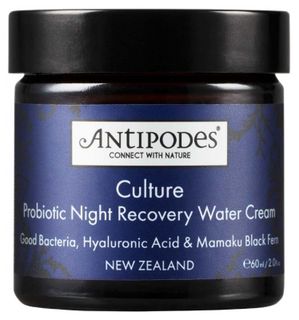
Antipodes Culture Repairing Night Cream Gel With Probiotics
Works for
1 of 1 advertised claim delivered
MoisturizingMannitol, Simmondsia chinensis seed oil + 7 moreGood evidence
“It is enriched with good bacteria and hyaluronic acid for soothed, moisturised and visibly healthier skin.This cocktail of hyaluronic acid and good bacteria promotes healthy skin, so you wake up in the morning with a fresh, healthy glow.Kalibiome AGE probiotic, a powerful and innovative complex, helps strengthen the skin barrier and increase skin elasticity and moisture while reducing irritation and redness.It cares for stressed and tired skin by helping to support hydration with hyaluronic acid and New Zealand mamaku black tree fern.This cream is suitable for all skin types, especially tired, sensitive and stressed skin.Vegan.”
This product can help improve hydration of the skin with the two types of ingredients.
The first type is called “humectants”:
these ingredients help attract water.
When humectants are on the surface of the skin, they “pull in” the moisture from the outside environment, or from
within deeper layers of the skin. The following ingredients in this product do the job:
glycerin, lactobacillus ferment.
This product also contains ingredients called “occlusives”. They help reduce the speed with which our skin loses moisture to the outside environment. These ingredients also help soften the upper layer of the skin, so it feels less tight and nicer to the touch. The following ingredients in this product do the job: simmondsia chinensis seed oil, limnanthes alba seed oil.
Can it cause trouble?
Irritancy8 strong irritants: Hibiscus sabdariffa flower extract, Parfum + 6 more — patch-test recommendedHigh risk
ComedogenicClean of flagged comedogenic ingredientsNone flagged
User reviews
Be the first — your take helps the next person decide.
Ingredients
Filter by role to see what each ingredient is doing.
Water~40–60%
Glycerin~3.9–5.8%
- Irritation risk
- Low
One of the best moisturizing ingredients. Naturally present in skin. It attracts water to the upper layer of the skin working as a humectant
More about GlycerinCetearyl olivate~3.1–4.6%
Sorbitan olivate~2.2–3.3%
Sodium acrylates copolymer~1.7–2.5%
- Irritation risk
- Medium
Used to create a thicker product consistency
More about Sodium acrylates copolymerLecithin~1.4–2.1%
- Irritation risk
- Low
Used mostly for creating emulsions - helping oil and water mix together. Helps soften the upper layer of the skin
More about LecithinSimmondsia chinensis seed oil~1.2–1.9%
- Irritation risk
- Medium
Softens the upper layer of skin and helps restore the healthy skin barrier. Has shown to help calm down inflammation in skin. It is a stable oil, meaning that it retains its properties even when exposed to air.
More about Simmondsia chinensis seed oilLimnanthes alba seed oil~1.2–1.8%
- Irritation risk
- Low
This oil's cmposition is closest to rapeseed oil. It is a very stable oil and serves as an emoillient
More about Limnanthes alba seed oilDehydroacetic acid~0.3–0.6%
Benzyl alcohol~0.4–0.95%
- Irritation risk
- High
A preservative. Can be used to mask unpleasant smell. Can be irritating
More about Benzyl alcoholGlyceryl caprylate~0.45–1.05%
- Irritation risk
- Low
An emollient that can also help water and oil mix together, as well as prevent bacteria growth in products
More about Glyceryl caprylateBisabolol~0.3–0.7%
- Irritation risk
- Low
An active component of chamomile plant that historically has been used to calm down irritated skin. A recent study shows that bisabolol indeed can have some anti-inflammatory effect on skin, even though conclusive data is lacking. Bisabolol has a sweet floral scent and can be added to products for its aromatic properties
More about BisabololSodium hyaluronate~0.2–0.75%
- Irritation risk
- Low
One of the best moisturizing ingredients. Attracts water into the upper layer of the skin
More about Sodium hyaluronateXanthan gum~0.2–0.7%
- Irritation risk
- Low
Used to create a thicker product consistency
More about Xanthan gumLecithin~0.2–0.7%
- Irritation risk
- Low
Used mostly for creating emulsions - helping oil and water mix together. Helps soften the upper layer of the skin
More about LecithinSclerotium gum~0.15–0.6%
- Irritation risk
- Low
Used to create gel-like formulas and stabilize emulsions
More about Sclerotium gumPullulan~0.15–0.7%
- Irritation risk
- High
Creates a thin drying film on the skin resulting in a short-term tightening effect
More about PullulanAloe barbadensis leaf extract~0.15–0.7%
- Irritation risk
- Medium
Traditionally used to treat sunburns, dermatitis and inflammation, but evidence for its effectiveness is lacking. The extract can contain humectants that help attract water into the skin
More about Aloe barbadensis leaf extractLactobacillus ferment~0.15–0.5%
- Irritation risk
- Low
A fermentation product created by bacteria Lactobacillus. The fermented product has anti-bacterial properties and might be helpful in calming down inflammation, but studies are lacking. Helps attract water to the upper layer of the skin. Can be used as a preservative
More about Lactobacillus fermentMannitol~0.1–0.45%
- Irritation risk
- Low
Helps to attract water to the upper layer of the skin
More about MannitolMaltodextrin~0.1–0.5%
- Irritation risk
- Low
Used to stabilize the product formulation and can help absorb oil
More about MaltodextrinSodium citrate~0.1–0.45%
- Irritation risk
- Medium
Helps to control the skin's pH level. Maintains the skin's natural film of amino-lactic acids and oils. Helps to preserve products
More about Sodium citrateCyathea medullaris leaf extract~0.1–0.4%
- Irritation risk
- Low
Phormium tenax extract~0.1–0.4%
- Irritation risk
- Low
Hibiscus sabdariffa flower extract~0.1–0.4%
- Irritation risk
- High
A plant extract that can be irritating. It might contain a compound anthocyanin that could be helpful in neutralizing free radicals
More about Hibiscus sabdariffa flower extractMica~0.1–0.5%
- Irritation risk
- Low
Creates an illusion of smoother and more radiant skin tone. Adds shimmer to the skin by reflecting light
More about MicaTitanium dioxide~0.15–0.6%
- Irritation risk
- Low
Works as a UV filter when used in high concentrations. It is photostable and is effective mostly against the UVB light, with some protection in the UVA range. In small concentrations, used for its ability to improve the color of cosmetic products. Is usually well tolerated by the skin
More about Titanium dioxidePotassium oxide~0.1–0.4%
- Irritation risk
- Low
Ci 77742~0.1–0.4%
Parfum~0.1–0.3%
- Irritation risk
- High
An aromatic blend of unspecified and possibly irritating ingredients
More about ParfumRosa damascena extract~0.05–0.3%
- Irritation risk
- High
Oil of a very fragrant pink rose used as fragrance in cosmetics. Extensive research has shown it has mixed benefits. In the pro column, inhaling this flower’s scent seems to have relaxing properties and the plant’s petals contain skin-soothing and antioxidant compounds that can benefit skin. On the flipside, the numerous chemicals that create this rose’s distinctive fragrance pose a risk of causing skin aggravation.
More about Rosa damascena extractCitral~0.05–0.15%
Citronellol~0.05–0.15%
Geraniol~0.01–0.05%
Limonene~0.01–0.05%
- Irritation risk
- High
A common frangrance that can easily irritate skin, especially if exposed to air, light or heat
More about LimoneneLinalool~0.01–0.05%
Ingredient list view
Water, Glycerin, Cetearyl olivate, Sorbitan olivate, Sodium acrylates copolymer, Lecithin, Simmondsia chinensis seed oil, Limnanthes alba seed oil, Dehydroacetic acid, Benzyl alcohol, Glyceryl caprylate, Bisabolol, Sodium hyaluronate, Xanthan gum, Lecithin, Sclerotium gum, Pullulan, Aloe barbadensis leaf extract, Lactobacillus ferment, Mannitol, Maltodextrin, Sodium citrate, Cyathea medullaris leaf extract, Phormium tenax extract, Hibiscus sabdariffa flower extract, Mica, Titanium dioxide, Unknown, Potassium oxide, Ci 77742, Parfum, Unknown, Rosa damascena extract, Citral, Citronellol, Geraniol, Limonene, Linalool
Compare prices
Retailers ranked by price — lowest first.

Affiliate links · prices updated regularly
Sources cited in this review
Every concentration estimate and effectiveness label is anchored to one of these 13 studies and safety reviews.
- 1
- 2
- 3
- 4
- 5Hyaluronic acid: A key molecule in skin agingncbi.nlm.nih.gov
- 6

Affiliate links · As an Amazon Associate, WIMJ earns from qualifying purchases.