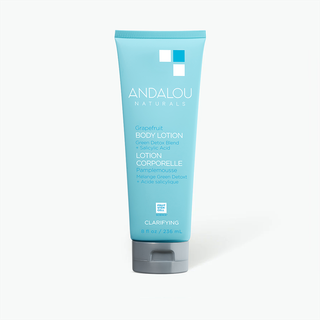
Andalou Naturals US Clarifying Body Lotion with Salicylic Acid
Works for
2 of 2 advertised claims delivered
Evens skin tone4 ingredients credited for this claimStrong support
“Lightweight lotion that helps exfoliate bumpy skin and improve skin tone, leaving skin visibly clear, smooth, and soothed.”
This product can help reduce hypepigmentation and even out the skin tone because it contains the following effective ingredients: bakuchiol, salicylic acid
Keep in mind that you would need to apply any topical skincare targetted at hypigmentation consistently for a couple of months to get a result. No topical skincare product can help get rid of hyperpigmentation (including post-acne marks and age spots) instantly.
Anti-blemish6 ingredients credited for this claimStrong support
“Key Ingredients Green detox blend of tea tree , witch hazel , and clarifying fruits helps soothe and purify pores without disrupting the skin microbiome Salicylic acid , a BHA known for its ability to help exfoliate and clarify the complexion Bakuchiol , a natural, plant-based retinol alternative shown to be as effective as retinol without the side effects Naturally scented of fresh greens, grapefruit, and yuzu to refresh the senses. Size 8 fl oz”
This product can help reduce breakouts and clogged pores because it contains the following ingredient: salicylic acid. This ingredient is used for treating acne and can have a noticeable effect.
In addition, this product contains bakuchiol. It can help in reducing blemishes, even though it is less effective.
Anti-oxidationNot advertised by the brand · 5 ingredients credited for this claimStrong support
This product contains antioxidants (bakuchiol) that can help neutralize free radicals in skin. By doing so, they can lessen the damage the skin gets from the UV light (sun).
Anti-agingNot advertised by the brand · 4 ingredients credited for this claimStrong support
This product can help reduce and prevent fine lines and wrinkles, improve skin elasticity and firmness because it contains bakuchiol.
Keep in mind that it typically takes at least 6 weeks to notice any results because the changes that are needed to improve fine lines and elasticity happen in the deeper layers of the skin. No topical anti-aging product can “erase” wrinkles or fully reverse signs of aging.
ExfoliationNot advertised by the brand · 2 ingredients credited for this claimStrong support
This product can help exfoliate the skin. In other words, it helps break down the bonds between dead cells on the surface of the skin and speed up the skin turnover. Skin often appears softer and brighter after exfoliation, but overdoing it can result in disrupted skin barrier. The following ingredient is doing the exfoliating job in this product: salicylic acid.
MoisturizingNot advertised by the brand · 14 ingredients credited for this claimGood support
This product can help improve hydration of the skin with the two types of ingredients.
The first type is called “humectants”:
these ingredients help attract water.
When humectants are on the surface of the skin, they “pull in” the moisture from the outside environment, or from
within deeper layers of the skin. The following ingredients in this product do the job:
glycerin, isomalt.
This product also contains ingredients called “occlusives”. They help reduce the speed with which our skin loses moisture to the outside environment. These ingredients also help soften the upper layer of the skin, so it feels less tight and nicer to the touch. The following ingredients in this product do the job: caprylic/capric triglyceride, helianthus annuus seed oil.
Can it cause trouble?
Irritancy12 strong irritants: Hamamelis virginiana water, Melaleuca alternifolia leaf extract + 10 more — patch-test recommendedHigh risk
Comedogenic1 ingredient rated 2 or more on the 0–5 pore-clogging scale1 flagged


User reviews
Be the first — your take helps the next person decide.
Ingredients
Filter by role to see what each ingredient is doing.
Water~45–55%
Glycerin~4.4–5.4%
- Irritation risk
- Low
One of the best moisturizing ingredients. Naturally present in skin. It attracts water to the upper layer of the skin working as a humectant
More about GlycerinCaprylic/capric triglyceride~4.2–5.2%
- Irritation risk
- Medium
A good mix of fatty acids that forms a protective layer on the skin. Improves the shelf life of products. Derived from coconut and glycerin
More about Caprylic/capric triglycerideGlyceryl stearate~2.8–3.4%
- Irritation risk
- Low
An emollient that softens the skin and forms a protective layer on its surface. Helps water and oil mix together
More about Glyceryl stearateCoco-caprylate~2.4–2.9%
- Irritation risk
- Medium
An emollient that softens skin and creates a nice product texture
More about Coco-caprylateCetearyl alcohol~2–2.4%
- Irritation risk
- Low
- Comedogenicity
- 2/5
A non-drying alcohol. Works as an emollient. Helps water and oil mix together and creates a nice product texture
More about Cetearyl alcoholAloe barbadensis leaf juice~1.6–2%
- Irritation risk
- Medium
Traditionally used to treat sunburns, dermatitis and inflammation, but evidence for its effectiveness is lacking. The extract can contain humectants that help attract water into the skin
More about Aloe barbadensis leaf juiceSalicylic acid~1–1.3%
- Irritation risk
- High
Used for skin exfoliation. It has an anti-inflammatory and anti-bacterial effect, helps to unclog pores, prevent blemishes and speed up healing of the existing ones. Sometimes referred to as a BHA (beta-hydroxy acid)
More about Salicylic acidKaolin~1.5–1.8%
- Irritation risk
- Low
A type of clay that consists mainly of aluminum silicate. Helps absorb oil and creates a thicker product consistency. Can be used to add a white color
More about KaolinHelianthus annuus seed oil~1–1.2%
- Irritation risk
- Low
A great emollient due to its high linoleic acid content. One of the most effective plant oils in helping skin hydration and repairing skin barrier function
More about Helianthus annuus seed oilOlea europaea leaf extract~0.65–0.95%
- Irritation risk
- Medium
A plant extract that might have some anti-oxidant and anti-inflammatory properties but evidence for effectiveness in skin is missing
More about Olea europaea leaf extractHamamelis virginiana water~0.4–0.65%
- Irritation risk
- High
A plant extract that can help calm down inflammation in skin. Can, however, itself be irritating
More about Hamamelis virginiana waterMelaleuca alternifolia leaf extract~0.5–0.7%
- Irritation risk
- High
An essential oil that can be irritating. Has some anti-bacterial properties
More about Melaleuca alternifolia leaf extractLavandula angustifolia flower/leaf/stem extract~0.45–0.7%
Simmondsia chinensis seed oil~0.5–0.75%
- Irritation risk
- Medium
Softens the upper layer of skin and helps restore the healthy skin barrier. Has shown to help calm down inflammation in skin. It is a stable oil, meaning that it retains its properties even when exposed to air.
More about Simmondsia chinensis seed oilCitrus junos seed extract~0.45–0.65%
- Irritation risk
- High
Citrus unshiu peel extract~0.4–0.65%
- Irritation risk
- High
Dipotassium glycyrrhizate~0.3–0.6%
- Irritation risk
- Low
A salt derived from licorice. Works as an emollient to soften the upper layer of the skin and can help calm down inflammation. Might be helpful for skin lightening
More about Dipotassium glycyrrhizateActinidia chinensis seed extract~0.3–0.55%
- Irritation risk
- Low
Fragaria chiloensis fruit extract~0.3–0.5%
- Irritation risk
- Medium
Vitis vinifera leaf extract~0.25–0.5%
- Irritation risk
- Medium
Vitis vinifera skin extract~0.25–0.5%
- Irritation risk
- Low
Garcinia mangostana peel extract~0.25–0.45%
- Irritation risk
- Low
Cucumis sativus extract~0.25–0.45%
- Irritation risk
- Medium
Malus domestica fruit cell culture extract~0.25–0.45%
- Irritation risk
- Low
Lecithin~0.3–0.55%
- Irritation risk
- Low
Used mostly for creating emulsions - helping oil and water mix together. Helps soften the upper layer of the skin
More about LecithinArgania spinosa callus culture extract~0.25–0.45%
- Irritation risk
- Low
Citrus paradisi seed extract~0.25–0.45%
- Irritation risk
- High
Aronia melanocarpa fruit extract~0.25–0.45%
- Irritation risk
- Low
Camellia sinensis leaf extract~0.25–0.5%
- Irritation risk
- Low
Can contain potent anti-oxidant compounds (abbreviated ECG, GCG, EGC, and EGCG) that might help protect the skin from free radicals. Can help calm down inflammation and has some anti-bacterial properties. Unfortunately, these antioxidants are unstable and lose their effectiveness very quickly in products. The concentration of the antioxidant compounds in the extract also tends to be low to be effective in topical formulation
More about Camellia sinensis leaf extractEuterpe oleracea fruit extract~0.25–0.45%
- Irritation risk
- Medium
A plant extract that can have some anti-oxidant effect in skin
More about Euterpe oleracea fruit extractLycium barbarum fruit extract~0.25–0.45%
- Irritation risk
- Medium
A plant extract that can help neutralize free radicals in skin and attract water to its upper layer
More about Lycium barbarum fruit extractBakuchiol~0.25–0.5%
- Irritation risk
- Medium
A plant extract that is, though different in chemical structure, acts similar to retinoids. First studies show that it can help reduce fine lines and wrinkles, improve skin tone, reduce clogged pores and blemishes, and reduce inflammation. There is no conclusive evidence that bakuchiol is as effective as retinol however. The study that directly compared retinol with bakuchiol used bakuchiol applied twice daily compared to once per day for the retinol. According to this study, bakuchiol is less irritating than retinol. Bakuchiol is extracted from seeds of Babchi plant. Other parts of the plant contain coumarins that could cause allergic and irritant reactions. These compounds should be removed in the extraction process when bakuchiol is produced, but it is a good idea to be cautious and stay away from products that include the Babchi plant extracts other than purified bakuchiol to avoid irritation
More about BakuchiolCitric acid~0.25–0.45%
- Irritation risk
- Medium
Can work as an exfoliant but is typically used to adjust the product pH
More about Citric acidPotassium hydroxide~0.25–0.5%
Propanediol~0.25–0.5%
- Irritation risk
- Low
Acts as a solvent for other ingredients. Speeds up the absorption of other ingredients into the skin
More about PropanediolAllantoin~0.2–0.4%
- Irritation risk
- Low
Helps calm down inflammation in skin and can help reduce itching. Helps to repair the skin barrier and keep skin hydrated
More about AllantoinSodium hydroxide~0.25–0.45%
Sodium stearoyl glutamate~0.3–0.55%
- Irritation risk
- Medium
Helps oil and water mix together
More about Sodium stearoyl glutamateDehydroacetic acid~0.25–0.45%
Xanthan gum~0.25–0.45%
- Irritation risk
- Low
Used to create a thicker product consistency
More about Xanthan gumBenzyl alcohol~0.2–0.35%
- Irritation risk
- High
A preservative. Can be used to mask unpleasant smell. Can be irritating
More about Benzyl alcoholIsomalt~0.2–0.4%
- Irritation risk
- Low
Helps attract water to the upper layer of the skin
More about IsomaltPhenoxyethanol~0.2–0.4%
- Irritation risk
- Low
A preservative. It helps prevent bacterial growth in cosmetic products
More about PhenoxyethanolParfum~0.2–0.35%
- Irritation risk
- High
An aromatic blend of unspecified and possibly irritating ingredients
More about ParfumSodium benzoate~0.15–0.3%
Citral~0.15–0.25%
Citronellol~0.15–0.25%
Geraniol~0.15–0.25%
Limonene~0.1–0.15%
- Irritation risk
- High
A common frangrance that can easily irritate skin, especially if exposed to air, light or heat
More about LimoneneLinalool~0.1–0.15%
Ingredient list view
Water, Glycerin, Caprylic/capric triglyceride, Glyceryl stearate, Coco-caprylate, Cetearyl alcohol, Aloe barbadensis leaf juice, Salicylic acid, Kaolin, Helianthus annuus seed oil, Olea europaea leaf extract, Hamamelis virginiana water, Melaleuca alternifolia leaf extract, Lavandula angustifolia flower/leaf/stem extract, Simmondsia chinensis seed oil, Citrus junos seed extract, Citrus unshiu peel extract, Dipotassium glycyrrhizate, Actinidia chinensis seed extract, Fragaria chiloensis fruit extract, Vitis vinifera leaf extract, Vitis vinifera skin extract, Garcinia mangostana peel extract, Cucumis sativus extract, Malus domestica fruit cell culture extract, Lecithin, Argania spinosa callus culture extract, Citrus paradisi seed extract, Aronia melanocarpa fruit extract, Camellia sinensis leaf extract, Euterpe oleracea fruit extract, Lycium barbarum fruit extract, Bakuchiol, Citric acid, Potassium hydroxide, Propanediol, Allantoin, Sodium hydroxide, Sodium stearoyl glutamate, Dehydroacetic acid, Xanthan gum, Benzyl alcohol, Isomalt, Phenoxyethanol, Parfum, Sodium benzoate, Unknown, Citral, Citronellol, Geraniol, Limonene, Linalool
Compare prices
Retailers ranked by price — lowest first.
.png)
Affiliate links · prices updated regularly
Worth comparing, line by line.
Match % combines shared ingredients, the first five ingredients, shared actives and hero ingredients, irritancy (lower counts in the alternative's favour), texture and body area. Only products in the same routine step are compared.
| Andalou Naturals USClarifying Body Lotion with Salicylic AcidYOUR PRODUCT | BYOMABlemish Control Moisturiser | Mara BeautyMara Clear Skin Mineral Milk | NorevaExfoliac Global 6 | |
|---|---|---|---|---|
| Match | — | 74% | 72% | 68% |
| Price | $12.99 | $14.79+$1.80 | $108.41+$95.42 | — |
| Shared key ingredients | — | 4 of 12 | 6 of 12 | 3 of 12 |
| Key difference | — | Ceramide Np | Niacinamide | 10-Hydroxydecanoic Acid |
| Irritancy | High | Medium | Medium | Medium |
| Drying alcohol | — | — | — | — |
| View product | Shop | Shop | Shop |


Sources cited in this review
Every concentration estimate and effectiveness label is anchored to one of these 23 studies and safety reviews.
- 1
- 2Salicylic acid as a peeling agent: a comprehensive reviewncbi.nlm.nih.gov
- 3Beta Hydroxy Acidsfda.gov
- 4A review of toxicity from topical salicylic acid preparationssciencedirect.com
- 5
- 6

Affiliate links · As an Amazon Associate, WIMJ earns from qualifying purchases.