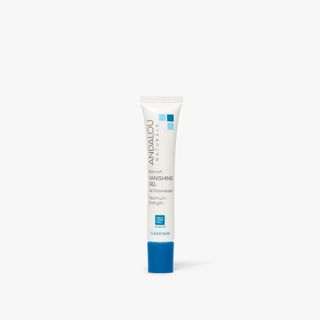
Andalou Naturals Clear Skin Blemish Vanishing Gel
Works for
0 of 1 advertised claim delivered
Anti-blemish3 ingredients credited for this claimWeak support
“Clear Skin Blemish Vanishing Gel”
Effective ingredients missing or their concentration is too low.
MoisturizingNot advertised by the brand · 5 ingredients credited for this claimGood support
This product contains good ingredients to attract water to the upper layer of the skin. These ingredients are called "humectants": glycerin, aloe barbadensis leaf juice.
When humectants are on the surface of the skin, they “pull in” the moisture from the outside environment, or from within deeper layers of the skin. If the air is dry, humectants can speed up the moisture loss from the skin. This is why it is a good idea to use another product on top of this one to help "seal in" the moisture (look for ingredients like dimethicone, squalane, oils and butters).
Can it cause trouble?
Irritancy7 strong irritants: Alcohol, Hamamelis virginiana extract + 5 more — patch-test recommendedHigh risk
ComedogenicClean of flagged comedogenic ingredientsNone flagged
User reviews
Ingredients
Filter by role to see what each ingredient is doing.
Aloe barbadensis leaf juice~23–34%
- Irritation risk
- Medium
Traditionally used to treat sunburns, dermatitis and inflammation, but evidence for its effectiveness is lacking. The extract can contain humectants that help attract water into the skin
More about Aloe barbadensis leaf juiceWater~12–17%
Glycerin~4.7–7.1%
- Irritation risk
- Low
One of the best moisturizing ingredients. Naturally present in skin. It attracts water to the upper layer of the skin working as a humectant
More about GlycerinAlcohol~3.6–5.4%
- Irritation risk
- High
Can be drying and contribute to skin irritation. Used in formulars to dissolve other ingredients, create a thinner product consistency or for its antibacterial properties
More about AlcoholHamamelis virginiana extract~2.6–3.9%
- Irritation risk
- High
A plant extract that can help calm down inflammation in skin. Can, however, itself be irritating
More about Hamamelis virginiana extractArgania spinosa extract~1.8–2.8%
- Irritation risk
- Low
Malus domestica fruit cell culture extract~1.4–2.1%
- Irritation risk
- Low
Hydroxyethylcellulose~1.2–1.8%
- Irritation risk
- Low
Used to thicken product formulations and create gel-like textures
More about HydroxyethylcelluloseSalix alba extract~1–1.5%
- Irritation risk
- Low
Spiraea ulmaria extract~0.85–1.25%
- Irritation risk
- Low
Epilobium angustifolium extract~0.5–1.2%
- Irritation risk
- Medium
A plant extract that might help neutralize free radicals and calm down irritation in skin. However, it can contain compounds that can be irritating themselves
More about Epilobium angustifolium extractMagnesium ascorbyl phosphate~0.45–1%
- Irritation risk
- Medium
A derivative of vitamin C that is more stable, but less bioavailable than the pure form of vitamin C. It does not penetrate the skin well, but has been shown to convert to pure vitamin C once in skin. It can be helpful in stimulating collagen production and lightening the skin tone, but the required concentration is likely to be very high
More about Magnesium ascorbyl phosphateZinc gluconate~0.4–0.9%
- Irritation risk
- Medium
Typically used to stabilize the product formulations. It is a salt of a polyhydroxy acid (PHA) and in larger concentrations, can help shed the dead cells from the skin surface revealing smoother skin. It can help attract water to the upper layer of the skin. Might to be helpful against acne and clogged pores. Could be helpful in neutralizing free radicals, but solid research is missing. Due to the zinc content, might help calm down inflammation in skin
More about Zinc gluconateCamellia sinensis leaf extract~0.35–0.85%
- Irritation risk
- Low
Can contain potent anti-oxidant compounds (abbreviated ECG, GCG, EGC, and EGCG) that might help protect the skin from free radicals. Can help calm down inflammation and has some anti-bacterial properties. Unfortunately, these antioxidants are unstable and lose their effectiveness very quickly in products. The concentration of the antioxidant compounds in the extract also tends to be low to be effective in topical formulation
More about Camellia sinensis leaf extractTocopherol~0.2–0.8%
- Irritation risk
- Low
Pure form of vitamin E. Can help moisturise and protect the skin from free radicals. Often used to help stabilise other ingredients or the formula itself
More about TocopherolArnica montana flower extract~0.15–0.6%
- Irritation risk
- High
A plant extract that can be irritating. It can have some anti-bacterial properties, but there are no evidence of a beneficial effect for skin
More about Arnica montana flower extractLavandula officinalis flower/extract~0.15–0.6%
- Irritation risk
- Low
Chamomilla recutita flower extract~0.1–0.4%
- Irritation risk
- High
Plant extract that can have healing and anti-inflammatory properties. It is a potential allergen and can be irritating
More about Chamomilla recutita flower extractCalendula officinalis flower extract~0.05–0.25%
- Irritation risk
- High
A plant extract that has some anti-oxidant and anti-bacterial properties. Can be irritating
More about Calendula officinalis flower extractCinnamomum camphora bark oil~0.05–0.25%
- Irritation risk
- High
Mentha piperita oil~0.05–0.2%
Thymus vulgaris oil~0.05–0.2%
- Irritation risk
- High
Ingredient list view
Aloe barbadensis leaf juice, Water, Glycerin, Alcohol, Hamamelis virginiana extract, Unknown, Argania spinosa extract, Malus domestica fruit cell culture extract, Unknown, Hydroxyethylcellulose, Salix alba extract, Spiraea ulmaria extract, Epilobium angustifolium extract, Magnesium ascorbyl phosphate, Zinc gluconate, Camellia sinensis leaf extract, Tocopherol, Arnica montana flower extract, Lavandula officinalis flower/extract, Chamomilla recutita flower extract, Calendula officinalis flower extract, Cinnamomum camphora bark oil, Mentha piperita oil, Thymus vulgaris oil
Compare prices
Retailers ranked by price — lowest first.
.png)
Affiliate links · prices updated regularly
Sources cited in this review
Every concentration estimate and effectiveness label is anchored to one of these 24 studies and safety reviews.
- 1
- 2
- 3
- 4
- 5
- 6

Affiliate links · As an Amazon Associate, WIMJ earns from qualifying purchases.