Works for:
based on ingredients and %- Moisturizing
Can it cause trouble?
- Irritation risk: medium
- Comedogenic risk ingredients: 2
Key actives
Works for
Moisturizing
What does the product description say?
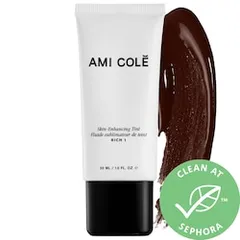
Skin-Enhancing Tinted Moisturizer
Source: From product name
This product can help improve hydration of the skin with the two types of ingredients.
The first type is called “humectants”:
these ingredients help attract water.
When humectants are on the surface of the skin, they “pull in” the moisture from the outside environment, or from
within deeper layers of the skin. The following ingredients in this product do the job:
glycerin.
This product also contains ingredients called “occlusives”. They help reduce the speed with which our skin loses moisture to the outside environment. These ingredients also help soften the upper layer of the skin, so it feels less tight and nicer to the touch. The following ingredients in this product do the job: dimethicone, isopropyl myristate.
An emollient that helps soften the skin. Could be comedogenic
One of the best moisturizing ingredients. Naturally present in skin. It attracts water to the upper layer of the skin working as a humectant
A silicone that helps to reduce water loss from the surface of the skin. Can temporarily "fill in" lines and wrinkles, absorb oil, and create a nice product finish
Used to create a thicker product texture. Helps soften the upper layer of the skin and might be able to prevent moisture loss from its surface
Improves the texture of the product and helps soften the skin. Helps oil and water mix together and can be used as a cleansing agent
An emollient that helps soften the skin
Pure form of vitamin E. Can help moisturise and protect the skin from free radicals. Often used to help stabilise other ingredients or the formula itself
How honest is this product?
| Promise | Can it deliver? |
|---|---|
| Moisturizing |
Total Promises Fulfilled score: 75/100.
Potential irritants
Comedogenic ingredients
User reviews (0)
Averages from community submissions.
No reviews yet for this product.
Be the first to share your experience!
Tried this product?
Help capture what the ingredient list can't—texture, finish, pilling, scent, and more. Answer what you can, skip the rest.
Takes ~30 seconds.
Reviews are shown in aggregate. No personal details.
Key Actives
Pure form of vitamin E. Can help moisturise and protect the skin from free radicals. Often used to help stabilise other ingredients or the formula itself
A plant extract that might be helpful in neutralizing free radicals and have a skin lightening effect if used in high enough concentrations
A silicone that helps to reduce water loss from the surface of the skin. Can temporarily "fill in" lines and wrinkles, absorb oil, and create a nice product finish
An emollient that helps soften the skin. Could be comedogenic
One of the best moisturizing ingredients. Naturally present in skin. It attracts water to the upper layer of the skin working as a humectant
Works as a UV filter when used in high concentrations. It is photostable and is effective mostly against the UVB light, with some protection in the UVA range. In small concentrations, used for its ability to improve the color of cosmetic products. Is usually well tolerated by the skin
Potential irritants
A plant extract that can be irritating. It might contain a compound anthocyanin that could be helpful in neutralizing free radicals
A plant extract that might be helpful in neutralizing free radicals and have a skin lightening effect if used in high enough concentrations
Comedogenic ingredients
An emollient that helps soften the skin
An emollient that helps soften the skin. Could be comedogenic
All ingredients
Improves the texture of the product and helps soften the skin. Helps oil and water mix together and can be used as a cleansing agent
A silicone that helps to reduce water loss from the surface of the skin. Can temporarily "fill in" lines and wrinkles, absorb oil, and create a nice product finish
An emollient that helps soften the skin
An emollient that helps soften the skin. Could be comedogenic
One of the best moisturizing ingredients. Naturally present in skin. It attracts water to the upper layer of the skin working as a humectant
Acts as a solvent for other ingredients. Speeds up the absorption of other ingredients into the skin
Used to create a thicker product texture. Helps soften the upper layer of the skin and might be able to prevent moisture loss from its surface
A plant extract that can be irritating. It might contain a compound anthocyanin that could be helpful in neutralizing free radicals
Helps to retain moisture by creating a protective barrier on the skin. Rich in fatty acids. Improves product texture and helps with the penetration of other ingredients.
A plant extract that might be helpful in neutralizing free radicals and have a skin lightening effect if used in high enough concentrations
Pure form of vitamin E. Can help moisturise and protect the skin from free radicals. Often used to help stabilise other ingredients or the formula itself
Used to stabilize the product formulation and can help absorb oil
Used to stabilize mixtures of oil and water, and create thicker, gel-like product textures
A preservative. It helps prevent bacterial growth in cosmetic products
Works as a UV filter when used in high concentrations. It is photostable and is effective mostly against the UVB light, with some protection in the UVA range. In small concentrations, used for its ability to improve the color of cosmetic products. Is usually well tolerated by the skin
An umbrella term for the following three colorants: CI 77491, CI 77492, CI 77499. They might be able to offer some protection against visible light, but the degree of the protection is not clear
Ingredient list view
Water, Isohexadecane, Dimethicone, Isopropyl isostearate, Isopropyl myristate, C18-36 acid triglyceride, Glycerin, Propanediol, Cucurbita pepo seed extract, Magnesium sulfate, Peg-30 dipolyhydroxystearate, Dimethicone crosspolymer, Adansonia digitata fruit extract, Hibiscus sabdariffa flower extract, Hydrogenated lecithin, Phyllanthus emblica fruit extract, Tocopherol, Maltodextrin, Ethylhexylglycerin, Sodium benzoate, Sodium chloride, Phenoxyethanol, Titanium dioxide, Ci 77891, Iron oxides
- Dimethicone as a protective ingredient in topical medications
- Final Report on the Safety Assessment of Dimethicone Copolyol
- Glycerol and the skin: holistic approach to its origin and functions
- Safety Assessment of Magnesium Sulfate as Used in Cosmetics
- Anthocyanin-rich extract from Hibiscus sabdariffa calyx counteracts UVC-caused impairments in rats
- Hibiscus sabdariffa L. – A phytochemical and pharmacological review
- Liposome-containing Hibiscus sabdariffa calyx extract formulations with increased antioxidant activity, improved dermal penetration and reduced dermal toxicity
- Emblica
- Amla (Emblica officinalis Gaertn.) extract promotes procollagen production and inhibits matrix metalloproteinase-1 in human skin fibroblasts
- Emblica Cascading Antioxidant: A Novel Natural Skin Care Ingredient
- Vitamin E in dermatology
- Vitamin E and Skin Health