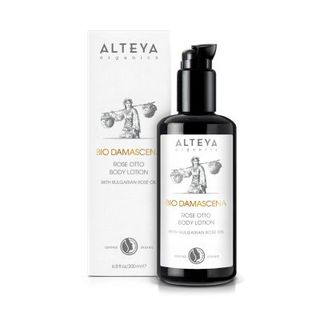
Alteya Organics Rose Otto Body Lotion Bio Damascena
Works for
1 of 2 advertised claims delivered
Moisturizing17 ingredients credited for this claimGood support
“The rich botanical complex support skin’s repair mechanism, provides deep nourishment and hydration and helps lock in moisture.”
This product can help improve hydration of the skin with the two types of ingredients.
The first type is called “humectants”:
these ingredients help attract water.
When humectants are on the surface of the skin, they “pull in” the moisture from the outside environment, or from
within deeper layers of the skin. The following ingredients in this product do the job:
fructooligosaccharides, glycerin.
This product also contains ingredients called “occlusives”. They help reduce the speed with which our skin loses moisture to the outside environment. These ingredients also help soften the upper layer of the skin, so it feels less tight and nicer to the touch. The following ingredients in this product do the job: helianthus annuus seed oil, ricinus communis seed oil.
Evens skin tone1 ingredient credited for this claimWeak support
“It helps heal dry and cracked skin, improving the appearance of stretch marks and scars.”
Effective ingredients missing or their concentration is too low
Can it cause trouble?
Irritancy9 strong irritants: Copaifera officinalis resin oil, Cymbopogon martini oil + 7 more — patch-test recommendedHigh risk
ComedogenicClean of flagged comedogenic ingredientsNone flagged
User reviews
Be the first — your take helps the next person decide.
Ingredients
Filter by role to see what each ingredient is doing.
Aloe barbadensis leaf juice~23–35%
- Irritation risk
- Medium
Traditionally used to treat sunburns, dermatitis and inflammation, but evidence for its effectiveness is lacking. The extract can contain humectants that help attract water into the skin
More about Aloe barbadensis leaf juiceWater~11–16%
Glycerin~4.3–6.5%
- Irritation risk
- Low
One of the best moisturizing ingredients. Naturally present in skin. It attracts water to the upper layer of the skin working as a humectant
More about GlycerinPolyglyceryl-3 distearate~3.1–4.7%
Garcinia indica seed butter~2.5–3.7%
- Irritation risk
- Low
Helps soften the upper layer of the skin. It mostly contains oleic acid which is not the most effective emollient to prevent water loss, but might have an anti-inflammatory effect
More about Garcinia indica seed butterHelianthus annuus seed oil~1.9–2.9%
- Irritation risk
- Low
A great emollient due to its high linoleic acid content. One of the most effective plant oils in helping skin hydration and repairing skin barrier function
More about Helianthus annuus seed oilCetearyl olivate~1.3–2%
Glyceryl caprylate~1.2–1.8%
- Irritation risk
- Low
An emollient that can also help water and oil mix together, as well as prevent bacteria growth in products
More about Glyceryl caprylateRicinus communis seed oil~1.3–1.9%
- Irritation risk
- Medium
A plant oil that can help soften the skin. It might be helpful in calming down inflammation, but solid research is lacking. Is often used in lip products to create the needed product consistency
More about Ricinus communis seed oilMacadamia ternifolia seed oil~1–1.5%
- Irritation risk
- Medium
Plant oil from nuts that helps soften the upper layer of the skin. Contains a high concentration of oleic acid that can weaken skin's barrier function and increase water-loss while enhancing penetration of other ingredients
More about Macadamia ternifolia seed oilSimmondsia chinensis seed oil~0.85–1.3%
- Irritation risk
- Medium
Softens the upper layer of skin and helps restore the healthy skin barrier. Has shown to help calm down inflammation in skin. It is a stable oil, meaning that it retains its properties even when exposed to air.
More about Simmondsia chinensis seed oilGlyceryl undecylenate~0.55–1.3%
- Irritation risk
- Medium
Helps oil and water mix together and helps preserve the product formulation
More about Glyceryl undecylenateSorbitan olivate~0.5–1.15%
Citric acid~0.45–1.05%
- Irritation risk
- Medium
Can work as an exfoliant but is typically used to adjust the product pH
More about Citric acidPrunus domestica seed oil~0.4–1%
- Irritation risk
- Medium
Helps soften the upper layer of the skin
More about Prunus domestica seed oilCannabis sativa seed oil~0.45–1.05%
- Irritation risk
- Medium
A plant oil that due to its high linoleic acid content can help strengthen skin's barrier function and soften its upper layer
More about Cannabis sativa seed oilCopernicia cerifera cera~0.5–1.2%
- Irritation risk
- Low
Brazilian palm wax. Helps soften the upper layer of the skin
More about Copernicia cerifera ceraLecithin~0.45–1%
- Irritation risk
- Low
Used mostly for creating emulsions - helping oil and water mix together. Helps soften the upper layer of the skin
More about LecithinEthyl ferulate~0.35–0.85%
- Irritation risk
- Low
Almond/borage/linseed/olive acids/glycerides~0.4–0.9%
- Irritation risk
- Low
Glyceryl stearate citrate~0.4–0.9%
- Irritation risk
- Low
Helps oil and water mix together while softening the upper layer of the skin
More about Glyceryl stearate citrateCopaifera officinalis resin oil~0.35–0.75%
Cymbopogon martini oil~0.3–0.7%
- Irritation risk
- High
Aromatic plant oil used in cosmetics as a fragrance. A likely irritant
More about Cymbopogon martini oilRosa damascena flower extract~0.3–0.75%
Beta vulgaris root extract~0.2–0.8%
- Irritation risk
- Medium
A plant extract that might have some antioxidant properties, but mostly used in cosmetics for its color
More about Beta vulgaris root extractFructooligosaccharides~0.2–0.75%
- Irritation risk
- Low
Help attract water to the upper layer of the skin
More about FructooligosaccharidesTocopherol~0.3–0.7%
- Irritation risk
- Low
Pure form of vitamin E. Can help moisturise and protect the skin from free radicals. Often used to help stabilise other ingredients or the formula itself
More about TocopherolSodium benzoate~0.25–0.5%
Cyamopsis tetragonoloba gum~0.35–0.75%
- Irritation risk
- Low
Potassium sorbate~0.3–0.6%
Water~0.2–0.75%
Helianthus annuus seed oil~0.3–0.7%
- Irritation risk
- Low
A great emollient due to its high linoleic acid content. One of the most effective plant oils in helping skin hydration and repairing skin barrier function
More about Helianthus annuus seed oilPelargonium graveolens oil~0.15–0.65%
Lactic acid~0.15–0.7%
- Irritation risk
- Medium
An exfoliating and moisturizing alpha-hydroxy acid (AHA). Typically causes less irritation than other AHAs, for example, glycolic acid. At high concentrations (about 15%), lactic acid can help reduce lines and wrinkles. Recent studies show that lactic acid can support the "good" bacteria living on skin's surface (healthy skin microbiome)
More about Lactic acidHumulus lupulus extract~0.15–0.65%
- Irritation risk
- High
Hops extract. Can contain common irritants and allergens geraniol, limonene, linalool
More about Humulus lupulus extractPotassium lactate~0.1–0.45%
- Irritation risk
- Low
Eugenol~0.1–0.4%
Geraniol~0.1–0.3%
Citronellol~0.1–0.3%
Linalool~0.05–0.3%
Ingredient list view
Aloe barbadensis leaf juice, Unknown, Water, Glycerin, Polyglyceryl-3 distearate, Garcinia indica seed butter, Helianthus annuus seed oil, Cetearyl olivate, Glyceryl caprylate, Ricinus communis seed oil, Macadamia ternifolia seed oil, Simmondsia chinensis seed oil, Glyceryl undecylenate, Sorbitan olivate, Citric acid, Prunus domestica seed oil, Cannabis sativa seed oil, Copernicia cerifera cera, Lecithin, Ethyl ferulate, Almond/borage/linseed/olive acids/glycerides, Glyceryl stearate citrate, Copaifera officinalis resin oil, Unknown, Cymbopogon martini oil, Rosa damascena flower extract, Beta vulgaris root extract, Fructooligosaccharides, Tocopherol, Sodium benzoate, Cyamopsis tetragonoloba gum, Potassium sorbate, Water, Helianthus annuus seed oil, Pelargonium graveolens oil, Lactic acid, Humulus lupulus extract, Unknown, Potassium lactate, Eugenol, Geraniol, Citronellol, Linalool
Compare prices
Retailers ranked by price — lowest first.
Sources cited in this review
Every concentration estimate and effectiveness label is anchored to one of these 17 studies and safety reviews.
- 1
- 2TECHNICAL DATA SHEET KOKUM FAT 2.imimg.com
- 3
- 4
- 5Effect of topically applied lipids on surfactant-irritated skinonlinelibrary.wiley.com
- 6

Affiliate links · As an Amazon Associate, WIMJ earns from qualifying purchases.