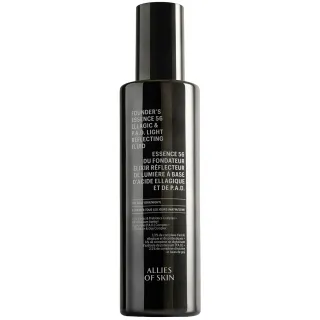
Allies of Skin Founder's Essence 56 Ellagic & P.A.D. Light Reflecting Fluid

Allies of Skin Founder's Essence 56 Ellagic & P.A.D. Light Reflecting Fluid

Efficacy100/100IrritancyMedium

Works for

Moisturizing
Panthenol, Acetyl glucosamine + 23 more
Works well
What the product description says
“84% see more hydrated skin²”
Source: Dermstore

This product contains good ingredients to attract water to the upper layer of the skin. These ingredients are called "humectants": glycerin, hyaluronic acid.

When humectants are on the surface of the skin, they “pull in” the moisture from the outside environment, or from within deeper layers of the skin. If the air is dry, humectants can speed up the moisture loss from the skin. This is why it is a good idea to use another product on top of this one to help "seal in" the moisture (look for ingredients like dimethicone, squalane, oils and butters).

The following ingredients in this product are especially good for supporting the skin barrier and helping with the hydration level: acetyl glucosamine, panthenol

PanthenolHero· HumectantEffect: HighHelps attract water to the upper layer of the skin and can help improve skin barrier function~0.1–0.3%
Acetyl glucosamineHero· HumectantEffect: HighAn effective moisturizing ingredient that also has been shown to be effective in evening out the skin tone and reducing hyperpigmentation. It can help somewhat reduce wrinkles in skin~0.1–0.3%
GlycerinKey active· HumectantEffect: HighOne of the best moisturizing ingredients. Naturally present in skin. It attracts water to the upper layer of the skin working as a humectant~3.2–4.8%
Potassium azeloyl diglycinateKey activeEffect: MediumA derivative of azelaic acid. It is obtained by reacting the chloride of azelaic acid with two molecules of glycine (an amino acid) and potassium hydroxide. It is less studied than azelaic acid, but the available research suggests that it also can be effective in reducing skin redness, hyperpigmentation and blemishes. There are claims that it is more bio-available and more effective than azelaic acid, but no comparison study is available. Potassium azeloyl diglycinate is better soluble in water compared with azelaic acid. Because of this property, products with potassium azeloyl digclycinate can have a nicer texture~2.6–3.8%
Alpha-glucan oligosaccharideKey activeEffect: HighHelps attract water to the upper layer of the skin~2.1–3.2%
Lycium barbarum fruit extractKey activeEffect: MediumA plant extract that can help neutralize free radicals in skin and attract water to its upper layer~1.4–2%
EctoinKey activeEffect: HighSoftens the upper layer of the skin and can support skin barrier function~0.3–0.7%
UbiquinoneKey activeEffect: HighCoenzyme Q10. It helps neutralize free radicals in skin, improves skin hydration and might be helpful agains fine lines and wrinkles. It can be an allergen~0.15–0.5%
GlutathioneKey activeEffect: HighA peptide that can help neutralize free radicals in skin and reduce melanin production resulting in skin lightening effect and reduction in hyperpigmentation. It can also help attract moisture to the upper layer of the skin~0.1–0.35%
Hyaluronic acidKey active· HumectantEffect: HighOne of the best moisturizing ingredients. Attracts water into the upper layer of the skin. Naturally present in skin. Typically has large molecule size unless advertised otherwise on the product label. Helps support skin's barrier function and may help to reduce inflammation~0.1–0.3%
InulinKey activeEffect: HighHelps attract water to the upper layer of the skin. Is claimed to support the growth of "good" bacteria in skin (as a "prebiotic"), but the research is lacking~0.1–0.4%
LactobacillusKey activeEffect: HighA non-living ingredient made by fermentation with the bacteria Lactobacillus. It can help attract water to the upper layer of the skin and might help reduce inflammation~0.1–0.45%
LysineKey activeEffect: HighAn amino-acid that helps to attract water to the upper layer of the skin. In combination with other amino-acids, might help to reduce fine lines and wrinkles~0.1–0.3%
Saccharide isomerateKey active· HumectantEffect: HighHelps attract water to the upper layer of the skin~0.1–0.3%
Chlorella vulgaris extractKey activeEffect: MediumA plant extract that can help to attract water to the upper layer of the skin and might have some anti-oxidant and anti-inflammatory properties~0.1–0.45%
ProlineKey activeEffect: Medium~0.1–0.35%
Heptyl undecylenateKey active· Emollient, OcclusiveEffect: MediumHelps soften the upper layer of the skin, reduce water loss from the skin surface over time and create a nice product finish~0.1–0.4%
AsiaticosideKey activeEffect: HighAn active compound of Centella Asiatica plant extract. In combination with other active compounds of Centella Asiatica extract (madecasosside, asiatic acid and madecassic acid), asiaticoside has been shown to be helpful in wound-healing, restoring skin barrier function and supporting collagen production in skin. It can, however, itself be irritating~0.05–0.25%
Camellia sinensis leaf extractEffect: LowCan contain potent anti-oxidant compounds (abbreviated ECG, GCG, EGC, and EGCG) that might help protect the skin from free radicals. Can help calm down inflammation and has some anti-bacterial properties. Unfortunately, these antioxidants are unstable and lose their effectiveness very quickly in products. The concentration of the antioxidant compounds in the extract also tends to be low to be effective in topical formulation~0.45–1%
Polymnia sonchifolia root juiceEffect: LowA plant extract that helps attract water to the upper layer of the skin and might have some anti-oxidant properties~0.1–0.45%
Caprylyl glycol· Humectant, EmollientEffect: LowHelps preserve products and creates a nice product texture~0.1–0.4%
LecithinEffect: Low, below effective doseUsed mostly for creating emulsions - helping oil and water mix together. Helps soften the upper layer of the skin~0.1–0.45%
TocopherolEffect: Low, below effective dosePure form of vitamin E. Can help moisturise and protect the skin from free radicals. Often used to help stabilise other ingredients or the formula itself~0.1–0.35%
Laminaria digitata extractUnder-dosedSeaweed extract that helps the skin to attract water and make it more smooth for touch. Also shows promise of anti-aging properties, but good research is lacking at the moment~0.15–0.55%
Lactic acidUnder-dosedAn exfoliating and moisturizing alpha-hydroxy acid (AHA). Typically causes less irritation than other AHAs, for example, glycolic acid. At high concentrations (about 15%), lactic acid can help reduce lines and wrinkles. Recent studies show that lactic acid can support the "good" bacteria living on skin's surface (healthy skin microbiome)~0.05–0.2%
Evens skin tone
Potassium azeloyl diglycinate, Glutathione + 6 more
Works well
What the product description says
“A naturally occurring antioxidant, Ellagic Acid can help brighten skin, visibly improve dark spots and discoloration, and protect skin from environmental damage.”
Source: Dermstore

This product can help reduce hypepigmentation and even out the skin tone because it contains the following effective ingredients: acetyl glucosamine, ellagic acid, glutathione, potassium azeloyl diglycinate

The following ingredient (ingredients) in this product might be helpful, but there is no evidence to confirm that it actually can help even out the skin tone: glycyrrhiza glabra root extract, punica granatum extract.

Keep in mind that you would need to apply any topical skincare targetted at hypigmentation consistently for a couple of months to get a result. No topical skincare product can help get rid of hyperpigmentation (including post-acne marks and age spots) instantly.

Potassium azeloyl diglycinateKey activeEffect: HighA derivative of azelaic acid. It is obtained by reacting the chloride of azelaic acid with two molecules of glycine (an amino acid) and potassium hydroxide. It is less studied than azelaic acid, but the available research suggests that it also can be effective in reducing skin redness, hyperpigmentation and blemishes. There are claims that it is more bio-available and more effective than azelaic acid, but no comparison study is available. Potassium azeloyl diglycinate is better soluble in water compared with azelaic acid. Because of this property, products with potassium azeloyl digclycinate can have a nicer texture~2.6–3.8%
GlutathioneKey activeEffect: HighA peptide that can help neutralize free radicals in skin and reduce melanin production resulting in skin lightening effect and reduction in hyperpigmentation. It can also help attract moisture to the upper layer of the skin~0.1–0.35%
Ellagic acidKey activeEffect: HighCan help neutralize free radicals in skin. It can help prevent and treat hyperpigmentation and even out the skin tone~0.1–0.45%
Acetyl glucosamineKey activeEffect: HighAn effective moisturizing ingredient that also has been shown to be effective in evening out the skin tone and reducing hyperpigmentation. It can help somewhat reduce wrinkles in skin~0.1–0.3%
Punica granatum extractEffect: LowA plant extract that can help neutralize free radicals in skin and even out the skin tone, but is typically used in products in a concentration that is too low to be effective~1.2–1.8%
Glycyrrhiza glabra root extractEffect: LowA plant extract that can help lighten the skin and calm down inflammation. Might be helpful in neutralizing free radicals~0.5–1.15%
Camellia sinensis leaf extractEffect: LowCan contain potent anti-oxidant compounds (abbreviated ECG, GCG, EGC, and EGCG) that might help protect the skin from free radicals. Can help calm down inflammation and has some anti-bacterial properties. Unfortunately, these antioxidants are unstable and lose their effectiveness very quickly in products. The concentration of the antioxidant compounds in the extract also tends to be low to be effective in topical formulation~0.45–1%
Lactic acidUnder-dosedAn exfoliating and moisturizing alpha-hydroxy acid (AHA). Typically causes less irritation than other AHAs, for example, glycolic acid. At high concentrations (about 15%), lactic acid can help reduce lines and wrinkles. Recent studies show that lactic acid can support the "good" bacteria living on skin's surface (healthy skin microbiome)~0.05–0.2%
Anti-oxidation
Side benefit · Lycium barbarum fruit extract, Punica granatum extract + 13 more
Works well

This product contains antioxidants (asiaticoside, astaxanthin, glutathione, ubiquinone) that can help neutralize free radicals in skin. By doing so, they can lessen the damage the skin gets from the UV light (sun).

The following ingredients - camellia sinensis leaf extract, lycium barbarum fruit extract, punica granatum extract also can have an antioxidant effect, but there is less evidence to confirm their effectiveness in skin.

Lycium barbarum fruit extractKey activeEffect: MediumA plant extract that can help neutralize free radicals in skin and attract water to its upper layer~1.4–2%
Punica granatum extractKey activeEffect: MediumA plant extract that can help neutralize free radicals in skin and even out the skin tone, but is typically used in products in a concentration that is too low to be effective~1.2–1.8%
Camellia sinensis leaf extractKey activeEffect: MediumCan contain potent anti-oxidant compounds (abbreviated ECG, GCG, EGC, and EGCG) that might help protect the skin from free radicals. Can help calm down inflammation and has some anti-bacterial properties. Unfortunately, these antioxidants are unstable and lose their effectiveness very quickly in products. The concentration of the antioxidant compounds in the extract also tends to be low to be effective in topical formulation~0.45–1%
UbiquinoneKey activeEffect: HighCoenzyme Q10. It helps neutralize free radicals in skin, improves skin hydration and might be helpful agains fine lines and wrinkles. It can be an allergen~0.15–0.5%
AstaxanthinKey activeEffect: HighHelps neutralize free radicals in skin and might help to calm down inflammation~0.1–0.3%
GlutathioneKey activeEffect: HighA peptide that can help neutralize free radicals in skin and reduce melanin production resulting in skin lightening effect and reduction in hyperpigmentation. It can also help attract moisture to the upper layer of the skin~0.1–0.35%
AsiaticosideKey activeEffect: HighAn active compound of Centella Asiatica plant extract. In combination with other active compounds of Centella Asiatica extract (madecasosside, asiatic acid and madecassic acid), asiaticoside has been shown to be helpful in wound-healing, restoring skin barrier function and supporting collagen production in skin. It can, however, itself be irritating~0.05–0.25%
Glycyrrhiza glabra root extractEffect: LowA plant extract that can help lighten the skin and calm down inflammation. Might be helpful in neutralizing free radicals~0.5–1.15%
Chlorella vulgaris extractEffect: LowA plant extract that can help to attract water to the upper layer of the skin and might have some anti-oxidant and anti-inflammatory properties~0.1–0.45%
Ellagic acidEffect: LowCan help neutralize free radicals in skin. It can help prevent and treat hyperpigmentation and even out the skin tone~0.1–0.45%
Laminaria digitata extractEffect: Low, below effective doseSeaweed extract that helps the skin to attract water and make it more smooth for touch. Also shows promise of anti-aging properties, but good research is lacking at the moment~0.15–0.55%
Tocopheryl acetateEffect: Low, below effective doseA more stable but less bio-available form of vitamin E compared to Tocopherol. Might help moisturize and protect the skin from free radicals, but mostly used in low concentrations to stabilize other ingredients.~0.1–0.35%
BisabololEffect: Low, below effective doseAn active component of chamomile plant that historically has been used to calm down irritated skin. A recent study shows that bisabolol indeed can have some anti-inflammatory effect on skin, even though conclusive data is lacking. Bisabolol has a sweet floral scent and can be added to products for its aromatic properties~0.05–0.3%
ErgothioneineUnder-dosedCan help neutralize free radicals in skin. Preliminary studies show that it can be more effective than coenzyme Q10 but studies on effective concentration for topical applications are lacking~0.1–0.3%
TocopherolUnder-dosedPure form of vitamin E. Can help moisturise and protect the skin from free radicals. Often used to help stabilise other ingredients or the formula itself~0.1–0.35%
Anti-aging
Side benefit · Centella asiatica leaf extract, Acetyl glucosamine + 10 more
Works well

This product can help reduce and prevent fine lines and wrinkles, improve skin elasticity and firmness because it contains acetyl glucosamine.

These ingredients in the product can also be helpful, even though there is less evidence for their effectiveness: asiaticoside, astaxanthin, centella asiatica leaf extract, lysine.

Keep in mind that it typically takes at least 6 weeks to notice any results because the changes that are needed to improve fine lines and elasticity happen in the deeper layers of the skin. No topical anti-aging product can “erase” wrinkles or fully reverse signs of aging.

Centella asiatica leaf extractKey activeEffect: MediumA plant extract that has been shown to be able to reduce inflammation in skin, support restoration of skin barrier function, as well as support collagen production. It can be irritating to sensitive skin. Might be helpful in preventing stretch marks. It could, however, itself be irritating.~0.95–1.4%
Acetyl glucosamineKey activeEffect: HighAn effective moisturizing ingredient that also has been shown to be effective in evening out the skin tone and reducing hyperpigmentation. It can help somewhat reduce wrinkles in skin~0.1–0.3%
LysineKey activeEffect: MediumAn amino-acid that helps to attract water to the upper layer of the skin. In combination with other amino-acids, might help to reduce fine lines and wrinkles~0.1–0.3%
AstaxanthinKey activeEffect: MediumHelps neutralize free radicals in skin and might help to calm down inflammation~0.1–0.3%
AsiaticosideKey activeEffect: MediumAn active compound of Centella Asiatica plant extract. In combination with other active compounds of Centella Asiatica extract (madecasosside, asiatic acid and madecassic acid), asiaticoside has been shown to be helpful in wound-healing, restoring skin barrier function and supporting collagen production in skin. It can, however, itself be irritating~0.05–0.25%
Lycium barbarum fruit extractEffect: LowA plant extract that can help neutralize free radicals in skin and attract water to its upper layer~1.4–2%
Camellia sinensis leaf extractEffect: LowCan contain potent anti-oxidant compounds (abbreviated ECG, GCG, EGC, and EGCG) that might help protect the skin from free radicals. Can help calm down inflammation and has some anti-bacterial properties. Unfortunately, these antioxidants are unstable and lose their effectiveness very quickly in products. The concentration of the antioxidant compounds in the extract also tends to be low to be effective in topical formulation~0.45–1%
UbiquinoneEffect: LowCoenzyme Q10. It helps neutralize free radicals in skin, improves skin hydration and might be helpful agains fine lines and wrinkles. It can be an allergen~0.15–0.5%
Hyaluronic acidEffect: LowOne of the best moisturizing ingredients. Attracts water into the upper layer of the skin. Naturally present in skin. Typically has large molecule size unless advertised otherwise on the product label. Helps support skin's barrier function and may help to reduce inflammation~0.1–0.3%
Laminaria digitata extractEffect: Low, below effective doseSeaweed extract that helps the skin to attract water and make it more smooth for touch. Also shows promise of anti-aging properties, but good research is lacking at the moment~0.15–0.55%
TocopherolEffect: Low, below effective dosePure form of vitamin E. Can help moisturise and protect the skin from free radicals. Often used to help stabilise other ingredients or the formula itself~0.1–0.35%
Lactic acidUnder-dosedAn exfoliating and moisturizing alpha-hydroxy acid (AHA). Typically causes less irritation than other AHAs, for example, glycolic acid. At high concentrations (about 15%), lactic acid can help reduce lines and wrinkles. Recent studies show that lactic acid can support the "good" bacteria living on skin's surface (healthy skin microbiome)~0.05–0.2%
Anti-blemish
Side benefit · Potassium azeloyl diglycinate, Centella asiatica leaf extract + 2 more
May help

This product might be able to help reduce blemishes and clogged pores because it contains potassium azeloyl diglycinate.

Potassium azeloyl diglycinateKey activeEffect: HighA derivative of azelaic acid. It is obtained by reacting the chloride of azelaic acid with two molecules of glycine (an amino acid) and potassium hydroxide. It is less studied than azelaic acid, but the available research suggests that it also can be effective in reducing skin redness, hyperpigmentation and blemishes. There are claims that it is more bio-available and more effective than azelaic acid, but no comparison study is available. Potassium azeloyl diglycinate is better soluble in water compared with azelaic acid. Because of this property, products with potassium azeloyl digclycinate can have a nicer texture~2.6–3.8%
Centella asiatica leaf extractEffect: LowA plant extract that has been shown to be able to reduce inflammation in skin, support restoration of skin barrier function, as well as support collagen production. It can be irritating to sensitive skin. Might be helpful in preventing stretch marks. It could, however, itself be irritating.~0.95–1.4%
Camellia sinensis leaf extractEffect: LowCan contain potent anti-oxidant compounds (abbreviated ECG, GCG, EGC, and EGCG) that might help protect the skin from free radicals. Can help calm down inflammation and has some anti-bacterial properties. Unfortunately, these antioxidants are unstable and lose their effectiveness very quickly in products. The concentration of the antioxidant compounds in the extract also tends to be low to be effective in topical formulation~0.45–1%
InulinEffect: LowHelps attract water to the upper layer of the skin. Is claimed to support the growth of "good" bacteria in skin (as a "prebiotic"), but the research is lacking~0.1–0.4%

Can it cause trouble?

Irritancy
19 flagged ingredients
Medium risk
We flagged 19 ingredients with irritancy potential. Severity depends on your sensitivity threshold; the table lists the worst offenders first.
IngredientFunctionIrritationEst. amount
Polymnia sonchifolia root juiceA plant extract that helps attract water to the upper layer of the skin and might have some anti-oxidant propertiesHigh~0.1–0.45%est.
Lycium barbarum fruit extractA plant extract that can help neutralize free radicals in skin and attract water to its upper layerMedium~1.4–2%est.
Punica granatum extractA plant extract that can help neutralize free radicals in skin and even out the skin tone, but is typically used in products in a concentration that is too low to be effectiveMedium~1.2–1.8%est.
Centella asiatica leaf extractA plant extract that has been shown to be able to reduce inflammation in skin, support restoration of skin barrier function, as well as support collagen production. It can be irritating to sensitive skin. Might be helpful in preventing stretch marks. It could, however, itself be irritating.Medium~0.95–1.4%est.
Glycyrrhiza glabra root extractA plant extract that can help lighten the skin and calm down inflammation. Might be helpful in neutralizing free radicalsMedium~0.5–1.15%est.
Chlorella vulgaris extractA plant extract that can help to attract water to the upper layer of the skin and might have some anti-oxidant and anti-inflammatory propertiesMedium~0.1–0.45%est.
Ellagic acidCan help neutralize free radicals in skin. It can help prevent and treat hyperpigmentation and even out the skin toneMedium~0.1–0.45%est.
AsiaticosideAn active compound of Centella Asiatica plant extract. In combination with other active compounds of Centella Asiatica extract (madecasosside, asiatic acid and madecassic acid), asiaticoside has been shown to be helpful in wound-healing, restoring skin barrier function and supporting collagen production in skin. It can, however, itself be irritatingMedium~0.05–0.25%est.
AstaxanthinHelps neutralize free radicals in skin and might help to calm down inflammationMedium~0.1–0.3%est.
GlutathioneA peptide that can help neutralize free radicals in skin and reduce melanin production resulting in skin lightening effect and reduction in hyperpigmentation. It can also help attract moisture to the upper layer of the skinMedium~0.1–0.35%est.
Tocopheryl acetateA more stable but less bio-available form of vitamin E compared to Tocopherol. Might help moisturize and protect the skin from free radicals, but mostly used in low concentrations to stabilize other ingredients.Medium~0.1–0.35%est.
Heptyl undecylenateHelps soften the upper layer of the skin, reduce water loss from the skin surface over time and create a nice product finishMedium~0.1–0.4%est.
1,2-hexanediolA preservativeMedium~0.1–0.3%est.
Caprylyl glycolHelps preserve products and creates a nice product textureMedium~0.1–0.4%est.
EthylhexylglycerinA preservativeMedium~0.05–0.25%est.
Citric acidCan work as an exfoliant but is typically used to adjust the product pHMedium~0.05–0.2%est.
Hexylene glycolHelps create a more spreadable product textureMedium~0.05–0.2%est.
Lactic acidAn exfoliating and moisturizing alpha-hydroxy acid (AHA). Typically causes less irritation than other AHAs, for example, glycolic acid. At high concentrations (about 15%), lactic acid can help reduce lines and wrinkles. Recent studies show that lactic acid can support the "good" bacteria living on skin's surface (healthy skin microbiome)Medium~0.05–0.2%est.
Potassium sorbateA preservativeMedium~0.05–0.15%est.
Comedogenic
2 ingredients rated 2 or more on the 0–5 pore-clogging scale
2 flagged
These ingredients have a comedogenic rating of 2 or more on a 0–5 scale; the table shows each one's rating. In leave-on products they can clog pores in acne-prone skin.
IngredientFunctionRatingEst. amount
Laminaria digitata extractSeaweed extract that helps the skin to attract water and make it more smooth for touch. Also shows promise of anti-aging properties, but good research is lacking at the moment3/5~0.15–0.55%est.
Chlorella vulgaris extractA plant extract that can help to attract water to the upper layer of the skin and might have some anti-oxidant and anti-inflammatory properties3/5~0.1–0.45%est.

User reviews

Would you recommend?
No community reviews yet.

Be the first — your take helps the next person decide.

Ingredients

Filter by role to see what each ingredient is doing.

Water~40–60%
Formula
Irritation risk
Low

Plain old water

More about Water
Polysorbate 20~3.4–5.1%
Formula
Irritation risk
Low
Works for
Cleansing

Helps oil and water mix together

More about Polysorbate 20
Glycerin~3.2–4.8%
Key active
Irritation risk
Low
Works for
Moisturizing

One of the best moisturizing ingredients. Naturally present in skin. It attracts water to the upper layer of the skin working as a humectant

More about Glycerin
Potassium azeloyl diglycinate~2.6–3.8%
Key active
Irritation risk
Low
Works for
Anti-inflammatoryEvens skin toneAnti-blemishMoisturizing

A derivative of azelaic acid. It is obtained by reacting the chloride of azelaic acid with two molecules of glycine (an amino acid) and potassium hydroxide. It is less studied than azelaic acid, but the available research suggests that it also can be effective in reducing skin redness, hyperpigmentation and blemishes. There are claims that it is more bio-available and more effective than azelaic acid, but no comparison study is available. Potassium azeloyl diglycinate is better soluble in water compared with azelaic acid. Because of this property, products with potassium azeloyl digclycinate can have a nicer texture

More about Potassium azeloyl diglycinate
Alpha-glucan oligosaccharide~2.1–3.2%
Key active
Irritation risk
Low
Works for
Moisturizing

Helps attract water to the upper layer of the skin

More about Alpha-glucan oligosaccharide
Dimethyl isosorbide~1.6–2.4%
Formula
Irritation risk
Low

Used to dissolve other ingredients in a product and can enhance their ability to penetrate the skin

More about Dimethyl isosorbide
Lycium barbarum fruit extract~1.4–2%
Key activeIrritant · medium
Irritation risk
Medium
Works for
Anti-oxidationMoisturizingAnti-agingAnti-inflammatory

A plant extract that can help neutralize free radicals in skin and attract water to its upper layer

More about Lycium barbarum fruit extract
Punica granatum extract~1.2–1.8%
Key activeIrritant · medium
Irritation risk
Medium
Works for
Anti-oxidationEvens skin tone

A plant extract that can help neutralize free radicals in skin and even out the skin tone, but is typically used in products in a concentration that is too low to be effective

More about Punica granatum extract
Centella asiatica leaf extract~0.95–1.4%
Key activeIrritant · medium
Irritation risk
Medium
Works for
Anti-inflammatoryReduces irritationReduces rednessAnti-agingAnti-blemish

A plant extract that has been shown to be able to reduce inflammation in skin, support restoration of skin barrier function, as well as support collagen production. It can be irritating to sensitive skin. Might be helpful in preventing stretch marks. It could, however, itself be irritating.

More about Centella asiatica leaf extract
Glycyrrhiza glabra root extract~0.5–1.15%
Irritant · medium
Irritation risk
Medium
Works for
Reduces rednessEvens skin toneAnti-oxidationAnti-inflammatoryAntibacterial

A plant extract that can help lighten the skin and calm down inflammation. Might be helpful in neutralizing free radicals

More about Glycyrrhiza glabra root extract
Camellia sinensis leaf extract~0.45–1%
Key active
Irritation risk
Low
Works for
Anti-oxidationAntibacterialAnti-agingAnti-blemishEvens skin toneMoisturizing

Can contain potent anti-oxidant compounds (abbreviated ECG, GCG, EGC, and EGCG) that might help protect the skin from free radicals. Can help calm down inflammation and has some anti-bacterial properties. Unfortunately, these antioxidants are unstable and lose their effectiveness very quickly in products. The concentration of the antioxidant compounds in the extract also tends to be low to be effective in topical formulation

More about Camellia sinensis leaf extract
Ectoin~0.3–0.7%
Key active
Irritation risk
Low
Works for
Moisturizing

Softens the upper layer of the skin and can support skin barrier function

More about Ectoin
Ribose~0.15–0.6%
Formula
Irritation risk
Low
More about Ribose
Laminaria digitata extract~0.15–0.55%
Under-dosedComedogenic 3/5
Irritation risk
Low
Comedogenicity
3/5
Works for
MoisturizingAnti-oxidationAnti-aging

Seaweed extract that helps the skin to attract water and make it more smooth for touch. Also shows promise of anti-aging properties, but good research is lacking at the moment

More about Laminaria digitata extract
Chlorella vulgaris extract~0.1–0.45%
Key activeComedogenic 3/5Irritant · medium
Irritation risk
Medium
Comedogenicity
3/5
Works for
MoisturizingAnti-inflammatoryAnti-oxidation

A plant extract that can help to attract water to the upper layer of the skin and might have some anti-oxidant and anti-inflammatory properties

More about Chlorella vulgaris extract
Polymnia sonchifolia root juice~0.1–0.45%
Irritant · high
Irritation risk
High
Works for
Moisturizing

A plant extract that helps attract water to the upper layer of the skin and might have some anti-oxidant properties

More about Polymnia sonchifolia root juice
Ellagic acid~0.1–0.45%
Key activeIrritant · medium
Irritation risk
Medium
Works for
Evens skin toneAnti-oxidation

Can help neutralize free radicals in skin. It can help prevent and treat hyperpigmentation and even out the skin tone

More about Ellagic acid
Ubiquinone~0.15–0.5%
Key active
Irritation risk
Low
Works for
MoisturizingAnti-oxidationAnti-aging

Coenzyme Q10. It helps neutralize free radicals in skin, improves skin hydration and might be helpful agains fine lines and wrinkles. It can be an allergen

More about Ubiquinone
Lactobacillus~0.1–0.45%
Key active
Irritation risk
Low
Works for
Moisturizing

A non-living ingredient made by fermentation with the bacteria Lactobacillus. It can help attract water to the upper layer of the skin and might help reduce inflammation

More about Lactobacillus
Inulin~0.1–0.4%
Key active
Irritation risk
Low
Works for
MoisturizingAnti-blemish

Helps attract water to the upper layer of the skin. Is claimed to support the growth of "good" bacteria in skin (as a "prebiotic"), but the research is lacking

More about Inulin
Lecithin~0.1–0.45%
Formula
Irritation risk
Low
Works for
CleansingMoisturizing

Used mostly for creating emulsions - helping oil and water mix together. Helps soften the upper layer of the skin

More about Lecithin
Bisabolol~0.05–0.3%
Formula
Irritation risk
Low
Works for
Reduces irritationAnti-inflammatoryAnti-oxidation

An active component of chamomile plant that historically has been used to calm down irritated skin. A recent study shows that bisabolol indeed can have some anti-inflammatory effect on skin, even though conclusive data is lacking. Bisabolol has a sweet floral scent and can be added to products for its aromatic properties

More about Bisabolol
Panthenol~0.1–0.3%
Hero · Moisturizing
Irritation risk
Low
Works for
Reduces rednessMoisturizingReduces irritation

Helps attract water to the upper layer of the skin and can help improve skin barrier function

More about Panthenol
Hyaluronic acid~0.1–0.3%
Key active
Irritation risk
Low
Works for
MoisturizingAnti-inflammatoryAnti-aging

One of the best moisturizing ingredients. Attracts water into the upper layer of the skin. Naturally present in skin. Typically has large molecule size unless advertised otherwise on the product label. Helps support skin's barrier function and may help to reduce inflammation

More about Hyaluronic acid
Acetyl glucosamine~0.1–0.3%
Hero · Moisturizing
Irritation risk
Low
Works for
Anti-agingEvens skin toneMoisturizingExfoliation

An effective moisturizing ingredient that also has been shown to be effective in evening out the skin tone and reducing hyperpigmentation. It can help somewhat reduce wrinkles in skin

More about Acetyl glucosamine
Asiaticoside~0.05–0.25%
Key activeIrritant · medium
Irritation risk
Medium
Works for
MoisturizingAnti-oxidationReduces irritationAnti-aging

An active compound of Centella Asiatica plant extract. In combination with other active compounds of Centella Asiatica extract (madecasosside, asiatic acid and madecassic acid), asiaticoside has been shown to be helpful in wound-healing, restoring skin barrier function and supporting collagen production in skin. It can, however, itself be irritating

More about Asiaticoside
Astaxanthin~0.1–0.3%
Key activeIrritant · medium
Irritation risk
Medium
Works for
Anti-oxidationAnti-agingAnti-inflammatory

Helps neutralize free radicals in skin and might help to calm down inflammation

More about Astaxanthin
Ergothioneine~0.1–0.3%
Under-dosed
Irritation risk
Low
Works for
Anti-oxidation

Can help neutralize free radicals in skin. Preliminary studies show that it can be more effective than coenzyme Q10 but studies on effective concentration for topical applications are lacking

More about Ergothioneine
Glutathione~0.1–0.35%
Key activeIrritant · medium
Irritation risk
Medium
Works for
Anti-oxidationMoisturizingEvens skin tone

A peptide that can help neutralize free radicals in skin and reduce melanin production resulting in skin lightening effect and reduction in hyperpigmentation. It can also help attract moisture to the upper layer of the skin

More about Glutathione
Tocopherol~0.1–0.35%
Under-dosed
Irritation risk
Low
Works for
Anti-oxidationMoisturizingAnti-inflammatoryAnti-aging

Pure form of vitamin E. Can help moisturise and protect the skin from free radicals. Often used to help stabilise other ingredients or the formula itself

More about Tocopherol
Tocopheryl acetate~0.1–0.35%
Irritant · medium
Irritation risk
Medium
Works for
Anti-oxidation

A more stable but less bio-available form of vitamin E compared to Tocopherol. Might help moisturize and protect the skin from free radicals, but mostly used in low concentrations to stabilize other ingredients.

More about Tocopheryl acetate
Heptyl undecylenate~0.1–0.4%
Key activeIrritant · medium
Irritation risk
Medium
Works for
Moisturizing

Helps soften the upper layer of the skin, reduce water loss from the skin surface over time and create a nice product finish

More about Heptyl undecylenate
Sodium mannose phosphate~0.05–0.3%
Formula
Mannose~0.1–0.35%
Formula
Irritation risk
Low
More about Mannose
Lysine~0.1–0.3%
Key active
Irritation risk
Low
Works for
MoisturizingAnti-aging

An amino-acid that helps to attract water to the upper layer of the skin. In combination with other amino-acids, might help to reduce fine lines and wrinkles

More about Lysine
Proline~0.1–0.35%
Key active
Irritation risk
Low
Works for
Moisturizing
More about Proline
Copper sulfate~0.1–0.3%
Formula
Irritation risk
Low
More about Copper sulfate
Disodium adenosine triphosphate~0.1–0.3%
Formula
Saccharide isomerate~0.1–0.3%
Key active
Irritation risk
Low
Works for
Moisturizing

Helps attract water to the upper layer of the skin

More about Saccharide isomerate
Sea water~0.1–0.3%
Formula
Irritation risk
Low

Dissolves other ingredients. It does not have additional skin benefits compared to plain water

More about Sea water
C13-15 alkane~0.1–0.35%
Formula
Irritation risk
Low

Helps dissolve other ingredients in the formula

More about C13-15 alkane
1,2-hexanediol~0.1–0.3%
Irritant · medium
Irritation risk
Medium

A preservative

More about 1,2-hexanediol
Caprylyl glycol~0.1–0.4%
Irritant · medium
Irritation risk
Medium
Works for
Moisturizing

Helps preserve products and creates a nice product texture

More about Caprylyl glycol
Propanediol~0.1–0.3%
Formula
Irritation risk
Low

Acts as a solvent for other ingredients. Speeds up the absorption of other ingredients into the skin

More about Propanediol
Maltodextrin~0.05–0.3%
Formula
Irritation risk
Low
Works for
Mattifying

Used to stabilize the product formulation and can help absorb oil

More about Maltodextrin
Xanthan gum~0.05–0.3%
Formula
Irritation risk
Low
Works for
Cleansing

Used to create a thicker product consistency

More about Xanthan gum
Sodium gluconate~0.05–0.25%
Formula
Irritation risk
Low

Helps stabilize product formulations

More about Sodium gluconate
Sclerotium gum~0.05–0.25%
Formula
Irritation risk
Low

Used to create gel-like formulas and stabilize emulsions

More about Sclerotium gum
Tropolone~0.05–0.3%
Formula
Irritation risk
Low
More about Tropolone
Ethylhexylglycerin~0.05–0.25%
Irritant · medium
Irritation risk
Medium

A preservative

More about Ethylhexylglycerin
Citric acid~0.05–0.2%
Irritant · medium
Irritation risk
Medium

Can work as an exfoliant but is typically used to adjust the product pH

More about Citric acid
Sodium hydroxide~0.05–0.2%
Formula
Irritation risk
Low

Used to adjust the product's pH

More about Sodium hydroxide
Hexylene glycol~0.05–0.2%
Irritant · medium
Irritation risk
Medium
Works for
Cleansing

Helps create a more spreadable product texture

More about Hexylene glycol
Lactic acid~0.05–0.2%
Under-dosedIrritant · medium
Irritation risk
Medium
Works for
ExfoliationEvens skin toneMoisturizingAnti-aging

An exfoliating and moisturizing alpha-hydroxy acid (AHA). Typically causes less irritation than other AHAs, for example, glycolic acid. At high concentrations (about 15%), lactic acid can help reduce lines and wrinkles. Recent studies show that lactic acid can support the "good" bacteria living on skin's surface (healthy skin microbiome)

More about Lactic acid
Potassium sorbate~0.05–0.15%
Irritant · medium
Irritation risk
Medium

A preservative

More about Potassium sorbate
Phenoxyethanol~0.05–0.15%
Formula
Irritation risk
Low

A preservative. It helps prevent bacterial growth in cosmetic products

More about Phenoxyethanol
Ingredient list view

Water, Polysorbate 20, Glycerin, Potassium azeloyl diglycinate, Alpha-glucan oligosaccharide, Dimethyl isosorbide, Lycium barbarum fruit extract, Punica granatum extract, Centella asiatica leaf extract, Glycyrrhiza glabra root extract, Camellia sinensis leaf extract, Ectoin, Ribose, Laminaria digitata extract, Chlorella vulgaris extract, Polymnia sonchifolia root juice, Ellagic acid, Ubiquinone, Lactobacillus, Inulin, Lecithin, Bisabolol, Panthenol, Hyaluronic acid, Acetyl glucosamine, Asiaticoside, Astaxanthin, Ergothioneine, Glutathione, Tocopherol, Tocopheryl acetate, Heptyl undecylenate, Sodium mannose phosphate, Mannose, Lysine, Proline, Copper sulfate, Disodium adenosine triphosphate, Saccharide isomerate, Sea water, C13-15 alkane, 1,2-hexanediol, Caprylyl glycol, Propanediol, Maltodextrin, Xanthan gum, Sodium gluconate, Sclerotium gum, Tropolone, Ethylhexylglycerin, Citric acid, Sodium hydroxide, Hexylene glycol, Lactic acid, Potassium sorbate, Phenoxyethanol

Compare prices

Retailers ranked by price — lowest first.

Amazon USPrice as of 11/10 21:24 GMT
$110.00
Buy
Dermstore
$111.00
Buy

Affiliate links · As an Amazon Associate, WIMJ earns from qualifying purchases.

Worth comparing, line by line.

Match % combines shared ingredients, the first five ingredients, shared actives and hero ingredients, irritancy (lower counts in the alternative's favour), texture and body area. Only products in the same routine step are compared.

Side-by-side comparison of this product against its closest alternatives
Allies of SkinFounder's Essence 56 Ellagic & P.A.D. Light Reflecting FluidYOUR PRODUCTTracie MartynAbsolute Purity TonerAnthonyPurifying Astringent PadsFilorgaGlobal Repair Essence
Match—59%56%51%
Price$111.00$60.00−$51.00$32.00−$79.00$51.90−$59.10
Shared key ingredients—3 of 203 of 203 of 20
Key difference—Epilobium Angustifolium Flower/Leaf/Stem ExtractOatmeal ExtractAcetyl Tetrapeptide-11
Irritancy Medium Medium High High
Drying alcohol—— Contains drying alcohol —
View product Shop Shop Shop

More alternatives: etvos Balancing VC Clear SpotsManyo Galac Niacin 3.0 Essence

Cheaper alternatives? See how this stacks up against similar formulas.
We compare ingredient profiles across our catalog — pick the closest match for your budget.
Open dupe finder

Sources cited in this review

Every concentration estimate and effectiveness label is anchored to one of these 44 studies and safety reviews.

  1. 1
  2. 2
  3. 3
  4. 4
  5. 5
  6. 6
Allies of Skin Founder's Essence 56 Ellagic & P.A.D. Light Reflecting Fluid
Allies of SkinFounder's Essence 56 Ellagic & P.A.D. Light Reflecting Fluid

Affiliate links · As an Amazon Associate, WIMJ earns from qualifying purchases.

As an Amazon Associate, WIMJ earns from qualifying purchases.