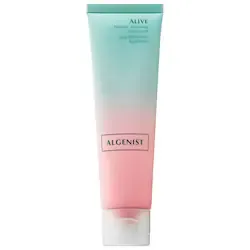
Algenist Hydratant équilibrant aux prébiotiques ALIVE
Works for
1 of 1 advertised claim delivered
Moisturizing15 ingredients credited for this claimGood support
“Hydratant équilibrant aux prébiotiques ALIVE”
This product can help improve hydration of the skin with the two types of ingredients.
The first type is called “humectants”:
these ingredients help attract water.
When humectants are on the surface of the skin, they “pull in” the moisture from the outside environment, or from
within deeper layers of the skin. The following ingredients in this product do the job:
glycerin, parachlorella beijerinckii exopolysaccharides.
This product also contains ingredients called “occlusives”. They help reduce the speed with which our skin loses moisture to the outside environment. These ingredients also help soften the upper layer of the skin, so it feels less tight and nicer to the touch. The following ingredients in this product do the job: caprylic/capric triglyceride, simmondsia chinensis seed oil.
Can it cause trouble?
Irritancy13 flagged ingredientsLow risk
Comedogenic3 ingredients rated 2 or more on the 0–5 pore-clogging scale3 flagged
User reviews
Be the first — your take helps the next person decide.
Ingredients
Filter by role to see what each ingredient is doing.
Zinc oxide13.65%
- Irritation risk
- Low
A broad spectrum sunblock (protects from both UVA and UVB rays). Is suitable for most sensitive skins. In small concentrations, can be used as a colorant
More about Zinc oxideWater~45–55%
Caprylic/capric triglyceride~7.2–8.8%
- Irritation risk
- Medium
A good mix of fatty acids that forms a protective layer on the skin. Improves the shelf life of products. Derived from coconut and glycerin
More about Caprylic/capric triglycerideCoco-caprylate~5.3–6.4%
- Irritation risk
- Medium
An emollient that softens skin and creates a nice product texture
More about Coco-caprylateGlycerin~3.1–3.8%
- Irritation risk
- Low
One of the best moisturizing ingredients. Naturally present in skin. It attracts water to the upper layer of the skin working as a humectant
More about GlycerinGlyceryl behenate~2.4–2.9%
- Irritation risk
- Medium
Used to create a thicker product consistency and help soften the upper layer of the skin
More about Glyceryl behenateCoco-glucoside~2.1–2.5%
- Irritation risk
- High
Used as a cleansing agent (surfactant) in cleansers. Helps water and oil mix together in lotions. Can be irritating
More about Coco-glucosideSimmondsia chinensis seed oil~1.8–2.1%
- Irritation risk
- Medium
Softens the upper layer of skin and helps restore the healthy skin barrier. Has shown to help calm down inflammation in skin. It is a stable oil, meaning that it retains its properties even when exposed to air.
More about Simmondsia chinensis seed oilCetearyl alcohol~1.6–2%
- Irritation risk
- Low
- Comedogenicity
- 2/5
A non-drying alcohol. Works as an emollient. Helps water and oil mix together and creates a nice product texture
More about Cetearyl alcoholGlyceryl caprylate~1.4–1.7%
- Irritation risk
- Low
An emollient that can also help water and oil mix together, as well as prevent bacteria growth in products
More about Glyceryl caprylateSodium stearoyl glutamate~1.1–1.4%
- Irritation risk
- Medium
Helps oil and water mix together
More about Sodium stearoyl glutamateParachlorella beijerinckii exopolysaccharides~0.95–1.15%
- Irritation risk
- Low
Compounds extracted from green algae that could help neutralize free radicals, but evidence of effectiveness in skincare products (topical applicaiton) is missing. Helps moisturize the skin by attracting water to its upper layer
More about Parachlorella beijerinckii exopolysaccharidesChlorella vulgaris extract~0.65–1%
- Irritation risk
- Medium
- Comedogenicity
- 3/5
A plant extract that can help to attract water to the upper layer of the skin and might have some anti-oxidant and anti-inflammatory properties
More about Chlorella vulgaris extractLactococcus ferment lysate~0.6–0.9%
- Irritation risk
- Low
Consists of remains of dead bacteria cells. Is likely helpful in attracting water to the upper layer of the skin. Might be helpful in reducing inflammation and neutralizing free radicals in skin
More about Lactococcus ferment lysateAlteromonas ferment extract~0.55–0.85%
- Irritation risk
- Low
A marine extract that helps attract water to the upper layer of the skin. It is claimed to have anti-inflammatory properties but research is lacking
More about Alteromonas ferment extractCaesalpinia spinosa fruit pod extract~0.55–0.8%
- Irritation risk
- Medium
A plant extract with antioxidant effect. Is often added to skincare to boost SPF
More about Caesalpinia spinosa fruit pod extractHelianthus annuus sprout extract~0.5–0.75%
- Irritation risk
- Low
Helps soften the upper layer of the skin and can help support the skin barrier
More about Helianthus annuus sprout extractCaprylyl glycol~0.55–0.8%
- Irritation risk
- Medium
Helps preserve products and creates a nice product texture
More about Caprylyl glycolMicrocrystalline cellulose~0.5–0.7%
Polyglyceryl-3 polyricinoleate~0.45–0.7%
- Irritation risk
- Medium
Helps oil and water mix together
More about Polyglyceryl-3 polyricinoleateXanthan gum~0.4–0.6%
- Irritation risk
- Low
Used to create a thicker product consistency
More about Xanthan gumButylene glycol~0.3–0.55%
- Irritation risk
- Low
Used to create a nice product texture and help delivery of other ingredients. Might be somewhat helpful in attracting water to the upper layer of the skin
More about Butylene glycolIsostearic acid~0.4–0.65%
- Irritation risk
- Low
Used to create a nice product texture
More about Isostearic acidCaprylhydroxamic acid~0.25–0.45%
Algin~0.25–0.4%
- Irritation risk
- Low
- Comedogenicity
- 3/5
Used to thicken product formulation. Can help attract water to the upper layer of the skin
More about AlginCalcium alginate~0.15–0.3%
Propanediol~0.2–0.35%
- Irritation risk
- Low
Acts as a solvent for other ingredients. Speeds up the absorption of other ingredients into the skin
More about PropanediolMaltodextrin~0.15–0.25%
- Irritation risk
- Low
Used to stabilize the product formulation and can help absorb oil
More about MaltodextrinLactic acid~0.1–0.2%
- Irritation risk
- Medium
An exfoliating and moisturizing alpha-hydroxy acid (AHA). Typically causes less irritation than other AHAs, for example, glycolic acid. At high concentrations (about 15%), lactic acid can help reduce lines and wrinkles. Recent studies show that lactic acid can support the "good" bacteria living on skin's surface (healthy skin microbiome)
More about Lactic acidSodium benzoate~0.1–0.2%
Sodium chloride~0.1–0.15%
- Irritation risk
- Low
Used to stabilize mixtures of oil and water, and create thicker, gel-like product textures
More about Sodium chlorideIngredient list view
Zinc oxide, Water, Caprylic/capric triglyceride, Coco-caprylate, Glycerin, Glyceryl behenate, Coco-glucoside, Simmondsia chinensis seed oil, Cetearyl alcohol, Glyceryl caprylate, Sodium stearoyl glutamate, Parachlorella beijerinckii exopolysaccharides, Chlorella vulgaris extract, Lactococcus ferment lysate, Alteromonas ferment extract, Caesalpinia spinosa fruit pod extract, Helianthus annuus sprout extract, Caprylyl glycol, Microcrystalline cellulose, Polyglyceryl-3 polyricinoleate, Xanthan gum, Butylene glycol, Isostearic acid, Caprylhydroxamic acid, Algin, Calcium alginate, Propanediol, Maltodextrin, Lactic acid, Sodium benzoate, Sodium chloride
Compare prices
Retailers ranked by price — lowest first.
Sources cited in this review
Every concentration estimate and effectiveness label is anchored to one of these 12 studies and safety reviews.
- 1A review of inorganic UV filters zinc oxide and titanium dioxideonlinelibrary.wiley.com
- 2
- 3
- 4
- 5
- 6

Affiliate links · As an Amazon Associate, WIMJ earns from qualifying purchases.