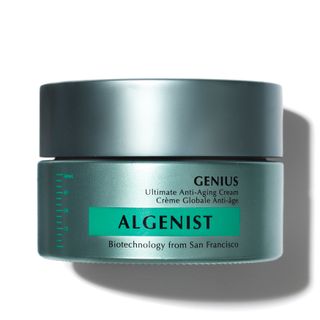
Algenist Genius Ultimate Anti-Aging Cream
Works for
2 of 2 advertised claims delivered
MoisturizingCeramide np, Caprylic/capric triglyceride + 14 moreStrong evidence
“A luxurious replenishing moisturizer infused with biomimetic collagen, nourishing algae and reparative microalgae oil that combats lines and wrinkles and helps visibly restore skin resiliency and elasticity, to firm, smooth, brighten, hydrate and nourish skin.”
This product can help improve hydration of the skin with the two types of ingredients.
The first type is called “humectants”:
these ingredients help attract water.
When humectants are on the surface of the skin, they “pull in” the moisture from the outside environment, or from
within deeper layers of the skin. The following ingredients in this product do the job:
glycerin, parachlorella beijerinckii exopolysaccharides.
This product also contains ingredients called “occlusives”. They help reduce the speed with which our skin loses moisture to the outside environment. These ingredients also help soften the upper layer of the skin, so it feels less tight and nicer to the touch. The following ingredients in this product do the job: butyrospermum parkii butter, caprylic/capric triglyceride.
The following ingredients in this product are especially good for supporting the skin barrier and helping with the hydration level: ceramide np
Anti-agingRetinyl palmitate, Butyrospermum parkii butterModerate evidence
“Genius Ultimate Anti-Aging Cream”
This product contains retinyl palmitate. This ingredient might be able to help reduce and prevent fine lines and wrinkles, improve skin elasticity and firmness, but there is not enough evidence that it actually works.
Evens skin toneNot advertised by the brand · Retinyl palmitateModerate evidence
The following ingredient (ingredients) in this product might be helpful, but there is no evidence to confirm that it actually works: retinyl palmitate.
Can it cause trouble?
Irritancy3 strong irritants: Retinyl palmitate, Parfum + 1 more — patch-test recommendedHigh risk
Comedogenic2 ingredients rated 2 or more on the 0–5 pore-clogging scale2 flagged


User reviews
Be the first — your take helps the next person decide.
Ingredients
Filter by role to see what each ingredient is doing.
Water~45–55%
Caprylic/capric triglyceride~6.5–8%
- Irritation risk
- Medium
A good mix of fatty acids that forms a protective layer on the skin. Improves the shelf life of products. Derived from coconut and glycerin
More about Caprylic/capric triglycerideHydrogenated polyisobutene~4.3–5.3%
- Irritation risk
- Low
Used to improve the product consistency and soften the upper layer of the skin
More about Hydrogenated polyisobuteneGlycerin~3.2–3.9%
- Irritation risk
- Low
One of the best moisturizing ingredients. Naturally present in skin. It attracts water to the upper layer of the skin working as a humectant
More about GlycerinChlorella protothecoides oil~2.5–3.1%
- Irritation risk
- Low
- Comedogenicity
- 3/5
An emollient. Is unlikely to have additional benefits for the skin
More about Chlorella protothecoides oilDimethicone~2.1–2.6%
- Irritation risk
- Low
A silicone that helps to reduce water loss from the surface of the skin. Can temporarily "fill in" lines and wrinkles, absorb oil, and create a nice product finish
More about DimethiconeButylene glycol~1.7–2.1%
- Irritation risk
- Low
Used to create a nice product texture and help delivery of other ingredients. Might be somewhat helpful in attracting water to the upper layer of the skin
More about Butylene glycolGlyceryl stearate~1.5–1.9%
- Irritation risk
- Low
An emollient that softens the skin and forms a protective layer on its surface. Helps water and oil mix together
More about Glyceryl stearatePeg-100 stearate~1.3–1.6%
- Irritation risk
- Low
Helps oil and water mix togehter and creates a nice product texture
More about Peg-100 stearateButyrospermum parkii butter~1–1.3%
- Irritation risk
- Low
- Comedogenicity
- 3/5
A great moisturising ingredient that softens the skin and reduces water loss from its upper layer. It also can be helpful in protecting skin from free radicals
More about Butyrospermum parkii butterPentylene glycol~0.75–1.15%
- Irritation risk
- Medium
Used to preserve products, dissolve other ingredients and create a nice product texture
More about Pentylene glycolPotassium cetyl phosphate~0.6–0.9%
- Irritation risk
- Medium
Helps oil and water mix together
More about Potassium cetyl phosphateParachlorella beijerinckii exopolysaccharides~0.55–0.85%
- Irritation risk
- Low
Compounds extracted from green algae that could help neutralize free radicals, but evidence of effectiveness in skincare products (topical applicaiton) is missing. Helps moisturize the skin by attracting water to its upper layer
More about Parachlorella beijerinckii exopolysaccharidesCollagen~0.5–0.7%
- Irritation risk
- Low
Cannot penetrate the skin barrier so is not particularly useful in skincare products
More about CollagenCeramide np~0.5–0.75%
- Irritation risk
- Low
A type of lipid similar to ceramides naturally present in skin. Helps to soften the upper layer of the skin and supports the skin barrier function to keep it hydrated. Can help to prevent inflammation in skin
More about Ceramide npCynara scolymus leaf extract~0.45–0.65%
- Irritation risk
- High
A plant extract that might have some anti-oxidant properties. It might be irritating
More about Cynara scolymus leaf extractRetinyl palmitate~0.4–0.6%
- Irritation risk
- High
Three steps removed from the active form of vitamin A - retinoic acid. To have an effect in the skin, it first needs to be converted twice to become the retinoic acid. This means it is less potent than retinol, but could also be less irritating. Once converted to the retinoic acid in the skin, it helps against all signs of aging, improves skin cell turnover and helps fight blemishes and clogged pores. However, in many cosmetic formulations, it is used in a concentration that is too low to have the full effect
More about Retinyl palmitateAstragalus membranaceus root extract~0.45–0.65%
- Irritation risk
- Low
Atractylodes macrocephala root extract~0.3–0.6%
- Irritation risk
- Low
Iris florentina root extract~0.3–0.55%
- Irritation risk
- Low
Bupleurum falcatum root extract~0.3–0.55%
- Irritation risk
- High
A plant extract that might help to attract water to the upper layer of the skin, but it is not well studied. It can be irritating
More about Bupleurum falcatum root extractCopper lysinate/prolinate~0.25–0.5%
- Irritation risk
- Low
Methylglucoside phosphate~0.25–0.45%
- Irritation risk
- Low
Stearalkonium bentonite~0.25–0.45%
- Irritation risk
- Low
Acrylates/c10-30 alkyl acrylate crosspolymer~0.25–0.5%
- Irritation risk
- Medium
Maintains the texture of skincare products. Allows the product to spread evenly. Helps oil and water mix together
More about Acrylates/c10-30 alkyl acrylate crosspolymerSilica~0.35–0.65%
Caprylyl glycol~0.25–0.5%
- Irritation risk
- Medium
Helps preserve products and creates a nice product texture
More about Caprylyl glycolSodium hydroxide~0.25–0.45%
Disodium edta~0.2–0.4%
Ethylhexylglycerin~0.2–0.4%
Cetyl alcohol~0.25–0.5%
- Irritation risk
- Low
A non-drying alcohol that works to soften the skin and stabilize product formulations helping oil and water mix together
More about Cetyl alcoholPropylene carbonate~0.25–0.45%
- Irritation risk
- Low
Is used to dissolve other ingredients and create nice product texture
More about Propylene carbonateQuartz~0.25–0.5%
Phenoxyethanol~0.15–0.3%
- Irritation risk
- Low
A preservative. It helps prevent bacterial growth in cosmetic products
More about PhenoxyethanolLeuconostoc/radish root ferment filtrate~0.15–0.3%
- Irritation risk
- Medium
A preservative that comes from radishes fermented by a bacteria. New research suggests that the preservation properties in the ingredient come from an ammonium salt that is not present naturally in radish root but used in its cultivation. Is problematic because the exact amount of the preservative agents is difficult to determine
More about Leuconostoc/radish root ferment filtrateChlorphenesin~0.15–0.25%
Parfum~0.1–0.15%
- Irritation risk
- High
An aromatic blend of unspecified and possibly irritating ingredients
More about ParfumCoumarin~0.05–0.15%
Ingredient list view
Water, Caprylic/capric triglyceride, Hydrogenated polyisobutene, Glycerin, Chlorella protothecoides oil, Dimethicone, Butylene glycol, Glyceryl stearate, Peg-100 stearate, Butyrospermum parkii butter, Pentylene glycol, Potassium cetyl phosphate, Parachlorella beijerinckii exopolysaccharides, Collagen, Ceramide np, Cynara scolymus leaf extract, Retinyl palmitate, Astragalus membranaceus root extract, Atractylodes macrocephala root extract, Iris florentina root extract, Bupleurum falcatum root extract, Copper lysinate/prolinate, Methylglucoside phosphate, Stearalkonium bentonite, Acrylates/c10-30 alkyl acrylate crosspolymer, Silica, Caprylyl glycol, Sodium hydroxide, Disodium edta, Ethylhexylglycerin, Cetyl alcohol, Propylene carbonate, Quartz, Phenoxyethanol, Leuconostoc/radish root ferment filtrate, Chlorphenesin, Parfum, Coumarin
Compare prices
Retailers ranked by price — lowest first.


Worth comparing, line by line.
Match % combines shared ingredients, the first five ingredients, shared actives and hero ingredients, irritancy (lower counts in the alternative's favour), texture and body area. Only products in the same routine step are compared.
| AlgenistGenius Ultimate Anti-Aging CreamYOUR PRODUCT | Augustinus BaderThe Cream | CeraVeRenewing Peptide Moisturise | CetaphilPro Sens Night Cream - Redness & Rosacea | |
|---|---|---|---|---|
| Match | — | 64% | 64% | 64% |
| Price | $40.00 | $39.00−$1.00 | — | $20.04−$19.96 |
| Shared key ingredients | — | 5 of 8 | 5 of 8 | 5 of 8 |
| Key difference | — | Ceramide Ng | Niacinamide | Niacinamide |
| Irritancy | High | Medium | Medium | Low |
| Drying alcohol | — | Contains drying alcohol | — | — |
| View product | Shop | Shop | Shop |


Product summary
Judging from the ingredient list, "Algenist - Genius Ultimate Anti-Aging Cream" works well for improving skin hydration To work well, any moisturizer needs to include a combination of water-binding and emollient ingredients. Algenist - Genius Ultimate Anti-Aging Cream ticks this box. Glycerin, parachlorella beijerinckii exopolysaccharides, sodium pca, butylene glycol and caprylyl glycol in this product (humectants) attract water molecules to the upper layer of the skin (the water comes from the outside air or from the deeper layers of the skin if the air is dry). Palmitoyl tetrapeptide-7, palmitoyl tripeptide-1, butyrospermum parkii butter, caprylic/capric triglyceride and chlorella protothecoides oil in this product help decrease the water evoporation from the skin, so that it stays hydrated for longer. These ingredients also soften the skin and take away the feeling of tightness and dryness.
Ingredient callouts
- We like that this moisturizer contains peptides (palmitoyl tetrapeptide-7 0.35% - 0.65% and palmitoyl tripeptide-1 0.40% - 0.60%). There are many different kind of Peptides and they are naturally present in our skin. They all are a combination of aminoacids. Some of them work as natural antibiotics, promote wound-healing and production of collagen. The science is still not settled on how effective Peptides are in skincare, but it is very likely that they have a benefit. Peptides might help restore the skin barrier and fight the signs of aging. At the very least, Peptides work as humectants: they attract water to the upper layer of the skin and improve its hydration.
Irritation risk
This formulation includes some common irritants, including ingredients that do not provide a benefit for the skin. We assess the overall irritancy of this moisturizer to be medium. For a detailed overview of all potential irritants: click here
You can see the detailed formula review with the breakdown of all actives in the product and the full ingredient list with estimated concentrations in the tables below.
Price
The product retails from 40.00$ up to 112.00$ in the United States, from 47.95£ up to 89.00£ in the United Kingdom, for 139.00CA$ in Canada and from 594.00HK$ up to 990.00HK$ in Hong Kong.
For a detailed price comparison: click here.
Sources cited in this review
Every concentration estimate and effectiveness label is anchored to one of these 8 studies and safety reviews.
- 1
- 2
- 3
- 4Final Report on the Safety Assessment of Dimethicone Copolyoljournals.sagepub.com
- 5
- 6Microalgal polysaccharide compositionspatents.google.com

Affiliate links · As an Amazon Associate, WIMJ earns from qualifying purchases.