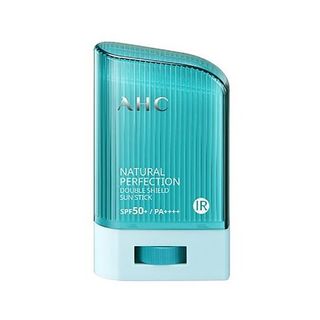
AHC Natural Perfection Double Shield Sun Stick Sunscreen SPF 50+ / PA++++

AHC Natural Perfection Double Shield Sun Stick Sunscreen SPF 50+ / PA++++

SPF 50Efficacy90/100IrritancyHigh·5 UV filters
Edit

Works for

2 of 2 advertised claims delivered

Sun protection
SPF 50 · 5 UV filters
Broad spectrum
SPF 50Broad spectrumChemical filtersNo white cast

This product offers a good level of protection against both UVB and UVA rays.

This sunscreen uses organic (so-called "chemical") sunscreen filters. Organic, or "chemical" filters usually provide reliable sun protection and rarely leave a white cast. Sunscreens with organic filters can sting eyes.

UV spectrum
UVB290–320 nmUVA II320–340 nmUVA I340–400 nm
Homosalate
Octinoxate
Octisalate
Tinosorb S
Uvinul A Plus
FilterCoverageWhat it doesEst. amount
HomosalateUVB Photo-stable A weak sunscreen that offers some protection against the sun rays that cause sunburn (UVB), but does not offer meaningful protection against protect against the most aging sun rays (UVA). It loses its effectiveness quickly when exposed to sunlight. It is an organic, or so called "chemical" sunscreen. When used in low concentrations, helps to stabilize the product formulation~3.8–4.6%
OctinoxateEthylhexyl MethoxycinnamateUVBOctinoxate. When used in higher concentrations, works as a sunscreen protecting the skin from UVB rays. When used in lower concentration, helps to preserve the product formulation. Is shown to be harmful to coral reefs - consider avoiding bathing in coral reef areas when wearing a product with this ingredient. It can be irritating~2.8–3.4%
OctisalateEthylhexyl SalicylateUVBOctisalate. A UV filter. It offers some protection against the sun rays that cause sunburn (UVB), but does not protect against the most aging sun rays (UVA). It loses its effectiveness quickly when exposed to sunlight. It is an organic, or so called "chemical" sunscreen~1.8–2.1%
Tinosorb SBis-ethylhexyloxyphenol Methoxyphenyl TriazineUVBUVA Photo-stable Tinosorb S. One of the most effective broad spectrum sunscreen ingredients. Protects from both UVA and UVB rays. It is photostable. Unfortunately, not approved by FDA (US) yet.~1–1.3%
Uvinul A PlusDiethylamino Hydroxybenzoyl Hexyl BenzoateUVA1 Photo-stable Uvinul A Plus. A new generation broad spectrum sunscreen that offers an effective protection especially in the UVA range. It is stable in formulations. Unfortunately, is not approved by the FDA (US) yet~1.2–1.4%
~ marks concentrations estimated from label position and typical use levels
Anti-aging
3 ingredients credited for this claim
Strong support
What the product description says
“-Reduces the look of fine lines & wrinkles while enhancing clarity (Whitening & wrinkle-improvement functional product).”
Source: Walmart

This product can help prevent early signs of skin aging because it offers a good level of broad spectrum sun protection. Sun damage is the main cause of premature skin aging, and protecting your skin from the sun is the best anti-aging strategy.

These ingredients in the product might also be helpful for reducing and preventing fine lines, wrinkles, and skin elasticity, even though there is no conclusive evidence for their effectiveness: centella asiatica extract.

Centella asiatica extractKey activeEffect: MediumA plant extract that has been shown to be able to reduce inflammation in skin, support restoration of skin barrier function, as well as support collagen production. Contains active compounds called centelloids: asiaticoside, madecasosside, asiatic acid and madecassic acid. Might be helpful in preventing stretch marks. It can be itself be irritating though.~0.6–0.9%
Camellia sinensis leaf extractEffect: LowCan contain potent anti-oxidant compounds (abbreviated ECG, GCG, EGC, and EGCG) that might help protect the skin from free radicals. Can help calm down inflammation and has some anti-bacterial properties. Unfortunately, these antioxidants are unstable and lose their effectiveness very quickly in products. The concentration of the antioxidant compounds in the extract also tends to be low to be effective in topical formulation~0.65–0.95%
TocopherolEffect: Low, below effective dosePure form of vitamin E. Can help moisturise and protect the skin from free radicals. Often used to help stabilise other ingredients or the formula itself~0.1–0.2%
Evens skin tone
Not advertised by the brand · 1 ingredient credited for this claim
Strong support

This product offers broad spectrum sun protection. It means that it can prevent hyperpigmentation and help keep the skin tone even (sun damage is the main factor causing age spots, darkening of post-acne marks and other discolorations).

Camellia sinensis leaf extractEffect: LowCan contain potent anti-oxidant compounds (abbreviated ECG, GCG, EGC, and EGCG) that might help protect the skin from free radicals. Can help calm down inflammation and has some anti-bacterial properties. Unfortunately, these antioxidants are unstable and lose their effectiveness very quickly in products. The concentration of the antioxidant compounds in the extract also tends to be low to be effective in topical formulation~0.65–0.95%
Anti-oxidation
Not advertised by the brand · 12 ingredients credited for this claim
Moderate support

This product contains antioxidants (camellia japonica flower extract, camellia sinensis leaf extract, centella asiatica extract) that might be able to help neutralize free radicals in skin to lessen the damage it gets from the UV light (sun). There is not enough evidence to confirm their effectiveness in skin though.

Camellia sinensis leaf extractKey activeEffect: MediumCan contain potent anti-oxidant compounds (abbreviated ECG, GCG, EGC, and EGCG) that might help protect the skin from free radicals. Can help calm down inflammation and has some anti-bacterial properties. Unfortunately, these antioxidants are unstable and lose their effectiveness very quickly in products. The concentration of the antioxidant compounds in the extract also tends to be low to be effective in topical formulation~0.65–0.95%
Centella asiatica extractKey activeEffect: MediumA plant extract that has been shown to be able to reduce inflammation in skin, support restoration of skin barrier function, as well as support collagen production. Contains active compounds called centelloids: asiaticoside, madecasosside, asiatic acid and madecassic acid. Might be helpful in preventing stretch marks. It can be itself be irritating though.~0.6–0.9%
Camellia japonica flower extractKey activeEffect: MediumA plant extract that might help neutralize free radicals in skin~0.6–0.9%
Salix alba bark extractEffect: LowA plant extract that can help neutralize free radicals in skin. It contains a compound salicin that can theoretically be converted into salicylic acid that, in turn, helps reduce inflammation in skin, but the evidence of effectiveness in skin is lacking and the extract is usually not used in a concentration that would enable an exfoliating effect~0.45–0.7%
Scutellaria baicalensis root extractEffect: LowA plant extract that might contain a compound baicalin that could be helpful in neutralizing free radicals and reducing inflammation in skin. The baicalin concentration in skincare products is often too low for an effective action. Can be used for its fragrant properties~0.45–0.65%
Tocopheryl acetateEffect: LowA more stable but less bio-available form of vitamin E compared to Tocopherol. Might help moisturize and protect the skin from free radicals, but mostly used in low concentrations to stabilize other ingredients.~1.1–1.4%
Origanum vulgare leaf extractEffect: LowA plant extract. Can have an anti-oxidant effect, but can also contain irritants~0.5–0.7%
Portulaca oleracea extractEffect: LowA plant extract that has some anti-oxidant activity, but solid research is lacking. Can help attract water to the upper layer of the skin~0.5–0.7%
Calendula officinalis flower extractEffect: LowA plant extract that has some anti-oxidant and anti-bacterial properties. Can be irritating~0.45–0.65%
TocopherolUnder-dosedEffect: HighPure form of vitamin E. Can help moisturise and protect the skin from free radicals. Often used to help stabilise other ingredients or the formula itself~0.1–0.2%
BisabololEffect: Low, below effective doseAn active component of chamomile plant that historically has been used to calm down irritated skin. A recent study shows that bisabolol indeed can have some anti-inflammatory effect on skin, even though conclusive data is lacking. Bisabolol has a sweet floral scent and can be added to products for its aromatic properties~0.45–0.65%
Argania spinosa kernel oilEffect: Low, below effective doseAn emollient that helps soften the upper layer of the skin. Might have some weak anti-oxidant properties~0.5–0.8%
Moisturizing
Not advertised by the brand · 25 ingredients credited for this claim
Good support

This product can help improve hydration of the skin with the two types of ingredients.

The first type is called “humectants”:
these ingredients help attract water. When humectants are on the surface of the skin, they “pull in” the moisture from the outside environment, or from within deeper layers of the skin. The following ingredients in this product do the job: anhydroxylitol, glycerin.

This product also contains ingredients called “occlusives”. They help reduce the speed with which our skin loses moisture to the outside environment. These ingredients also help soften the upper layer of the skin, so it feels less tight and nicer to the touch. The following ingredients in this product do the job: cocos nucifera oil, dimethicone.

Helianthus annuus seed oil unsaponifiablesKey active· EmollientEffect: HighA great emollient due to its high linoleic acid content. One of the most effective plant oils in helping skin hydration and repairing skin barrier function~0.55–0.8%
Hydrolyzed hyaluronic acidKey active· HumectantEffect: HighOne of the best moisturizing ingredients. Attracts water into the upper layer of the skin. A version of it is naturally present in skin~0.45–0.7%
AnhydroxylitolKey active· HumectantEffect: HighHelps attract water to the upper layer of the skin and repair the skin barrir function~0.45–0.65%
Centella asiatica extractKey activeEffect: HighA plant extract that has been shown to be able to reduce inflammation in skin, support restoration of skin barrier function, as well as support collagen production. Contains active compounds called centelloids: asiaticoside, madecasosside, asiatic acid and madecassic acid. Might be helpful in preventing stretch marks. It can be itself be irritating though.~0.6–0.9%
Cocos nucifera oilKey active· Emollient, OcclusiveEffect: HighAn emollient. Found to be as effective as a moisturizer for dry skin as mineral oil. Could be comedogenic~0.45–0.7%
DimethiconeKey active· Emollient, OcclusiveEffect: HighA silicone that helps to reduce water loss from the surface of the skin. Can temporarily "fill in" lines and wrinkles, absorb oil, and create a nice product finish~25–30%
GlycerinKey active· HumectantEffect: HighOne of the best moisturizing ingredients. Naturally present in skin. It attracts water to the upper layer of the skin working as a humectant~0.5–0.75%
Helianthus annuus seed oilKey active· Emollient, OcclusiveEffect: HighA great emollient due to its high linoleic acid content. One of the most effective plant oils in helping skin hydration and repairing skin barrier function~0.5–0.8%
SarcosineKey active· HumectantEffect: HighHelps to enhance the penetration of other ingredients and attract water to the upper layer of the skin~0.35–0.6%
XylitylglucosideKey active· HumectantEffect: HighHelps attract water to the upper layer of the skin and repair the skin barrier function~0.45–0.65%
Lactobacillus/soybean ferment extractKey activeEffect: MediumA fermentation product created by bacteria Lactobacillus out of soybean. The fermented product helps to attract water to the upper layer of the skin and has anti-bacterial properties. It might be helpful in calming down inflammation and could be helpful in evening out skin tone, but studies are lacking~0.5–0.7%
Hydrogenated poly(c6-14 olefin)Key active· EmollientEffect: MediumHelps soften the upper layer of the skin and create a nice product texture~1.6–2%
Capryloyl glycineKey activeEffect: MediumHelps oil and water mix together, preserve cosmetic products, and attract water to the upper layer of the skin~0.5–0.8%
Cetyl ethylhexanoate· EmollientEffect: LowAn emollient that helps soften the skin and creates a thicker product texture~4.2–5.1%
Dicaprylyl carbonate· EmollientEffect: LowHelps products spread more easily and works as an emollient to soften skin~1.8–2.2%
Butylene glycol· HumectantEffect: LowUsed to create a nice product texture and help delivery of other ingredients. Might be somewhat helpful in attracting water to the upper layer of the skin~0.45–0.7%
Caprylyl glycol· Humectant, EmollientEffect: LowHelps preserve products and creates a nice product texture~0.2–0.4%
Scutellaria baicalensis root extract· HumectantEffect: LowA plant extract that might contain a compound baicalin that could be helpful in neutralizing free radicals and reducing inflammation in skin. The baicalin concentration in skincare products is often too low for an effective action. Can be used for its fragrant properties~0.45–0.65%
Lauryl peg-9 polydimethylsiloxyethyl dimethiconeEffect: LowA type of silicone that helps to soften upper layer of the skin and create a nice product texture~0.5–0.75%
Portulaca oleracea extract· HumectantEffect: LowA plant extract that has some anti-oxidant activity, but solid research is lacking. Can help attract water to the upper layer of the skin~0.5–0.7%
Tremella fuciformis extractEffect: LowA mushroom extract that might help attract water to the upper layer of the skin~0.45–0.7%
Camellia sinensis leaf extractEffect: LowCan contain potent anti-oxidant compounds (abbreviated ECG, GCG, EGC, and EGCG) that might help protect the skin from free radicals. Can help calm down inflammation and has some anti-bacterial properties. Unfortunately, these antioxidants are unstable and lose their effectiveness very quickly in products. The concentration of the antioxidant compounds in the extract also tends to be low to be effective in topical formulation~0.65–0.95%
Argania spinosa kernel oilUnder-dosedEffect: HighAn emollient that helps soften the upper layer of the skin. Might have some weak anti-oxidant properties~0.5–0.8%
Aloe barbadensis leaf extractEffect: Low, below effective doseTraditionally used to treat sunburns, dermatitis and inflammation, but evidence for its effectiveness is lacking. The extract can contain humectants that help attract water into the skin~0.55–0.8%
TocopherolEffect: Low, below effective dosePure form of vitamin E. Can help moisturise and protect the skin from free radicals. Often used to help stabilise other ingredients or the formula itself~0.1–0.2%

Can it cause trouble?

Irritancy
10 strong irritants: Citrus aurantium dulcis oil, Citrus nobilis peel oil + 8 more — patch-test recommended
High risk
We flagged 31 ingredients with irritancy potential. Severity depends on your sensitivity threshold; the table lists the worst offenders first.
IngredientFunctionIrritationEst. amount
Ethylhexyl methoxycinnamateOctinoxate. When used in higher concentrations, works as a sunscreen protecting the skin from UVB rays. When used in lower concentration, helps to preserve the product formulation. Is shown to be harmful to coral reefs - consider avoiding bathing in coral reef areas when wearing a product with this ingredient. It can be irritatingHigh~2.8–3.4%est.
Citrus aurantium dulcis oilUsed as a fragrance. It can be irritating and cause photosensitivityHigh~0.65–0.95%est.
Citrus nobilis peel oilA plant oil with high content of volatile compounds that, especially when exposed to air, can cause allergic reactions and irritate the skinHigh~0.55–0.85%est.
Camellia japonica flower extractA plant extract that might help neutralize free radicals in skinHigh~0.6–0.9%est.
Citrus aurantium dulcis fruit extractA plant extract that is used as a fragrance. Can be irritating and lead to photosensitivityHigh~0.5–0.7%est.
Calendula officinalis flower extractA plant extract that has some anti-oxidant and anti-bacterial properties. Can be irritatingHigh~0.45–0.65%est.
Origanum vulgare leaf extractA plant extract. Can have an anti-oxidant effect, but can also contain irritantsHigh~0.5–0.7%est.
Chamaecyparis obtusa leaf extractUsed as a fragranceHigh~0.5–0.7%est.
Salix alba bark extractA plant extract that can help neutralize free radicals in skin. It contains a compound salicin that can theoretically be converted into salicylic acid that, in turn, helps reduce inflammation in skin, but the evidence of effectiveness in skin is lacking and the extract is usually not used in a concentration that would enable an exfoliating effectHigh~0.45–0.7%est.
Cinnamomum cassia bark extractUsed as a fragrance. Can be irritatingHigh~0.5–0.8%est.
Scutellaria baicalensis root extractA plant extract that might contain a compound baicalin that could be helpful in neutralizing free radicals and reducing inflammation in skin. The baicalin concentration in skincare products is often too low for an effective action. Can be used for its fragrant propertiesHigh~0.45–0.65%est.
Cinnamomum zeylanicum bark extract—High~0.45–0.7%est.
Gardenia taitensis flower extractUsed as a fragranceHigh~0.5–0.7%est.
Cetyl ethylhexanoateAn emollient that helps soften the skin and creates a thicker product textureMedium~4.2–5.1%est.
HomosalateA weak sunscreen that offers some protection against the sun rays that cause sunburn (UVB), but does not offer meaningful protection against protect against the most aging sun rays (UVA). It loses its effectiveness quickly when exposed to sunlight. It is an organic, or so called "chemical" sunscreen. When used in low concentrations, helps to stabilize the product formulationMedium~3.8–4.6%est.
Tocopheryl acetateA more stable but less bio-available form of vitamin E compared to Tocopherol. Might help moisturize and protect the skin from free radicals, but mostly used in low concentrations to stabilize other ingredients.Medium~1.1–1.4%est.
Diethylamino hydroxybenzoyl hexyl benzoateUvinul A Plus. A new generation broad spectrum sunscreen that offers an effective protection especially in the UVA range. It is stable in formulations. Unfortunately, is not approved by the FDA (US) yetMedium~1.2–1.4%est.
Bis-ethylhexyloxyphenol methoxyphenyl triazineTinosorb S. One of the most effective broad spectrum sunscreen ingredients. Protects from both UVA and UVB rays. It is photostable. Unfortunately, not approved by FDA (US) yet.Medium~1–1.3%est.
Centella asiatica extractA plant extract that has been shown to be able to reduce inflammation in skin, support restoration of skin barrier function, as well as support collagen production. Contains active compounds called centelloids: asiaticoside, madecasosside, asiatic acid and madecassic acid. Might be helpful in preventing stretch marks. It can be itself be irritating though.Medium~0.6–0.9%est.
Argania spinosa kernel oilAn emollient that helps soften the upper layer of the skin. Might have some weak anti-oxidant propertiesMedium~0.5–0.8%est.
Aloe barbadensis leaf extractTraditionally used to treat sunburns, dermatitis and inflammation, but evidence for its effectiveness is lacking. The extract can contain humectants that help attract water into the skinMedium~0.55–0.8%est.
Tremella fuciformis extractA mushroom extract that might help attract water to the upper layer of the skinMedium~0.45–0.7%est.
Portulaca oleracea extractA plant extract that has some anti-oxidant activity, but solid research is lacking. Can help attract water to the upper layer of the skinMedium~0.5–0.7%est.
Dehydroacetic acidA preservativeMedium~0.3–0.6%est.
Hexylene glycolHelps create a more spreadable product textureMedium~0.35–0.65%est.
1,2-hexanediolA preservativeMedium~0.25–0.5%est.
Citric acidCan work as an exfoliant but is typically used to adjust the product pHMedium~0.2–0.35%est.
Caprylyl glycolHelps preserve products and creates a nice product textureMedium~0.2–0.4%est.
Potassium sorbateA preservativeMedium~0.15–0.3%est.
EthylhexylglycerinA preservativeMedium~0.1–0.2%est.
Comedogenic
1 ingredient rated 2 or more on the 0–5 pore-clogging scale
1 flagged
These ingredients have a comedogenic rating of 2 or more on a 0–5 scale; the table shows each one's rating. In leave-on products they can clog pores in acne-prone skin.
IngredientFunctionRatingEst. amount
Cocos nucifera oilAn emollient. Found to be as effective as a moisturizer for dry skin as mineral oil. Could be comedogenic3/5~0.45–0.7%est.
Edit
Cheaper Alternatives
Similar formulations, better price
No cheaper similar product found.

User reviews

Would you recommend?
No community reviews yet.

Be the first — your take helps the next person decide.

Write a review · ~30s

Ingredients

Filter by role to see what each ingredient is doing.

Dimethicone~25–30%
Key active
Irritation risk
Low
Works for
MoisturizingMattifying

A silicone that helps to reduce water loss from the surface of the skin. Can temporarily "fill in" lines and wrinkles, absorb oil, and create a nice product finish

More about Dimethicone
Vinyl dimethicone/methicone silsesquioxane crosspolymer~9.5–11.6%
Formula
Irritation risk
Low

A type of silicone that create a smooth product finish and can create an optical soft-focus effect on the skin. Helps to thicken the product consistency

More about Vinyl dimethicone/methicone silsesquioxane crosspolymer
Polyethylene~5.1–6.2%
Formula
Irritation risk
Low

Used to thicken the product's texture

More about Polyethylene
Cetyl ethylhexanoate~4.2–5.1%
Irritant · medium
Irritation risk
Medium
Works for
Moisturizing

An emollient that helps soften the skin and creates a thicker product texture

More about Cetyl ethylhexanoate
Homosalate~3.8–4.6%
UV filterKey activeIrritant · medium
Irritation risk
Medium
Works for
Sun protection

A weak sunscreen that offers some protection against the sun rays that cause sunburn (UVB), but does not offer meaningful protection against protect against the most aging sun rays (UVA). It loses its effectiveness quickly when exposed to sunlight. It is an organic, or so called "chemical" sunscreen. When used in low concentrations, helps to stabilize the product formulation

More about Homosalate
Ethylhexyl methoxycinnamate~2.8–3.4%
UV filterKey activeIrritant · high
Irritation risk
High
Works for
Sun protection

Octinoxate. When used in higher concentrations, works as a sunscreen protecting the skin from UVB rays. When used in lower concentration, helps to preserve the product formulation. Is shown to be harmful to coral reefs - consider avoiding bathing in coral reef areas when wearing a product with this ingredient. It can be irritating

More about Ethylhexyl methoxycinnamate
Dicaprylyl carbonate~1.8–2.2%
Formula
Irritation risk
Low
Works for
Moisturizing

Helps products spread more easily and works as an emollient to soften skin

More about Dicaprylyl carbonate
Hydrogenated poly(c6-14 olefin)~1.6–2%
Key active
Irritation risk
Low
Works for
Moisturizing

Helps soften the upper layer of the skin and create a nice product texture

More about Hydrogenated poly(c6-14 olefin)
Ethylhexyl salicylate~1.8–2.1%
UV filter
Irritation risk
Low
Works for
Sun protection

Octisalate. A UV filter. It offers some protection against the sun rays that cause sunburn (UVB), but does not protect against the most aging sun rays (UVA). It loses its effectiveness quickly when exposed to sunlight. It is an organic, or so called "chemical" sunscreen

More about Ethylhexyl salicylate
Tocopheryl acetate~1.1–1.4%
Irritant · medium
Irritation risk
Medium
Works for
Anti-oxidation

A more stable but less bio-available form of vitamin E compared to Tocopherol. Might help moisturize and protect the skin from free radicals, but mostly used in low concentrations to stabilize other ingredients.

More about Tocopheryl acetate
Diethylamino hydroxybenzoyl hexyl benzoate~1.2–1.4%
UV filterKey activeIrritant · medium
Irritation risk
Medium
Works for
Sun protection

Uvinul A Plus. A new generation broad spectrum sunscreen that offers an effective protection especially in the UVA range. It is stable in formulations. Unfortunately, is not approved by the FDA (US) yet

More about Diethylamino hydroxybenzoyl hexyl benzoate
Bis-ethylhexyloxyphenol methoxyphenyl triazine~1–1.3%
UV filterKey activeIrritant · medium
Irritation risk
Medium
Works for
Sun protection

Tinosorb S. One of the most effective broad spectrum sunscreen ingredients. Protects from both UVA and UVB rays. It is photostable. Unfortunately, not approved by FDA (US) yet.

More about Bis-ethylhexyloxyphenol methoxyphenyl triazine
Ozokerite~0.75–1.15%
Formula
Irritation risk
Low

Used to thicken the product consistency

More about Ozokerite
Citrus aurantium dulcis oil~0.65–0.95%
Irritant · high
Irritation risk
High

Used as a fragrance. It can be irritating and cause photosensitivity

More about Citrus aurantium dulcis oil
Citrus nobilis peel oil~0.55–0.85%
Irritant · high
Irritation risk
High

A plant oil with high content of volatile compounds that, especially when exposed to air, can cause allergic reactions and irritate the skin

More about Citrus nobilis peel oil
Litsea cubeba (may chang) oil
Not recognized
Camellia sinensis leaf extract~0.65–0.95%
Key active
Irritation risk
Low
Works for
AntibacterialAnti-oxidationAnti-agingAnti-blemishEvens skin toneMoisturizing

Can contain potent anti-oxidant compounds (abbreviated ECG, GCG, EGC, and EGCG) that might help protect the skin from free radicals. Can help calm down inflammation and has some anti-bacterial properties. Unfortunately, these antioxidants are unstable and lose their effectiveness very quickly in products. The concentration of the antioxidant compounds in the extract also tends to be low to be effective in topical formulation

More about Camellia sinensis leaf extract
Camellia japonica flower extract~0.6–0.9%
Key activeIrritant · high
Irritation risk
High
Works for
Anti-oxidation

A plant extract that might help neutralize free radicals in skin

More about Camellia japonica flower extract
Lavandula angustifolia flower water~0.55–0.8%
Irritant · high
Centella asiatica extract~0.6–0.9%
Key activeIrritant · medium
Irritation risk
Medium
Works for
Reduces rednessReduces irritationMoisturizingAnti-inflammatoryAnti-agingAnti-oxidationAnti-blemish

A plant extract that has been shown to be able to reduce inflammation in skin, support restoration of skin barrier function, as well as support collagen production. Contains active compounds called centelloids: asiaticoside, madecasosside, asiatic acid and madecassic acid. Might be helpful in preventing stretch marks. It can be itself be irritating though.

More about Centella asiatica extract
Water~0.5–0.75%
Formula
Irritation risk
Low

Plain old water

More about Water
Opuntia ficus-indica stem extract~0.45–0.7%
Formula
Oryza sativa bran extract~0.45–0.7%
Formula
Irritation risk
Low

Used to thicken the product consistency

More about Oryza sativa bran extract
Argania spinosa kernel oil~0.5–0.8%
Under-dosedIrritant · medium
Irritation risk
Medium
Works for
MoisturizingAnti-oxidation

An emollient that helps soften the upper layer of the skin. Might have some weak anti-oxidant properties

More about Argania spinosa kernel oil
Aloe barbadensis leaf extract~0.55–0.8%
Irritant · medium
Irritation risk
Medium
Works for
Moisturizing

Traditionally used to treat sunburns, dermatitis and inflammation, but evidence for its effectiveness is lacking. The extract can contain humectants that help attract water into the skin

More about Aloe barbadensis leaf extract
Citrus aurantium dulcis fruit extract~0.5–0.7%
Irritant · high
Irritation risk
High

A plant extract that is used as a fragrance. Can be irritating and lead to photosensitivity

More about Citrus aurantium dulcis fruit extract
Calendula officinalis flower extract~0.45–0.65%
Irritant · high
Irritation risk
High
Works for
Anti-oxidation

A plant extract that has some anti-oxidant and anti-bacterial properties. Can be irritating

More about Calendula officinalis flower extract
Cocos nucifera oil~0.45–0.7%
Key activeComedogenic 3/5
Irritation risk
Low
Comedogenicity
3/5
Works for
Moisturizing

An emollient. Found to be as effective as a moisturizer for dry skin as mineral oil. Could be comedogenic

More about Cocos nucifera oil
Vanilla tahitensis fruit extract~0.45–0.7%
Formula
Helianthus annuus seed oil unsaponifiables~0.55–0.8%
Key active
Irritation risk
Low
Works for
Moisturizing

A great emollient due to its high linoleic acid content. One of the most effective plant oils in helping skin hydration and repairing skin barrier function

More about Helianthus annuus seed oil unsaponifiables
Sea water~0.5–0.7%
Formula
Irritation risk
Low

Dissolves other ingredients. It does not have additional skin benefits compared to plain water

More about Sea water
Lactobacillus/soybean ferment extract~0.5–0.7%
Key active
Irritation risk
Low
Works for
Moisturizing

A fermentation product created by bacteria Lactobacillus out of soybean. The fermented product helps to attract water to the upper layer of the skin and has anti-bacterial properties. It might be helpful in calming down inflammation and could be helpful in evening out skin tone, but studies are lacking

More about Lactobacillus/soybean ferment extract
Dioscorea japonica root extract~0.5–0.7%
Formula
Pseudoalteromonas ferment extract~0.5–0.7%
Formula
Origanum vulgare leaf extract~0.5–0.7%
Irritant · high
Irritation risk
High
Works for
Anti-oxidation

A plant extract. Can have an anti-oxidant effect, but can also contain irritants

More about Origanum vulgare leaf extract
Chamaecyparis obtusa leaf extract~0.5–0.7%
Irritant · high
Irritation risk
High

Used as a fragrance

More about Chamaecyparis obtusa leaf extract
Salix alba bark extract~0.45–0.7%
Irritant · high
Irritation risk
High
Works for
Anti-oxidationAnti-inflammatoryExfoliationAnti-blemish

A plant extract that can help neutralize free radicals in skin. It contains a compound salicin that can theoretically be converted into salicylic acid that, in turn, helps reduce inflammation in skin, but the evidence of effectiveness in skin is lacking and the extract is usually not used in a concentration that would enable an exfoliating effect

More about Salix alba bark extract
Tremella fuciformis extract~0.45–0.7%
Irritant · medium
Irritation risk
Medium
Works for
Moisturizing

A mushroom extract that might help attract water to the upper layer of the skin

More about Tremella fuciformis extract
Portulaca oleracea extract~0.5–0.7%
Irritant · medium
Irritation risk
Medium
Works for
Anti-oxidationMoisturizing

A plant extract that has some anti-oxidant activity, but solid research is lacking. Can help attract water to the upper layer of the skin

More about Portulaca oleracea extract
Cinnamomum cassia bark extract~0.5–0.8%
Irritant · high
Irritation risk
High

Used as a fragrance. Can be irritating

More about Cinnamomum cassia bark extract
Scutellaria baicalensis root extract~0.45–0.65%
Irritant · high
Irritation risk
High
Works for
AntibacterialAnti-inflammatoryAnti-oxidationMoisturizingReduces irritation

A plant extract that might contain a compound baicalin that could be helpful in neutralizing free radicals and reducing inflammation in skin. The baicalin concentration in skincare products is often too low for an effective action. Can be used for its fragrant properties

More about Scutellaria baicalensis root extract
Nymphaea alba flower extract~0.45–0.7%
Formula
Epilobium fleischeri extract~0.5–0.7%
Formula
Cinnamomum zeylanicum bark extract~0.45–0.7%
Irritant · high
Nephelium lappaceum branch/fruit/leaf extract~0.5–0.7%
Formula
Litchi chinensis fruit extract~0.5–0.7%
Formula
Garcinia mangostana peel extract~0.5–0.7%
Formula
Gardenia taitensis flower extract~0.5–0.7%
Irritant · high
Irritation risk
High

Used as a fragrance

More about Gardenia taitensis flower extract
Helianthus annuus seed oil~0.5–0.8%
Key active
Irritation risk
Low
Works for
Moisturizing

A great emollient due to its high linoleic acid content. One of the most effective plant oils in helping skin hydration and repairing skin barrier function

More about Helianthus annuus seed oil
Bisabolol~0.45–0.65%
Formula
Irritation risk
Low
Works for
Anti-inflammatoryReduces irritationAnti-oxidation

An active component of chamomile plant that historically has been used to calm down irritated skin. A recent study shows that bisabolol indeed can have some anti-inflammatory effect on skin, even though conclusive data is lacking. Bisabolol has a sweet floral scent and can be added to products for its aromatic properties

More about Bisabolol
Lauryl peg-9 polydimethylsiloxyethyl dimethicone~0.5–0.75%
Formula
Irritation risk
Low
Works for
CleansingMoisturizing

A type of silicone that helps to soften upper layer of the skin and create a nice product texture

More about Lauryl peg-9 polydimethylsiloxyethyl dimethicone
Dehydroacetic acid~0.3–0.6%
Irritant · medium
Irritation risk
Medium

A preservative

More about Dehydroacetic acid
Water~0.5–0.75%
Formula
Irritation risk
Low

Plain old water

More about Water
Carbon~0.5–0.75%
Formula
Irritation risk
Low
More about Carbon
Water~0.5–0.75%
Formula
Irritation risk
Low

Plain old water

More about Water
Hydrolyzed hyaluronic acid~0.45–0.7%
Key active
Irritation risk
Low
Works for
Moisturizing

One of the best moisturizing ingredients. Attracts water into the upper layer of the skin. A version of it is naturally present in skin

More about Hydrolyzed hyaluronic acid
Dipropylene glycol~0.45–0.65%
Formula
Irritation risk
Low

Helps to dissolve other ingredients in a formulation. Slows down the rate of product drying

More about Dipropylene glycol
Butylene glycol~0.45–0.7%
Formula
Irritation risk
Low
Works for
Moisturizing

Used to create a nice product texture and help delivery of other ingredients. Might be somewhat helpful in attracting water to the upper layer of the skin

More about Butylene glycol
Glycerin~0.5–0.75%
Key active
Irritation risk
Low
Works for
Moisturizing

One of the best moisturizing ingredients. Naturally present in skin. It attracts water to the upper layer of the skin working as a humectant

More about Glycerin
Xylitylglucoside~0.45–0.65%
Key active
Irritation risk
Low
Works for
Moisturizing

Helps attract water to the upper layer of the skin and repair the skin barrier function

More about Xylitylglucoside
Anhydroxylitol~0.45–0.65%
Key active
Irritation risk
Low
Works for
Moisturizing

Helps attract water to the upper layer of the skin and repair the skin barrir function

More about Anhydroxylitol
Capryloyl glycine~0.5–0.8%
Key active
Irritation risk
Low
Works for
CleansingMoisturizing

Helps oil and water mix together, preserve cosmetic products, and attract water to the upper layer of the skin

More about Capryloyl glycine
Sodium palmitoyl proline~0.4–0.65%
Formula
Hexylene glycol~0.35–0.65%
Irritant · medium
Irritation risk
Medium
Works for
Cleansing

Helps create a more spreadable product texture

More about Hexylene glycol
Xylitol~0.35–0.6%
Formula
Irritation risk
Low

Helps attract water to the upper layer of the skin and repair the skin barrier function

More about Xylitol
Sarcosine~0.35–0.6%
Key active
Irritation risk
Low
Works for
Moisturizing

Helps to enhance the penetration of other ingredients and attract water to the upper layer of the skin

More about Sarcosine
1,2-hexanediol~0.25–0.5%
Irritant · medium
Irritation risk
Medium

A preservative

More about 1,2-hexanediol
Citric acid~0.2–0.35%
Irritant · medium
Irritation risk
Medium

Can work as an exfoliant but is typically used to adjust the product pH

More about Citric acid
Caprylyl glycol~0.2–0.4%
Irritant · medium
Irritation risk
Medium
Works for
Moisturizing

Helps preserve products and creates a nice product texture

More about Caprylyl glycol
Potassium sorbate~0.15–0.3%
Irritant · medium
Irritation risk
Medium

A preservative

More about Potassium sorbate
Oxygen~0.15–0.3%
Formula
Irritation risk
Low

Oxygen molecules that are abundant in normal air. In cosmetic formulas typically comes as a perfluorohexane oxygen emulsion. There is no evidence for benefits of the oxygen emulsion in topical creams, lotions or serums. There is a study available confirming a positive impact of oxygen therapy for skin wound healing, but it used an emulsion stored under high pressure using special equipment

More about Oxygen
Ethylhexylglycerin~0.1–0.2%
Irritant · medium
Irritation risk
Medium

A preservative

More about Ethylhexylglycerin
Tocopherol~0.1–0.2%
Under-dosed
Irritation risk
Low
Works for
Anti-oxidationAnti-agingAnti-inflammatoryMoisturizing

Pure form of vitamin E. Can help moisturise and protect the skin from free radicals. Often used to help stabilise other ingredients or the formula itself

More about Tocopherol
Ingredient list view

Dimethicone, Vinyl dimethicone/methicone silsesquioxane crosspolymer, Polyethylene, Cetyl ethylhexanoate, Homosalate, Ethylhexyl methoxycinnamate, Dicaprylyl carbonate, Hydrogenated poly(c6-14 olefin), Ethylhexyl salicylate, Tocopheryl acetate, Diethylamino hydroxybenzoyl hexyl benzoate, Bis-ethylhexyloxyphenol methoxyphenyl triazine, Ozokerite, Citrus aurantium dulcis oil, Citrus nobilis peel oil, Unknown, Camellia sinensis leaf extract, Camellia japonica flower extract, Lavandula angustifolia flower water, Centella asiatica extract, Water, Opuntia ficus-indica stem extract, Oryza sativa bran extract, Argania spinosa kernel oil, Aloe barbadensis leaf extract, Citrus aurantium dulcis fruit extract, Calendula officinalis flower extract, Cocos nucifera oil, Vanilla tahitensis fruit extract, Helianthus annuus seed oil unsaponifiables, Sea water, Lactobacillus/soybean ferment extract, Dioscorea japonica root extract, Pseudoalteromonas ferment extract, Origanum vulgare leaf extract, Chamaecyparis obtusa leaf extract, Salix alba bark extract, Tremella fuciformis extract, Portulaca oleracea extract, Cinnamomum cassia bark extract, Scutellaria baicalensis root extract, Nymphaea alba flower extract, Epilobium fleischeri extract, Cinnamomum zeylanicum bark extract, Nephelium lappaceum branch/fruit/leaf extract, Litchi chinensis fruit extract, Garcinia mangostana peel extract, Gardenia taitensis flower extract, Helianthus annuus seed oil, Bisabolol, Lauryl peg-9 polydimethylsiloxyethyl dimethicone, Dehydroacetic acid, Water, Carbon, Water, Hydrolyzed hyaluronic acid, Dipropylene glycol, Butylene glycol, Glycerin, Xylitylglucoside, Anhydroxylitol, Capryloyl glycine, Sodium palmitoyl proline, Hexylene glycol, Xylitol, Sarcosine, 1,2-hexanediol, Citric acid, Caprylyl glycol, Potassium sorbate, Oxygen, Ethylhexylglycerin, Tocopherol

Compare prices

Retailers ranked by price — lowest first.

Walmart
$13.90
Buy

Affiliate links · prices updated regularly

Worth comparing, line by line.

Match % combines shared ingredients, the first five ingredients, shared actives and hero ingredients, irritancy (lower counts in the alternative's favour), texture and body area. Only products in the same routine step are compared.

Side-by-side comparison of this product against its closest alternatives
AHCNatural Perfection Double Shield Sun Stick Sunscreen SPF 50+ / PA++++YOUR PRODUCTMake P:remUV Defense Me. Blue Ray Sun Gel SPF50+ PA++++
Match—51%
Price$13.90$31.90+$18.00
Shared key ingredients—7 of 18
Key difference—Niacinamide
Irritancy High Medium
SPFSPF 50SPF 50
Drying alcohol— Contains drying alcohol
View product Shop
Cheaper alternatives? See how this stacks up against similar formulas.
We compare ingredient profiles across our catalog — pick the closest match for your budget.
Open dupe finder

Product summary

Based on the ingredient list, we assess that "AHC - Natural Perfection Double Shield Sun Stick Sunscreen SPF 50+ / PA++++" can provide reliable sun protection. It can protect from both UVA and UVB rays. This is great news because not all sunscreens with SPF ratings give UVA protection. (UVA rays do not cause sunburn, but still damage our skin and lead to early aging).

Because it includes good moisturizing ingredients, it can also work as a hydrating day cream. This product prevents early signs of aging by protecting against sun damage (all broad spectrum sunscreens do that).

Sunscreen filters

This is a so-called "chemical" sunscreen. It means that it uses organic UV filters. They typically offer good sun protection and rarely leave a white cast, but they can be irritating for some people with sensitive skin. Here are the exact UV filters in this sunscreen: tinosorb s 1.00% - 1.30%, uvinul a plus 1.20% - 1.40%, octinoxate 2.80% - 3.40%, octisalate 1.80% - 2.10% and homosalate 3.80% - 4.60%.

Irritation risk

This sunscreen contains a bunch of common irritants, including ingredients that do not provide any known benefit for the skin. It might not be the best choice if your skin is sensitive. We assess the overall irritancy of this sunscreen to be high. For a detailed overview of all potential irritants: click here

You can see the detailed formula review with the breakdown of all actives in the product and the full ingredient list with estimated concentrations in the tables below.

Price

The product retails for 13.90$ in the United States.

For a detailed price comparison: click here.

Sources cited in this review

Every concentration estimate and effectiveness label is anchored to one of these 40 studies and safety reviews.

  1. 1
  2. 2
  3. 3
  4. 4
  5. 5
  6. 6
AHC Natural Perfection Double Shield Sun Stick Sunscreen SPF 50+ / PA++++
AHCNatural Perfection Double Shield Sun Stick Sunscreen SPF 50+ / PA++++

Affiliate links · As an Amazon Associate, WIMJ earns from qualifying purchases.

As an Amazon Associate, WIMJ earns from qualifying purchases.