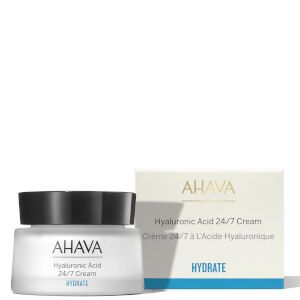
Ahava Hyaluronic Acid 24/7 Cream
Works for
2 of 2 advertised claims delivered
Moisturizing19 ingredients credited for this claimStrong evidence
“The AHAVA Hyaluronic Acid 24/7 Cream is a nourishing emollient designed to maximise hydration.”
This product can help improve hydration of the skin with the two types of ingredients.
The first type is called “humectants”:
these ingredients help attract water.
When humectants are on the surface of the skin, they “pull in” the moisture from the outside environment, or from
within deeper layers of the skin. The following ingredients in this product do the job:
erythritol, glycerin.
This product also contains ingredients called “occlusives”. They help reduce the speed with which our skin loses moisture to the outside environment. These ingredients also help soften the upper layer of the skin, so it feels less tight and nicer to the touch. The following ingredients in this product do the job: caprylic/capric triglyceride, squalane.
The following ingredients in this product are especially good for supporting the skin barrier and helping with the hydration level: tripeptide-3
Anti-aging2 ingredients credited for this claimModerate evidence
“Suitable for all skin types, particularly dry, dehydrated and ageing skin”
This product contains tripeptide-3. This ingredient might be able to help reduce and prevent fine lines and wrinkles, improve skin elasticity and firmness, but there is not enough evidence that it actually works.
Can it cause trouble?
Irritancy5 strong irritants: Parfum, Hexyl cinnamal + 3 more — patch-test recommendedHigh risk
Comedogenic1 ingredient rated 2 or more on the 0–5 pore-clogging scale1 flagged


User reviews
Be the first — your take helps the next person decide.
Ingredients
Filter by role to see what each ingredient is doing.
Water~45–55%
C15-19 alkane~5.9–7.2%
- Irritation risk
- Low
Helps soften the upper layer of the skin and create a nice product texture
More about C15-19 alkaneSqualane~4.2–5.2%
- Irritation risk
- Low
An oil naturally present in skin. Works as an emollient to soften the skin and form a protective layer on its surface without a greasy feeling.
More about SqualaneGlycerin~3.1–3.8%
- Irritation risk
- Low
One of the best moisturizing ingredients. Naturally present in skin. It attracts water to the upper layer of the skin working as a humectant
More about GlycerinCaprylic/capric triglyceride~2.5–3%
- Irritation risk
- Medium
A good mix of fatty acids that forms a protective layer on the skin. Improves the shelf life of products. Derived from coconut and glycerin
More about Caprylic/capric triglycerideCellulose~2–2.5%
- Irritation risk
- Low
Can be used to help absorb oil as well as add volume and imporve texture of products.
More about CelluloseHydroxyethyl acrylate/sodium acryloyldimethyl taurate copolymer~1.6–2%
- Irritation risk
- Medium
A gelling agent that thickens the product consistency and leaves the skin with a velvety finish
More about Hydroxyethyl acrylate/sodium acryloyldimethyl taurate copolymerPhenoxyethanol~0.5–1%
- Irritation risk
- Low
A preservative. It helps prevent bacterial growth in cosmetic products
More about PhenoxyethanolGlyceryl stearate~1.2–1.5%
- Irritation risk
- Low
An emollient that softens the skin and forms a protective layer on its surface. Helps water and oil mix together
More about Glyceryl stearateCetearyl alcohol~1–1.3%
- Irritation risk
- Low
- Comedogenicity
- 2/5
A non-drying alcohol. Works as an emollient. Helps water and oil mix together and creates a nice product texture
More about Cetearyl alcoholErythritol~0.65–1%
- Irritation risk
- Low
Helps to attract water to the upper layer of the skin
More about ErythritolButylene glycol~0.55–0.85%
- Irritation risk
- Low
Used to create a nice product texture and help delivery of other ingredients. Might be somewhat helpful in attracting water to the upper layer of the skin
More about Butylene glycolBehenyl behenate~0.5–0.8%
- Irritation risk
- Low
Sclerotium gum~0.45–0.65%
- Irritation risk
- Low
Used to create gel-like formulas and stabilize emulsions
More about Sclerotium gumLysolecithin~0.45–0.65%
- Irritation risk
- Low
Lecithin derivative. It helps oil and water mix together and can enhance penetration of other ingredients. It helps soften the upper layer of the skin
More about LysolecithinGlyceryl oleate~0.45–0.65%
- Irritation risk
- High
Helps oil and water mix together. Can be irritating
More about Glyceryl oleateTribehenin~0.4–0.65%
- Irritation risk
- Low
Used to create a thicker product consistency and soften the upper layer of the skin
More about TribeheninParfum~0.3–0.55%
- Irritation risk
- High
An aromatic blend of unspecified and possibly irritating ingredients
More about ParfumBenzyl alcohol~0.25–0.5%
- Irritation risk
- High
A preservative. Can be used to mask unpleasant smell. Can be irritating
More about Benzyl alcoholHexyl cinnamal~0.25–0.45%
Benzyl salicylate~0.25–0.4%
Limonene~0.2–0.4%
- Irritation risk
- High
A common frangrance that can easily irritate skin, especially if exposed to air, light or heat
More about LimoneneLinalool~0.2–0.35%
Chlorphenesin~0.16–0.32%
Hydrogenated polydecene~0.2–0.4%
- Irritation risk
- Low
Helps to soften the upper layer of the skin and create a nice product texture
More about Hydrogenated polydeceneXanthan gum~0.2–0.4%
- Irritation risk
- Low
Used to create a thicker product consistency
More about Xanthan gumPullulan~0.2–0.4%
- Irritation risk
- High
Creates a thin drying film on the skin resulting in a short-term tightening effect
More about PullulanCaprylyl glycol~0.25–0.45%
- Irritation risk
- Medium
Helps preserve products and creates a nice product texture
More about Caprylyl glycolDidecyldimonium chloride~0.25–0.45%
Sodium benzoate~0.2–0.4%
Potassium sorbate~0.2–0.4%
Lactic acid~0.2–0.35%
- Irritation risk
- Medium
An exfoliating and moisturizing alpha-hydroxy acid (AHA). Typically causes less irritation than other AHAs, for example, glycolic acid. At high concentrations (about 15%), lactic acid can help reduce lines and wrinkles. Recent studies show that lactic acid can support the "good" bacteria living on skin's surface (healthy skin microbiome)
More about Lactic acidHomarine hcl~0.2–0.35%
- Irritation risk
- Medium
Might help to improve skin hydration levels
More about Homarine hclCitric acid~0.2–0.35%
- Irritation risk
- Medium
Can work as an exfoliant but is typically used to adjust the product pH
More about Citric acidTripeptide-3~0.2–0.35%
Olea europaea fruit oil~0.2–0.35%
- Irritation risk
- Medium
An emollient that helps soften the skin but is not effective for restoring its barrier function. Might be helpful to calm down inflammation
More about Olea europaea fruit oilSpilanthes acmella flower extract~0.15–0.3%
- Irritation risk
- High
Plant extract that might hep calm down inflammation in skin
More about Spilanthes acmella flower extractHydrolyzed oat protein~0.15–0.3%
- Irritation risk
- Low
Helps attract water to the upper layer of the skin
More about Hydrolyzed oat proteinSodium hyaluronate~0.15–0.25%
- Irritation risk
- Low
One of the best moisturizing ingredients. Attracts water into the upper layer of the skin
More about Sodium hyaluronatePhoenix dactylifera fruit extract~0.2–0.35%
- Irritation risk
- Low
Dunaliella salina extract~0.1–0.2%
- Irritation risk
- Low
A green micro-algae extract that might help neutralize free radicals in skin, but solid evidence is lacking. It helps to soften the upper layer of the skin
More about Dunaliella salina extractMaris aqua~0.1–0.2%
Ingredient list view
Water, C15-19 alkane, Squalane, Glycerin, Caprylic/capric triglyceride, Cellulose, Hydroxyethyl acrylate/sodium acryloyldimethyl taurate copolymer, Phenoxyethanol, Glyceryl stearate, Cetearyl alcohol, Erythritol, Butylene glycol, Behenyl behenate, Sclerotium gum, Lysolecithin, Glyceryl oleate, Tribehenin, Parfum, Benzyl alcohol, Hexyl cinnamal, Benzyl salicylate, Limonene, Linalool, Chlorphenesin, Hydrogenated polydecene, Xanthan gum, Pullulan, Caprylyl glycol, Didecyldimonium chloride, Sodium benzoate, Potassium sorbate, Lactic acid, Homarine hcl, Citric acid, Tripeptide-3, Olea europaea fruit oil, Spilanthes acmella flower extract, Hydrolyzed oat protein, Sodium hyaluronate, Phoenix dactylifera fruit extract, Dunaliella salina extract, Maris aqua
Compare prices
Retailers ranked by price — lowest first.
Affiliate links · prices updated regularly · As an Amazon Associate, WIMJ earns from qualifying purchases.
Worth comparing, line by line.
Match % combines shared ingredients, the first five ingredients, shared actives and hero ingredients, irritancy (lower counts in the alternative's favour), texture and body area. Only products in the same routine step are compared.
| AhavaHyaluronic Acid 24/7 CreamYOUR PRODUCT | AHCYouth Lasting Real Eye Cream For Face | SWANICOCOPeptine Biome Eye Cream | |
|---|---|---|---|
| Match | — | 58% | 51% |
| Price | $33.37 | $7.91−$25.46 | $18.00−$15.37 |
| Shared key ingredients | — | 5 of 8 | 4 of 8 |
| Key difference | — | Acetyl Dipeptide-1 Cetyl Ester | Acetyl Dipeptide-1 Cetyl Ester |
| Irritancy | High | High | Medium |
| Drying alcohol | — | Contains drying alcohol | — |
| View product | Shop | Shop |

Product summary
Based on the ingredient list, "Ahava - Hyaluronic Acid 24/7 Cream" can work well for skin moisturization. This moisturizer uses a good combo of humectants and emollients. These both types of ingredients are essentials for improving the skin hydration and keeping the skin barrier healthy. Humectants in this product (erythritol, glycerin, hyaluronic acid, sodium hyaluronate and butylene glycol) help to increase the water content in the upper layer of the skin. (These ingredients do so by "capturing" water molecules from the outside air or from within the deeper layers of the skin). Emollients in this formulation (caprylic/capric triglyceride, squalane, cetearyl alcohol, olea europaea fruit oil and caprylyl glycol) help to reduce the moisture loss from the skin. They also soften the skin surface and relieve the feeling of dryness and tightness.
Ingredient callouts
- We like that this moisturizer contains peptides (tripeptide-3 0.20% - 0.35%). There are many different kind of peptides and they are naturally present in our skin. They all are a combination of amino-acids. Some of them work as natural anti-biotics, promote wound-healing and production of collagen. The science is still not settled on how effective peptides in skincare are, but it is very likely that they have a benefit. Peptides might help restore the skin barrier and fight the signs of aging. At the very least, peptides work as humectants: they attract water to the upper layer of the skin and improve its hydration.
Irritation risk
There are quite a few common irritants in this product, including ingredients without particular skin benefits. We would not recommend it for sensitive skin. We assess the overall irritancy of this moisturizer to be high. For a detailed overview of all potential irritants: click here
You can see the detailed formula review with the breakdown of all actives in the product and the full ingredient list with estimated concentrations in the tables below.
Price
The product retails for 69.30A$ in Australia, for 50.00$ in the United States and from 25.00£ up to 50.00£ in the United Kingdom.
For a detailed price comparison: click here.
Sources cited in this review
Every concentration estimate and effectiveness label is anchored to one of these 11 studies and safety reviews.
- 1
- 2
- 3Safety Assessment of Polyene Group as Used in Cosmeticscir-safety.org
- 4Epidermal and dermal effects of topical lactic acidncbi.nlm.nih.gov
- 5Dual Effects of Alpha-Hydroxy Acids on the Skinpdfs.semanticscholar.org
- 6Use of “natural” oils for moisturization: Review of olive, coconut, and sunflower seed oilonlinelibrary.wiley.com

Affiliate links · As an Amazon Associate, WIMJ earns from qualifying purchases.